
生物科技投资

Search documents
香港交易所罗博仁:今年香港生物科技行业增长动力依然稳固
智通财经网· 2026-03-06 07:21
Core Insights - The biotechnology sector remains one of the most focused themes in the global investment market, with strong growth momentum reflected in the performance of related stocks and the overall sector [1] - The Hang Seng Biotechnology Index, launched in 2019, tracks 30 of the largest biotechnology companies listed in Hong Kong and has seen a significant increase of 64.5% in 2025, with an additional rise of 10.7% year-to-date as of February 24, 2026 [1] Group 1: Market Performance - The Hang Seng Biotechnology Index has a weight distribution of approximately 50% for biotechnology companies and 40% for pharmaceutical companies, with additional representation from drug distribution (6%) and medical devices (4%) [1] - The number of biotechnology and healthcare companies listed in Hong Kong has exceeded 270, with a total market capitalization of over HKD 4.2 trillion, showing substantial growth since the end of 2018 [2] Group 2: Investment Tools - The Hong Kong Stock Exchange offers a diverse range of investment and risk management tools in the biotechnology sector, including stocks, ETFs, structured products, and derivatives [2] - As of the end of February 2026, there are 10 ETFs tracking the Hang Seng Biotechnology Index, with a total asset management scale of HKD 15.6 billion, and the number of structured products linked to biotechnology stocks has increased from 132 in January 2025 to 500 in January 2026 [2] Group 3: Derivative Instruments - The introduction of the Hang Seng Biotechnology Index futures in November 2025 provides investors with more options for participation and risk management in the biotechnology sector [3] - Each futures contract has a contract multiplier of HKD 50 per index point, meaning a 100-point change in the index results in a contract value change of HKD 5,000 [3] Group 4: Volatility and Risk Management - The annualized volatility of the Hang Seng Biotechnology Index was approximately 41.2% for the 12 months ending January 2026, significantly higher than the Hang Seng Index (24.2%) and the Hang Seng China Enterprises Index (25.9%) [4] - Investors can use the Hang Seng Biotechnology Index futures in conjunction with biotechnology ETFs or stocks to manage overall sector risk, allowing for hedging while maintaining long-term positions [4]

26年策略之创新药篇
2026-01-30 03:11
Summary of Key Points from the Conference Call Industry Overview - The overall positioning of the pharmaceutical industry in 2026 is "innovation first, with drugs and devices flying together," indicating a more diversified market compared to 2025 [2] - The investment in innovative drugs requires careful selection, with the current market conditions presenting a good opportunity for entry after adjustments at the beginning of the year [3] Company Insights - Biofarma companies are highlighted as better investment choices due to their combination of R&D innovation, certainty, and long-term growth potential. The record-breaking BD amount in 2025 indicates a positive cycle of capital inflow into R&D [6] - Companies like 康方 (Kangfang), 百济神州 (BeiGene), and 英恩生物 (InnoCare) are expected to achieve commercial breakthroughs or expand internationally in the coming years [20] Market Trends - The global innovative drug development cycle is just beginning, with Chinese companies expected to account for 40% of transaction amounts by 2025, indicating a strong role in the global market [5] - The second-generation immune checkpoint inhibitors (IO) market is projected to reach $120 billion within the next decade, with significant participation from Chinese innovative drugs [12] Technological Advancements - Emerging technologies such as small nucleic acid therapies, molecular glue, gene editing, and long-acting drugs are expected to see significant development in 2026 [11][18] - Dual-specific antibodies and antibody-drug conjugates (ADC) are highlighted as promising treatment options for various cancers, including triple-negative breast cancer and small cell lung cancer [16][14] Policy and Regulatory Environment - The Chinese healthcare negotiation supports emerging therapies, including ADCs and siRNA, which are included in the healthcare directory, promoting self-sustaining funding and attracting more investors [7] Investment Opportunities - The report emphasizes the importance of focusing on companies with clear growth potential and stable revenue expectations, particularly those with significant upcoming data releases [26] - Notable companies to watch include 康诺亚 (Conway), 康弘 (Kanghong), and 毕比特 (BIBIT), which are considered to have strong upside potential [24] Conclusion - The future growth of companies in the pharmaceutical sector will rely on their global ecosystem platforms and the continuous iteration of their pipeline priorities, with a focus on high-potential projects [22]
2026美股生物科技板块怎么投资?杰富瑞:关注这6大首选股、7大潜力标的、5大并购目标
美股IPO· 2025-12-24 16:03
Core Viewpoint - Jefferies recently released a report on the outlook for the U.S. biotech industry in 2026, focusing on preferred investment targets, undervalued potential companies, and potential acquisition opportunities. The report highlights that the biotech sector will see multiple key clinical trial data disclosures, new drug approvals, and policy dynamics, with companies in niche segments expected to achieve value re-evaluation through technological breakthroughs and commercialization progress [1]. Six Preferred Targets - Jefferies identified six companies as core recommendations for 2026 based on market catalysts and valuation potential: - **Dianthus Therapeutics (DNTH.US)**, target price $66: Focused on the drug claseprubart, showing potential in various neuromuscular diseases with an estimated peak revenue of $2 billion. Key milestones include mid-analysis of Phase III trials for CIDP and initiation of trials for gMG in 2026 [3]. - **Taysha Gene Therapies (TSHA.US)**, target price $11: The gene therapy TSHA-102 for Rett syndrome has a market potential of $2 billion. The three-phase clinical trial is expected to disclose mid-term data by the end of 2026 [3]. - **Tyra Biosciences (TYRA.US)**, target price $32: The oral FGFR3 inhibitor dabogratinib has disruptive potential in two areas, with key data expected next year [4]. - **Tango Therapeutics (TNGX.US)**, target price $14: Collaborating with Revolution Medicines to explore a combination therapy for pancreatic cancer, with data expected in the first half of 2026 [4]. - **ORIC Pharmaceuticals (ORIC.US)**, target price $23: Focused on two potential assets for prostate cancer and lung cancer, with key catalysts expected next year [5]. - **Solid Biosciences (SLDB.US)**, target price $15: Concentrating on gene therapy for Duchenne muscular dystrophy, with critical meetings with the FDA planned for 2026 [5]. Seven Undervalued Companies - The report highlights seven companies with significant catalysts and potential for value re-evaluation: - **Ultragenyx Pharmaceutical (RARE.US)**, target price $114: Current stock price undervalued, with key catalysts expected in 2026, including data for treatments of osteogenesis imperfecta and Angelman syndrome [6]. - **Beam Therapeutics (BEAM.US)**, target price $41: Focused on gene editing, with promising data updates expected in early 2026 [6]. - **Aurinia Pharmaceuticals (AUPH.US)**, target price $21: Core product Lupkynis shows steady growth, with new drug development paths expected to be announced in early 2026 [7]. - **Kodiak Sciences (KOD.US)**, target price $39: Potential in retinal disease therapies, with three Phase III trial data readouts expected in 2026 [7]. - **Intellia Therapeutics (NTLA.US)**, target price $45: A leader in gene editing, with key data expected in mid-2026 [8]. - **Compass Therapeutics (CMPX.US)**, target price $8: Focused on tumor bispecific antibodies, with data expected in early 2026 [8]. - **KalVista Pharmaceuticals (KALV.US)**, target price $38: Known for the first oral treatment for hereditary angioedema, with significant revenue growth expected in 2026 [9]. Five Potential Acquisition Targets - Jefferies identified five companies that may become acquisition targets in 2026 due to their unique assets or market positions: - **Arrowhead Pharmaceuticals (ARWR.US)**: Strong RNAi product line for cardiovascular metabolism and new obesity targets [10]. - **Celcuity (CELC.US)**: Drug gedatolisib shows unique efficacy in PIK3CA wild-type breast cancer [11]. - **ORIC Pharmaceuticals**: High-value prostate and lung cancer projects [12]. - **Travere Therapeutics (TVTX.US)**: Potential market opening in rare kidney diseases if FSGS indication is approved [13]. - **KalVista Pharmaceuticals**: First-mover advantage and strong growth in oral HAE drugs [14].


2026美股生物科技板块怎么投资?杰富瑞:关注6大首选、7大潜力和5大并购目标
Zhi Tong Cai Jing· 2025-12-24 13:30
Core Insights - Jefferies recently released a report on the outlook for the U.S. biotech industry in 2026, focusing on preferred investment targets, undervalued potential companies, and potential acquisition opportunities. The report highlights that the biotech sector will see multiple key clinical trial data disclosures, new drug approvals, and policy developments in 2026, with companies in niche segments likely to achieve value re-evaluation through technological breakthroughs and commercialization progress [1]. Preferred Investment Targets - Jefferies identified six core recommended companies for 2026 based on market catalysts and valuation potential: - **Dianthus Therapeutics**: Target price of $66, focusing on the drug claseprubart for various neuromuscular diseases, with peak revenue estimated at $2 billion. Key milestones include mid-analysis of Phase III trials for CIDP and initiation of trials for gMG in 2026 [1]. - **Taysha Gene Therapies**: Target price of $11, with TSHA-102 for Rett syndrome showing significant market potential (peak revenue of $2 billion). Phase III trial data is expected by the end of 2026 [2]. - **Tyra Biosciences**: Target price of $32, with the drug dabogratinib showing disruptive potential in bladder cancer and achondroplasia. Key data is expected next year [2]. - **Tango Therapeutics**: Target price of $14, exploring a combination therapy for pancreatic cancer with expected data release in mid-2026 [2]. - **ORIC Pharmaceuticals**: Target price of $23, with two key assets targeting prostate cancer and lung cancer. Key data updates are anticipated next year [3]. - **Solid Biosciences**: Target price of $15, focusing on gene therapy for Duchenne muscular dystrophy, with critical meetings with the FDA planned for 2026 [3]. Undervalued Companies - The report highlights seven undervalued companies with significant catalysts and potential for value re-evaluation: - **Ultragenyx Pharmaceutical**: Target price of $114, with a current undervalued stock price. Key catalysts include Phase III data for setrusumab expected in late 2025 to early 2026, potentially driving a 100% stock price increase [4]. - **Beam Therapeutics**: Target price of $41, focusing on gene editing with promising data updates expected in early 2026 [5]. - **Aurinia Pharmaceuticals**: Target price of $21, with steady growth in lupus nephritis treatment and new drug development expected to drive growth [5]. - **Kodiak Sciences**: Target price of $39, with three Phase III trial data readouts expected in 2026 [6]. - **Intellia Therapeutics**: Target price of $45, with key data for hereditary angioedema therapy expected in mid-2026 [6]. - **Compass Therapeutics**: Target price of $8, with upcoming data for cholangiocarcinoma therapy expected in early 2026 [6]. - **KalVista Pharmaceuticals**: Target price of $38, with a first-in-class oral treatment for hereditary angioedema expected to drive rapid growth [7]. Potential Acquisition Targets - Jefferies identified five companies that may become acquisition targets in 2026 due to their unique assets or market positions: - **Arrowhead Pharmaceuticals**: Strong RNAi product line in cardiovascular metabolism and new obesity targets [8]. - **Celcuity**: Unique efficacy of gedatolisib in PIK3CA wild-type breast cancer [8]. - **ORIC Pharmaceuticals**: High-value prostate and lung cancer projects [8]. - **Travere Therapeutics**: Potential market expansion in rare kidney diseases if FSGS indication is approved [8]. - **KalVista Pharmaceuticals**: First-mover advantage and strong growth in oral HAE treatment [8].
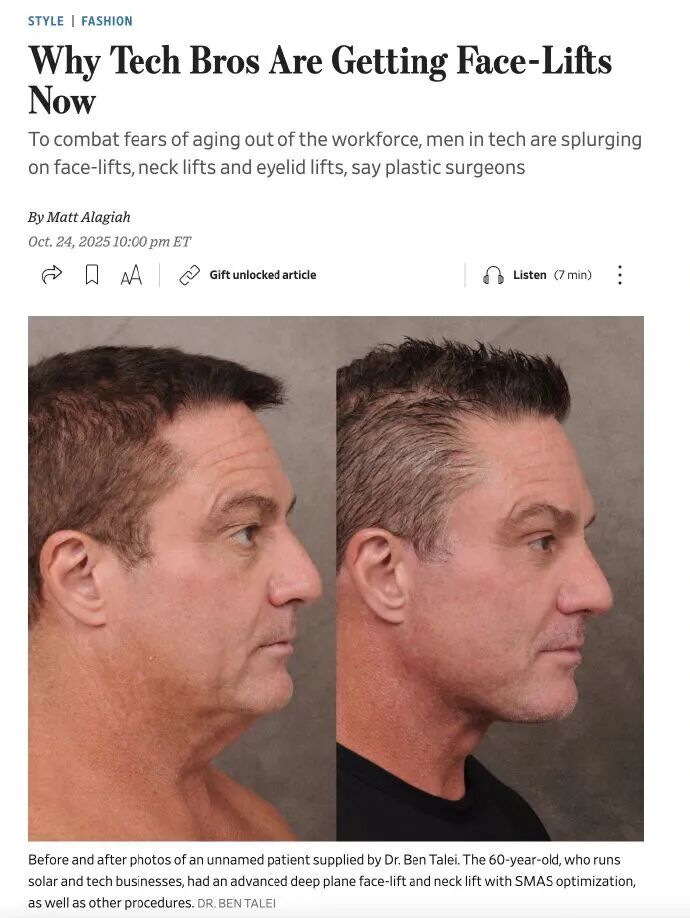
怕老怕死卷疯了,科技大佬砸钱“买永生”
3 6 Ke· 2025-12-08 00:55
Core Viewpoint - The article discusses the rising trend of appearance anxiety in Silicon Valley, where tech workers are increasingly turning to cosmetic procedures to maintain a youthful appearance amid job insecurity and competitive work environments [1][3][31]. Group 1: Cosmetic Procedures in Silicon Valley - Appointment volumes at plastic surgery clinics in Silicon Valley have surged by 40% over the past six months, with two-thirds of clients being tech employees, averaging under 35 years old [1]. - The perception that youth equates to creativity has led some investors to openly state a preference for hiring younger individuals, further fueling the trend of cosmetic enhancements among tech workers [3]. Group 2: Wealthy Individuals and Anti-Aging Investments - High-profile Silicon Valley billionaires are investing heavily in anti-aging technologies, with Amazon founder Jeff Bezos investing $3 billion in a cellular rejuvenation company aimed at reversing cellular aging [6]. - Elon Musk has also engaged in various anti-aging treatments while developing technologies like Neuralink, which aims to upload human consciousness to the cloud for digital immortality [10]. Group 3: Extreme Anti-Aging Practices - Entrepreneur Bryan Johnson spends $2 million annually on a medical team for his anti-aging regimen, which includes blood exchanges with his son and father to create a "life perpetual motion machine" [15][17]. - Johnson's extreme practices include strict dietary controls, extensive exercise, and a rigorous skincare routine, reflecting a broader trend of obsessive self-care among the wealthy [21][23]. Group 4: Broader Implications in the Tech Industry - The anti-aging anxiety is not limited to Silicon Valley; it has spread to tech circles in China, with a reported 27% increase in male spending on cosmetic procedures in 2023 [31]. - The pressure to appear youthful is seen as a survival strategy in the tech industry, where layoffs can be influenced by perceived age and vitality [34]. Group 5: Capitalizing on Anti-Aging Trends - Bryan Johnson has turned his anti-aging pursuits into a business, selling supplements at inflated prices and hosting events that attract thousands, despite safety concerns about his products [40][42]. - The trend of wealthy individuals investing in anti-aging technologies is viewed as a form of "life insurance," with many seeking to extend their lives through capital and privilege [47][49].
共享基经丨与AI一起读懂ETF(二十二):标普生物科技和纳指生物科技,有何不同?
Sou Hu Cai Jing· 2025-07-10 12:53
Core Viewpoint - The financial sector, including banks and brokerages, has shown strong performance, with several related ETFs leading in gains, particularly in the S&P Biotechnology and Nasdaq Biotechnology themes [1] Differences - Sample Range: The S&P Biotechnology Select Industry Index includes constituents from the biotechnology and life sciences tools and services sectors, while the Nasdaq Biotechnology Index comprises securities listed on Nasdaq classified as biotechnology or pharmaceuticals [2] - Constituent Distribution: As of June 30, 2025, the S&P Biotechnology Select Industry Index has 124 constituents, primarily in biotechnology and life sciences tools and services [3] - Weighting Method: The S&P Biotechnology Select Industry Index uses modified equal weighting to balance the influence of constituents, whereas the Nasdaq Biotechnology Index is market-cap weighted, giving larger companies more influence [4] - Concentration of Constituents: The top ten constituents of the S&P Biotechnology Select Industry Index account for 25% of the index, while the corresponding ETF has a slightly higher concentration of 25.94% [5] Similarities - Industry Theme: Both indices focus on the biotechnology sector, reflecting the performance of companies involved in biotechnology research and pharmaceuticals, providing tools for investors to track the biotechnology industry [10] - Market Correlation: There is a high overlap in constituents between the two indices, including major companies like Amgen, Alnylam Pharmaceuticals, Vertex Pharmaceuticals, and Gilead Sciences [10]
