
白酒市场分化

Search documents
2026春节酒市复盘:高端、次高端、大众酒反差迎来春节市场之最!
Sou Hu Cai Jing· 2026-02-27 00:25
Core Insights - The liquor market did not experience the anticipated overall growth during the 2026 Spring Festival, instead showcasing a highly differentiated landscape with significant disparities in performance across different segments [1] High-End Market - The high-end liquor segment (priced above 800 yuan) remained robust, driven by brand value, gifting attributes, and preservation functions, which were amplified during the Spring Festival [4] - Moutai's bottle price rose from 1500 yuan to 1650 yuan, with the original box price stabilizing around 1700 yuan. Wuliangye's price increased from 760 yuan to the 800 yuan range, indicating strong demand in high-end banquet and gifting scenarios [6] - As of February 11, many Moutai distributors had completed 35%-40% of their annual payment plans, with sales in multiple regions increasing by 10%-20% year-on-year, demonstrating the resilience of core assets in the high-end market [6] Mid-Range Market - The mid-range liquor segment (priced between 400-800 yuan) faced significant challenges, with a decline in sales due to a shift in consumer focus from business gifting to home consumption and genuine gatherings. The estimated decline in this price range varied from 10% to 50% [7] - For instance, Gujing Gongjiu's products experienced single-digit declines, while its higher-end offerings saw declines exceeding 20% due to reduced business banquets. Many mid-range brands resorted to price cuts and promotions to capture limited market share, which compressed distributor profits and intensified price competition [9] Mass Market - The mass liquor segment (priced between 50-200 yuan) experienced explosive growth, with some products expected to see significant increases in market share during the Spring Festival. Sales in the 100-300 yuan price range were notably better than the previous year [10] - Consumer behavior shifted towards focusing on value-for-money products rather than high-priced brands, indicating a deeper transformation in consumption logic. This trend aligns with the rise of practical consumption and rational choices, which became the defining characteristic of this year's Spring Festival [12] - The market is evolving into a new structure where high-end and ultra-high-end products maintain brand image and pricing power, while mass-market products drive volume and cover basic consumption needs, leaving the mid-range segment increasingly squeezed [12]



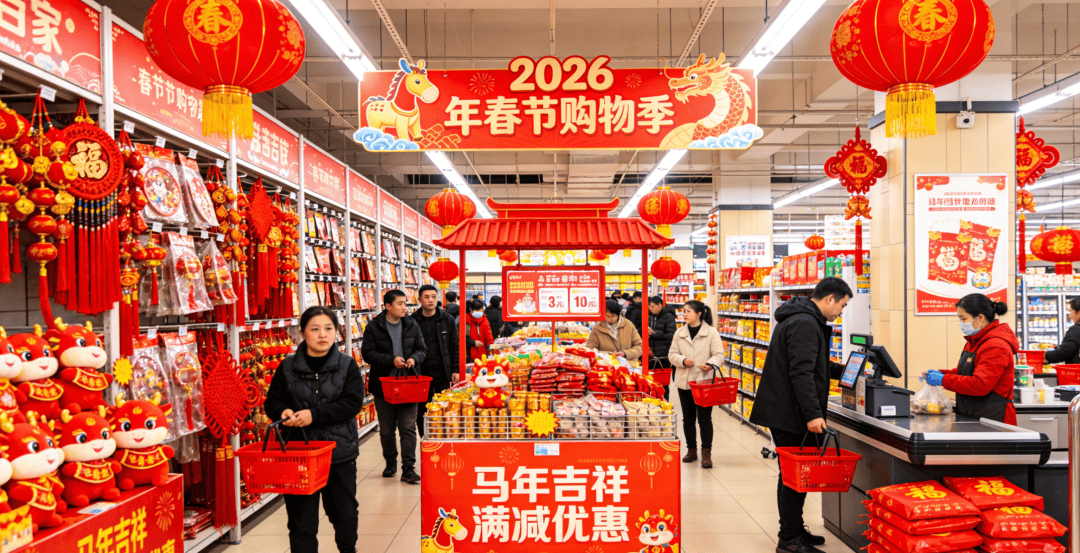
整体下滑超10%、旺季缩短、茅台断货……酒类春节动销“冰与火”
Sou Hu Cai Jing· 2026-02-13 19:30
Core Viewpoint - The Chinese liquor market, particularly the white liquor segment, is experiencing a significant downturn during the traditional peak sales season around the Spring Festival, with sales expected to decline over 10% compared to last year, indicating a challenging outlook for 2026 [2][3] Group 1: Market Dynamics - The sales peak for the Spring Festival has been notably shortened to about two weeks, compared to a month in previous years, disrupting the usual consumption rhythm [4] - Three main factors contributing to the market cooling include decreased consumer purchasing power, the lingering effects of alcohol bans leading to reduced consumption in social settings, and the impact of e-commerce promotions reducing foot traffic in physical stores [4][5] - The cautious approach of distributors, who are hesitant to stock up due to fears of excess inventory, reflects a broader lack of confidence in the market [4] Group 2: Competitive Landscape - The decline in sales has intensified competition, leading to thinner profit margins, with many distributors resorting to price cuts to attract customers [5] - The market is showing a structural divide, with products priced between 80-200 yuan and those above 800 yuan performing well, while the mid-range segment (300-600 yuan) is facing significant declines [6][7] - Moutai remains a standout performer, with sales growth exceeding 30%, particularly in online channels, while other premium brands like Wuliangye and Guojiao 1573 are also benefiting from Moutai's success [7] Group 3: Consumer Behavior and Trends - The 300-600 yuan price range, which is typically associated with business gifting and dining, has seen sales drop over 20%, highlighting the correlation with economic activity [8] - The current market environment is shifting focus from growth potential to survival and resilience, emphasizing the importance of brand strength, pricing health, and channel cohesion for companies to navigate through challenging times [8]
酒价内参2月9日价格发布,飞天茅台上涨5元实现五连阳
Xin Lang Cai Jing· 2026-02-09 01:26
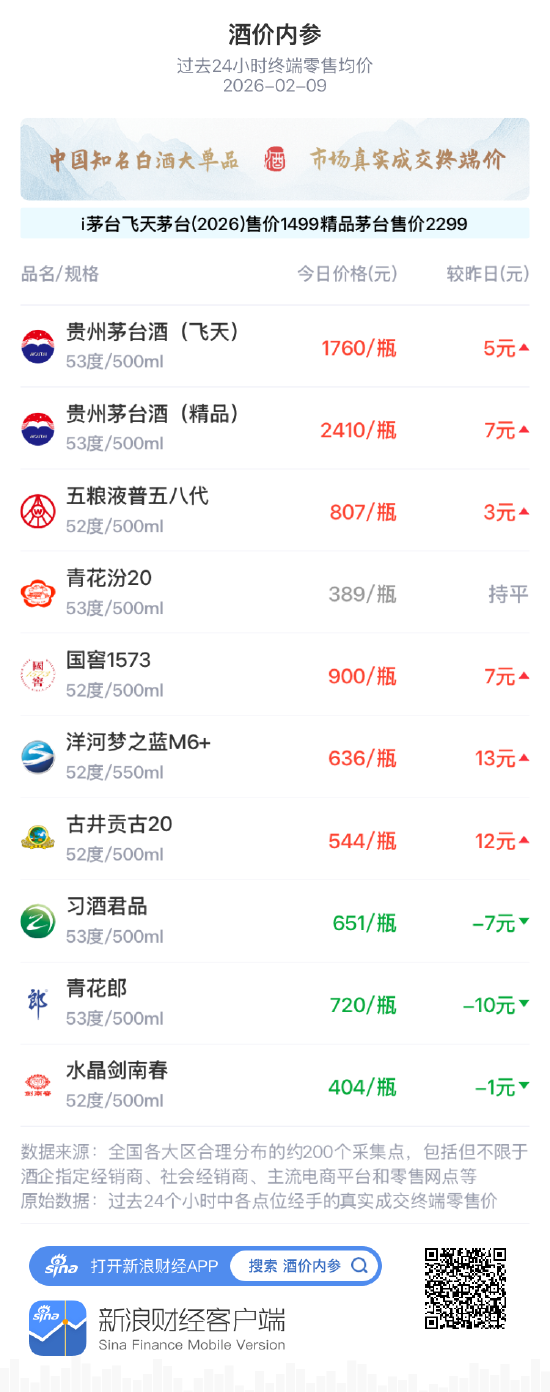
Core Insights - The Chinese white liquor market continues to see an upward trend in retail prices, with the average price of the top ten products reaching 9,221 yuan on February 9, marking a 29 yuan increase from the previous day and the highest since December 27, 2025 [1][6] Price Movements - Among the top ten products, six saw price increases, three experienced declines, and one remained stable, indicating a strong overall upward momentum in prices [1][6] - Leading the price increases, Yanghe Dream Blue M6+ rose by 13 yuan per bottle, followed by Gujing Gong 20 with a 12 yuan increase, and both Guojiao 1573 and premium Moutai increased by 7 yuan per bottle [1][6] - Moutai's Flying Moutai saw a 5 yuan increase, achieving a one-month high, supported by strong market demand ahead of the Spring Festival [1][6] Market Dynamics - The white liquor market is experiencing significant differentiation, with high-end products performing well while mid-range products face slight declines [2][7] - A recent survey indicated a 10%-20% decline in overall sales across the white liquor market, with regional variations; for instance, Shandong and Anhui saw declines of about 20% [2][7] - Despite the overall downturn, over 30% of distributors reported stable or growing performance, particularly for premium brands like Flying Moutai, which saw some distributors' sales increase by over 40% year-on-year [2][7] Pricing Trends - The price dynamics show a clear bifurcation: high-end products priced above 800 yuan are driven by gifting and banquet demands, while the 100-200 yuan range benefits from business and daily consumption needs [2][7] - Conversely, the 300-600 yuan mid-range segment is under pressure, experiencing over a 20% decline in sales due to economic conditions and market competition [2][7]



白酒市场分化加剧,头部企业韧性凸显
Mei Ri Jing Ji Xin Wen· 2025-06-25 01:02
Group 1 - The core viewpoint of the article highlights the increasing differentiation in the Chinese liquor market, with a rising concentration of the top six companies (CR6) and a notable resilience among leading enterprises, despite overall declines in operational indicators and rising costs [1] - The white liquor industry is undergoing a deep adjustment period characterized by "stock competition + structural upgrades," presenting both challenges and opportunities. Companies need to enhance supply-side quality and efficiency while accurately reaching demand-side targets to reshape growth logic [1] - Current demand for white liquor is at a historical low, with limited downside risks. A relatively loose policy environment is expected to support a gradual recovery in consumption, with short-term rigid demand and potential improvements in banquet demand due to low base effects [1] Group 2 - In the broader consumer goods sector, there is a rising interest in yellow wine, while beer consumption is entering a peak season. The raw milk prices in the dairy industry have stabilized, and segments like snacks and energy drinks are experiencing high growth [2] - The food and beverage sector shows a strong willingness to distribute dividends, with expectations for an overall increase in dividend rates led by benchmark companies like Moutai and Wuliangye [2] - The Food and Beverage ETF (515170) tracks the CSI segmented food and beverage industry index, focusing on high-barrier and resilient sectors such as liquor, beverages, dairy, and seasoning products, providing a convenient investment tool for small capital investors [2]