知情权

Search documents
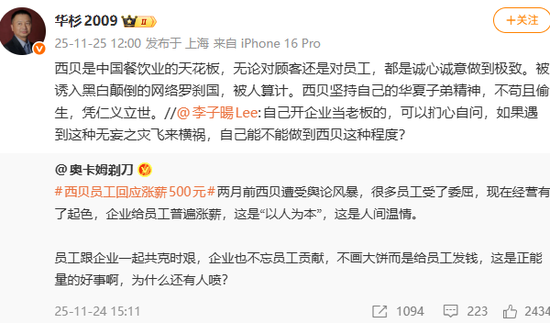
华与华创始人称西贝被算计,罗永浩要求下午六点前公开道歉
2 1 Shi Ji Jing Ji Bao Dao· 2025-11-26 07:01
Core Viewpoint - The recent controversy involving entrepreneur Luo Yonghao and the restaurant brand Xibei has reignited discussions about the pre-made food industry in China, highlighting issues of consumer rights and public relations within the sector [1][4]. Group 1: Controversy Background - Luo Yonghao criticized Xibei for serving pre-made dishes at high prices, which led to a significant public backlash against the restaurant [5]. - Xibei's founder, Jia Guolong, expressed feeling "hurt" by the criticism and announced intentions to sue Luo Yonghao [5]. - The controversy escalated with Luo emphasizing the importance of consumer rights and Xibei's subsequent decision to open its kitchens for public inspection [5][6]. Group 2: Financial Impact - Following the criticism, Xibei experienced a drastic decline in customer traffic, with daily revenues dropping by 1 million yuan on September 10 and 11, and an estimated decrease of 2 to 3 million yuan on September 12 [6]. - The financial repercussions of the controversy have been significant, affecting Xibei's overall business performance [6]. Group 3: Marketing and Consulting Relationships - Xibei has been working with the marketing consulting firm "Hua Yu Hua" since 2013, which has played a crucial role in its branding and marketing strategies [6]. - The collaboration has been financially substantial, with Hua Yu Hua reportedly receiving over 60 million yuan in consulting fees over ten years, averaging more than 6 million yuan annually [6].

X @𝘁𝗮𝗿𝗲𝘀𝗸𝘆
𝘁𝗮𝗿𝗲𝘀𝗸𝘆· 2025-09-16 03:09
Consumer Concerns Regarding Prepared Meals - The primary concern is the lack of transparency regarding prepared meals, not necessarily safety or health issues [1] - Consumers advocate for mandatory labeling of prepared meals, specifying the degree of processing and shelf life [1] - The core issue revolves around information transparency and consumers' right to know [1] Counterarguments and Rebuttals - Some argue that they have consumed prepared meals for years without any adverse effects [2] - Counterarguments emphasize that the debate is not about safety, but about clear labeling and informed consumer choice [1]
在法院外蹲了6小时,我和起诉《王者荣耀》的律师见了一面
3 6 Ke· 2025-08-14 00:11
Core Viewpoint - The article discusses a legal case involving the game "Honor of Kings," where a player, Sun Qianhe, is suing Tencent, claiming that the game's matchmaking system is flawed and manipulates player win rates to maintain engagement [2][18]. Group 1: Legal Case Overview - Sun Qianhe, a player and lawyer, has raised concerns about the matchmaking mechanism in "Honor of Kings," alleging that it intentionally arranges matches to control player win rates around 50% [2][9]. - The court case has attracted attention, with Tencent presenting over 1,000 pages of evidence to counter Sun's claims, arguing that the matchmaking system is not designed to manipulate win rates [11][16]. - The court has yet to deliver a verdict on the case, and legal experts suggest that Sun's claims may face significant challenges [18][30]. Group 2: Matchmaking Mechanism - Sun Qianhe's main argument is based on her personal experiences of inconsistent matchmaking, where she feels that winning streaks lead to poor teammates and losing streaks lead to easy opponents [4][9]. - Tencent has defended its matchmaking system, stating that it does not aim to control win rates and has provided evidence of various players achieving win rates significantly above 50% [16][17]. - The company emphasizes that revealing the specific details of the matchmaking algorithm could harm the game's integrity and lead to exploitation by malicious players [16][22]. Group 3: Legal and Ethical Considerations - The case raises questions about the balance between players' right to know and the protection of commercial secrets, with legal experts debating the definition of "commercial secrets" in this context [20][22]. - Sun Qianhe's request for transparency in the matchmaking algorithm is seen as a challenge to the boundaries of commercial confidentiality, with some lawyers arguing that the algorithm qualifies as a protected secret [20][22]. - The article highlights the broader implications of the case for the gaming industry, particularly regarding how player engagement and fairness are managed within competitive gaming environments [27][28].