
硬科技自主可控

Search documents
美股又炸了!道指破49000点创历史新高 普通人该跟风还是跑路?这3个信号藏着答案
Sou Hu Cai Jing· 2026-01-07 01:50
Core Insights - The U.S. stock market has reached historical highs, with the Dow Jones Industrial Average surpassing 49,000 points, indicating a significant shift in the investment environment that could present both opportunities and risks for investors [1][2]. Market Performance - On January 6, 2025, the Dow Jones increased by 484.90 points (0.99%) to close at 49,462.08, marking a new record [1]. - The S&P 500 rose by 42.77 points (0.62%) to 6,944.82, also achieving a historical closing high [1]. - The Nasdaq Composite gained 151.35 points (0.65%) to reach 23,547.17 [1]. - The Dow Jones had already increased by 1.23% on January 5, leading to a cumulative rise of over 2% in just two days [2]. Economic Drivers - The first driving force behind the stock market surge is the Federal Reserve's monetary policy, which has lowered interest rates to a range of 3.50% to 3.75% by 2025, increasing liquidity in the market [2]. - The second factor is corporate stock buybacks, which have reached near-historical highs, reducing the number of shares and pushing stock prices higher [2]. - The third influence is the AI boom and the self-reinforcing nature of passive investments, where rising large-cap stocks lead to increased index fund purchases, further driving prices up [3]. Valuation Concerns - The Buffett Indicator, which measures the ratio of total stock market capitalization to GDP, has reached 223%, significantly exceeding the 70%-80% range considered reasonable [3]. - Historical data shows that after two consecutive years of over 10% gains in the S&P 500, the following year typically sees a decline [3]. Diverging Opinions - Optimists argue that AI profits have yet to be fully realized, and the U.S. economy has not faced a hard landing, with S&P 500 earnings growing by 13.4% year-over-year in Q3 2025 [4]. - Pessimists highlight the high valuations based on uncertain economic conditions, warning that any negative developments could lead to a market correction [4][5]. Global Investment Trends - Analysts suggest that the trend of global capital moving towards Asia will continue, driven by a weakening dollar, significant valuation differences, and higher economic growth rates in China compared to the U.S. [6]. - The S&P 500's TTM P/E ratio is 29.5, while the CSI 300 is at 14.1, indicating a higher safety margin in the Chinese market [6]. Investment Opportunities - Key sectors to watch include hard technology, high-end manufacturing, and structural opportunities in domestic demand, particularly in aging-related and emotional value consumption sectors [8]. - Companies with core technologies and those benefiting from domestic trends are expected to attract investment [8]. Conclusion - The current market dynamics suggest that investors should focus on structural opportunities in Asia, particularly in undervalued sectors with strong growth potential, rather than chasing high valuations in the U.S. market [10].
彻底爆了!“吸金”超4800亿
Xin Lang Cai Jing· 2025-12-31 05:49
Core Insights - The stock ETF market in China has seen significant inflows, with a net inflow of over 1189 billion yuan in December alone and a total of 4847 billion yuan since the beginning of 2025 [1][8]. Fund Flows - On December 30, the total net inflow for all stock ETFs (including cross-border ETFs) was 65.81 billion yuan, with the top inflow sectors being non-ferrous metals (28.7 billion yuan), the CSI A500 index (16.6 billion yuan), and gold (8.2 billion yuan) [2][10]. - The top outflow sectors included the Sci-Tech 50 index (-12.4 billion yuan), the Shanghai 50 index (-5.3 billion yuan), and communication (-4.3 billion yuan) [2][10]. Leading Funds - E Fund's ETF had a total scale of 844.4 billion yuan, increasing by 15.8 billion yuan on December 30, with a net inflow of 3.5 billion yuan [2][10]. - The non-ferrous metals ETF from Huaxia Fund saw a net inflow of 27 billion yuan, reaching a new high in both share count and scale, growing over 59 times in the year [3][11]. Sector Performance - The non-ferrous metals ETF, brokerage ETFs, and dividend ETFs were the main contributors to inflows, while the Sci-Tech 50 ETF and Shanghai 50 ETF were among the largest outflows [4][12]. - The top-performing ETFs on December 30 included the non-ferrous metals ETF (61.95 billion yuan, +1.30%), A500 ETF (216.79 billion yuan, +0.25%), and CSI 300 ETF (1977.96 billion yuan, +0.35%) [5][13]. Market Outlook - The market is expected to see continued inflows as conditions remain favorable, including increased capital entering the market and reasonable valuations across indices [6][14]. - Investment opportunities are anticipated in growth sectors such as AI, electric new energy, and industrial metals, alongside potential policy-driven movements in non-bank financials, hotels, logistics, and aviation as the year-end approaches [6][14].

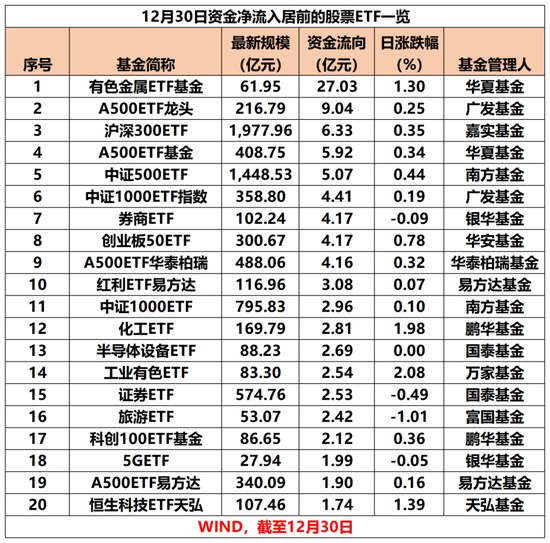
彻底爆了!“吸金”超4800亿
中国基金报· 2025-12-31 05:45
Core Viewpoint - The A-share market has seen significant inflows into stock ETFs, with a total net inflow of 1189.94 billion yuan in December and 4847.40 billion yuan since the beginning of 2025, indicating strong investor interest in this asset class [2]. Group 1: Fund Inflows - In December 30, the total net inflow for all stock ETFs reached 65.81 billion yuan, with the top inflow sectors being non-ferrous metals (28.7 billion yuan), the CSI A500 index (16.6 billion yuan), and gold (8.2 billion yuan) [4]. - The leading fund companies include E Fund, which saw its ETF scale increase to 844.4 billion yuan, with a net inflow of 3.5 billion yuan on December 30 and a total increase of 243.75 billion yuan since the beginning of 2025 [4]. - The non-ferrous metals ETF from Huaxia Fund reported a net inflow of 27 billion yuan, achieving a new high in both share and scale, growing over 59 times in the year [5]. Group 2: Fund Outflows - The top outflow sectors on December 30 included the Sci-Tech 50 ETF (net outflow of 12.4 billion yuan) and the Shanghai 50 ETF (net outflow of 5.3 billion yuan), indicating a shift in investor sentiment away from these areas [9]. - Other notable outflows were seen in the communication sector (4.3 billion yuan) and artificial intelligence (4.2 billion yuan), suggesting a cautious approach from investors in these segments [9]. Group 3: Market Outlook - The market outlook remains positive, with expectations of increased capital inflows as insurance companies begin year-end allocations and private equity firms engage in concentrated purchases [10]. - Key investment themes for 2026 include AI innovation, domestic hard technology, and the Hong Kong tech market, which is seen as a vital area for investment due to its competitive advantages [10].

布局2026:五大具备强逻辑的行业赛道 | 一财号每周思想荟(第43期)
Sou Hu Cai Jing· 2025-11-21 08:27
Group 1: Investment Opportunities in Key Industries - The five key industries identified for investment by 2026 are AI hardware, biomedicine, aerospace, power equipment, and non-ferrous metals, which show clear investment logic amid macroeconomic cycles and industrial transformations [1] - Non-ferrous metals are in a tight balance phase characterized by "insufficient capacity and expanding demand," while power equipment is experiencing a recovery in inventory cycles due to energy storage and new energy vehicles [1] - The biomedicine sector is at a resonant point with the overseas expansion of innovative drugs and the performance inflection point of CXO [1] - AI hardware is in an explosive phase of technological diffusion and commercialization, supported by the "14th Five-Year Plan" which provides a solid foundation for defense, new energy, and technological innovation [1] Group 2: Policy and Technological Support - The "14th Five-Year Plan" continues to support key industries, creating a robust bottom line for sectors like defense and new energy [1] - Technological breakthroughs such as the domestic production of AI computing chips, mass production of core components for humanoid robots, and advancements in ADC/small nucleic acid drugs are continuously opening up growth space for these industries [1] Group 3: Market Dynamics in the Baijiu Industry - The Baijiu industry is facing its worst quarterly performance in ten years, with net profits dropping by as much as 92.6% in a single quarter [4] - Changes in the overall consumption market environment and a shift in consumer preferences towards cost-effective options are impacting the Baijiu sector [5] - Baijiu companies need to redefine their target consumer groups and embrace market changes by focusing on family consumption, younger demographics, and healthier product offerings [5] Group 4: Humanoid Robots in Consumer Electronics - Humanoid robot technology is rapidly advancing from laboratory settings to real-world applications, poised to reshape the consumer electronics market [6] - The convergence of technology, policy, and demand is driving the development of humanoid robots, with significant breakthroughs in AI models and embodied intelligence [7] - The government is promoting AI development, with the 2025 government work report including "embodied intelligence" and "smart robots" as key focus areas, indicating strong policy support for the industry [7]