离婚财产分割

Search documents
预亏股卓胜微董事长前妻分走13亿 实控人方去年套现4亿
Zhong Guo Jing Ji Wang· 2026-02-12 08:13
Core Viewpoint - The announcement regarding the change in shareholder equity at ZTE Microelectronics (卓胜微) is primarily due to the divorce settlement between actual controller Xu Zhihan and Zhang Yu, which involves the transfer of shares but does not affect the company's control structure [1][2]. Group 1: Shareholder Equity Changes - Xu Zhihan will transfer 17,152,005 shares, representing 3.21% of the total share capital, to Zhang Yu, with a market value of approximately 1.289 billion yuan based on the closing price of 75.16 yuan on February 11 [1][2]. - After the transfer, both Xu Zhihan and Zhang Yu will hold 17,152,005 shares each, maintaining their respective ownership at 3.21% of the total share capital [2]. Group 2: Voting Rights and Control - Zhang Yu has signed a voting rights delegation agreement, granting Xu Zhihan full authority to exercise all voting rights associated with the transferred shares, while retaining certain financial rights [3]. - The actual controllers of the company, including Xu Zhihan, Feng Chenhui, and Tang Zhuang, will continue to jointly control 31.90% of the voting rights, indicating no change in the control structure of the company [3]. Group 3: Financial Performance and Fundraising - ZTE Microelectronics has raised a total of 388.78 million yuan through two rounds of fundraising since its IPO, with the latest round aimed at expanding production capacity and supplementing working capital [6]. - The company has projected a revenue decline of approximately 16% to 18% for the fiscal year 2025, with expected net losses significantly increasing compared to the previous year [8].

卓胜微实控人之一许志翰离婚,前妻分走近13亿元股票
Xin Lang Cai Jing· 2026-02-12 00:43
Group 1 - The company announced that one of its actual controllers, Xu Zhihan, has divorced Zhang Yu, and they have made arrangements regarding the division of marital property [1] - Xu Zhihan plans to transfer 17.152 million shares of the company to Zhang Yu, which represents 3.21% of the company's total share capital [1] - The estimated market value of the shares transferred to Zhang Yu is approximately 1.289 billion yuan, based on the current stock price of 75.16 yuan per share [1] Group 2 - The actual controllers and their concerted parties have issued a commitment letter stating that they will not reduce their holdings of the company's shares in any way within six months from the date of the commitment letter [1] - The commitment period is from February 12, 2026, to August 11, 2026 [1]
A股“分手长跑”第二?申通实控人离婚13年被诉2.8亿股权
阿尔法工场研究院· 2026-01-23 04:09
Core Viewpoint - The article discusses the ongoing legal dispute between Chen Xiaoying, co-founder of Shentong Express, and her ex-husband Xi Chunyang over the division of shares valued at approximately 278 million yuan, highlighting the complexities of asset division post-divorce in the context of corporate governance and ownership [3][5][6]. Group 1: Legal Dispute - Chen Xiaoying is being sued by her ex-husband Xi Chunyang for the transfer of approximately 20.2842 million shares of Shentong Express, which represents 2.65% of the company, valued at around 278 million yuan [3][6]. - Xi Chunyang claims that these shares were part of the marital property agreed upon during their divorce and should be divided equally [3][5]. - Legal experts suggest that if Xi Chunyang can provide sufficient evidence supporting his claim, he may have a high chance of winning the case [5]. Group 2: Company Background - Shentong Express was co-founded by Chen Xiaoying and her first husband, Nie Tengfei, in 1993, and has since become a significant player in China's express delivery industry [9][10]. - Following Nie Tengfei's death in 1998, Chen Xiaoying continued to manage the company alongside her brother, Chen Dejun, who became the chairman [9][10]. - The company went public in 2015 through a reverse merger and has since engaged in strategic partnerships, including a significant investment from Alibaba in 2019 [22][23]. Group 3: Financial Performance - As of 2025, Shentong Express reported a revenue of 54.861 billion yuan, completing a business volume of 26.138 billion parcels, ranking it second to last among major private express companies [26]. - The company has seen fluctuations in its per parcel revenue, with a reported increase of 15.35% year-on-year, reaching 2.33 yuan per parcel [28]. - Shentong Express is currently seeking to raise up to 2 billion yuan through the issuance of medium-term notes to support its liquidity and operational needs [28].


索要股权市值近2.8亿元!申通快递创始人被前夫起诉
证券时报· 2026-01-22 04:23
Core Viewpoint - The article discusses a lawsuit involving Shentong Express (申通快递), where an individual named Xi Chunyang is seeking to confirm his ownership of a portion of shares currently registered under the name of Chen Xiaoying, a significant figure in the company and its actual controller [1][4]. Group 1: Lawsuit Details - Xi Chunyang has filed a civil lawsuit against Shentong Express and Chen Xiaoying, claiming that 20,284,200 shares (2.65% of the company) registered in Chen's name should be recognized as his property [4]. - The lawsuit centers on the division of marital property following Xi and Chen's divorce, with Xi asserting that he is entitled to 50% of the shares based on their divorce settlement [8][9]. Group 2: Company Valuation and Impact - Shentong Express has a current market value of 21.1 billion yuan, with a share price of 13.78 yuan, making the disputed shares worth approximately 280 million yuan [5]. - The shares in question represent about 1.33% of the total equity of Shentong Express, and the company has stated that the lawsuit will not significantly impact its operations or governance [9][10]. Group 3: Background Information - Chen Xiaoying is a prominent figure in the Chinese express delivery industry, having co-founded Shentong Express after her husband, Nie Tengfei, passed away in a car accident [8]. - Following the death of Nie Tengfei, the company experienced internal divisions, leading to the establishment of several competing express delivery companies [9].

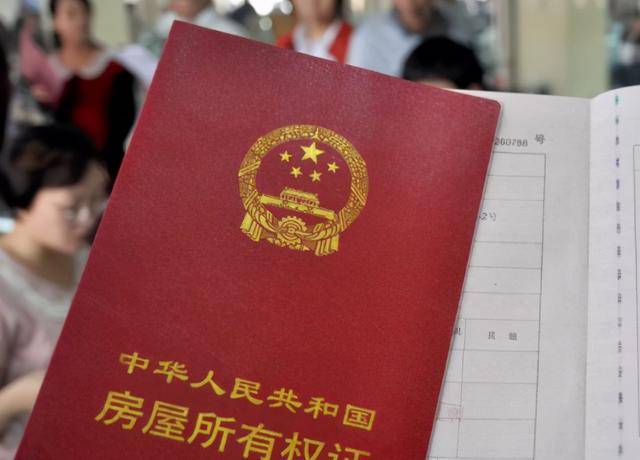
要买房的小夫妻注意,房产证上尽量别写两个人的名字,这是为何?
Sou Hu Cai Jing· 2025-10-20 17:52
Core Insights - In China, homeownership is closely tied to marriage, with young people typically purchasing homes around the age of 27, significantly earlier than their Western counterparts who average 35 years old [1] - The expectation for homeownership before marriage has led many families to take on substantial debt, often resulting in financial strain [1][3] Group 1: Homeownership and Marriage - For women, a new home symbolizes the beginning of a new family and marriage life, leading to a desire for their names to be included on the property deed [3] - Experts advise against both parties signing the property deed to avoid financial disadvantages in case of divorce and to prevent restrictions from purchase policies on subsequent properties [4] Group 2: Divorce and Financial Implications - The divorce rate in China is notably high at 43.53%, with individuals born in the 1980s being the most affected, complicating property division during divorce [6] - If a property is solely funded by one partner but includes the other’s name on the deed, the contributing partner may face significant losses during asset division [6] - Jointly named properties can hinder the ability to purchase a second home due to government restrictions, leading to the phenomenon of "fake divorces" to circumvent these limitations [6] - Recent regulations have been introduced to limit the ability to purchase a home within three years of a divorce, aiming to curb the "fake divorce" trend [6] - Pre-marital property notarization is suggested as a prudent measure for young couples, particularly when one party is fully financing the home [6]
韩国财阀300亿天价离婚案,再生变数
财联社· 2025-10-17 02:33
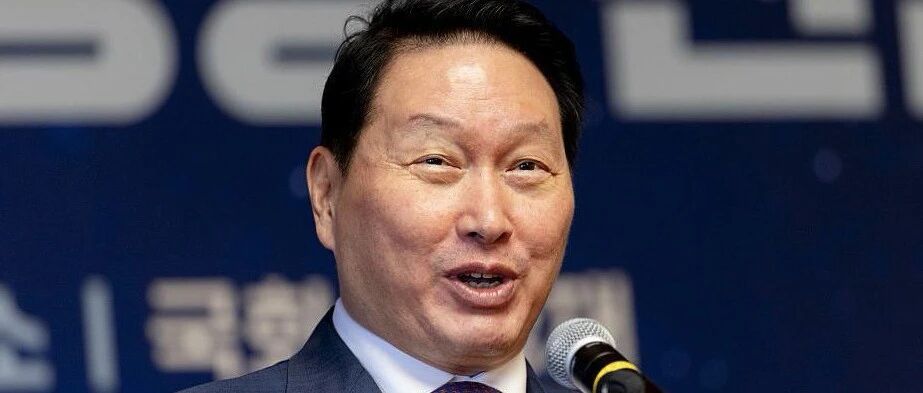
Core Viewpoint - The South Korean Supreme Court's ruling on the divorce case of SK Group's chairman, Choi Tae-won, significantly alleviates the pressure on SK Hynix, a major player in the semiconductor market, to urgently raise large amounts of capital [2]. Group 1: Court Ruling and Financial Implications - The Supreme Court overturned the lower court's decision requiring Choi Tae-won to pay a record divorce settlement and sent the case back for retrial [1]. - The initial ruling by the Seoul Family Court awarded 66.5 billion KRW in compensation but denied the request to divide 17.5% of SK Group's holding company [2]. - The Seoul High Court later increased the compensation to over 1.38 trillion KRW (approximately 7 billion RMB) and mandated an additional 2 billion KRW for emotional damages, which Choi Tae-won appealed [2]. Group 2: Legal Considerations and Asset Division - The main controversy revolves around whether a 30 billion KRW fund provided by former President Roh Tae-woo to Choi Tae-won's father can be considered a contribution from the Roh family to SK Group's development [2]. - The Supreme Court indicated that even if the funding was legitimate, it might have originated from bribery during Roh's presidency, thus excluding it from property division considerations [3]. - The court also ruled that the lower court's inclusion of assets disposed of by Choi Tae-won prior to the divorce was inappropriate, recognizing these actions as part of effective company management [3][4]. Group 3: Future Considerations - The retrial will likely focus on the issue of "separate property," with Choi Tae-won claiming that his SK shares were purchased with inherited and gifted funds, while the opposing side argues they are marital assets [6][7].
郑素贞大恒科技持股归零 徐翔案资产处置尚在进行
Jing Ji Guan Cha Wang· 2025-10-16 08:01
Core Points - The actual controller of Daheng New Era Technology Co., Ltd. has changed from Zheng Suzhen to no actual controller, following the legal issues surrounding Xu Xiang, a well-known private equity fund manager in China [1] - Zheng Suzhen's shares in Daheng Technology were auctioned off, resulting in a total of 1.3 billion shares being sold for 17.12 billion yuan, yielding a profit of 5.1 billion yuan compared to her original purchase price [3] Group 1 - Zheng Suzhen became the largest shareholder of Daheng Technology in 2014 after acquiring 1.3 billion shares for approximately 12.02 billion yuan [2] - The company faced significant challenges following Xu Xiang's legal troubles, which directly impacted its planned 30 billion yuan capital increase project in 2015 [2] - As of the first half of 2025, Daheng Technology reported a revenue of 8.44 billion yuan but incurred a net loss of 2.74 million yuan, indicating a significant decline in financial performance compared to when Zheng Suzhen took control [3] Group 2 - The divorce proceedings between Xu Xiang and Ying Ying have been complicated by the ongoing asset disposals related to Xu's criminal case, with the court not supporting Ying Ying's request for divorce due to insufficient evidence of a broken relationship [4] - Multiple asset disposals related to Xu Xiang's case are still ongoing, with significant amounts of assets, including 210 billion yuan, being subject to legal proceedings [4] - Zheng Suzhen's remaining shares in other companies, such as Wenfeng Co. and Ningbo Zhongbai, are also undergoing judicial sale processes, indicating a broader trend of asset liquidation [5][6]

马斯克为多任妻子离婚分割财产:曾经拥有5000亿美元
Sou Hu Cai Jing· 2025-10-13 00:44
Group 1 - Elon Musk has had seven formal partners and fathered 13 children, with two of these partners being married to him three times [1] - Musk's first marriage was to Justine, with whom he had a son who tragically died shortly after birth, leading to Justine's depression and subsequent use of IVF to have twins and triplets [1] - The couple divorced in 2008, with Justine receiving $2 million in cash, a car, and a property due to a prenuptial agreement [1] Group 2 - After his first divorce, Musk met actress Talulah Riley, and they married in 2010, but their relationship was strained due to Musk's demanding work schedule and controlling nature [3] - The couple divorced in January 2012, with Riley receiving approximately $4.2 million in compensation [3] - They reconciled later that year but divorced again after nearly two years, with Musk providing Riley about $16 million in compensation at that time when his net worth was $12.9 billion [3]
A股又见天价离婚,“分手费”或近34亿
Ge Long Hui A P P· 2025-10-11 13:42
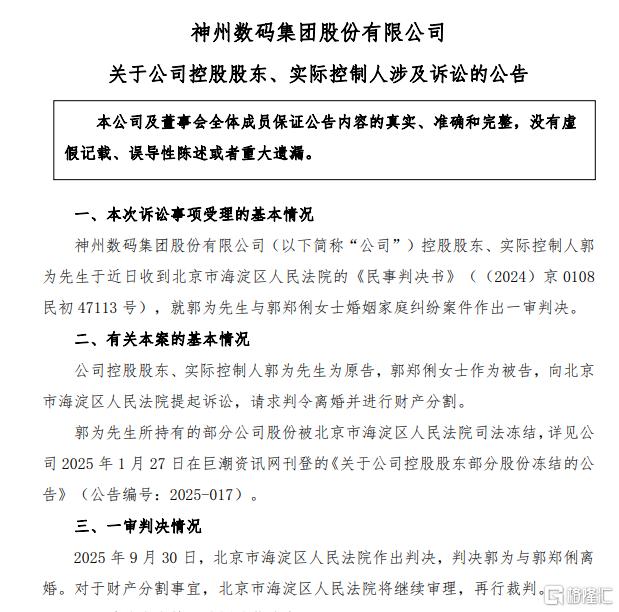
Core Viewpoint - The article discusses the high-profile divorce case of Guo Wei, the controlling shareholder of Digital China, which has attracted market attention due to the potential implications for the company's control and financial situation [1][5][6]. Group 1: Divorce Case Details - Guo Wei, the actual controller of Digital China, was ruled to be divorced from Guo Zhengli by the Haidian District People's Court, with property division matters still under review [1][6]. - Both parties possess significant business acumen and legal resources, indicating that the upcoming property division negotiations will be closely watched [7]. Group 2: Financial Implications - Guo Wei's shares in Digital China are currently valued at approximately 6.789 billion yuan, with about 3.394 billion yuan worth of shares frozen by the court [8]. - If the property is divided equally, Guo Wei may need to transfer half of his shares to his ex-wife, potentially affecting the company's control [8][9]. - Digital China stated that the lawsuit only concerns the personal shareholder rights of the controlling shareholder and will not significantly impact the company's profits or operations [9]. Group 3: Company Performance - In 2024, Digital China reported a revenue of 128.166 billion yuan, a year-on-year increase of 7%, but a net profit of 753 million yuan, down 36% [9]. - For the first half of 2025, the company achieved a revenue of 71.586 billion yuan, up 14.42%, but the net profit decreased by 16.29% to 426 million yuan [9][10]. - Despite the financial challenges, Digital China's stock price has shown an upward trend over the past two years, contributing to Guo Wei's personal wealth increase [11].

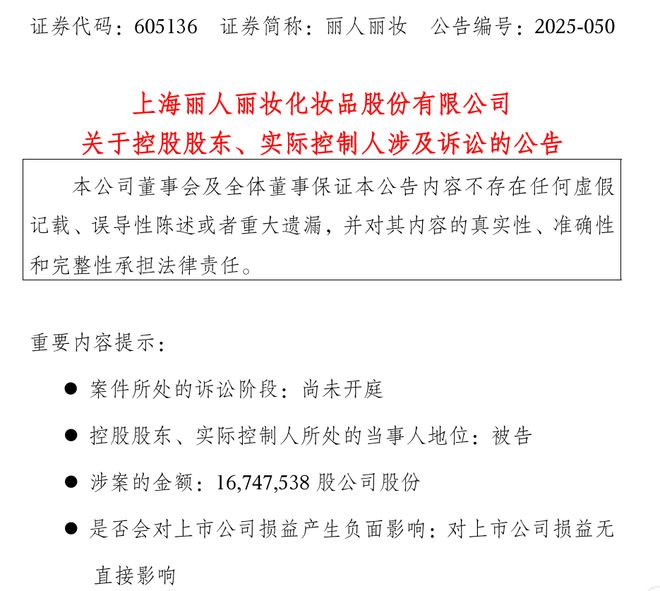
天价离婚案未了,前妻要求上市公司实控人过户1.7亿元股票
Nan Fang Du Shi Bao· 2025-09-30 07:43
Core Viewpoint - The ongoing divorce and property dispute involving Huang Tao, the actual controller of Liren Lizhuang, has led to a new court notification regarding the transfer of shares to his children, potentially impacting the company's financial standing and Huang's ownership stake [1][2][4]. Shareholder Changes - Huang Tao received a court notification regarding a request from his ex-wife, Weng Shuhua, to transfer 16,747,538 shares to their child, Huang Yiqi [2][4]. - Following a previous court ruling in August, Huang's shareholding decreased from approximately 32.46% to 28.28%, while Weng's stake increased to 4.18% [4][6]. - If the court supports Weng's current request, Huang could face a loss exceeding 300 million yuan [6]. Financial Performance - Liren Lizhuang reported a revenue of 831 million yuan for the first half of 2025, a decrease of 13.98% year-on-year, with a net profit loss of 32.76 million yuan [9][10]. - The company experienced a significant decline in cash flow, with a net cash flow from operating activities of 63.34 million yuan, down 54.27% [9]. - The revenue drop was attributed to underperformance of cooperative brands and the termination of partnerships with certain Korean brands [10]. Company Background - Liren Lizhuang, established in May 2010, specializes in online retail of cosmetics, primarily through Tmall [7]. - The company went public on the Shanghai Stock Exchange in September 2020 after a previous failed IPO attempt in 2018 [8].