算力芯片自主可控

Search documents
北水成交净卖出40.69亿 北水继续抢筹阿里巴巴 全天抛售港股ETF
Zhi Tong Cai Jing· 2025-09-23 11:54
Summary of Key Points Core Viewpoint - The Hong Kong stock market experienced significant net selling from northbound capital, totaling 40.69 billion HKD, with notable net selling in both Shanghai and Shenzhen stock connects [1]. Group 1: Northbound Capital Flow - Northbound capital recorded a net selling of 40.69 billion HKD, with 23.22 billion HKD from Shanghai Stock Connect and 17.47 billion HKD from Shenzhen Stock Connect [1]. - The most net bought stocks by northbound capital included Alibaba-W (09988), SMIC (00981), and Kangfang Biotech (09926) [1]. - The most net sold stocks included the Tracker Fund of Hong Kong (02800), Hang Seng China Enterprises Index (02828), and Huahong Semiconductor (01347) [1]. Group 2: Individual Stock Performance - Alibaba-W (09988) saw a net inflow of 7.12 billion HKD, with a total trading volume of 76.09 billion HKD [2]. - SMIC (00981) had a net inflow of 5.73 billion HKD, with total trading volume reaching 58.35 billion HKD [2]. - Kangfang Biotech (09926) recorded a net inflow of 2.19 billion HKD, driven by positive news regarding its clinical research [7]. Group 3: Market Reactions and Trends - The Tracker Fund of Hong Kong (02800) and Hang Seng China Enterprises Index (02828) faced significant net selling of 32.71 billion HKD and 9.93 billion HKD respectively, indicating a bearish sentiment towards these ETFs [8]. - The technology sector in Hong Kong has shown a rebound, with indices rising nearly 20% since July, influenced by advancements in AI and expectations of further market improvements [8].




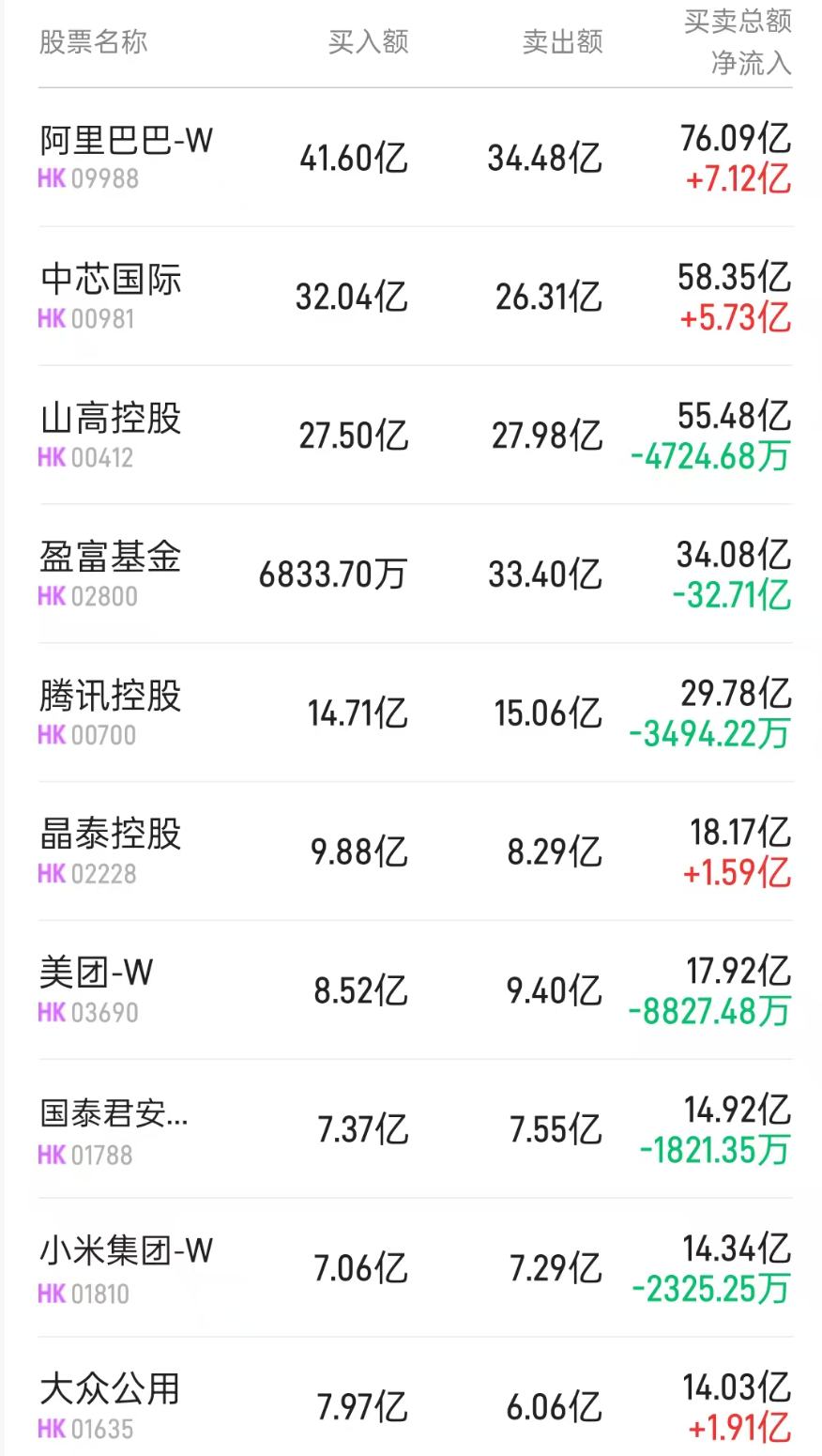
北水动向|北水成交净卖出40.69亿 北水继续抢筹阿里巴巴 全天抛售港股ETF
智通财经网· 2025-09-23 11:12
Market Overview - On September 23, the Hong Kong stock market saw a net sell-off of 40.69 billion HKD from Northbound trading, with 23.22 billion HKD from Shanghai Stock Connect and 17.47 billion HKD from Shenzhen Stock Connect [2] Top Net Buy Stocks - Alibaba-W (09988) received the highest net buy of 16.73 billion HKD, supported by promotional activities and incentives for merchants [6][7] - Semiconductor stocks showed mixed results, with SMIC (00981) gaining a net buy of 5.02 billion HKD, while Hua Hong Semiconductor (01347) faced a net sell of 2.33 billion HKD [7] - Kangfang Bio (09926) attracted a net buy of 2.19 billion HKD, bolstered by its participation in a significant clinical study [7] Top Net Sell Stocks - The ETF Yingfu Fund (02800) and Hang Seng China Enterprises (02828) experienced significant net sell-offs of 32.71 billion HKD and 9.93 billion HKD, respectively [8] - Tencent (00700), Xiaomi Group-W (01810), and Shanda Holdings (00412) also faced net sells of 2.22 billion HKD, 2.86 billion HKD, and 0.30 billion HKD [8] Sector Insights - The technology sector has shown a rebound, with the Hang Seng Technology Index rising nearly 20% since July [8] - The market sentiment may improve further due to new rounds of monetary easing from the Federal Reserve and advancements in the internet and technology sectors [8]

ETF盘中资讯|寒武纪募资近40亿,加码AI芯片与生态布局!科创人工智能ETF(589520)盘中拉升2.49%,再创新高!
Sou Hu Cai Jing· 2025-08-18 02:05
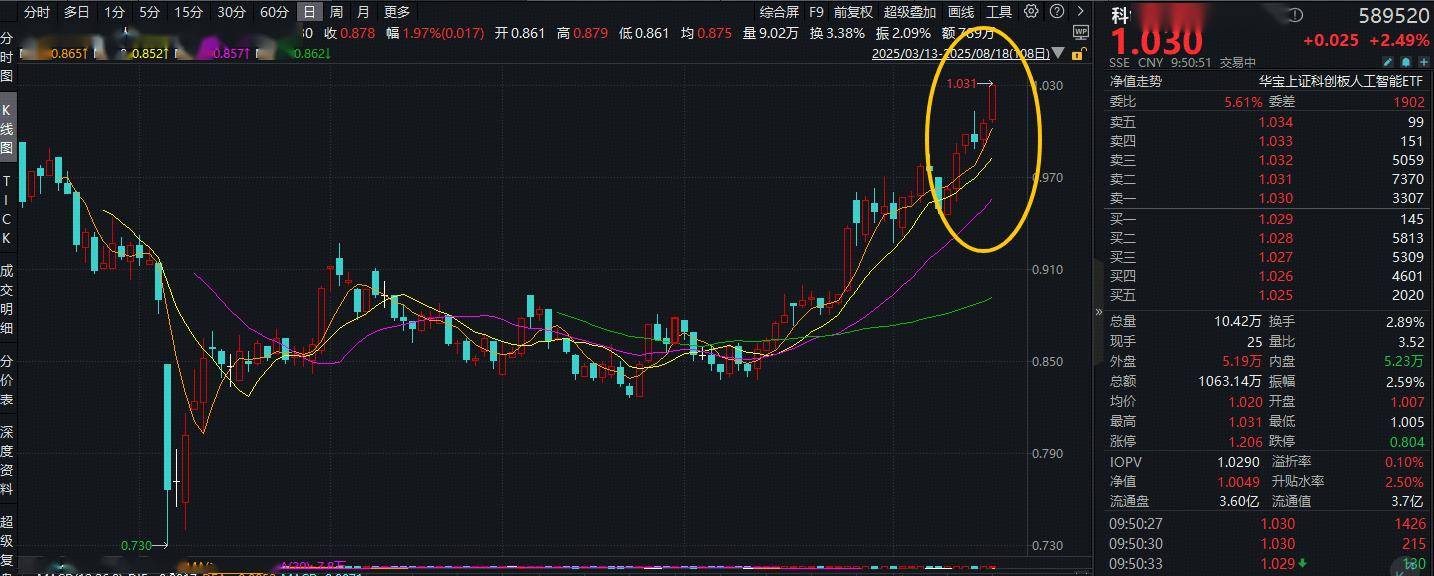
Core Insights - The domestic AI industry chain-focused ETF (589520) has seen a price increase of 2.49% on August 18, reaching a new high since its launch, driven by strong investor interest in domestic alternatives and edge AI development [1][3] - The ETF has attracted a total of 75.64 million yuan in capital over the past 60 days, indicating robust market confidence [1] Company Performance - Stone Technology reported a revenue of 7.903 billion yuan for the first half of 2025, marking a year-on-year growth of 78.96%, while its net profit attributable to shareholders decreased by 39.55% to 678 million yuan [3] - The revenue growth for Stone Technology is attributed to domestic sales driven by national subsidy policies and ongoing brand development efforts overseas [3] Industry Developments - Cambricon, a leading domestic AI chip company, has received approval for a private placement plan aimed at raising up to 3.985 billion yuan to enhance its chip and software platform for large models and to supplement working capital [3] - The 2025 Lujiazui Forum highlighted the establishment of a growth layer on the Sci-Tech Innovation Board to support cutting-edge technology companies, particularly in AI [3] - Analysts from CITIC Securities and Guotai Junan suggest that the domestic chip industry is poised for growth, especially in light of security vulnerabilities in Nvidia chips, which may accelerate the adaptation of domestic computing chips by cloud service providers [3] ETF Characteristics - The Sci-Tech Innovation AI ETF (589520) has a high elasticity feature with a daily price fluctuation limit of 20%, and its top ten holdings account for over 67% of the total weight, with semiconductors making up nearly half of the weight [4] - The ETF is designed to benefit from the acceleration of AI integration in edge computing, with a balanced allocation across application software, terminal applications, terminal chips, and cloud chips [4]


国泰海通|电子:H20存在安全风险,自主可控再加速
国泰海通证券研究· 2025-08-03 13:50
Core Viewpoint - The H20 chip has serious security issues, including "tracking and positioning" and "remote shutdown," which may affect domestic manufacturers' procurement willingness and accelerate the trend towards self-controlled computing power chips in China [1][2]. Group 1: Security Issues - The National Internet Information Office of China has interviewed NVIDIA regarding the security risks associated with the H20 chip, particularly its vulnerabilities related to "tracking and positioning" and "remote shutdown" technologies [1]. - The security concerns stem from the U.S. House of Representatives' proposed "Chip Security Act," which mandates that the U.S. Department of Commerce develop implementation rules to ensure chips have feasible location verification technology during export or transfer [1]. Group 2: Market Impact - Despite strong demand in the Chinese market, NVIDIA has placed an order for 300,000 H20 chips with TSMC, but the security vulnerabilities may lead to instability in domestic data center operations, potentially causing domestic manufacturers to reduce their original procurement plans [2]. - The trend towards self-controlled computing power chips is seen as inevitable, with the security vulnerabilities of NVIDIA's chips likely accelerating the adaptation of domestic cloud manufacturers to domestic computing power chips [2]. Group 3: Regulatory Environment - There is an expectation of increased procurement controls on the H20 chip within China, which may serve as a catalyst for the shift towards domestic alternatives [2].