医疗医药

Search documents
阿里健康(00241.HK):3月25日南向资金减持638.99万股
Sou Hu Cai Jing· 2026-03-25 20:22
Group 1 - Southbound funds reduced their holdings in Alibaba Health (00241.HK) by 6.39 million shares on March 25 [1] - Over the past 5 trading days, southbound funds increased their holdings on 3 days, with a total net increase of 1.62 million shares [1] - In the last 20 trading days, there were 11 days of net increases by southbound funds, totaling 20.04 million shares [1] - Currently, southbound funds hold 2.005 billion shares of Alibaba Health, accounting for 12.39% of the company's total issued ordinary shares [1] Group 2 - Alibaba Health Information Technology Co., Ltd. provides industrial internet solutions for the medical and pharmaceutical industry [2] - The company is the flagship platform of Alibaba Group in the health sector, primarily engaged in the sales of pharmaceutical health products [2] - Alibaba Health operates an e-commerce platform for pharmaceuticals and a consumer healthcare service platform, utilizing cloud computing and big data for traceability and digital healthcare [2]



阿里健康(00241.HK):3月16日南向资金减持192.46万股
Sou Hu Cai Jing· 2026-03-16 20:20
Group 1 - The core point of the article highlights the recent trading activity of southbound funds in Alibaba Health, indicating a reduction of 192.46 million shares on March 16, while also noting a net increase of 282.96 million shares over the last five trading days [1] - Over the past 20 trading days, Alibaba Health has seen a net increase of 47.19 million shares from southbound funds, with 12 days of net buying [1] - As of now, southbound funds hold 1.992 billion shares of Alibaba Health, representing 12.31% of the company's total issued ordinary shares [1] Group 2 - Alibaba Health Information Technology Co., Ltd. is a holding company providing industrial internet solutions for the medical and pharmaceutical industry, serving as Alibaba Group's flagship platform in the health sector [1] - The company primarily engages in the sales of pharmaceutical health products, operates an e-commerce platform for pharmaceuticals, and offers consumer healthcare services, leveraging technologies such as cloud computing and big data for traceability and digital healthcare [1]
阿里健康(00241.HK):2月23日南向资金增持650万股
Sou Hu Cai Jing· 2026-02-23 21:32
Core Viewpoint - Southbound funds have increased their holdings in Alibaba Health (00241.HK) significantly, indicating growing investor confidence in the company [1] Group 1: Investment Activity - On February 23, southbound funds increased their holdings by 6.5 million shares of Alibaba Health [1] - Over the past 5 trading days, there have been 4 days of net increases in holdings, totaling 20.14 million shares [1] - In the last 20 trading days, there were 14 days of net increases, amounting to 20.54 million shares [1] - Currently, southbound funds hold 1.985 billion shares of Alibaba Health, representing 12.27% of the company's total issued ordinary shares [1] Group 2: Company Overview - Alibaba Health Information Technology Co., Ltd. provides industrial internet solutions for the medical and pharmaceutical industry [1] - The company is the flagship platform of Alibaba Group in the health sector, focusing on the development of pharmaceutical health product sales [1] - It operates a pharmaceutical e-commerce platform and consumer healthcare service platform, utilizing cloud computing and big data for traceability and digital healthcare [1]
新财观|打造产业并购利器 赋能产业高质量发展
Xin Hua Cai Jing· 2026-02-03 12:27
Group 1 - Government investment funds are crucial for developing new productive forces, supporting national strategies, promoting industrial upgrades, and fostering innovation and entrepreneurship [1] - A series of favorable policies have invigorated the merger and acquisition (M&A) activities of government investment funds, which are significant players in the private equity market [2] - Government investment funds are focusing on "building, strengthening, and supplementing" industrial chains through M&A, integrating platform assets, and facilitating the transformation of state-owned enterprises [2] Group 2 - The choice of M&A models and tools is critical for success, with government investment funds needing to embrace industrial M&A and innovation as a long-term challenge [3] - Government investment funds typically adopt a guiding fund model, employing strategies such as F (investing in sub-funds), D (direct investment), and S (participating in secondary share transfers) [3] - Key considerations for M&A include timing, pricing, transaction methods, and balancing the interests of various stakeholders [3] Group 3 - Compliance and risk control remain core issues, with government investment funds facing strict regulatory constraints in decision-making, valuation, and post-investment governance [4] - The risk of M&A transactions is high, with potential issues such as synergy failure and governance chaos in target companies [4] - The shift towards deep industrial chain collaboration necessitates a coordinated approach among government investment funds, industry players, intermediaries, and target companies [4] Group 4 - Establishing a risk-sharing mechanism is essential for addressing uncertainties in high-tech industry M&A, leveraging government investment funds as patient capital [5] - Emphasis should be placed on the substantive risks of M&A transactions, avoiding unrealistic high-premium acquisitions and performance commitments [5] - Innovations in payment methods, such as installment payments and convertible bonds, are recommended to mitigate risks [5][6]
1月29日美联储的靴子落地!A股是黑是红?三大异动信号,一个关键点位,今日盯紧了
Sou Hu Cai Jing· 2026-01-29 16:17
Core Viewpoint - The A-share market is experiencing a divergence where the index shows stability while the majority of individual stocks are declining, leading to a situation where investors may earn on the index but lose on their accounts [1][3][12]. Market Performance - On January 28, the Shanghai Composite Index closed at 4151.24 points, up 0.27%, indicating a healthy trend, but only 1739 stocks rose while 3640 stocks fell, showing over 70% of stocks were down [3][4]. - The market is characterized by a "split" where large-cap stocks, particularly in banking and insurance, are driving the index up while smaller stocks are suffering [3][4]. Sector Analysis - The precious metals sector is seeing significant activity, with 84 stocks hitting the daily limit up, particularly in silver and gold, which surged by 10.75% and 4 consecutive days of gains respectively [4][10]. - Conversely, sectors like photovoltaic equipment, medical pharmaceuticals, and aerospace are experiencing sharp declines, indicating rapid sector rotation and volatility [6][10]. Capital Flow - Domestic institutional investors have net sold 43.5 billion yuan, with 33.8 billion yuan flowing out of the Shenzhen market, suggesting a strategy of profit-taking or portfolio reallocation [6][7]. - In contrast, foreign capital continues to flow into the market, with a net inflow of 12.5 billion yuan on the same day, marking the fifth consecutive day of inflows and over 30 billion yuan for January [6][7]. Technical Analysis - The Shanghai Composite Index is approaching a critical resistance level at 4188.23 points, which could trigger a significant market reaction depending on whether it breaks through or faces a pullback [9][12]. - The market's current state is influenced by both external factors, such as the Federal Reserve's decision to maintain interest rates, and internal dynamics, including the rapid rotation of capital among sectors [9][12]. Investment Strategy - For aggressive short-term investors, participating in strong stocks at the right moment is advised, but with strict stop-loss measures due to the fast-paced market dynamics [12][13]. - For conservative investors, a strategy of patience and holding quality stocks is recommended, avoiding the temptation to chase after rapidly rising sectors to prevent losses from volatility [13].
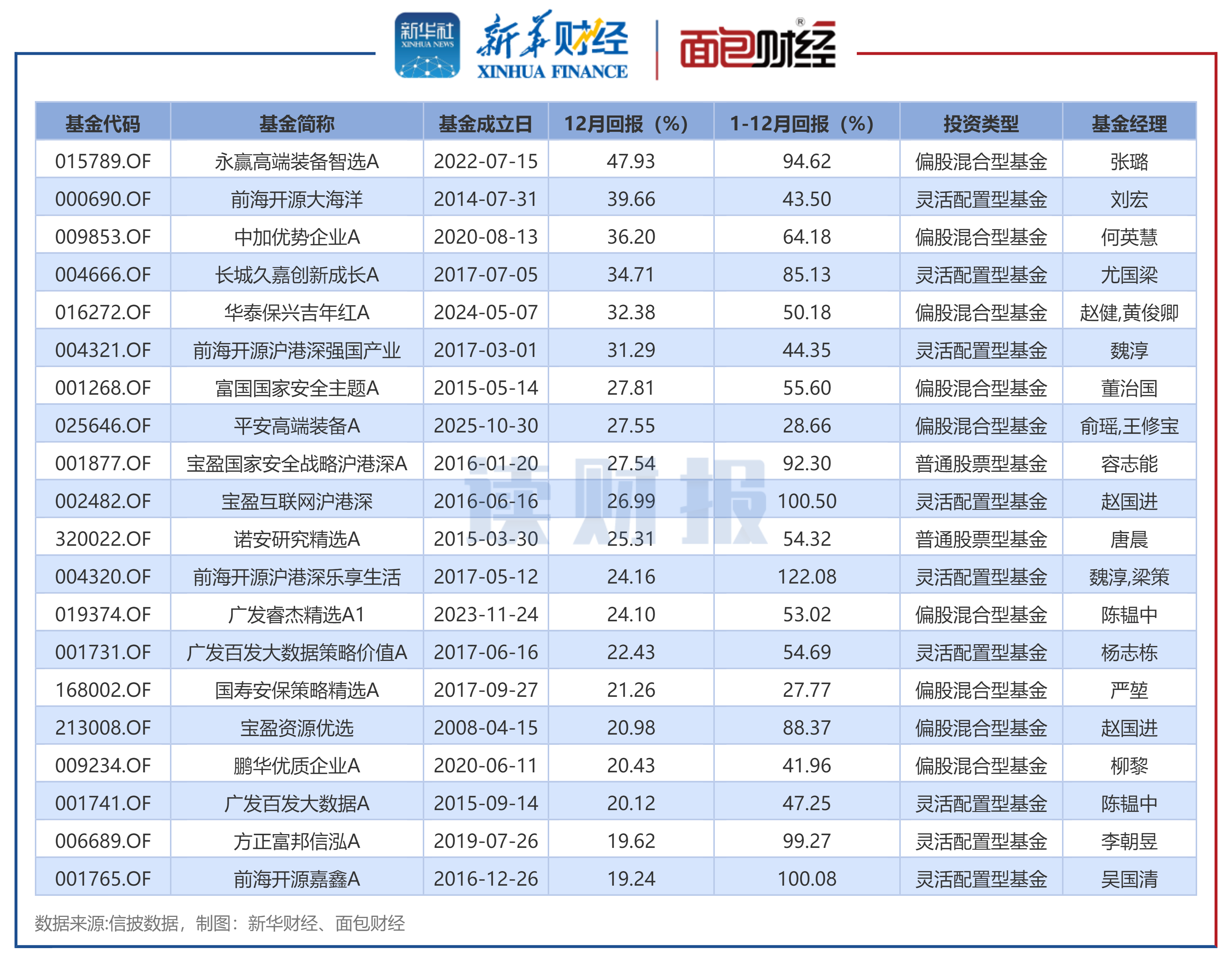
【读财报】主动权益基金12月表现:6只产品净值上涨超30% 永赢基金、前海开源基金等旗下产品表现靠前
Zhong Guo Jin Rong Xin Xi Wang· 2026-01-14 23:36
Core Insights - The average return of over 4,600 active equity funds established before December 2025 was 3.18%, with a median return of 2.92%, outperforming the CSI 300 and Shanghai Composite Index returns of 2.28% and 2.06%, respectively [1] - In December, the performance gap between the best and worst performing funds exceeded 60 percentage points, with 18 funds achieving returns over 20% [1] - Notable funds with significant returns included those from Yongying Fund and Qianhai Kaiyuan Fund, while funds from Baoying Fund and Huafu Fund saw declines exceeding 10% [1][6] Fund Performance - The top-performing fund, Yongying High-end Equipment Select A, achieved a net value increase of 47.93% in December 2025, leading among active equity funds [3][4] - The fund's strategy focuses on high-value, high-barrier investments in the satellite internet industry, with significant holdings in China Satellite and Aerospace Electronics, which saw stock price increases over 90% in December [4] - In total, 18 funds recorded returns exceeding 20% in December, with 6 funds achieving over 30% [1][6] Underperforming Funds - Baoying Fund and Huafu Fund had over 50 active equity funds with net value declines exceeding 10% in December, primarily in the medical and pharmaceutical sectors [6][10] - Baoying Innovation Medical A, established in June 2025, reported a net value drop of 14.14% in December, with a cumulative decline of approximately 11.14% since inception [10]
突发两大利空!投机盛宴散场,黄金爆拉,资金悄悄转向这个新方向
Sou Hu Cai Jing· 2026-01-14 17:55
Market Overview - The A-share market experienced a rapid shift from "frenzy" to "panic," highlighted by a 1000% surge in the "Pentagon Pizza Index," indicating rising geopolitical tensions as the U.S. urged citizens to leave Iran [1] - The significant drop in A-shares on January 13, 2026, was primarily driven by internal factors, particularly the commercial aerospace sector, which faced a sudden downturn after being heavily speculated [3][4] Commercial Aerospace Sector - The commercial aerospace sector, previously in a "white-hot" state, saw leading stocks like Aerospace Development hit their daily limit down, catching many investors off guard [3] - Regulatory warnings were issued the previous evening regarding abnormal stock price fluctuations in companies like Aerospace Development and LeiKe Defense, leading to increased scrutiny and a halt in speculative trading [4] Market Sentiment and Reactions - The panic led to a chain reaction, with funds that had previously invested in high-flying sectors like commercial aerospace and AI applications quickly exiting the market [6] - A phenomenon of capital reallocation occurred, where funds from falling stocks were used to buy into perceived undervalued sectors, causing a broader market decline [8] Global Market Influences - Concurrently, external factors from the U.S. heightened market tensions, including a criminal investigation into Federal Reserve Chairman Jerome Powell, which undermined confidence in the Fed's independence [9][10][11] - This led to a "sell-off in America" trend, with gold prices soaring past $4600 per ounce, indicating a flight to safety among global investors [13] AI and Healthcare Sector - Despite the overall market downturn, the AI healthcare and pharmaceutical sectors showed resilience, driven by significant partnerships like NVIDIA and Eli Lilly's $1 billion investment in a joint research lab [14] - Stocks in the AI healthcare space, such as Hongbo Pharmaceutical and Berry Genomics, saw strong gains, contrasting sharply with the commercial aerospace sector's decline [14] Policy Developments - The Ministry of Industry and Information Technology released a plan for the high-quality development of industrial internet platforms from 2026 to 2028, which was viewed positively by some market participants [16] - Local government initiatives, such as Jiangsu Province's AI action plan, further emphasized the strategic direction of integrating AI with traditional industries [16] Market Performance Data - As of January 13, 2026, the Shanghai Composite Index fell by 0.64%, while the ChiNext Index dropped by 1.96%, with a notable increase in trading volume to 3.69 trillion yuan, indicating active capital movement [17] - Defensive sectors like oil, pharmaceuticals, and banking showed relative strength, while defense, electronics, and technology sectors faced declines, reflecting a broader risk-off sentiment [17] Hong Kong Market Context - The Hong Kong market exhibited different dynamics, with the Hang Seng Index rising by 0.90%, suggesting that the issues affecting A-shares had a more indirect impact on Hong Kong stocks [19] - Analysts noted that the commercial aerospace sector's rapid price increase had outpaced previous hot sectors, indicating a potential shift in the upward trend of this sector [19]
苦干实干 勇于争先 打造高质量发展高品质生活高效能治理示范区
Xin Lang Cai Jing· 2025-12-26 21:02
Group 1 - The core message emphasizes the commitment of the Ping'an District to implement the economic work meeting's spirit, focusing on high-quality development and efficient governance to ensure a strong start for the 14th Five-Year Plan [1] - The district aims to strengthen domestic demand by attracting renowned automotive brands and enhancing consumer activities, with plans for 160 promotional events and the establishment of 20 new brand flagship stores [1] - The district has set ambitious targets for project implementation, with 160 new contracts signed for projects over 100 million and over 200 projects expected to resume or commence construction [1] Group 2 - Innovation-driven growth is prioritized, with support for the establishment of key laboratories and innovation platforms, and a focus on emerging industries such as artificial intelligence and digital economy [2] - The district is enhancing its business environment through reforms, aiming for over 90% of services to be "one-time no-run" and promoting the growth of state-owned enterprises with a target of over 5% revenue increase [2] - The district is committed to improving living standards by upgrading urban infrastructure, creating over 600 new parking spaces, and increasing employment opportunities by over 16,000 [3]
“AI泡沫论”再起,公募岁末如何应对?新发基金提前布局
券商中国· 2025-12-24 06:44
Core Viewpoint - The article discusses the recent shifts in ETF fund flows, highlighting a net outflow from popular sectors like artificial intelligence and healthcare, while stable sectors such as dividend low volatility and free cash flow have attracted investment [1][3]. Fund Flow Analysis - Recent fund flows indicate a significant net inflow into broad-based ETFs like CSI 300 and CSI A500, with net inflows exceeding 1.2 billion and 30 billion respectively as of December 22 [3]. - Stable ETFs focusing on dividend low volatility and free cash flow have also seen net inflows, with the dividend low volatility category attracting over 1.5 billion [3]. - Conversely, popular sectors such as healthcare and innovative pharmaceuticals have experienced net outflows, with multiple AI-themed ETFs recording over 1 billion in net outflows since December [3][4]. Market Style Shift - The discussion around a potential style switch in the A-share market has gained traction, with a focus on the "high to low" transition in investment styles [4]. - Short-term style shifts may not be sustainable, with a continued emphasis on large-cap growth styles into early next year, while longer-term shifts may occur around the first quarter of next year [4]. - The 2026 market outlook suggests that valuation recovery may outpace earnings recovery, similar to the 2019-2020 market phase [4]. Investment Strategy Insights - The article emphasizes the importance of cash flow and stable growth in investment strategies, with a focus on high-quality assets that can withstand market fluctuations [7]. - The 2026 investment landscape is expected to see a shift from technology towards stable cash flow sectors, with core assets likely to attract significant investment [7]. - New fund launches indicate a preference for both technology and stable value-oriented products, reflecting a diverse investment strategy [8]. Future Opportunities - The article highlights two key investment opportunities: cyclical industries benefiting from supply constraints and high-end manufacturing firms expanding in global markets [9]. - The ongoing competition in AI investment is noted, with a focus on the foundational infrastructure needed for growth, suggesting a mix of opportunities and challenges ahead [6].
华盖资本许小林:中国将诞生万亿医疗公司
投资界· 2025-12-09 08:40
Core Viewpoint - The article discusses the evolution and future prospects of China's medical investment landscape over the next decade, highlighting significant changes and opportunities in the industry, particularly in innovative pharmaceuticals and medical technology [2][3]. Summary by Sections Historical Context - The period from 2015 to 2024 marks a complete decade of development for China's innovative drug sector, with a focus on both achievements and future directions for medical investment [3]. Key Milestones in 2025 - 2025 is identified as a historic year for the medical industry, with notable events such as the emergence of Eli Lilly as the first trillion-dollar company in the healthcare sector, reflecting the industry's potential for high market valuations [4]. - The Hong Kong Stock Exchange has become a crucial platform for medical companies, achieving a financing amount of $36 billion and nearly 100 listed companies, with 10% being healthcare firms, particularly in innovative drugs [4]. - Significant business development (BD) transactions have occurred, including a landmark $1.25 billion upfront payment to 3SBio, indicating growing international recognition of Chinese innovative drug intellectual property [4]. Industry Growth and Changes - The past decade has seen a dramatic increase in clinical trial institutions from 400 to approximately 1,600, and the number of personnel in China's drug review center has risen from 100 to nearly 700, although still lagging behind the U.S. [6]. - The shift from licensing in to licensing out has transformed China's role in the global pharmaceutical market, with the country becoming the largest marketplace for innovative drugs [6][7]. Future Predictions - The article predicts that during the 14th Five-Year Plan, China will solidify its position as the world's largest innovative drug marketplace and will strive to achieve parity with the U.S. in original innovation [8]. - The integration of AI in healthcare is expected to grow significantly, with applications in clinical settings and drug development, indicating a trend towards more advanced healthcare solutions [9][11]. Investment Themes - Four core investment themes for the next decade are identified: 1. Original innovation in pharmaceuticals will be a key investment direction, potentially yielding high returns [10]. 2. The evolution of the Hong Kong Stock Exchange and the STAR Market will facilitate investment in innovative companies lacking immediate revenue or profits [10]. 3. The combination of AI and healthcare will lead to more practical applications, including AI-driven pharmaceuticals and home healthcare robots [11]. 4. As Chinese pharmaceutical innovation and international expansion continue, the market capitalization of leading companies may exceed one trillion, with the emergence of global multinational corporations [11].