
美国消费者信心指数

Search documents
美国消费者信心指数微涨,长期通胀预期微升
Jin Rong Jie· 2026-02-06 23:59
Core Insights - The preliminary consumer confidence index for February 2026 is reported at 57.3, which is an increase from January's final value of 56.4 but a decrease from February 2025's final value of 64.7 [1] Group 1: Consumer Confidence - The current economic conditions index for February 2026 is reported at 58.3, up from January's final value of 55.4 but down from February 2025's final value of 65.7 [1] - The preliminary consumer expectations index for February 2026 is reported at 56.6, which is lower than January's final value of 57 and also lower than February 2025's final value of 64 [1]
美国消费者信心指数微涨 长期通胀预期微升
Xin Lang Cai Jing· 2026-02-06 19:58
Group 1 - The core viewpoint of the article indicates that the consumer confidence index in the U.S. for February 2026 is at 57.3, which is higher than January's final value of 56.4 but lower than the 64.7 recorded in February 2025 [1] - The current economic conditions index for February is reported at 58.3, an increase from January's 55.4, yet it remains below the 65.7 from the same month last year [1] - The consumer expectations index stands at 56.6, which is a decrease from January's 57 and also lower than the 64 recorded in February 2025 [1] Group 2 - The one-year inflation expectation has decreased from 4.0% in January to 3.5% in February, marking the lowest reading since January 2025 [1] - Long-term inflation expectations have slightly increased from 3.3% in January to 3.4% in February, marking a second consecutive month of small increases [1] - Despite the consumer confidence index being at its highest level since August 2025, the monthly increases in recent months have been minimal, and overall confidence levels remain very low historically due to concerns over high prices and rising unemployment risks [1]
邦达亚洲:美元下挫油价攀升 美元加元大幅下挫
Xin Lang Cai Jing· 2026-01-28 06:57
Group 1 - The core expectation is that the Federal Reserve may only lower interest rates twice in the next two years, despite President Trump's upcoming appointment of a new Fed chair [1][6] - The average expectation among respondents is for two rate cuts of 25 basis points each this year, bringing the target range for the federal funds rate down to 3%–3.25% [1][6] - Trump's pressure on the Fed to lower rates significantly is noted, with his desire for rates to be among the lowest globally, aiming for a rate of 1% in a context of approximately 2% inflation [1][6] Group 2 - The U.S. Consumer Confidence Index unexpectedly dropped to its lowest level since May 2014, impacting market confidence in the labor market and growth prospects [2][7] - The index fell from a revised 94.2 to 84.5, marking a significant decline and below all economists' forecasts [2][7] - The drop in consumer confidence is seen as a key driver in reversing recent trends in the bond market, with expectations for two rate cuts by the Fed being reinforced [2][7] Group 3 - Gold prices surged to a new historical high, trading around 5260, supported by a weak dollar and heightened risk aversion due to trade tensions [3][8] - The dollar index is nearing a four-year low, influenced by Trump's comments on the dollar and concerns over a potential government shutdown [3][8] Group 4 - The USD/JPY pair fell significantly, reaching a 13-week low around 152.70, driven by trade tensions and concerns over the Fed's independence [4][9] - The USD/CAD pair also declined, hitting a six-month low around 1.3590, influenced by multiple negative factors including rising oil prices [5][10]
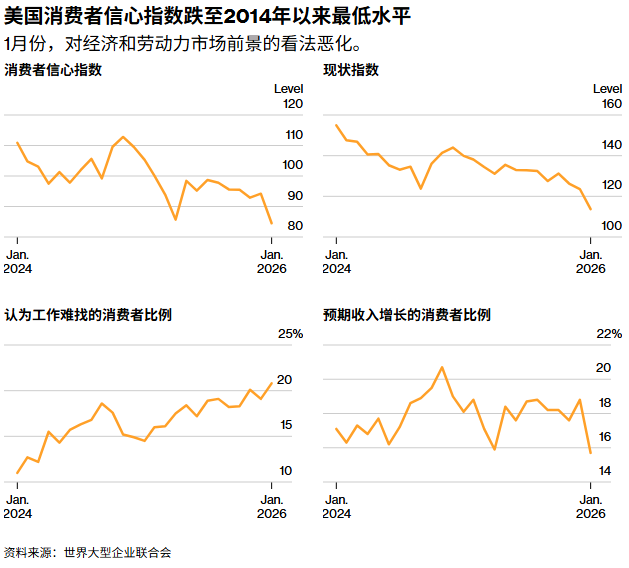
近12年来最低!美国消费者信心指数崩塌 低就业高物价联合“双杀”
Sou Hu Cai Jing· 2026-01-28 06:08
Core Viewpoint - In January, U.S. consumer confidence fell to its lowest level in nearly 12 years, driven by concerns over a sluggish job market and rising prices [1][2]. Group 1: Consumer Confidence Index - The consumer confidence index dropped by 9.7 points to 84.5, marking the lowest level since May 2014 [2]. - The decline in consumer confidence is widespread across political affiliations, with independent respondents being the most pessimistic [2]. Group 2: Economic Outlook - Economists express concern that the decline in consumer confidence, coupled with a negative outlook on the job market, could impact the U.S. consumption market [2]. - The consumer expectations index reached a nine-month low, indicating potential signs of slowing consumer spending [3]. Group 3: Consumer Behavior Trends - There is a noticeable decrease in consumers planning to purchase big-ticket items, take vacations, or buy homes, with home-buying plans at a nine-month low [3]. - The most significant decline in confidence is observed among consumers aged 35 and older, as well as households earning less than $15,000 and those earning $50,000 or more [3]. Group 4: Concerns Over Economic Factors - High levels of concern persist regarding prices and inflation, particularly for oil, gas, food, and groceries [4]. - Increasing mentions of tariffs, trade, politics, and labor market issues have been noted, alongside a slight rise in concerns about health insurance and war [4].
十年新低!美国1月消费者信心指数意外崩塌 美债收益率曲线陡峭化重启
智通财经网· 2026-01-28 00:33
Core Viewpoint - The unexpected collapse of the U.S. Consumer Confidence Index in January 2026 to its lowest level since May 2014 has significantly impacted market confidence regarding the labor market and growth prospects, reinforcing expectations for two interest rate cuts by the Federal Reserve this year [1][7]. Group 1: Consumer Confidence Index - The Consumer Confidence Index dropped from a revised 94.2 in the previous month to 84.5 in January, marking the lowest level since May 2014 and falling below all economists' forecasts [7]. - The expectations index for the next six months fell to its lowest level since April of the previous year, while the current situation index reached its lowest point in nearly five years [7]. - The proportion of consumers who believe jobs are hard to find has reached its highest level since February 2021, while the perception of job availability has worsened, narrowing the gap between these two metrics to the worst reading in years [8]. Group 2: Economic Factors Impacting Confidence - High prices for oil, gas, and everyday goods, along with concerns about the job market and healthcare, have been frequently mentioned by consumers in the survey responses [8]. - Geopolitical tensions, particularly related to Venezuela, Iran, and Greenland, have also contributed to the decline in consumer confidence, with the survey cutoff date being January 16 [8]. - Despite the decline in confidence, some analysts believe that upcoming tax refunds will enhance household purchasing power, suggesting that the drop in confidence may be overstated and could rebound soon [8]. Group 3: Market Reactions - The drop in consumer confidence has led to a rise in short-term Treasury prices, reactivating the steepening trend of the yield curve that had stalled earlier this month [9]. - The two-year Treasury yield fell over 3 basis points from its daily high in response to the consumer confidence index drop, while longer-term yields remained higher due to inflation and increased borrowing expectations [9][13]. - The yield spread between two-year and ten-year Treasuries widened to its largest level in nearly a decade, benefiting traders betting on this strategy [13].

美国消费者信心指数上涨,高物价成为沉重负担
Xin Lang Cai Jing· 2026-01-23 22:58
Core Insights - The University of Michigan's consumer confidence index for January 2026 stands at 56.4, which is higher than December 2025's final value of 52.9 but lower than January 2025's final value of 71.7 [2] - The current economic conditions index for January 2026 is 55.4, up from 50.4 in December 2025 but down from 75.1 in January 2025 [2] - The consumer expectations index for January 2026 is 57.0, an increase from December 2025's 54.6 but a decrease from January 2025's 69.5 [2] Economic Conditions - Consumers perceive a slight improvement in economic conditions over the past few months, yet high prices and declining income prospects are putting pressure on budgets, resulting in consumer confidence being over 20% lower than a year ago [2] - The survey was conducted just two days after President Trump's announcement on January 17, 2026, regarding new tariffs on eight European countries [2]
美国消费者信心指数上涨 高物价成为沉重负担
Yang Shi Xin Wen Ke Hu Duan· 2026-01-23 22:35
Core Viewpoint - The University of Michigan's consumer confidence index for January 2026 stands at 56.4, showing a month-over-month increase from December 2025's 52.9, but a year-over-year decrease from January 2025's 71.7 [1] Group 1: Consumer Confidence Index - The final value of the consumer confidence index for January 2026 is 56.4, which is higher than December 2025's final value of 52.9 but lower than January 2025's final value of 71.7 [1] - The current economic conditions index for January 2026 is 55.4, up from December 2025's 50.4, but down from January 2025's 75.1 [1] - The consumer expectations index for January 2026 is 57.0, which is higher than December 2025's 54.6 but lower than January 2025's 69.5 [1] Group 2: Economic Conditions - Consumers perceive a slight improvement in economic conditions over the past few months; however, high prices and declining income prospects are putting pressure on budgets, resulting in consumer confidence being over 20% lower than a year ago [1] - The survey was conducted just two days after President Trump's announcement on January 17, 2026, regarding tariffs on eight European countries [1]
美国消费者信心指数连续第二个月微升 创四个月新高
Xin Lang Cai Jing· 2026-01-09 15:38
Group 1 - The consumer confidence index in the U.S. has increased for the second consecutive month in January, with low-income consumers showing improvement while high-income consumers' confidence has declined [1] - Overall, consumers perceive a slight improvement in the economy over the past two months, but their confidence level remains nearly 25% lower than in January of the previous year [1] - Consumers continue to focus on "kitchen table issues" such as high prices and a weakening labor market, despite a gradual decline in concerns over tariffs [1] Group 2 - The one-year inflation expectation remains stable at 4.2%, the lowest reading since January 2025, yet still significantly higher than the 3.3% level from the same month last year [1] - Long-term inflation expectations have slightly increased from 3.2% in December to 3.4% in January [1]
美国消费者信心指数连续五个月走低,通胀与就业仍存隐忧
Sou Hu Cai Jing· 2025-12-24 12:53
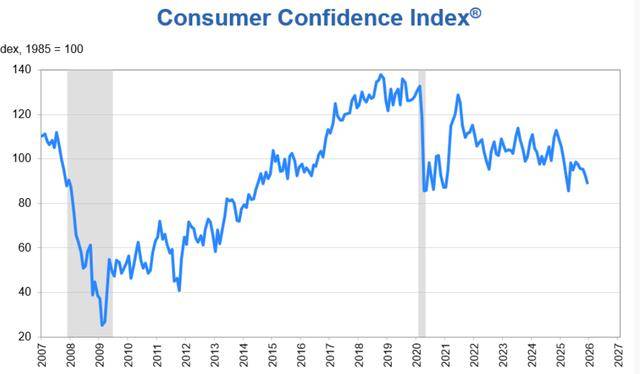
Core Insights - The consumer confidence index in the U.S. dropped from a revised 92.9 in November to 89.1 in December, marking the lowest level since April and reflecting a negative outlook on the business environment and increasing concerns about employment and income [1][4] Group 1: Consumer Confidence Index - The consumer confidence index has declined for five consecutive months, indicating growing uncertainty among consumers regarding the future economic outlook [1][4] - Four out of five components of the consumer confidence index decreased, with the only remaining component showing significant weakness [1] - The consumer expectations index, which reflects short-term income prospects, business, and employment market conditions, remained low at 70.7, significantly below the critical threshold of 80, which is a key indicator of potential economic recession [3][5] Group 2: Economic Implications - The decline in consumer confidence is a critical indicator for the U.S. economy, as consumer spending is a major pillar of economic activity [4] - There are concerns that the U.S. economy may enter a "soft recession," characterized by low growth, slowing employment, and persistent inflationary pressures [3][5] - The rigid nature of current inflation is expected to further erode wage growth, impacting consumer confidence and spending [4]
【环球财经】调查:高物价致美国消费者节日季负债增加
Xin Hua She· 2025-12-24 06:41
Core Insights - 37% of Americans reported increased debt during the holiday shopping season, with average debt rising from $1,181 last year to $1,223 this year [1] - The increase in debt is attributed to rising tariffs and prices, which have strained household budgets, particularly during the holiday season [1] - 63% of borrowers expect to take three months or longer to repay their debts, and approximately 41% are still repaying last year's debt [1] - High credit card interest rates, currently averaging over 20%, pose a significant concern for borrowers who may take six months to a year or longer to repay their debts [1] - Consumer sentiment has become increasingly pessimistic, with the consumer confidence index dropping to 89.1, the lowest level since April, due to negative perceptions of the business environment and concerns over employment and income [1]