美国经济分化

Search documents
纽约联储报告显示美国贷款违约率升至近十年来最高水平
Xin Lang Cai Jing· 2026-02-10 17:38
Core Insights - The overall loan delinquency rate in the U.S. rose to 4.8% of total household debt in Q4, the highest level since 2017, driven primarily by increased defaults among low-income and young borrowers [2][5]. Group 1: Loan Delinquency Trends - The delinquency rate increase is mainly attributed to mortgage payment defaults, particularly pronounced in low-income areas [6]. - The percentage of credit card loans overdue by at least 90 days rose to 12.7%, the highest since Q1 2011 [6]. - The rate of serious delinquency for auto loans increased to 5.2%, slightly below the record set in 2010 [6]. Group 2: Household Debt and Economic Disparities - Total U.S. household debt grew by 1% from the previous quarter, reaching $18.8 trillion [6]. - The rise in delinquency rates among low-income and young borrowers aligns with an increase in unemployment rates for certain demographics, with the unemployment rate for those aged 16 to 24 at 10.4% in December, close to the peak during the pandemic [3][6]. Group 3: Student Loan Defaults - Approximately 16.3% of student loans entered delinquency in Q4, marking the largest increase since data collection began in 2004 [7].


2026年美国经济冷热分化仍将扩大
21世纪经济报道· 2026-02-07 10:10
Economic Overview - The U.S. economy is experiencing a coexistence of "summer of growth" and "winter of employment," with increasing operational pressures on small and medium enterprises and a divergence in consumer spending across different income levels [1] - The "employment-consumption" chain in the U.S. has significantly slowed down, with the unemployment rate continuing its upward trend since the second half of 2025 [1] Financial Market Dynamics - In 2025, the U.S. stock market faced historical challenges due to tariff impacts, fiscal shifts, and industrial waves, but rebounded after initial shocks [1] - The "DeepSeek moment" and the April "reciprocal tariffs" caused market tremors, yet the market sentiment surged due to the AI investment wave led by companies like OpenAI, Nvidia, and Oracle [1] - By year-end, doubts about the AI narrative emerged as tech giants increased capital expenditures despite shrinking cash flows and heightened reliance on external financing [1] Economic Structure - The K-shaped economic structure in the U.S. is expected to persist, with a widening gap between AI-related sectors and the broader economy [2][5] - AI investments contributed 0.8 percentage points to GDP growth in 2025, while private consumption added 1.1 percentage points, indicating AI's role as a growth engine [5][6] - The disparity in economic performance is reflected in the increasing share of equity assets in net worth, with a significant wealth accumulation of approximately $20 trillion from corporate equity from Q1 2023 to Q2 2025 [5] Employment Trends - The trend of rising unemployment and weak non-farm job growth suggests that the Federal Reserve's expectations for supply-side weakness to curb unemployment need to be adjusted [8] - The labor market's instability and high volatility in job creation are impacting the consumption-employment-income chain in the U.S. [8] Monetary Policy - The Federal Reserve's monetary policy is under pressure to provide greater easing to support both the AI sector and the struggling real economy [9] - If the economy remains stable, the Fed may continue to lower rates by 25 basis points per quarter, potentially reaching a terminal rate of 3%-3.25% by mid-2026 [10] - In a cooling economy, the Fed might lower rates to a range of 2.5%-2.75% while expanding its balance sheet more aggressively [10] AI Investment Landscape - The AI investment narrative in the U.S. is under scrutiny, with concerns about the sustainability of high valuations and the interconnectedness of major tech firms [12][13] - The current AI investment scale and concentration far exceed that of the 2000 internet bubble, raising systemic risk concerns if major players face issues [12] - The reliance on external financing and competitive capital expenditures among tech giants may deepen vulnerabilities in the AI investment narrative [12]

张瑜:美国经济的冷与热:总量向上,民生向下——美国三季度GDP点评
一瑜中的· 2025-12-26 16:03
Core Viewpoint - The third quarter GDP of the United States exceeded expectations, with a quarter-on-quarter annualized growth rate of +4.3%, up from +3.8% previously and above the expected +3% [2][38] - The economic data indicates a K-shaped recovery, where overall economic growth contrasts with declining living standards for many, highlighting a significant wealth gap [4][13] Group 1: Economic Disparities - AI-related investments continue to drive economic growth, with a contribution of +0.4% to GDP growth in Q3, while traditional non-AI investments show negative growth [6][14] - The wealth effect from AI is concentrated among the top 20% of income earners, who hold approximately 87% of all stock assets, leaving the majority of the population unable to benefit from this growth [7][23] - 67% of wage-dependent individuals are classified as "living paycheck to paycheck," with a significant portion unable to cover daily expenses, contributing to rising credit defaults and declining consumer confidence [7][23] Group 2: Employment and Consumer Behavior - The job market remains weak, particularly for low-wage positions, with new job creation in these sectors expected to be below 100,000 annually starting in 2024 [8][29] - AI's contribution to economic growth does not translate into job creation, instead replacing entry-level positions, leading to higher unemployment rates among younger demographics [8][30] - The housing market is also struggling, with high mortgage rates and rising home prices making homeownership increasingly unattainable for average earners [9][35] Group 3: GDP Data Analysis - Q3 GDP growth was primarily driven by strong consumer spending, particularly in services, while durable goods consumption remained weak [6][42] - Private investment showed a decline, with inventory investment improving but still negative, indicating ongoing challenges in traditional sectors [6][43] - Net exports weakened significantly due to a contraction in imports, while government spending increased, contributing positively to GDP growth [6][46]

——美国三季度GDP点评:美国经济的冷与热:总量向上,民生向下
Huachuang Securities· 2025-12-26 10:13
Economic Performance - Q3 US GDP growth was +4.3% (annualized), exceeding expectations of +3% and previous value of +3.8%[1] - Year-on-year GDP growth was +2.3%, up from +2.1% and above the expected +2%[1] Investment Trends - AI-related investments contributed significantly, with a quarterly annualized growth rate of +0.4% (excluding imports) in Q3, compared to +0.3% in the first half of the year[2] - Non-AI residential and non-residential investments showed negative year-on-year growth, indicating weakness in traditional manufacturing and real estate sectors[3] Consumer Behavior - Wealth concentration is evident, with the top 20% holding approximately 87% of all stock assets, leading to a disparity in consumption patterns[4] - 67% of the population is classified as "living paycheck to paycheck," with 23% struggling to pay daily bills[4] Employment Landscape - Low-wage job creation is weak, with fewer than 100,000 new low-wage jobs expected in 2024, reflecting a downturn in traditional sectors[5] - The unemployment rate for the 22-25 age group in high AI exposure jobs has decreased by about 10% since late 2022, indicating job displacement due to AI[5] Housing Market - The median income required to afford housing without exceeding 30% of income is estimated at $120,000, while the median household income is only $85,000, highlighting affordability issues[6] - Housing prices and rents are at historical peaks, exacerbating the challenges for potential homebuyers[6]
被撕裂的美国经济:高收入者狂欢 年轻与低收入群体陷落
智通财经网· 2025-11-03 04:20
Core Insights - The pressure faced by low-income and young consumers in the U.S. is increasingly significant, with the Federal Reserve and Chipotle Mexican Grill highlighting the growing economic "divergence" [1][2] Economic Overview - Federal Reserve Chairman Jerome Powell noted that while the overall U.S. economy remains resilient, this resilience is uneven, with consumer spending increasingly concentrated among high-income households [1] - Powell emphasized that consumer spending continues to grow, driven primarily by high-end consumers, and remains a core pillar of current economic activity [1] Company-Specific Insights - Chipotle's CEO Scott Boatwright reported a significant decline in spending frequency among young and low-income customers, leading to a nearly 20% drop in the company's stock price [2] - Households earning less than $100,000 contribute approximately 40% of Chipotle's sales, but their spending has drastically reduced, particularly among the 25 to 35 age group [2] Industry Trends - The decline in spending among lower-income consumers is not unique to Chipotle but is observed across the restaurant industry and various non-essential consumer sectors [2] - Economic pressures such as rising unemployment rates, the resumption of student loan repayments, and slowing real wage growth are impacting consumer behavior [2] Consumer Sentiment - BTIG's Peter Saleh described the decline in Chipotle's young customer spending as a concerning signal, noting a sudden drop in September and October [3] - A consumer confidence survey by TD Securities indicated a "severe divergence" in the U.S. economy, with high-income households showing a decreased willingness to cut back on spending, while middle and low-income families express ongoing economic anxiety [3] Employment Market Dynamics - Powell warned of increasing pressures in the job market, with major companies like Amazon and UPS announcing significant layoffs [3][4] - Although current data does not indicate a widespread deterioration in the job market, Powell acknowledged that the effects of such pressures may take time to manifest [4] - The economic divergence is becoming increasingly evident, with low-income Americans reducing spending while high-income consumers maintain stable consumption [4]

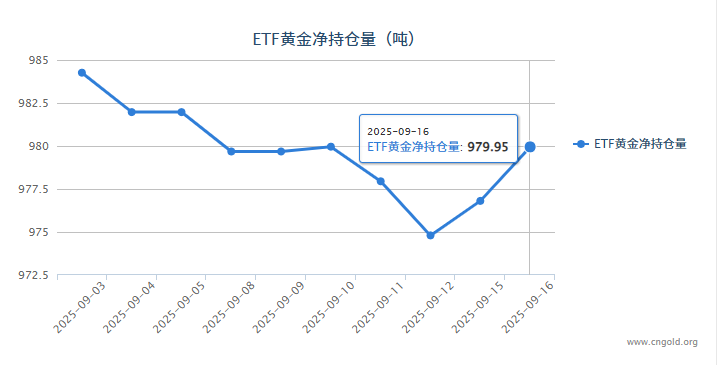
【黄金etf持仓量】9月16日黄金ETF较上一交易日增加3.14吨
Jin Tou Wang· 2025-09-17 07:13
Group 1 - The largest gold ETF, iShares Silver Trust, reported a holding of 979.95 tons of gold as of September 16, an increase of 3.14 tons from the previous trading day [1] - As of the market close on September 16, the spot gold price was $3689.83 per ounce, reflecting a 0.30% increase, with an intraday high of $3702.95 and a low of $3674.29 [1] Group 2 - The U.S. economy presents a dichotomy, with high-income earners and older individuals benefiting from strong economic growth, while low-income groups, young people, and minorities face stagnant wage growth and increasing living pressures [3]