购置税兜底政策

Search documents
“未见车,先付全款?”极氪车主声讨车企税补“变脸”
Di Yi Cai Jing· 2026-01-12 08:40
Core Viewpoint - The article discusses the disputes arising from the "purchase tax subsidy" policy implemented by Zeekr, where customers are required to pay the final payment and issue an invoice before vehicle delivery, leading to dissatisfaction among some car owners [1][2]. Group 1: Customer Experiences - A customer named Wang Li refused to pay the final payment without seeing the vehicle, citing commercial principles, but Zeekr used this as a reason to deny the purchase tax subsidy [1]. - Many customers share similar experiences, with over 240 individuals reported in a dispute group regarding the purchase tax subsidy [2]. - Customers argue that the right to inspect the vehicle before payment is a legal entitlement and should not be waived due to contractual terms or tax policies [2]. Group 2: Company Policies and Responses - Zeekr's policy states that for orders locked by November 30, 2025, if the vehicle is delivered in 2026 due to Zeekr's reasons, the company will cover the purchase tax difference, up to a maximum of 15,000 yuan [3]. - The company has introduced a "pay first, inspect later" service to expedite the delivery process, which has led to confusion among customers regarding the communication of this policy [5]. - Zeekr is currently mediating disputes related to the purchase tax subsidy, offering various compensation solutions, including points equivalent to cash and adjustments to future orders [6]. Group 3: Changes in Subsidy Policy - The purchase tax subsidy policy for 2026 will see a reduction, with maximum subsidies dropping from 15,000 yuan in 2025 to between 7,000 and 12,000 yuan [6]. - Customers who placed orders in 2025 but failed to complete payment and invoicing by the end of the year will not be eligible for the subsidy, while those whose vehicles were not delivered due to Zeekr's reasons will still receive the subsidy [6].
元旦假期乘用车需求情况跟踪
数说新能源· 2026-01-05 03:02
Group 1: Demand Situation During New Year - Overall passenger car demand during the 2026 New Year holiday was relatively weak, with only a few brands like Geely Galaxy, Zeekr, and Tesla seeing some customer flow [1] - New energy vehicle orders saw a significant decline, with daily electric vehicle orders dropping by 30%-50% and gasoline vehicle orders down by 20%-30% [1] - The main reason for the decline was consumer reaction to the half-price vehicle purchase tax policy, with many customers from the previous year not quickly converting their orders [1] Group 2: Future Outlook - Many automakers have set significant growth targets for 2026, but with current weak orders, manufacturers are likely to implement promotional policies to ensure sales [2] - There is still demand for car purchases during the New Year, and combined with promotions from manufacturers and dealers, a gradual recovery is expected [2] Group 3: Price Outlook - The first quarter is expected to see downward pricing and inventory clearance, with current discounts being reasonable [3] - The single vehicle subsidy from the purchase tax policy is around 4%-5%, and as long as it does not lead to losses for manufacturers and dealers, it should comply with regulations [3] Group 4: Impact of Raw Material Price Increases - In January, automakers are focused on inventory digestion, and end consumers have not yet felt the impact of price increases [4] - Any potential price hikes are expected to occur after March, coinciding with the new car release cycle [4] Group 5: Annual Demand Outlook - The total domestic passenger car registration volume in 2026 is expected to decline slightly by 2%-3%, making it difficult to match 2025 levels [5] - Gasoline vehicle sales are projected to drop by 1.5-1.8 million units, creating additional space for new energy vehicles, which are expected to grow by 5%-10% [5] - The market share of plug-in hybrids is anticipated to increase from 20% to 25%, while pure electric vehicles are expected to maintain around 35% market share, with plug-in hybrids having a greater impact on conservative gasoline vehicle users [5]


月渗透率连超五成、桩车增量比1:1.9,新能源车上位卷“车链”
Bei Jing Shang Bao· 2025-12-11 13:48
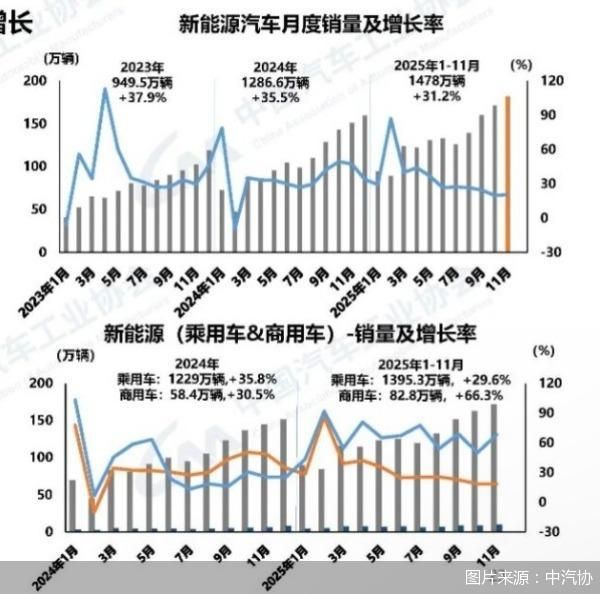
Core Insights - The Chinese automotive market has reported over 30 million vehicle sales this year, with new energy vehicles (NEVs) driving significant growth and influencing upstream and downstream sectors [1] - NEV sales reached 14.78 million units in the first 11 months, achieving a year-on-year growth of 31.2% and a market penetration rate exceeding 50% for two consecutive months [3][4] - Major automotive groups are increasingly dominating the NEV market, with the top 15 groups accounting for 95.2% of total NEV sales [5] Sales Performance - Total automotive sales in China for the first 11 months reached 31.12 million units, a year-on-year increase of 11.4% [1] - NEV sales for the same period were 14.78 million units, with a penetration rate of 47.5% [3] - In November alone, NEV sales surged to 188,000 units, achieving a market share of 53.2% [3] Market Dynamics - The growth in NEV sales is attributed to various vehicle types, with pure electric vehicles and plug-in hybrids showing significant year-on-year increases of 28.9% and 7.9%, respectively [4] - A and B segment vehicles are the primary focus, while A00 and A0 segments have seen remarkable growth rates of 56.9% and 65.1% [4] Competitive Landscape - BYD leads the NEV market with a sales volume of 4.18 million units, capturing 28.3% of the market share [5] - New entrants like Xiaomi and Hongmeng Zhixing have also reported impressive sales figures, with Hongmeng Zhixing delivering over 80,000 units in November, a 89.61% increase [6] Year-End Strategies - As the year-end approaches, automotive companies are intensifying their sales efforts, driven by expiring tax incentives and promotional activities [7][9] - Companies are adopting strategies such as offering existing stock vehicles to meet consumer demand and accelerate sales [8] Supply Chain Impact - The demand for NEVs is boosting the upstream battery market, with battery installation volumes reaching 578 GWh, a 42.4% increase year-on-year [10] - The construction of charging infrastructure is also accelerating, with a 77.2% increase in new charging facilities [10] Future Outlook - The Chinese government aims to enhance charging infrastructure significantly by 2027, targeting 28 million charging facilities to support over 80 million electric vehicles [10][11]




多家车企宣布税费“兜底”政策 ,年底抢单大战开始!
Xin Lang Ke Ji· 2025-11-03 04:09
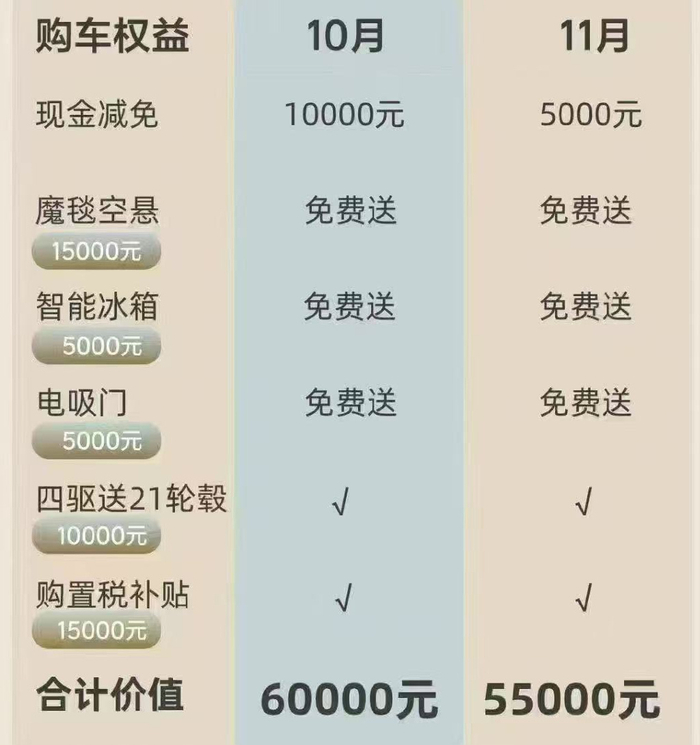
Core Insights - The upcoming reduction of the new energy vehicle purchase tax is expected to stimulate a surge in vehicle purchases before the end of the year [1][6] - Several automakers are offering "tax guarantee" policies to encourage consumers to place orders before the tax benefits expire [4][6] Group 1: Tax Policy and Consumer Behavior - The new energy vehicle purchase tax is anticipated to be halved, prompting consumers to rush to make purchases to take advantage of the tax exemption [1][6] - Consumers who place orders by the end of November can benefit from tax guarantee services offered by various automakers, which will cover any tax differences if delivery is delayed [1][4] - The cash subsidy for consumers who order in October is higher than for those who order in November, with a difference of 5,000 yuan [2][3] Group 2: Automaker Strategies - Companies like Li Auto, Xiaomi, and Chery are implementing "tax guarantee" policies to mitigate the risk of delayed deliveries affecting tax exemptions [1][4] - The "tax guarantee" policy typically covers up to 15,000 yuan in tax differences for delayed deliveries due to production or transportation issues [1][4] - Automakers are actively encouraging consumers to place orders quickly, as the end of the year approaches and the purchase tax policy is set to change [6][8] Group 3: Market Trends - The new energy vehicle market has shown strong sales performance, with a reported retail of 901,000 units in October, marking a 22% year-on-year increase [8] - The upcoming tax policy changes are expected to create a critical window for automakers to boost sales and meet annual targets [8]