资管产品

Search documents
拼手速!免费看电影
Sou Hu Cai Jing· 2026-02-18 14:20
Group 1 - The Jiangsu Provincial Federation of Trade Unions will invest 5 million yuan in 2026, with an additional 30 million yuan from various trade unions, to distribute movie consumption vouchers [5] - From February 17 to February 23, trade union members can receive 50 yuan movie vouchers to be used in participating cinemas across the province [6][7] - Special screenings will be organized for difficult worker families and other groups, ensuring cultural benefits reach the last mile [6] Group 2 - The total assets of asset management products in China are expected to reach 120 trillion yuan by the end of 2025, reflecting a year-on-year growth of 13.1% [11] - The growth in asset management products is primarily directed towards interbank deposits and certificates of deposit [11] Group 3 - Two mandatory national standards for the postal industry have been approved and will be implemented starting January 1, 2027, focusing on safety production operations and equipment configuration [12]


新华财经早报:2月18日
Xin Hua Cai Jing· 2026-02-18 01:35
Group 1 - The total asset balance of asset management in China is projected to reach 120 trillion yuan by the end of 2025, representing a year-on-year growth of 13.1% [1] - The scale of asset management products is rapidly increasing, with new assets primarily directed towards interbank deposits and certificates of deposit, totaling 28.7 trillion yuan by the end of 2025, which is an 18.9% increase year-on-year [1] - During the Spring Festival holiday, travel bookings have significantly increased, with hotel bookings up over 80% and ticket sales up 54% compared to last year [1] Group 2 - The UK job market continues to weaken, with the unemployment rate rising to 5.2% in the fourth quarter of 2025, the highest level in nearly five years, and the total number of unemployed reaching approximately 1.883 million, a year-on-year increase of 28.1% [2] - The Canadian Consumer Price Index (CPI) for January showed a month-on-month change of 0%, below the expected 0.2% [3] - The New York Federal Reserve's manufacturing index for February is reported at 7.1, slightly above the expected 6.98 [3]

时报观察|存款流失假象背后:权益投资需构筑“吸引力前提”
证券时报· 2026-02-12 00:27
Core Viewpoint - The central bank has recently discussed the impact of deposit changes on overall liquidity in its monetary policy report, indicating that the flow of deposits into asset management products largely returns to banks, thus having a limited impact on liquidity [1][2]. Group 1: Deposit Flow and Asset Management - A significant portion of deposits moving to asset management products eventually flows back to banks in the form of deposits, indicating that the change in deposit form does not significantly impact overall liquidity [2]. - In 2025, asset management products are expected to raise funds of 4 trillion yuan from households and 1 trillion yuan from non-financial enterprises, with 4.6 trillion yuan of new deposits and certificates of deposit accounting for 50% of the new underlying assets in these products [2]. Group 2: Future Trends in Financial Asset Allocation - In the short term, the allocation of financial assets by households and enterprises will continue to switch between deposits and fixed-income asset management products [3]. - In the long term, the substantial wealth accumulated by households and enterprises necessitates a broader range of asset categories for investment, with a trend towards reallocating funds from debt assets to equity assets, contingent on the stability of the capital market [3]. - Establishing a long-term mechanism to enhance the inherent stability of the capital market is crucial for promoting healthy development in the capital market and fostering a competitive ecosystem in the asset management industry [3].

债市看多的逻辑
2026-02-11 15:40
Summary of Conference Call Notes Industry Overview - The focus of the conference call is on the bond market in China, with a long-term bullish outlook on the bond market despite short-term fluctuations [1][15]. Key Points and Arguments 1. **Long-term Bullish Outlook**: The company maintains a long-term bullish view on the bond market, with expectations of upward trends despite potential short-term volatility, particularly after the Spring Festival [1][10]. 2. **High Real Interest Rates**: China's real interest rates, measured by the 10-year government bond yield relative to CPI, remain high at approximately 1.1168, which is conducive to economic growth and necessitates a low-interest environment [2][4]. 3. **International Comparisons**: Historical data from developed economies shows that exiting low-interest environments takes considerable time, suggesting that China may also require a prolonged period to stabilize its interest rates [3][4]. 4. **Government Debt Levels**: The increasing scale of government debt, projected to rise to over 70 trillion for central government bonds and 80 trillion for local government bonds by 2026, indicates significant fiscal pressure that necessitates a low-interest environment [4][5]. 5. **Banking Sector Stability**: The banking sector's net interest margin has been declining, from approximately 2.1% in 2020 to 1.42% in 2025, which impacts profitability and necessitates a stable interest rate environment to maintain financial stability [6][7]. 6. **Insurance Sector Growth**: The insurance sector has seen rapid growth, with new premium income reaching 212.6 billion in January 2026, a 27.6% increase year-on-year, indicating strong demand for bonds from non-bank financial institutions [8][9]. 7. **Bond Market Demand**: There is a significant demand for bonds from various sectors, including insurance, as large amounts of fixed deposits are maturing and being converted into insurance products and other financial instruments [9][10]. 8. **Interest Rate Projections**: The 10-year government bond yield is expected to remain within the range of 1.7% to 1.9%, with a potential decline to 1.6% if interest rates are cut further [10][11]. 9. **Investment Strategies**: The company recommends focusing on high liquidity government bonds and credit bonds, with an emphasis on safety and yield, particularly in the context of expected low interest rates and potential market volatility [22][23]. Additional Important Content - **Fiscal and Monetary Policy Coordination**: The need for coordinated fiscal and monetary policies to support domestic demand is emphasized, with a focus on maintaining liquidity and reducing financing costs [15][16]. - **Asset Management Products**: The total assets of asset management products have reached 120 trillion, reflecting a growing trend in the financial market that requires careful monitoring [17][18]. - **Regional Investment Insights**: Specific regions such as Beijing and Guangxi are highlighted for their stable investment opportunities, with a focus on local government bonds and enterprises that are financially sound [26][29]. This summary encapsulates the key insights and strategic outlook presented during the conference call, focusing on the bond market dynamics, fiscal pressures, and investment strategies in the context of China's economic landscape.
央行回应居民存款“搬家”
Sou Hu Cai Jing· 2026-02-11 12:38
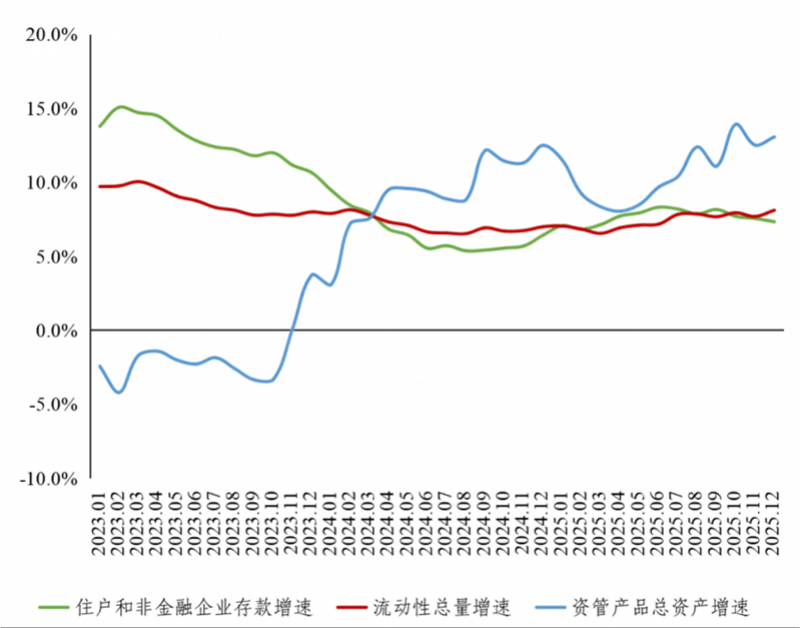
Core Insights - The discussion around the "50 trillion deposits maturing" has sparked widespread debate among residents regarding the reallocation of deposits [1] - The People's Bank of China (PBOC) released a report addressing the trends in the flow of these massive deposits [1] Group 1: Deposit Trends - In a low-interest-rate environment, there is a notable shift between asset management products and bank deposits, with the growth rates of these two categories showing an inverse relationship [2] - Since 2024, the one-year fixed deposit rate has decreased by 0.5 percentage points, while cash management products have maintained higher yields compared to bank deposits [2] Group 2: Asset Management Growth - By the end of 2025, the total assets in asset management reached 120 trillion yuan, marking a year-on-year increase of 13.1%, with an additional 13.8 trillion yuan added throughout the year [4] - The funds sourced from households and enterprises for asset management products reached 56.3 trillion yuan, reflecting a 9.7% year-on-year growth, which is 2.4 percentage points higher than the growth rate of household and enterprise deposits [4] Group 3: Fund Allocation - Over 80% of asset management products are directed towards fixed-income assets, with significant allocations to interbank deposits and certificates of deposit, totaling 28.7 trillion yuan by the end of 2025, which is an 18.9% increase [6] - The shift of deposits to asset management products does not imply a departure from the banking system, as most funds eventually return to banks, altering the structure of bank deposits rather than reducing overall deposits [6] Group 4: Diversification of Investments - Besides deposit-like assets, bonds, stocks, and non-standardized debt are also significant investment targets for asset management products, indicating a trend towards diversified asset allocation [6]
居民存款“搬家”,钱去了哪儿?央行回应
Nan Fang Du Shi Bao· 2026-02-11 02:44
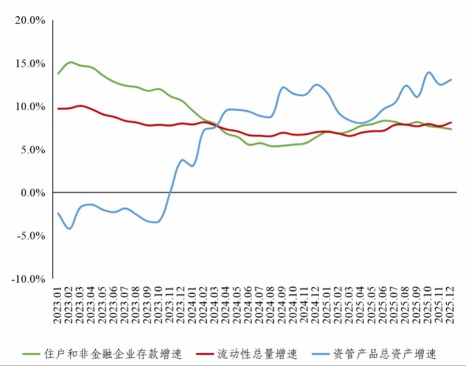
Core Viewpoint - The discussion around the "50 trillion deposits maturing" has sparked widespread debate among residents regarding the reallocation of deposits, with insights provided by the People's Bank of China (PBOC) in its monetary policy report [1] Group 1: Deposit Trends - In a low-interest-rate environment, there is a notable shift between asset management products and bank deposits, with the growth rate of household deposits declining while asset management products are gaining traction [2] - The report indicates that since 2024, the one-year fixed deposit rate has decreased by 0.5 percentage points, while cash management products continue to offer higher yields compared to bank deposits [2] Group 2: Asset Management Growth - By the end of 2025, the total assets in asset management reached 120 trillion yuan, marking a year-on-year increase of 13.1%, with an additional 13.8 trillion yuan added throughout the year [4] - The funds sourced from households and enterprises for asset management products amounted to 56.3 trillion yuan, reflecting a 9.7% year-on-year growth, which is 2.4 percentage points higher than the growth rate of household and enterprise deposits [4] Group 3: Fund Allocation - Despite the perception of deposits moving to asset management products, the majority of these funds are expected to return to the banking system, with over 80% of asset management products allocated to fixed-income assets [5] - By the end of 2025, the allocation to interbank deposits and certificates of deposit reached 28.7 trillion yuan, an increase of 18.9% year-on-year, indicating a significant shift in asset allocation [5] Group 4: Structural Changes in Deposits - The PBOC explains that the transition of deposits to asset management products does not equate to a loss of funds from the banking system, as these products often lead to increased deposits in banks through non-bank institutions [6] - The report highlights that besides deposit-like assets, bonds, stocks, and non-standardized debt are also significant investment targets for asset management products, showcasing a trend towards diversified asset allocation [6]
巨量存款悄悄搬家,钱去哪了
经济观察报· 2026-01-23 12:51
Core Viewpoint - The article discusses the significant shift in the flow of funds within the Chinese banking system, particularly focusing on the upcoming maturity of a large volume of household time deposits and the implications for investment and consumption in 2026 [1][4]. Group 1: Deposit Maturity and Flow - A brokerage report predicts that the total maturity of household time deposits will exceed 70 trillion yuan in 2026, with nearly 30 trillion yuan maturing in the first quarter alone [1][4]. - The article raises questions about where these deposits will flow and who will benefit from this substantial capital influx [5]. Group 2: Financial Statistics and Trends - As of the end of 2025, China's social financing scale and M2 money supply grew by 8.3% and 8.5% year-on-year, respectively, with new RMB deposits amounting to 26.4 trillion yuan [3]. - Non-bank financial institutions saw an increase of 6.4 trillion yuan in deposits, which was 3.8 trillion yuan more than the previous year, indicating a shift in deposit structure influenced by asset management products [3][4]. Group 3: Policy Measures and Market Response - The Chinese government aims to encourage the movement of funds to stimulate investment and consumption while avoiding excessive leverage in single assets to maintain financial stability [5]. - In early 2026, the A-share market showed increased trading activity, with the Shanghai Composite Index experiencing fluctuations and regulatory signals aimed at managing leverage [5][6]. Group 4: Monetary Policy Adjustments - The People's Bank of China announced a 0.25 percentage point reduction in the rates for structural monetary policy tools, aiming to lower funding costs and encourage lending to key sectors [6]. - A comprehensive policy package was introduced, focusing on lowering costs, expanding loan quotas, and providing risk mitigation tools to support innovation and private enterprises [6][7]. Group 5: Changes in Banking Products - The article highlights a transformation in banks' product offerings, with a shift from long-term large-denomination time deposits to more structured deposit products that incorporate investment risks [10][11]. - Structured deposits are becoming popular as they offer various underlying assets and potential returns, reflecting a change in wealth management strategies in a low-interest-rate environment [10][12]. Group 6: Implications for Investors - The transition from traditional time deposits to structured products indicates a broader change in how residents and enterprises perceive and manage their wealth, moving towards accepting variable returns based on market conditions [12][14]. - The article emphasizes the importance of understanding the terms and risks associated with these new financial products, as they represent a shift in the risk-return profile for investors [14].

2025年非银存款增量创十年新高
第一财经· 2026-01-16 13:39
Core Viewpoint - The People's Bank of China reported that in 2025, the total increase in RMB deposits reached 26.41 trillion yuan, with significant contributions from non-bank financial institutions and asset management products [3][4]. Group 1: Deposit Growth - In 2025, deposits from non-bank financial institutions increased by 6.41 trillion yuan, marking a year-on-year increase of 3.8 trillion yuan, the highest since 2015 [5][6]. - Household deposits grew steadily, adding 14.6 trillion yuan, which is 381.2 billion yuan more than the previous year, indicating that non-bank deposits and household deposits are not mutually exclusive [7]. - Non-financial corporate deposits also saw a significant increase of 2.3 trillion yuan, up 2.6 trillion yuan year-on-year, with demand deposits rising by 5.3 trillion yuan [7]. Group 2: Asset Management Products - Asset management products played a crucial role in the increase of non-bank deposits, with total assets reaching 119.9 trillion yuan by the end of 2025, a year-on-year growth of 13.1% [8]. - In 2025, the underlying assets of asset management products included 4.6 trillion yuan in deposits and certificates of deposit, accounting for 50% of the new underlying assets, which significantly boosted non-bank financial institution deposits [8]. Group 3: M2 and M1 Trends - As of December 2025, M2 reached 340.29 trillion yuan, growing by 8.5% year-on-year, while M1 increased by 3.8%, indicating a widening gap between M2 and M1 [10][11]. - The M2-M1 gap expanded from 3.1 percentage points to 4.7 percentage points, although it remains at a relatively low level compared to recent years [11]. - The increase in M1 was influenced by high base effects from the previous year, but the absolute increase of 2.6 trillion yuan in December was the second highest since 2019 [12].

谈降准降息、人民币汇率、物价水平……央行、外汇局发布会,信息量满满
证券时报· 2026-01-15 09:41
Core Viewpoint - The People's Bank of China (PBOC) is committed to supporting the high-quality development of the real economy through monetary policy adjustments, including a 0.25 percentage point reduction in various structural monetary policy tool rates, indicating that there is still room for further rate cuts and reserve requirement ratio (RRR) reductions [2][6]. Group 1: Monetary Policy Adjustments - The PBOC has lowered the rates of various structural monetary policy tools by 0.25 percentage points [2]. - There is still potential for further RRR and interest rate cuts [2]. - The PBOC emphasizes the importance of maintaining a stable RMB exchange rate, which is influenced by multiple factors including economic growth and geopolitical risks [2][3]. Group 2: Foreign Exchange Market Outlook - The State Administration of Foreign Exchange (SAFE) anticipates a stable operation of the foreign exchange market in 2026, with cross-border capital flows remaining orderly [4]. - The trading volume in China's foreign exchange market has reached historical highs, indicating a resilient market capable of absorbing external changes [4]. - The proportion of trade settled in RMB has increased to nearly 30%, reflecting a growing trend towards using RMB in international trade [4][9]. Group 3: Economic Indicators and Support Measures - Recent positive changes in China's price levels are noted, with the PBOC focusing on aligning monetary policy to support stable economic growth and reasonable price recovery [5][6]. - The PBOC plans to include medium-sized private enterprises in the re-lending support program, allocating a total of 1 trillion yuan for this purpose [7]. - The PBOC will also expand support for the health industry under the service consumption and elderly care re-lending program [8]. Group 4: Financial Market Developments - By the end of 2025, the total assets of asset management products are expected to reach 119.9 trillion yuan, with a year-on-year growth of 13.1% [12]. - The increase in funding for asset management products from households and non-financial enterprises is significant, with an additional 4 trillion yuan and 1 trillion yuan respectively compared to 2024 [13]. - Approximately 60% of import and export trade is minimally affected by exchange rate fluctuations, with ongoing improvements in financial services expected to enhance this resilience [9].
资管产品1-7月业绩出炉!国海良时、招商期货、瑞达期货上榜!
Sou Hu Cai Jing· 2025-08-21 09:44
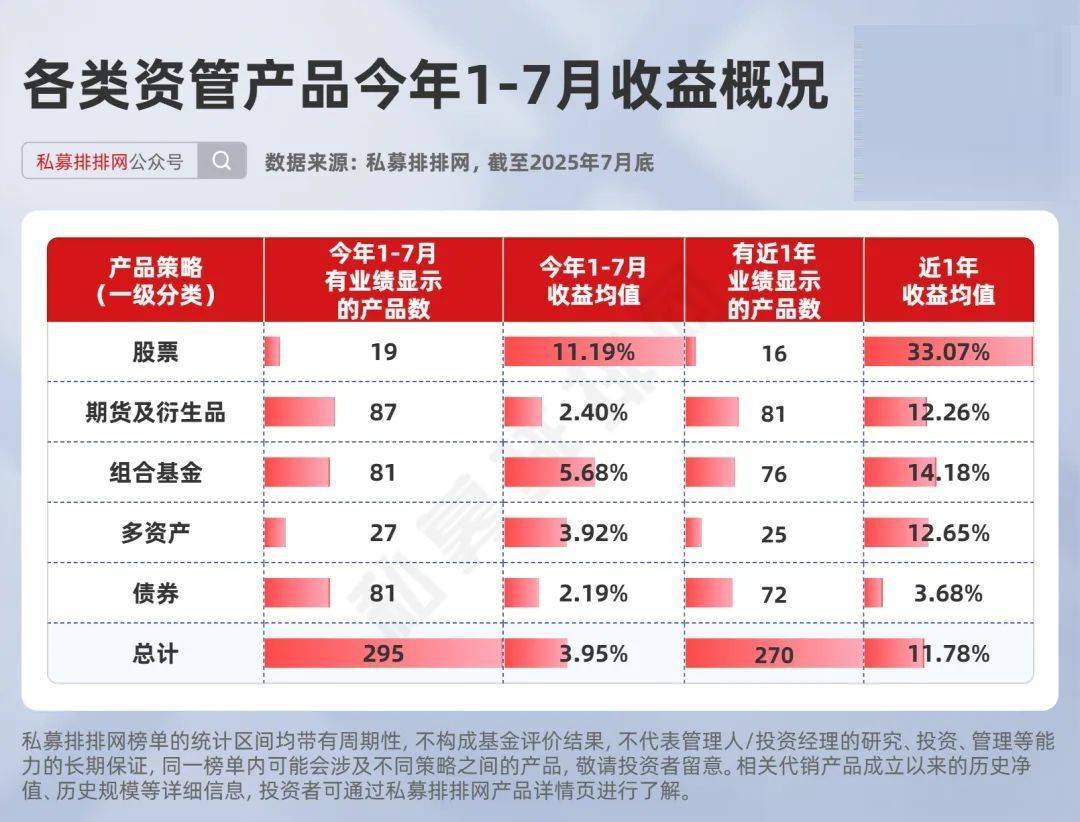
Market Overview - In April, stock markets including A-shares, Hong Kong stocks, and US stocks experienced significant volatility due to tariff issues, but major indices have been on an upward trend since early April [1] - From January to July, the A-share indices saw increases of approximately 6.61% for the Shanghai Composite Index, 5.71% for the Shenzhen Component Index, and 8.72% for the ChiNext Index [1] Asset Management Performance - Various asset management products showed strong performance in the first seven months of the year, with an average return of about 3.95% across 295 products displayed on the private equity platform [1] - Equity strategy asset management products outperformed others with an average return of 11.19%, while the average return for asset management products over the past year was approximately 11.78%, with equity strategy products leading at over 33% [1] Top Performing Products - The top three equity strategy products from January to July are: 1. Guohai Liangshi's "Guohai Liangshi Jinshi No. 2 Index Enhanced" 2. Jinying Fund's "Jinying Xingwen Zhi Yuan No. 3 Collection" 3. Xiangcai Securities' "Qitai No. 1" [4][5] - The top three products in the futures and derivatives strategy category are: 1. Shanghai Dongya Futures' "Dongfeng No. 1" 2. Ruida Futures' "Ruizhi Wuyou No. 99" 3. CITIC Construction Investment Futures' "Quantitative CTA No. 1" [8][10] Manager Profiles - He Xiangqi, the investment manager for Guohai Liangshi, has extensive experience in quantitative investment strategies and manages multiple core products [6] - The investment managers for Jinying Fund's top product include Chen Ying and Fang Chao, both with significant experience in TMT industry research and investment [6] Multi-Asset and Bond Strategies - The top multi-asset strategy products include Guohai Liangshi's "Guohai Liangshi Jinshi No. 6" and Jinxin Futures' "Jinxin Yueduan No. 1" [16][18] - In the bond strategy category, the leading products are Duyue Futures' "Xingfeng" and Shanghai Zhongqi Futures' "Convertible Bond Arbitrage No. 1" [21][22]