软件ETF基金

Search documents
ETF午评 | AI应用回暖,创业板软件ETF华夏涨2.9%
Ge Long Hui· 2026-02-27 03:57
Market Overview - The three major A-share indices experienced a collective decline in the morning session, with the Shanghai Composite Index down by 0.17%, the Shenzhen Component Index down by 0.68%, and the ChiNext Index down by 1.46% [1] - The North China 50 Index fell by 0.74%, and the total trading volume in the Shanghai and Shenzhen markets reached 1.5966 trillion yuan, a decrease of 53.2 billion yuan compared to the previous day [1] - Over 2,300 stocks in the market saw an increase [1] Sector Performance - The sectors that performed well included small metals, computing power leasing, cloud computing, coal mining and processing, cross-border payments, steel, photovoltaic equipment, AI applications, and tourism and hotel industries [1] - Conversely, the sectors that faced declines included paper making, PCB, CPO, storage chips, batteries, photolithography machines, and PET copper foil [1] ETF Performance - In the ETF market, AI applications showed a rebound, with the ChiNext Software ETF from Huaxia rising by 2.9%, the Software ETF increasing by 2.33%, and the Online Consumption ETF from Southern rising by 1.84% [1] - The small metals sector also strengthened, with the Rare Earth ETF from Jiashi and the Rare Metals ETF rising by 2.57% and 2.52%, respectively [1] - The computing power leasing sector saw gains, with the Computer ETF from Southern and the Big Data ETF increasing by 2.5% and 2.4%, respectively [1] - Growth sectors faced declines, with the ChiNext Growth ETF and the Shenzhen Growth ETF from Dacheng falling by 3% and 2.79% [1] - The semiconductor equipment sector experienced a pullback, with various ETFs in this category declining between 2.20% and 2.77% [1]

截至今天收盘,超三成跨境ETF场内交易价格出现溢价
Sou Hu Cai Jing· 2026-01-14 15:02
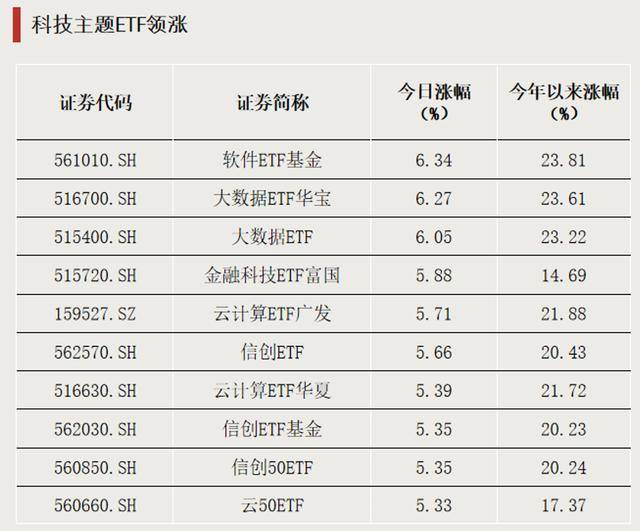
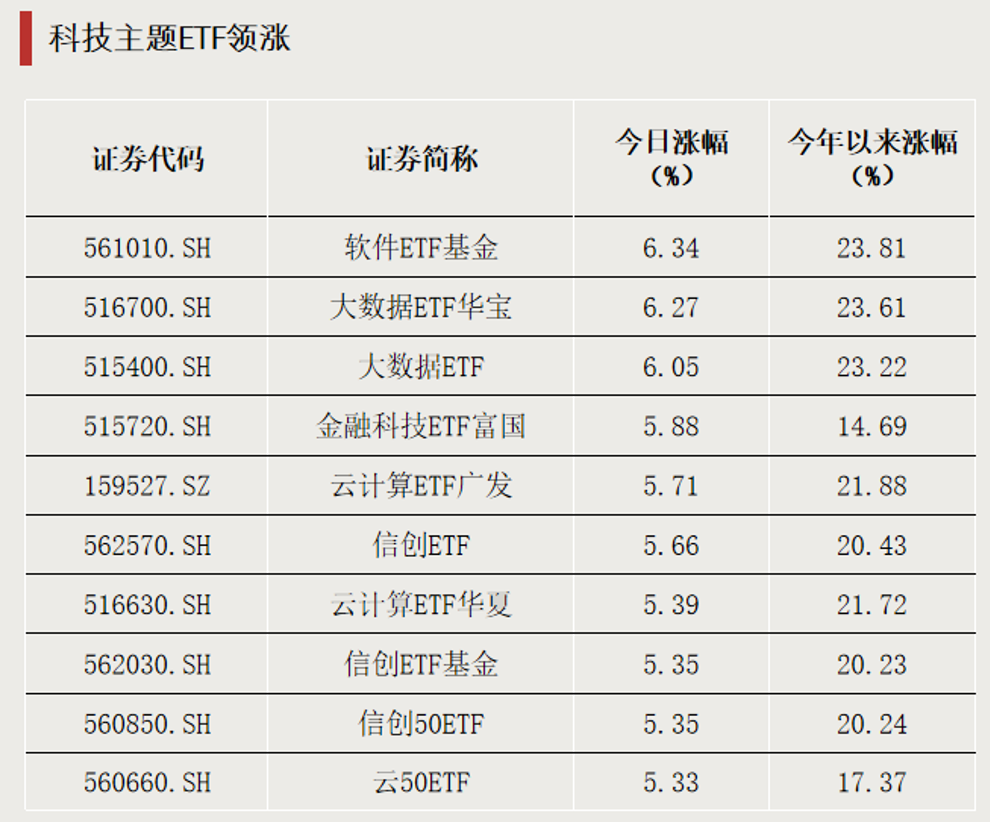
Group 1: ETF Market Overview - On January 14, the overall ETF market saw more funds rising than falling, with over half of the funds closing higher, particularly in technology sectors such as software, big data, fintech, and cloud computing, where several products rose over 5% [1][4] - The total scale of cross-border ETF products has surpassed 1 trillion yuan, with the number of products reaching 207. More than 30% of cross-border ETFs are trading at a premium, with the highest premium rate for the Nasdaq Technology ETF at 19.36% [2][15] - The ETF market experienced a net inflow of approximately 5.66 billion yuan, an increase from 1.157 billion yuan on January 12, with stock ETFs being the main attraction for capital [3][8] Group 2: Performance of Technology ETFs - Technology sector ETFs performed exceptionally well on January 14, with all top ten gainers being technology-related products, each rising over 5%. Several technology ETFs have seen gains exceeding 20% in the first eight trading days of the year [4][5] - The Software ETF (561010) topped the gainers list with a rise of 6.34% and a premium rate of 2.19%. It tracks the CSI Software Development Index, which includes 117 constituent stocks, with 10 stocks rising over 10% [4][5] - Two ETFs tracking the CSI Big Data Industry Index also saw gains exceeding 6%, with notable performances from Tianyuan Dike and Yidian Tianxia, which rose 18.61% and over 16%, respectively [4] Group 3: Decline in Other Sectors - Several ETFs in the electric grid and banking sectors saw significant declines on January 14, with the Electric Grid ETF (561380) dropping 5.81%, marking the largest decline of the day [6][7] - The banking sector ETFs also experienced widespread declines, with three ETFs falling more than 1.6%, reflecting a broader downturn in the sector [6][7] Group 4: Fund Flow Dynamics - The inflow of funds into stock ETFs showed a clear divergence, with many industry ETFs attracting significant capital while some broad-based index ETFs faced net outflows [8][9] - The Media ETF (512980) alone attracted over 4 billion yuan in net inflows in just one trading day, indicating strong investor interest in specific sectors [8][9] Group 5: Cross-Border ETF Insights - The cross-border ETF market is expanding, with a significant portion of new products targeting the Hong Kong stock market. The premium rates for many cross-border ETFs indicate strong demand [15] - The Nasdaq Technology ETF has issued a premium risk warning and will suspend trading for one hour if the premium does not decrease, highlighting the volatility and investor caution in this segment [15]

四点半观市 | 沪深北交易所提高融资保证金比例 机构:“一超三强”引领科技创新投资主线
Shang Hai Zheng Quan Bao· 2026-01-14 14:13
Market Overview - On January 14, the A-share market experienced mixed performance, with the Shanghai Composite Index closing at 4126.09 points, down 0.31%, while the Shenzhen Component Index rose 0.56% to 14248.60 points, and the ChiNext Index increased by 0.82% to 3349.14 points [1] - The total trading volume in the Shanghai and Shenzhen markets reached 39,868 billion [1] - The Japanese Nikkei 225 Index rose by 1.48% to 54341.23 points, and the Korean Composite Index increased by 0.65% to 4723.1 points [1] Commodity and Bond Market - Domestic commodity futures saw most contracts rise, with notable increases in silver (over 8%), tin (8%), and fuel (over 6%) [1] - In the bond market, most futures closed higher, with the 10-year main contract up 0.08% and the 5-year main contract up 0.04% [1] ETF and Fund Performance - On January 14, technology-focused ETFs continued to perform well, with software ETFs and big data ETFs rising over 6%, while several financial technology and cloud computing ETFs increased by over 5% [2] - The China Convertible Bond Index rose by 0.16% to 515.87 points, with significant gains in specific convertible bonds such as Jia Mei (up 17.69%) and Hao Han (up 14.99%) [2] Institutional Insights - Fidelity's fund manager highlighted that the core investment opportunities for 2026 will focus on technology innovation, particularly in self-controlled innovative industries, emphasizing the "super track" of artificial intelligence and three strong sectors: aerospace, low-altitude economy, and innovative consumer [3] - UBS anticipates that factors such as improved corporate earnings growth and attractive valuations will support further upward movement in the Chinese stock market, maintaining an overweight rating on the Chinese market [3] - Galaxy Securities suggests that the rise of generative search (GEO) could reshape business models, recommending attention to Hong Kong tech giants and AI application-related companies [3] Investment Strategy Outlook - According to GF Fund's advisory team, the current market risk appetite is high, and they recommend focusing on spring market opportunities, particularly in overseas and resource-related sectors, as well as technology growth segments [4]
大幅溢价!明天,停牌一小时
Zhong Guo Zheng Quan Bao· 2026-01-14 13:07
Group 1 - The overall ETF market saw more gains than losses on January 14, with over half of the funds rising, particularly in technology sectors such as software, big data, fintech, and cloud computing, where several products increased by over 5% [1][2] - The total scale of cross-border ETF products has surpassed 1 trillion yuan, with the number of products reaching 207. More than 30% of cross-border ETFs experienced premium trading prices, with the highest premium rate for the Nasdaq Technology ETF at 19.36% [1][13] - The ETF market had a net inflow of approximately 5.66 billion yuan, an increase from 1.157 billion yuan on January 12. Stock ETFs remain the main attraction for capital, although there is a divergence in internal structure [1][7] Group 2 - Technology sector ETFs performed exceptionally well on January 14, with all top gainers being technology-related products, each rising over 5%. Several technology ETFs have seen gains exceeding 20% in the first eight trading days of the year [2] - The Software ETF (561010) topped the gainers list with a 6.34% increase and a premium rate of 2.19%. The fund tracks the CSI All-Share Software Development Index, which includes 117 constituent stocks, with 10 stocks rising over 10% [2][3] - The two ETFs tracking the CSI Big Data Industry Index also saw gains exceeding 6%, with notable increases in stocks like Tianyuan Dike (300047) and Yidian Tianxia (301171) [2] Group 3 - Several ETFs in the electric grid and banking sectors experienced significant declines on January 14, with the electric grid ETF (561380) dropping 5.81%, marking the largest decline of the day [4][5] - The banking sector ETFs also saw widespread declines, with three ETFs falling more than 1.6%, all tracking the CSI Banking Index, where 41 out of 42 constituent stocks declined [5][6] - The electric grid ETF (561380) had a notable increase in turnover rate, reaching 51.72%, indicating heightened trading activity despite the price drop [5] Group 4 - The net inflow of 5.66 billion yuan into the ETF market indicates strong interest in stock ETFs, particularly in sectors like media, satellite, and software, while some broad-based index ETFs faced net outflows [7][8] - The Media ETF (512980) alone attracted over 4 billion yuan in net inflows in just one trading day, highlighting the strong demand for sector-specific ETFs [7][8] - Non-equity ETFs, particularly money market funds, have seen significant net outflows, with two money market ETFs experiencing outflows exceeding 2 billion yuan each [9][10]
四点半观市 | 沪深北交易所提高融资保证金比例 机构:“一超三强”引领科技创新投资主线
Sou Hu Cai Jing· 2026-01-14 08:47
Market Overview - The A-share market's trading volume approached 4 trillion yuan, with significant strength in AI application sectors [1] - Major indices showed mixed performance, with the Shanghai Composite Index down 0.31% and the Shenzhen Component Index up 0.56% [2] - The Shanghai and Shenzhen Stock Exchanges announced an increase in the minimum margin ratio for financing from 80% to 100% [2] Sector Performance - Technology-focused ETFs, including software and big data ETFs, continued to perform strongly, with some rising over 6% [3] - The domestic commodity futures market saw most main contracts rise, with notable increases in tin and silver [2] Fund Flows - The top ten stocks by net inflow included Shanzi Gaoke, which received a net inflow of 2.089 billion yuan [3] - Other stocks with significant inflows included Huasheng Tiancai and Huhua Electric, indicating strong investor interest in these companies [3] Institutional Insights - Fidelity highlighted that the core investment opportunities for 2026 will focus on technology innovation, particularly in AI and related sectors [4] - UBS maintained an overweight rating on the Chinese market, citing factors such as improved corporate earnings growth and attractive valuations [4] - Galaxy Securities suggested that the rise of generative search could reshape business models, recommending a focus on AI-related sectors and companies [4]
天赐良基日报:国新国证基金总经理谌重离任;跨境ETF规模突破万亿元
Mei Ri Jing Ji Xin Wen· 2026-01-14 08:38
Group 1 - The general manager of Guoxin Guozheng Fund, Chen Zhong, has resigned due to personal reasons, effective January 13, with deputy general manager Zhang Peng taking over the role [1] - The total scale of cross-border ETFs has surpassed 1 trillion yuan, reaching 1.0008 trillion yuan as of January 13, marking a historical milestone [2] - Five actively managed equity funds have seen gains exceeding 20% in the first five trading days of 2026, largely driven by heavy investments in the pharmaceutical sector, including innovative drugs and medical services [3] Group 2 - Fund manager Zhang Jiansheng from Baodao Fund has identified three major investment directions for 2026, focusing on AI hardware sectors, resource products benefiting from re-industrialization and re-globalization, and valuation recovery opportunities in traditional industries like chemicals and consumer goods [4][5][6][7] Group 3 - The market experienced fluctuations, with the Shanghai Composite Index falling by 0.31% while the Shenzhen Component Index and the ChiNext Index rose by 0.56% and 0.82%, respectively, with a total trading volume of 3.94 trillion yuan, an increase of 290.4 billion yuan from the previous trading day [8] - Software ETFs led the market with a gain of 6.34%, while energy metals, insurance, and banking sectors faced declines [8][9] - The top-performing ETFs included Software ETF, Big Data ETFs, and Cloud Computing ETFs, while the worst performer was the Electric Grid ETF, which fell by 5.81% [9][11] Group 4 - AI is increasingly being applied in various financial scenarios, including securities research, banking credit, and consumer finance, indicating a broad future potential for financial technology ETFs [12]
ETF收评 | A股成交额逼近4万亿元,冲高回落跌0.31%,软件ETF基金、大数据ETF华宝涨6%
Ge Long Hui· 2026-01-14 07:53
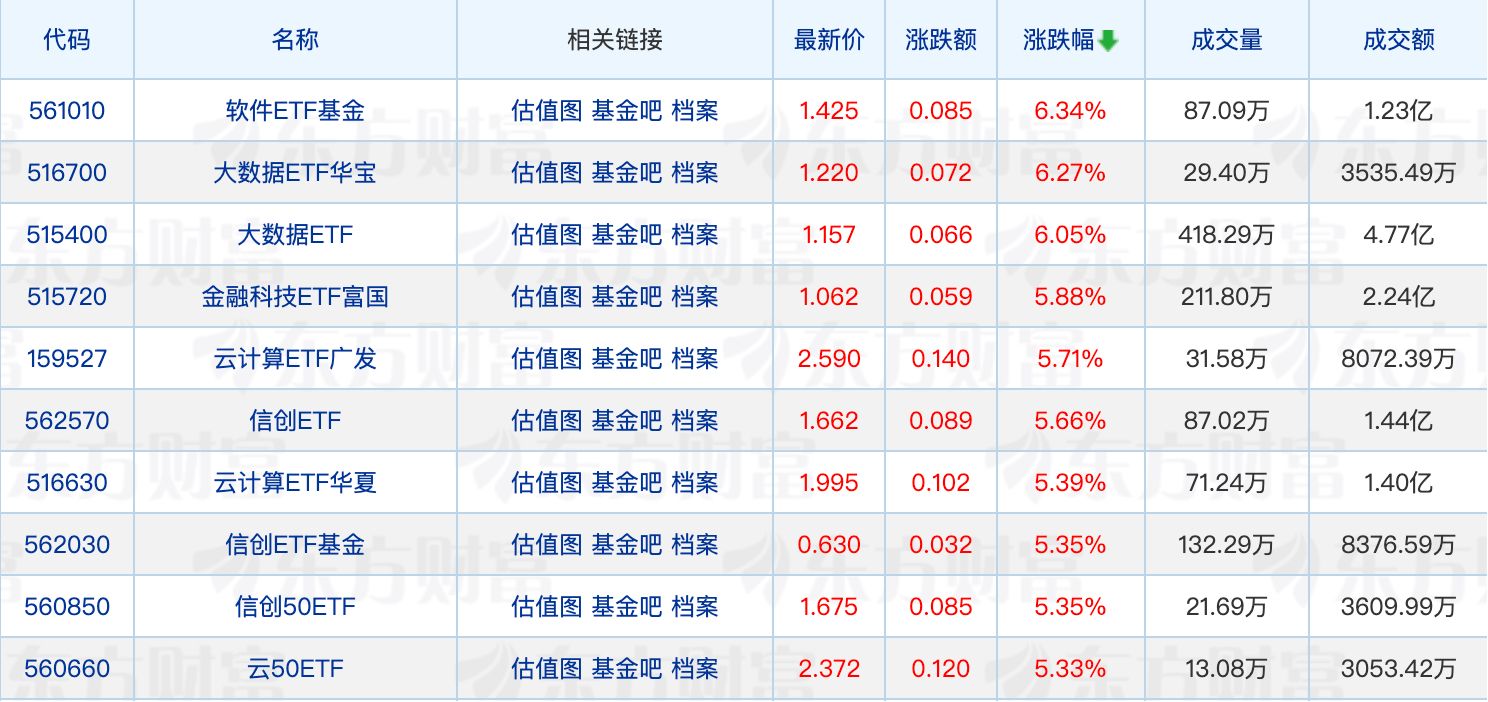
Group 1 - The A-share trading volume approached 4 trillion yuan, setting a new historical high, with the Shanghai Composite Index down 0.31% and the ChiNext Index up 0.82% [1] - Active sectors included AI applications, financial technology, computing hardware, smart wearables, and medical services, while lithium mining, commercial aerospace themes retreated, and insurance, banking, and real estate sectors declined [1] - In the ETF market, the software sector led gains, with notable increases in various software ETFs: Huazhang Fund Software ETF up 6.34%, Big Data ETF Huabao up 6.27%, Guotai Fund Software ETF up 4.38%, and Huitianfu Fund Software 50 ETF up 4.05% [1] - The cloud computing sector also performed well, with Guangfa Cloud Computing ETF up 5.71% and Huaxia Cloud Computing ETF up 5.39% [1] Group 2 - The Electric Power ETF experienced a pullback from yesterday's high premium, closing down 5.81%, while the Electric Power Index ETF fell by 2.78% [2] - The banking sector saw declines, with South Bank ETF and Huaxia Bank ETF both down 1.6% [2]
AI应用概念连续爆发,软件ETF基金、信创ETF基金、软件ETF易方达上涨
Ge Long Hui· 2026-01-14 05:30
Group 1 - The market experienced a collective rise, with the Shanghai and Shenzhen stock exchanges recording a half-day trading volume of 2.22 trillion, a decrease of 215.5 billion compared to the previous trading day [1] - By midday closing, the Shanghai Composite Index rose by 1.2%, the Shenzhen Component Index increased by 1.98%, and the ChiNext Index surged by 2.24% [2] - Over 4,700 stocks in the market saw an increase, with more than a hundred stocks hitting the daily limit up. The AI application concept has continuously exploded, with software ETFs, Xinchuang ETFs, and related funds rising over 7% [3] Group 2 - The Ministry of Industry and Information Technology released an action plan for the high-quality development of industrial internet platforms, aiming for significant achievements by 2028, including over 450 influential platforms and a connection of over 120 million industrial devices [3] - Jiangsu Province's "Artificial Intelligence+" action plan sets clear goals for AI integration, targeting over 70% application penetration by 2027 and over 90% by 2030, with the AI industry expected to exceed one trillion yuan [4] - Guohai Securities anticipates that with ongoing policy support, leading domestic companies will accelerate their layout in industrial large models and intelligent systems, driving innovation in industrial software and promoting new industrialization [4]
软件股逆势上涨,软件龙头ETF、软件ETF易方达、创业板软件ETF华夏、创业板软件ETF富国上涨
Ge Long Hui· 2025-11-18 07:51
Market Overview - The A-share market experienced a collective decline, with all three major indices recording a three-day losing streak. The Shanghai Composite Index fell by 0.81% to 3939 points, the Shenzhen Component Index dropped by 0.92%, and the ChiNext Index decreased by 1.16%. The North Star 50 Index saw a decline of 2.92%. The total market turnover was 1.95 trillion yuan, an increase of 15.6 billion yuan compared to the previous trading day, with over 4100 stocks declining [1]. Software Sector Performance - Software stocks showed resilience, with notable gains in companies such as Shiji Information, which hit the daily limit, and Weining Health and 360 Security, both rising over 3%. This performance positively impacted various software ETFs, including the Software ETF Index and several others focused on software leaders [1]. AI Developments - Alibaba announced its "Qianwen" project aimed at entering the AI to C market, offering a free personal AI assistant that can interact with users and assist in various tasks. The app is now available for public testing [2]. - Baidu unveiled its new model, Wenxin 5.0, at the 2025 Baidu World Conference, featuring a total parameter count of 2.4 trillion and designed for multi-modal understanding and generation [2]. - OpenAI released the GPT-5 series, including GPT-5.1 Instant and GPT-5.1 Thinking, focusing on enhancing model intelligence and communication capabilities [3]. - World Lab launched its 3D world generation model, Marble, which allows users to create editable 3D scenes from various input types [3]. Financial Performance of Software Companies - The third-quarter reports for computer companies showed strong performance, with firms like Kingsoft Office, Hikvision, and 360 Security reporting significant year-on-year revenue and net profit growth compared to the second quarter. Kingsoft Office, for instance, exceeded expectations in revenue and profit, driven by AI product launches and overseas market expansion [4]. - Huaxi Securities noted an overall recovery trend in the software sector during the third quarter, with policies expected to continue supporting the industry's revival. The emphasis on self-control and AI in the 14th Five-Year Plan is seen as a key growth driver [4]. - According to招商证券, domestic software companies are experiencing a bottoming out and recovery in fundamentals, with low institutional holdings and expectations, suggesting that the development of AI applications will accelerate with the iteration of large models [5].
ETF龙虎榜 | 抄底!资金逆势流入这一方向
Zhong Guo Zheng Quan Bao· 2025-11-17 13:57
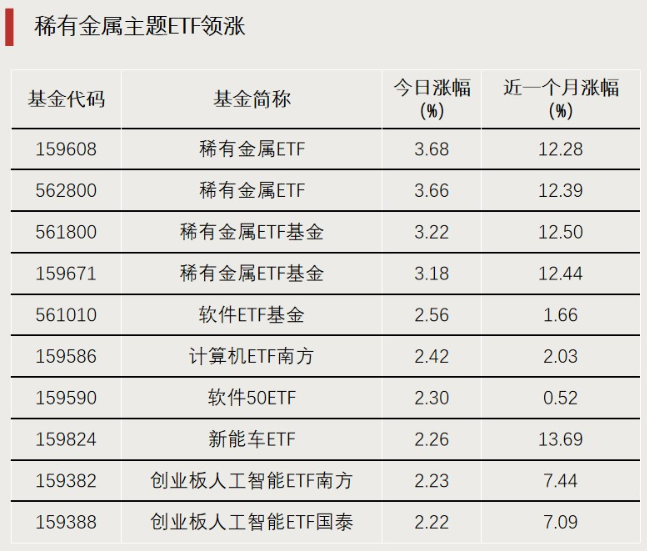
Group 1: Rare Metals ETF Performance - On November 17, rare metals ETFs led the market with four ETFs rising over 3%, including the rare metals ETF (159608) which increased by 3.68% [2][3] - The rise in the rare metals sector was driven by a significant increase in lithium carbonate futures, with expectations of improved supply-demand fundamentals in the lithium industry from 2026 to 2027 [2][10] - The overall performance of rare metals ETFs over the past month shows substantial gains, with the rare metals ETF (159608) up 12.28% [3] Group 2: AI Application ETFs - AI application-related ETFs also saw positive performance, with software ETFs and the Southern China AI ETF rising over 2% on November 17 [2] - The Southern China AI ETF (159382) recorded a net inflow of 8.99 billion yuan on November 14, indicating strong investor interest despite a general decline in tech stocks [8][9] Group 3: Bond ETFs Activity - Bond ETFs were notably active, with eight out of the top ten ETFs by trading volume being bond ETFs, including several from the Sci-Tech bond category [6] - The trading volume for the Sci-Tech bond ETF from Guotai reached 9.384 billion yuan, up from 7.215 billion yuan the previous day, reflecting increased investor activity [7] Group 4: Decline in Gold ETFs - Gold-themed ETFs experienced a collective decline, with several gold-related ETFs dropping over 2% [4][5] - The gold stock ETF saw a decrease of 2.57%, while other gold ETFs also reported significant losses over the past month [5] Group 5: Market Outlook - The outlook for the A-share market remains positive, with expectations of continued upward trends driven by structural economic improvements and declining risk-free rates [10] - Long-term prospects for the rare metals sector are bolstered by supply constraints and expanding demand, particularly from the new energy vehicle market and emerging industries [10]