
退休准备指数

Search documents
年龄越大的人,投资风险偏好却越高?为何养老储备不足的人会选择“铤而走险”?
Sou Hu Cai Jing· 2025-12-19 11:48
Core Insights - The 2025 Retirement Preparedness Index for Chinese residents is 5.49 out of 10, showing a slight increase from 5.34 in 2024, but underlying structural issues remain concerning retirement preparedness [3][4] Group 1: Awareness vs. Action - There is a significant gap between awareness and action regarding retirement planning, with "retirement responsibility awareness" and "financial planning awareness" scoring 7.45 and 7.36 respectively, while "retirement plan completeness" and "retirement savings sufficiency" scored only 3.82 and 3.78 [4][6] - Despite improved awareness of the importance of retirement planning, the actual implementation of these plans remains low, indicating a state of "cognitive anxiety" among the population [6][8] Group 2: Income Disparities - Low-income groups face a "want to act but lack funds" dilemma, with those earning below 50,000 yuan having a preparedness index of 5.15, indicating a weak foundation [8][10] - Conversely, middle and high-income groups exhibit a "can act but do not fully act" scenario, with many individuals earning over 200,000 yuan still not achieving a preparedness index of 6, suggesting that economic status is not the sole determinant of retirement readiness [10][12] Group 3: Risk Preferences - An unexpected finding reveals that older individuals tend to have a higher risk tolerance for investments as they age, particularly those over 65 with low retirement preparedness, who show a positive risk preference value of +0.39 [12][15] - This shift in risk preference is not due to increased bravery in investment but rather reflects a "desperate risk compensation" strategy to address insufficient savings as retirement approaches [15][16] Group 4: Demographic Challenges - The proportion of the population aged 65 and above has reached 15.6%, with a dependency ratio of 22.8%, indicating significant pressure on the social security pension system as the second baby boom generation retires in the next decade [16][17] - The report emphasizes that awareness alone is insufficient; immediate action towards retirement savings is crucial to avoid potential financial crises in old age [17]


2025中国居民退休准备指数调研报告
Sou Hu Cai Jing· 2025-12-03 13:45
Group 1 - The 2025 China Resident Retirement Readiness Index is 5.49, showing a slight increase from 5.34 in 2024, indicating stability with characteristics of "cognitive reinforcement, action lag, and confidence pressure" [1] - Residents' awareness of retirement responsibilities and financial planning continues to improve, but the completeness of retirement plans, savings adequacy, and future income confidence remain low, marking a critical transition from awareness to action [1] - High retirement readiness index groups are primarily composed of individuals born in the 1980s, married, in good health, with graduate degrees, employed in state-owned or foreign enterprises, and possessing high financial literacy [1] Group 2 - In terms of retirement life expectations, residents are rational and pragmatic, with independent home-based retirement being the mainstream choice, and most wishing to maintain their current living standards [2] - The overall risk tolerance for retirement investments has decreased, with a preference for capital safety and stable returns, reflected in an average risk preference of -0.15 for retirement investments [2] - There is a clear generational difference in preferences for retirement financial products, with older generations focusing on capital safety and health insurance, while younger generations seek balance amid multiple pressures [2] Group 3 - The report emphasizes the need for multi-faceted collaboration to enhance retirement readiness, including improving the multi-tiered pension security system, increasing financial literacy, optimizing retirement financial product supply, and strengthening financial security for the elderly [2]

2025年中国居民退休准备指数微升,80后最高
第一财经· 2025-11-30 11:58
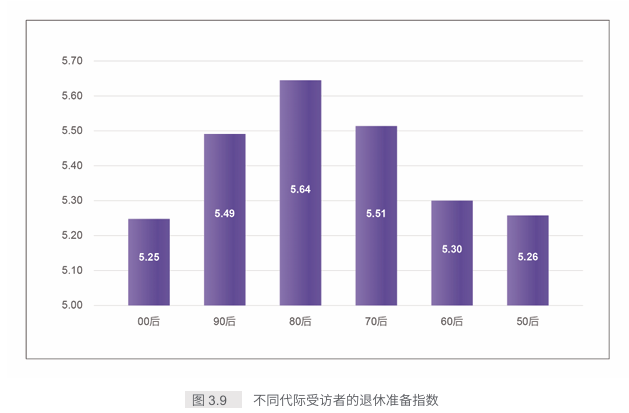
Core Viewpoint - The report indicates that while awareness of retirement preparation among Chinese residents has improved, actual actions remain lagging behind, highlighting a gap between knowledge and execution [3][4]. Group 1: Retirement Preparation Index - The 2025 Retirement Preparation Index for Chinese residents is 5.49, a slight increase from 5.34 in 2024, indicating a low level of retirement preparation that requires attention [3][4]. - The index is calculated based on six dimensions: awareness of retirement responsibilities, financial planning knowledge, understanding of financial issues, completeness of retirement plans, adequacy of retirement savings, and confidence in achieving expected income [3]. Group 2: Awareness vs. Action - Significant improvements were noted in awareness of retirement responsibilities (7.45) and financial planning knowledge (7.36), suggesting a better understanding of personal retirement responsibilities and financial literacy [4]. - However, the completeness of retirement plans dropped to 3.82 and the adequacy of retirement savings fell to 3.78, indicating that increased awareness has not translated into actionable retirement planning [4]. Group 3: Demographic Insights - The report identifies that the highest retirement preparation index is among individuals born in the 1980s, who typically have strong savings capabilities and long-term planning awareness [5]. - The lowest index is found in the post-2000 generation, primarily due to limited understanding of retirement responsibilities and financial planning [5]. Group 4: Pension Products and Preferences - The preference for personal pension products is skewed towards "retirement savings > retirement insurance > retirement financial management > retirement funds," with higher-income and better-prepared individuals favoring retirement insurance over savings [7]. - The report emphasizes the need for improved awareness, incentives, and product adaptation in the personal pension system to address existing gaps [7]. Group 5: Recommendations for Improvement - Recommendations include promoting the measurement of retirement preparation in pension services, enhancing the accessibility and incentives of personal pension accounts, and improving financial literacy and retirement planning education [7]. - The report also suggests that insurance institutions should explore a development path that combines long-term protection, stable investment, and appropriate services to support residents' retirement preparation [7].

2025年中国居民退休准备指数较去年略有上升
Zheng Quan Ri Bao Wang· 2025-11-30 11:51
Core Insights - The 2025 Retirement Preparedness Index for Chinese residents is reported at 5.49, a slight increase from 5.34 in the previous year, indicating a transition from awareness to action in retirement planning [1] - Significant improvements are noted in retirement responsibility awareness (7.45) and financial planning awareness (7.36), while areas such as retirement plan completeness (3.82), retirement savings adequacy (3.78), and confidence in achieving expected income (4.85) show lagging behaviors and pressure on confidence [1] Group 1: Income and Retirement Preparedness - The retirement preparedness index increases with income, but the gap between different income groups is narrowing, with notable improvements in low-income groups [1] - Some low-income individuals have retirement preparedness levels that exceed those of some high-income individuals, suggesting that factors beyond income, such as financial literacy and risk awareness, are also influential [1] Group 2: Characteristics of Prepared Individuals - Individuals with high preparedness indices tend to be "post-80s," married, in good health, have graduate degrees, and possess higher personal income and financial literacy [2] Group 3: Recommendations for Improvement - Suggestions to enhance the retirement preparedness index include integrating retirement preparedness measurement into pension financial services, improving accessibility and incentives for personal pension accounts, and promoting financial literacy and retirement planning education [2] - There is a call for better matching of pension financial products to diverse group needs and for the coordination of health management with retirement planning to enhance long-term security for residents [2]
2025年中国居民退休准备指数微升,80后最高
Di Yi Cai Jing· 2025-11-30 11:09
Core Insights - The report indicates an improvement in the awareness of retirement preparation among Chinese residents, but actions remain lagging behind [1][2] Group 1: Retirement Preparation Index - The 2025 retirement preparation index for Chinese residents is 5.49, a slight increase from 5.34 in 2024, indicating a low level of retirement readiness [1] - The index is calculated based on six dimensions: awareness of retirement responsibilities, financial planning knowledge, understanding of financial issues, completeness of retirement plans, adequacy of retirement savings, and confidence in achieving expected income [1] Group 2: Awareness vs. Action - Significant improvements were noted in retirement responsibility awareness (7.45) and financial planning knowledge (7.36), reflecting a growing understanding of personal retirement responsibilities and financial literacy [2] - However, the completeness of retirement plans dropped to 3.82 and the adequacy of retirement savings fell to 3.78, indicating a disconnect between increased awareness and actual retirement planning actions [2] Group 3: Demographic Insights - The report identifies that individuals born in the 1980s have the highest retirement preparation index, attributed to their dual maturity in career and family responsibilities [5] - The lowest index is observed in the post-2000 generation, who are either entering the workforce or still in education, showing limited awareness of retirement responsibilities [3][5] Group 4: Financial Products and Recommendations - The preference for retirement financial products is primarily for retirement savings, followed by retirement insurance, retirement financial management, and retirement funds, with high-income groups favoring retirement insurance [5] - Recommendations include enhancing the accessibility and incentive structures of personal pension accounts, promoting financial literacy, and improving the matching of financial products to different demographic needs [6]
认知提升、行为滞后!2025中国居民退休准备指数发布
券商中国· 2025-11-29 08:48
Core Insights - The 2025 China Resident Retirement Preparedness Index is 5.49, showing a slight increase compared to 2024, indicating a transition from awareness to action in retirement preparation [2][3] Group 1: Retirement Preparedness Index - The index measures retirement preparedness across six dimensions: awareness of retirement responsibility, financial planning awareness, understanding of financial issues, completeness of retirement plans, adequacy of retirement savings, and confidence in achieving expected income [3] - The index ranges from 0 to 10, with higher values indicating better preparedness; a score below 6 indicates insufficient preparation [3] - Key dimensions show significant improvement: retirement responsibility awareness (7.45) and financial planning awareness (7.36) are high, while retirement plan completeness (3.82), retirement savings adequacy (3.78), and confidence in expected income (4.85) are low, reflecting a gap between awareness and action [3] Group 2: Income and Retirement Preparedness - The retirement preparedness index increases with income, but the gap between different income groups is narrowing, with notable improvements in the low-income group [4] - Financial literacy, risk awareness, savings willingness, and social security participation are also critical factors influencing retirement preparedness [4] - The report introduces income replacement rate as a complementary indicator, showing a positive correlation with the retirement preparedness index [4] Group 3: Changing Retirement Needs - Retirement needs are shifting from basic security to rational planning and quality enhancement, with residents aiming to maintain their current living standards [5] - Independent living at home remains the preferred mode of retirement, while high-quality institutional care is gradually gaining traction among well-prepared and older groups [5] Group 4: Preferences for Financial Products - Residents exhibit a preference for low-risk financial products, with generational differences in choices: older generations prioritize safety and health insurance, while younger generations seek balance among housing, child-rearing, and retirement [6] - Recommendations include enhancing retirement planning tools, improving multi-tiered pension systems, and promoting financial literacy to facilitate the transition from awareness to action [6] Group 5: Elderly Care Market Dynamics - The elderly care market is transitioning from scale expansion to quality competition, with the number of care facilities nearly doubling in five years, reaching 406,000 by the end of 2024 [7] - Despite the growth, the average occupancy rate of care institutions is below 50%, highlighting a mismatch between supply and demand [7] - A new evaluation system for care institutions aims to improve quality and operational standards, moving the industry towards more refined and standardized operations [7]

最新报告揭示居民退休准备不足 计划完善度、储蓄充分度成短板
Bei Ke Cai Jing· 2025-11-28 12:09
Core Insights - The 2025 Retirement Preparedness Index (RRI) for Chinese residents is reported at 5.49, a slight increase from 5.34 in 2024, indicating insufficient retirement preparation [1] - The index has been published for 13 consecutive years, measuring attitudes and actual preparations across six dimensions: retirement responsibility awareness, financial planning recognition, understanding of financial issues, completeness of retirement plans, adequacy of retirement savings, and confidence in achieving expected income [1] - There is a notable improvement in retirement responsibility awareness and financial planning recognition, while completeness of retirement plans, adequacy of retirement savings, and confidence in achieving expected income have declined, reflecting a trend of "increased awareness, lagging behavior, and pressured confidence" [1] Income and Retirement Preparedness - The analysis shows that the RRI generally increases with income, but some low-income individuals have better preparedness than certain high-income individuals, indicating that income is not the sole determinant of retirement readiness; factors like financial literacy and risk awareness also play significant roles [1] Trends in Retirement Investment - The report highlights a trend where, despite a preference for home-based elderly care, there is a significant rise in the choice of high-quality commercial elderly care institutions or high-end elderly communities among those with an RRI above 8, reaching 27.2% [2] - The average risk preference for retirement investments among respondents is −0.15, indicating a generally conservative approach to retirement investment [2] - In terms of personal pension product preferences, respondents favor retirement savings, retirement insurance, retirement financial products, and retirement funds in that order [2] - The report suggests that higher-risk retirement funds need refined risk grading and holding incentives to attract more retirement investments [2] Financial Product Preferences and Risks - Higher preparedness respondents tend to have lower risk preferences for retirement financial products, while those with insufficient preparation often prefer higher-risk products as they approach retirement age, which may expose them to potential fraud if their financial literacy is lacking [2]
最新报告:中国居民退休准备不足 低收入人群准备水平下降
Nan Fang Du Shi Bao· 2025-10-22 15:59
Core Insights - The retirement preparation level of Chinese residents is significantly inadequate, with low-income groups showing a marked decline while high-income groups have improved, leading to a widening gap between different income groups [1][2] Group 1: Retirement Preparation Index - The 2024 China Resident Retirement Preparation Index stands at 5.53, unchanged from 2023, indicating a low level of retirement readiness [2] - The index is based on a scale of 0 to 10, where higher scores indicate better retirement preparation [1] Group 2: Income and Demographics - High retirement preparation levels are characterized by individuals aged 36-45, married, with children, in good health, holding a bachelor's degree, and employed in state-owned or foreign enterprises [2] - The average annual post-tax income for surveyed individuals is 90,600 yuan, slightly above the 88,000 yuan reported in 2023 [1] Group 3: Retirement Financial Preparation Methods - The most common retirement financial preparation methods include basic pension insurance, enterprise annuities, personal pensions, and bank savings/low-risk financial products [2] - Basic pension insurance has the highest coverage, while enterprise annuities have a coverage rate of approximately 34% among respondents [2] Group 4: Retirement Age Preferences - A majority of residents prefer to retire at the legal retirement age, with a significant portion of young respondents inclined towards early retirement [3] - 56.54% of young respondents (51.59% of males and 58.77% of females) prefer early retirement, indicating a strong desire for early retirement among the youth [3]
最新报告:中国居民退休准备不足,低收入人群准备水平下降
Nan Fang Du Shi Bao· 2025-10-22 13:18
Core Insights - The latest research indicates that the retirement preparedness level of Chinese residents is significantly inadequate, with low-income groups showing a notable decline while high-income groups have improved, leading to a widening gap between different income groups [1][2] Group 1: Retirement Preparedness Index - The 2024 China Residents Retirement Preparedness Index stands at 5.53, unchanged from 2023, indicating a low level of retirement preparedness [2] - The index is constructed on a scale of 0 to 10, where higher scores reflect better retirement readiness, with scores below 6 indicating a need for urgent improvement [1] Group 2: Demographic Characteristics - High retirement preparedness is characterized by individuals aged 36-45, married, with children, in good health, holding a bachelor's degree, and employed in state-owned or foreign enterprises, with higher personal and family incomes [2] Group 3: Retirement Financial Preparation Methods - The primary methods for retirement financial preparation include basic pension insurance, enterprise annuities, personal pensions, and bank savings/low-risk financial products, with basic pension insurance having the highest coverage [2] - The coverage rate for enterprise annuities/professional annuities among respondents is approximately 34%, particularly among those from government and state-owned enterprises due to mandatory contributions since 2015 [2] - Personal pensions, as the "third pillar" of China's pension system, have a coverage rate of 35%, with higher adoption among respondents with elevated after-tax income levels [2] Group 4: Retirement Age Preferences - Most residents prefer to retire at the legal retirement age, but a larger proportion expresses a desire to retire early, particularly among younger respondents [3] - 56.54% of young respondents (51.59% male, 58.77% female) prefer early retirement, while only 34.63% (35.65% male, 34.16% female) anticipate delaying retirement, indicating a strong inclination towards early retirement among the youth [3]