
商业养老险

Search documents
2025中国居民退休准备指数调研报告
Sou Hu Cai Jing· 2025-12-03 13:45
Group 1 - The 2025 China Resident Retirement Readiness Index is 5.49, showing a slight increase from 5.34 in 2024, indicating stability with characteristics of "cognitive reinforcement, action lag, and confidence pressure" [1] - Residents' awareness of retirement responsibilities and financial planning continues to improve, but the completeness of retirement plans, savings adequacy, and future income confidence remain low, marking a critical transition from awareness to action [1] - High retirement readiness index groups are primarily composed of individuals born in the 1980s, married, in good health, with graduate degrees, employed in state-owned or foreign enterprises, and possessing high financial literacy [1] Group 2 - In terms of retirement life expectations, residents are rational and pragmatic, with independent home-based retirement being the mainstream choice, and most wishing to maintain their current living standards [2] - The overall risk tolerance for retirement investments has decreased, with a preference for capital safety and stable returns, reflected in an average risk preference of -0.15 for retirement investments [2] - There is a clear generational difference in preferences for retirement financial products, with older generations focusing on capital safety and health insurance, while younger generations seek balance amid multiple pressures [2] Group 3 - The report emphasizes the need for multi-faceted collaboration to enhance retirement readiness, including improving the multi-tiered pension security system, increasing financial literacy, optimizing retirement financial product supply, and strengthening financial security for the elderly [2]


认知提升、行为滞后!2025中国居民退休准备指数发布
券商中国· 2025-11-29 08:48
Core Insights - The 2025 China Resident Retirement Preparedness Index is 5.49, showing a slight increase compared to 2024, indicating a transition from awareness to action in retirement preparation [2][3] Group 1: Retirement Preparedness Index - The index measures retirement preparedness across six dimensions: awareness of retirement responsibility, financial planning awareness, understanding of financial issues, completeness of retirement plans, adequacy of retirement savings, and confidence in achieving expected income [3] - The index ranges from 0 to 10, with higher values indicating better preparedness; a score below 6 indicates insufficient preparation [3] - Key dimensions show significant improvement: retirement responsibility awareness (7.45) and financial planning awareness (7.36) are high, while retirement plan completeness (3.82), retirement savings adequacy (3.78), and confidence in expected income (4.85) are low, reflecting a gap between awareness and action [3] Group 2: Income and Retirement Preparedness - The retirement preparedness index increases with income, but the gap between different income groups is narrowing, with notable improvements in the low-income group [4] - Financial literacy, risk awareness, savings willingness, and social security participation are also critical factors influencing retirement preparedness [4] - The report introduces income replacement rate as a complementary indicator, showing a positive correlation with the retirement preparedness index [4] Group 3: Changing Retirement Needs - Retirement needs are shifting from basic security to rational planning and quality enhancement, with residents aiming to maintain their current living standards [5] - Independent living at home remains the preferred mode of retirement, while high-quality institutional care is gradually gaining traction among well-prepared and older groups [5] Group 4: Preferences for Financial Products - Residents exhibit a preference for low-risk financial products, with generational differences in choices: older generations prioritize safety and health insurance, while younger generations seek balance among housing, child-rearing, and retirement [6] - Recommendations include enhancing retirement planning tools, improving multi-tiered pension systems, and promoting financial literacy to facilitate the transition from awareness to action [6] Group 5: Elderly Care Market Dynamics - The elderly care market is transitioning from scale expansion to quality competition, with the number of care facilities nearly doubling in five years, reaching 406,000 by the end of 2024 [7] - Despite the growth, the average occupancy rate of care institutions is below 50%, highlighting a mismatch between supply and demand [7] - A new evaluation system for care institutions aims to improve quality and operational standards, moving the industry towards more refined and standardized operations [7]

中国保险业再“进阶”需从四维度持续努力
Zheng Quan Ri Bao· 2025-10-15 16:24
Core Viewpoint - The Chinese insurance industry has achieved significant progress in high-quality development since the "14th Five-Year Plan," solidifying its position as the world's second-largest insurance market [1] Group 1: Insurance Industry's Role and Function - The insurance industry serves as a crucial pillar of the financial system and a stabilizer for the economy, enhancing resilience through risk diversification, loss compensation, and long-term capital supply [1] - Since the "14th Five-Year Plan," the insurance industry has paid out a total of 9 trillion yuan in claims, representing a 61.7% increase compared to the "13th Five-Year Plan" period [2] - The demand for reasonably priced and adequately covered commercial pension and health insurance is growing among residents, alongside increasing needs for liability insurance in emerging industries such as artificial intelligence and aerospace [2] Group 2: Financial Support for Economic Transformation - The scale of insurance fund utilization has exceeded 36 trillion yuan, supporting the real economy while achieving self-preservation and appreciation [3] - There is a need to optimize the allocation structure of insurance funds, which currently sees nearly 50% directed towards bonds, with relatively low investment in unlisted equity, stocks, and industrial investment funds [3] Group 3: Long-term Investment and Capital Market Stability - Insurance funds play a vital role as institutional investors in stabilizing market fluctuations and promoting value investment [4] - Regulatory bodies are encouraged to guide insurance funds to gradually increase their equity asset allocation and participate in corporate governance to support the growth of quality enterprises [4] Group 4: International Expansion and Global Competitiveness - Chinese insurance institutions have significant room for improvement in internationalization and global competitiveness [5] - Expanding overseas markets can meet the "going out" needs of Chinese enterprises and help insurance companies establish a second growth curve [5] - The future potential of the Chinese insurance market is vast, and by adhering to its foundational role and embracing reform, the industry can enhance quality, efficiency, and dynamism [5]
我国这一市场最新展望
Jing Ji Wang· 2025-08-04 02:55
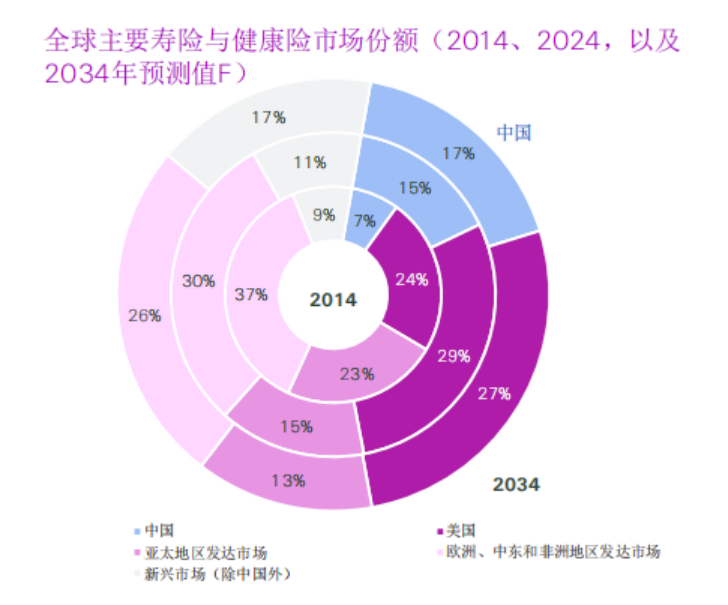
Core Insights - The Chinese life and health insurance market is expected to experience significant growth opportunities driven by demographic changes, healthcare payment reforms, and the introduction of commercial health insurance for innovative drugs [1][6][2] Group 1: Market Outlook - Despite current pressures such as low consumer demand and declining interest rates, the outlook for China's life and health insurance market remains optimistic, with premium growth expected to outpace GDP growth over the next decade [2][6] - By 2024, China's life and health insurance premiums are projected to reach $584 billion, accounting for 15% of the global market, with expectations to increase to 17% in the next ten years [2][6] Group 2: Key Growth Opportunities - The aging population in China is a significant driver, with the proportion of individuals aged 60 and above expected to rise from 22% in 2024 to 30% by 2035, indicating a growing demand for retirement financial products [6][2] - Healthcare payment reforms and the establishment of commercial insurance for innovative drugs are expected to clarify the roles of basic medical insurance and commercial insurance, facilitating the introduction of innovative products [6][7] - The further opening of the medical market, including the establishment of foreign-owned hospitals, is anticipated to attract advanced medical services and stimulate innovation in the health insurance sector [6][7] Group 3: Trends in Health Insurance - The health insurance market in China has seen over 30% compound annual growth rate in recent years, with premium income exceeding 800 billion yuan by 2020, although growth rates may stabilize moving forward [7][8] - Three key areas are identified for future growth: medical insurance, critical illness insurance, and nursing insurance, with a focus on product innovation in these segments [7][8] - Mid-range medical insurance is emerging as a key trend, driven by healthcare payment reforms, enhancing accessibility to new medical services and drugs for consumers [8]
三大机遇!我国这一市场最新展望
券商中国· 2025-08-03 23:41
Core Viewpoint - The Chinese life and health insurance market faces pressures but remains optimistic, with expected growth outpacing GDP growth over the next decade, driven by demographic changes and policy reforms [2][3]. Group 1: Key Opportunities - The three main opportunities for growth in China's life and health insurance sectors include demographic changes, healthcare payment reform, and further market opening [5]. - The aging population is a significant factor, with the proportion of individuals aged 60 and above expected to rise from 22% in 2024 to 30% by 2035, indicating a growing demand for retirement financial products [5]. - Healthcare payment reforms and the introduction of commercial insurance for innovative drugs will clarify the roles of basic medical insurance and commercial insurance, leading to rapid growth in commercial health insurance [5]. - The government's encouragement of foreign-owned hospitals in nine cities is expected to attract advanced medical services and stimulate innovation in the health insurance sector [5]. Group 2: Market Growth Trends - The health insurance market in China has seen over 30% compound annual growth rate in recent years, with premium income exceeding 800 billion yuan by 2020 [6]. - Future growth is anticipated in three areas: medical insurance, critical illness insurance, and nursing insurance, with medical insurance expected to maintain high growth due to policy reforms [7]. - The introduction of mid-range medical insurance products is a key trend, enhancing access to new medical services and drugs, while also posing challenges for insurance companies to develop suitable products [7].

《报告》:延迟退休政策叠加银行降息,激发年轻消费者对商业养老险的热情
Bei Jing Shang Bao· 2025-05-28 13:09
Core Insights - The "2024 China Internet Insurance Consumer Insight Report" indicates that the top five insurance products held by consumers remain unchanged from the previous year, including critical illness insurance, accident insurance, car insurance, life insurance, and commercial health insurance, with the trend expected to continue for the next two years [1] - Nearly 40% of consumers are expected to purchase new insurance products, driven by national policies and increased awareness of risk protection [1] Product Trends - Critical illness insurance has the highest upgrade rate in 2024, with nearly 30% of holders opting for upgrades, particularly among the 20-40 age group and high-income individuals seeking higher coverage and broader protection [2] - Accident insurance serves as an entry-level product for young people and a safety net for the elderly, with significantly higher new purchase rates among the 20-30 and 60+ age groups compared to others [2] - Car commercial insurance ranks among the top three for upgrade and replacement rates, with young consumers and those in first- and second-tier cities leading these trends, primarily due to affordability and convenience of online comparison [2] Regional Insights - Demand for life insurance is robust in third-tier cities and below, with new purchase, upgrade, and replacement rates exceeding those in first- and second-tier cities, particularly among consumers aged 41-50 [2] - The commercial health insurance sector is innovating in terms of relaxed health declarations, benefiting those with pre-existing conditions and consumers aged 60 and above, who have the highest rates of new purchases, upgrades, and replacements across all age groups [2] - Delayed retirement policies and bank interest rate cuts are stimulating interest in commercial pension insurance among younger consumers, with the 20-30 age group leading in new purchase and upgrade rates [2]