
量增价减

Search documents
共创草坪20260226
2026-02-27 04:00
Company and Industry Summary Company Overview - The company operates in the turf industry, focusing on the production and export of turf products, particularly to the U.S. market. Key Points Industry Dynamics - Vietnam's export tariff to the U.S. has decreased from 26% to 16%, which is expected to stimulate end-demand and significantly increase shipments in the Asia-Pacific, Middle East, and Africa regions, reversing previous declines. Europe is projected to grow faster than North America [2][3] - The overall market is experiencing a trend of increasing concentration, with smaller turf companies exiting the market, which may lead to changes in market share that will be monitored through AMI data expected in April-May [4][12] Financial Performance - In early 2026, sales growth (20%-30%) is significantly outpacing revenue growth (10%-15%), primarily due to previous price reductions and the appreciation of the RMB, indicating a "volume increase with price decrease" trend that is expected to continue [2][5] - The gross margin is maintained within the 30%-35% range, although there is pressure from exchange rate fluctuations and slight increases in domestic raw material prices [2][8][9] - The company aims to achieve its revenue and profit targets, with profit growth largely dependent on the extent of RMB appreciation [2][9] Currency Impact - The appreciation of the RMB has two main financial impacts: foreign exchange losses on USD assets and temporary pressure on gross margins. In January, the exchange loss was in the millions, and the company is adjusting its pricing system monthly to mitigate these effects [2][5][6][7] Regional Growth Insights - The company anticipates balanced growth across three major regions, with Asia-Pacific and Africa expected to exceed average growth rates. The primary growth driver is leisure turf, while domestic sports turf demand is expected to grow over 10% in the short term [10][12] - The Asia-Pacific region's recovery in early 2026 is showing stronger performance than the overall sales growth rate of 20%-30% [10] Production Capacity - The company’s production capacity in Vietnam is fully utilized in the first two phases, with the third phase set to meet new order demands. The expected production growth for 2026 is 20%-30%, reaching approximately 70-80 million square meters [4][13] Tax and Cost Structure - The company has received recognition as a technology enterprise in Vietnam, allowing it to benefit from significant tax incentives, potentially reducing tax liabilities by 60%-70% [4][18][21] - The cost structure in Vietnam is lower than in China, primarily due to lower labor and energy costs, despite higher raw material costs due to transportation [20] Competitive Landscape - The competitive intensity in the turf industry has eased since the second half of 2025, with no significant structural changes in market share observed. The company maintains a market share of approximately 18%, compared to a competitor's 12% [20] Future Outlook - The company is optimistic about the long-term demand for sports turf driven by increased sports events and infrastructure development, although short-term impacts on revenue remain limited [16] - The company plans to continue monitoring raw material prices and exchange rate impacts closely, as these factors are critical for future profitability [9][17]

结婚对数增长23%背后的冷思考:是婚宴市场的幻觉还是挑战
Sou Hu Cai Jing· 2025-12-22 08:17
Core Viewpoint - The recent data from the Ministry of Civil Affairs indicates a significant increase in marriage numbers, with a 23% year-on-year rise in the third quarter of 2025, reaching a record high of 5.122 million couples. This has led to expectations of a recovery in the liquor market, yet contrasting trends are emerging, as exemplified by the founder of Bawang Chaji's wedding, which featured tea instead of traditional liquor, signaling a shift in wedding customs [1][11]. Changes in Wedding Banquet Alcohol - The traditional wedding banquet alcohol selection has evolved, with high-end liquor no longer being the sole focus. Low-alcohol beverages and tea are now prominent, while red wine is declining in popularity. The market is seeing a shift towards new combinations of alcohol, with over 50% of new wedding packages featuring low-alcohol and fruit wines [2][4]. - In regions like Sichuan and Fujian, traditional preferences for high-end spirits are being replaced by whiskey and low-alcohol options, reflecting a broader trend of budget segmentation based on urbanization and consumer demographics [2][4]. Shift in Consumer Authority - The decision-making power regarding wedding alcohol has shifted from older generations to younger couples, who prioritize personal preferences and budget considerations over traditional expectations. This new generation favors lighter, more affordable options that enhance the celebratory atmosphere, moving away from the notion that high alcohol content equates to respect [4][5]. Market Dynamics and Challenges - The 23% increase in marriage numbers presents opportunities for the liquor industry, but it does not guarantee growth for all companies. The banquet market, valued at 250 billion yuan, remains a critical segment for traditional liquor, yet the competition is intensifying with the rise of new beverage categories [6][8]. - The industry faces challenges such as category fragmentation, with new products like Qingmei wine gaining popularity, and the pressure of price competition as younger consumers opt for mixed beverage packages to manage costs [8][9]. Insights for the Liquor Industry - The emergence of non-traditional beverages at weddings, such as tea, highlights the need for the liquor industry to adapt to changing consumer preferences. Understanding the emotional and experiential needs of younger couples is crucial for capturing market share in the evolving banquet landscape [11].




调味料巨头陷“血海”厮杀,谁能笑到最后?
3 6 Ke· 2025-10-09 02:43
Core Viewpoint - The condiment industry in China is experiencing a duality in performance, with some companies thriving while others face significant challenges due to intensified competition and market saturation [1][11]. Industry Overview - The overall performance of the condiment industry showed improvement in the first half of 2025, with most companies reporting growth in both revenue and net profit, although some faced considerable pressure [1][2]. - The market size of China's condiment industry reached 5,923 billion yuan in 2023, with expectations to grow to 7,881 billion yuan by 2025 and potentially exceed 10 trillion yuan by 2027, indicating strong market growth potential [6]. Company Performance - Haidilao reported its strongest performance since 2022, achieving a revenue of 15.23 billion yuan, a 7.6% increase year-on-year, and a net profit of 3.91 billion yuan, marking a 13.4% increase, the highest in five years [2][4]. - Other companies like Anqi Yeast and Lianhua Holdings also reported revenue and net profit growth, contributing to a competitive landscape where top companies maintain a leading position [3][4]. Competitive Landscape - The industry is characterized by a "one strong, many strong" development pattern, with leading companies like Haidilao, Meihua Biological, and Anqi Yeast consistently ranking at the top in revenue and profit levels [3][4]. - Companies in the mid-tier revenue range (10 billion to 30 billion yuan) are facing significant operational pressures, indicating a need for improved resilience [3]. Pricing and Market Dynamics - The condiment industry is experiencing a price war, with many brands resorting to aggressive pricing strategies to capture market share, leading to reduced profit margins [5][8]. - The soy sauce sector is particularly affected, with Haidilao's sales volume leading the industry but experiencing a decline in revenue due to falling prices [6][8]. Innovation and Future Trends - The industry is shifting from scale expansion to value competition, focusing on health, premiumization, and globalization as key growth drivers [9][10]. - Companies are increasing R&D investments to enhance product differentiation and innovation, with notable increases in R&D spending reported by several firms [10]. Conclusion - The condiment industry is at a crossroads, with some companies thriving while others struggle, highlighting the importance of innovation and brand differentiation in navigating the competitive landscape [11][12].

【读财报】快递行业2025年中报:营收普遍增长 快递业务“量增价减”
Xin Hua Cai Jing· 2025-09-11 23:12
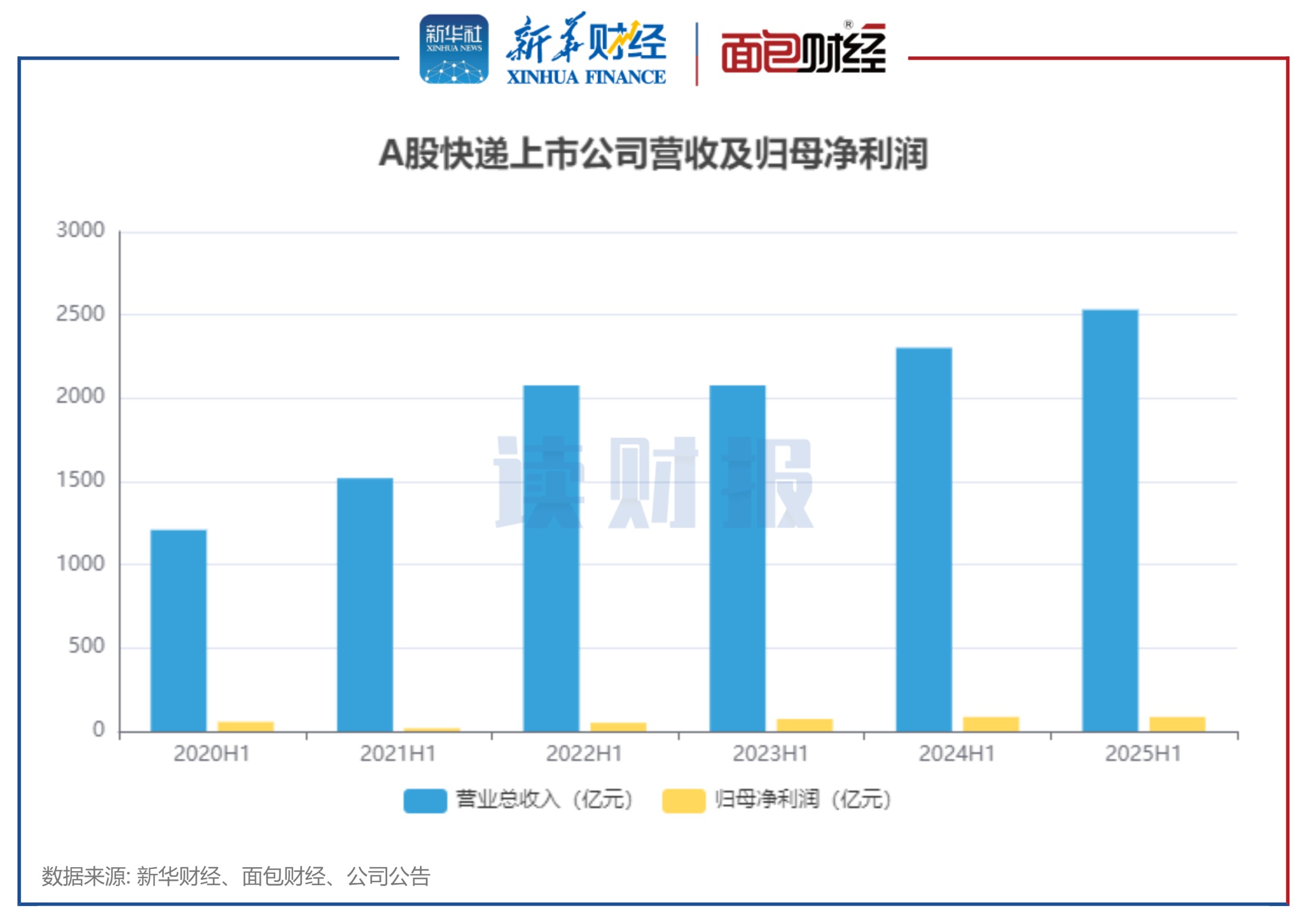
Core Insights - The express delivery sector in A-shares shows a mixed performance in revenue and net profit for the first half of 2025, with total revenue reaching 253.15 billion yuan, a year-on-year increase of 9.95%, while net profit slightly decreased by 0.03% to 8.60 billion yuan [1][2]. Revenue Performance - In H1 2025, SF Express led the revenue rankings with 146.86 billion yuan, followed by YTO Express with 35.88 billion yuan and Shentong Express with 25.03 billion yuan [5][6]. - Shentong Express exhibited the fastest revenue growth at 16.02% year-on-year, while Debon Express and YTO Express grew by 11.43% and 10.19%, respectively [5][12]. Net Profit Analysis - SF Express and YTO Express achieved net profits of 5.74 billion yuan and 1.83 billion yuan, respectively, while the other three companies reported net profits below 600 million yuan, with Debon Express experiencing a significant decline of 84.34% [8][9]. - SF Express and Shentong Express saw net profit increases of 19.37% and 3.73%, while YTO Express, Yunda Express, and Debon Express reported declines [8][9]. Market Trends - The express delivery industry is experiencing a "volume increase, price decrease" trend, with total express business volume reaching 95.64 billion pieces, a 19.3% increase year-on-year, but the average price per piece dropped by 8% to 7.5 yuan [9][12]. - In H1 2025, YTO Express led in business volume with 14.86 billion pieces, followed by Yunda Express and Shentong Express with 12.73 billion and 12.35 billion pieces, respectively [9][11]. Single Ticket Revenue - The single ticket revenue for major companies has shown a downward trend, with SF Express reporting a decline of 12.43% to 13.67 yuan in June compared to January, and YTO Express declining by 10.64% to 2.10 yuan [9][13].



青岛啤酒(600600):25Q1量增价减,利润率同比改善
EBSCN· 2025-04-29 03:15
Investment Rating - The report maintains a "Buy" rating for the company [4][6]. Core Views - In Q1 2025, the company achieved operating revenue of 10.45 billion yuan, a year-on-year increase of 2.9%, and a net profit attributable to shareholders of 1.71 billion yuan, up 7.1% year-on-year [1][2]. - The sales volume increased by 3.5% year-on-year, with a notable rise in the proportion of mid-to-high-end products, which saw a sales increase of 5.3% [2]. - The company improved its gross margin to 41.64%, up 1.20 percentage points year-on-year, driven by lower prices for barley and packaging materials, as well as an increase in the sales proportion of higher-margin products [3]. Summary by Sections Financial Performance - Q1 2025 operating revenue was 10.446 billion yuan, with a year-on-year growth of 2.9% driven by sales volume [2]. - The company reported a net profit of 1.71 billion yuan, reflecting a 7.1% increase year-on-year [1]. - The average selling price (ASP) decreased by 0.6% to 4,620 yuan per thousand liters [2]. Cost Control and Profitability - The gross margin improved to 41.64%, up 1.20 percentage points year-on-year, due to lower raw material costs and a higher sales proportion of mid-to-high-end products [3]. - The sales expense ratio decreased to 12.53%, down 0.29 percentage points year-on-year, indicating improved efficiency in expense allocation [3]. - The net profit margin reached 16.64%, an increase of 0.65 percentage points year-on-year [3]. Future Outlook - The company is expected to see improved profitability in 2025 due to low year-on-year comparisons and a favorable cost environment, with raw material costs projected to decline [4]. - The new management team, which completed its transition at the end of 2024, is anticipated to enhance operational efficiency [4]. - Profit forecasts for 2025-2027 are set at 4.846 billion, 5.171 billion, and 5.442 billion yuan respectively, with corresponding EPS of 3.55, 3.79, and 3.99 yuan [4].

中芯国际Q4营收同比增长30.9%创新高,净利润同比下降13.5%,预计2025年资本开支持平
Hua Er Jie Jian Wen· 2025-03-27 13:35
Revenue Performance - In Q4, the company achieved revenue of 15.917 billion yuan, a quarter-on-quarter increase of 2%, marking a record high for a single quarter, with total annual revenue reaching 57.108 billion yuan, an increase of 28.1% year-on-year [1] - The wafer sales volume reached a historical high, increasing by 36.7% year-on-year to 8,021 thousand pieces, with a capacity utilization rate of 85.6% [1] Profitability - The net profit attributable to shareholders in Q4 was 999.2 million yuan, a year-on-year decrease of 13.5%, with a gross margin of 18.6%, also showing a decline [1] - The annual net profit was 3.699 billion yuan, down 23.3% year-on-year, primarily impacted by declines in investment income and financial income [1] Research and Development - The company invested 765 million USD in R&D for the year, accounting for 9.5% of revenue, with R&D personnel making up 12.1% of the workforce [2] Capital Expenditure - Total cash payments for fixed assets, intangible assets, and other long-term assets amounted to 54.559 billion yuan for the year, an increase of 1.3% compared to the previous year [2] - The company expects capital expenditure in 2025 to remain flat compared to the previous year [4] Cash Reserves - At the end of the year, cash and cash equivalents reached 6.36 billion USD, ensuring future capital expenditure needs [3] Market Dynamics - The company experienced a contradiction between increasing sales volume and declining average selling prices, with the average selling price of wafers decreasing by 4.7% [6] - Demand for consumer electronics (37.8% share) and smartphones (27.8% share) is recovering, but the proportion of high-priced products like high-voltage drivers and RF chips remains insufficient [6] Operational Cash Flow - Operating cash flow in Q4 was 10.394 billion yuan, a quarter-on-quarter increase of 15.3%, while total capital expenditure for the year was 54.559 billion yuan [8] - The company anticipates that free cash flow will need to support both expansion and R&D, with caution advised regarding rising leverage risks [8] Strategic Outlook - The company aims to capture the growing demand for local manufacturing by quickly identifying incremental product categories and responding to customer demand changes [8] - For 2025, the company projects revenue growth to exceed the average of comparable peers, while maintaining a commitment to R&D investment and capacity expansion [8]
