
金融安全基石

Search documents
60亿美元,“击溃”比特币?怎么回事?
华尔街见闻· 2025-10-10 10:41
Group 1 - The core argument of the article is that Bitcoin faces a significantly underestimated threat of a "51% attack," which could be executed with approximately $6 billion [2][3][6]. - Campbell Harvey, a finance professor at Duke University, warns that the risks associated with Bitcoin are much greater than those associated with gold, despite both being viewed as hedges against currency devaluation [3][10]. - The cost breakdown for a potential attack includes $4.6 billion for hardware, $1.34 billion for data center construction, and about $130 million weekly for electricity, allowing attackers to gain control of the Bitcoin network within a week [4][6]. Group 2 - The article explains that attackers could profit significantly by shorting Bitcoin during a price drop, which would cover the costs of the attack [6][11]. - Harvey emphasizes that the attack cost represents only 0.26% of Bitcoin's total network value, which is much lower than many investors expect, raising serious concerns about Bitcoin's future viability and security [12]. - The article notes that the current thriving derivatives market for Bitcoin provides economic incentives for potential 51% attacks, as traders can establish short positions with less than 10% of the daily trading volume [11]. Group 3 - There is a divergence of opinions in the industry regarding the risk of such attacks. Matt Prusak, president of a U.S. Bitcoin company, argues that the concerns are exaggerated, citing the time required to accumulate and deploy mining equipment [7][15]. - Prusak also points out that shorting Bitcoin requires substantial collateral, and exchanges may suspend suspicious trading, making it difficult for attackers to realize profits [16]. - The article mentions that other smaller blockchains, such as Bitcoin Gold and Ethereum Classic, have experienced 51% attacks but managed to survive [17][18]. Group 4 - The article discusses the growing acceptance of Bitcoin as a potential hedge against macroeconomic risks, with companies increasingly adding Bitcoin to their balance sheets [20][21]. - A report from Deutsche Bank suggests that Bitcoin and gold may become significant components of central bank reserves by 2030, reflecting a shift in reserve strategies amid rising geopolitical risks and inflation concerns [23]. - The report indicates that the share of the dollar in global reserves has decreased from 60% in 2000 to an estimated 41% by 2025, benefiting both gold and Bitcoin [23].


德银:料比特币和黄金将成全球央行主要储备
Ge Long Hui· 2025-10-10 07:08
Core Insights - Deutsche Bank's report indicates increasing interest from institutional investors and a persistent weakness of the US dollar, predicting that by 2030, gold and Bitcoin may become primary reserve assets for central banks [1] - The report highlights that Bitcoin's allocation by central banks could represent a modern "financial security cornerstone," akin to the role gold played in the 20th century [1] Group 1: Central Bank Reserve Trends - The global share of US dollar reserves held by central banks has decreased from 60% in 2000 to approximately 41% this year [1] - Gold reserves have surpassed 360,000 tons, indicating a significant shift towards alternative reserve assets [1] Group 2: Investment Trends - In June of this year, net inflows into gold and Bitcoin exchange-traded funds (ETFs) reached $5 billion and $4.7 billion, respectively [1] - The trend of "gold is back" is closely related to the wave of "de-dollarization," creating space for alternative reserve assets like gold [1] Group 3: Future Outlook - Both gold and Bitcoin are not expected to completely replace the US dollar but should exist as "supplementary tools" for reserve currencies [1] - JPMorgan notes that stablecoins may create new demand for the US dollar, projecting that by 2027, the stablecoin market could generate approximately $1.4 trillion in additional demand for the dollar [1]
德银:机构投资者兴趣日增以及美元弱势持续,预期至2030年,黄金及比特币有望成为央行主要储备资产
Sou Hu Cai Jing· 2025-10-10 06:07
Core Insights - Deutsche Bank's report indicates increasing interest from institutional investors and a continued weakness of the US dollar, predicting that by 2030, gold and Bitcoin may become major reserve assets for central banks [1][3] Group 1: Central Bank Reserve Assets - Bitcoin is seen as a modern "financial security cornerstone" for central banks, akin to the role gold played in the 20th century [3] - The share of US dollar reserves held by global central banks has decreased from 60% in 2000 to approximately 41% this year, while gold reserves have surpassed 360,000 tons [3] - The trend of "de-dollarization" is creating space for alternative reserve assets like gold, as the dollar's status declines [3] Group 2: Investment Trends - In June of this year, net inflows into gold and Bitcoin exchange-traded funds (ETFs) reached $5 billion and $4.7 billion, respectively [3] - The current geopolitical risks and uncertainties from US tariff policies are driving investors to seek inflation-hedging assets [3] - Both gold and Bitcoin are not expected to completely replace the US dollar but are viewed as "supplementary tools" for reserve currency [3] Group 3: Future Projections - JPMorgan forecasts that the stablecoin market could generate an additional demand of approximately $1.4 trillion for the US dollar by 2027 [3]

德银预测:到2030年全球央行可能会持有大量比特币和黄金储备
Hua Er Jie Jian Wen· 2025-10-10 02:25
Group 1: Core Insights - The trend of de-dollarization and increased demand for safe-haven assets is leading to a significant shift in traditional central bank reserve allocations, with Bitcoin and gold expected to become important components by 2030 [1] - The report from Deutsche Bank highlights that the share of the US dollar in global reserves has decreased from 60% in 2000 to an estimated 41% by 2025, creating space for alternative reserve assets like gold and Bitcoin [1][2] - Gold's status as a traditional safe-haven asset is being reinforced, with central banks becoming net buyers since 2010, and the total amount of gold held in global reserves exceeding 36,000 tons [2] Group 2: Bitcoin as a Reserve Asset - Bitcoin is gaining attention as a potential reserve asset, drawing parallels to the historical discussions surrounding gold, with analysts suggesting it could become a new "financial safety cornerstone" [3] - Despite the growing interest, the debate around Bitcoin's role in central bank reserve strategies remains contentious, with its performance as an asset prompting wider discussions [3] Group 3: Perspectives on the Dollar - Not all market observers agree with the optimistic outlook for Bitcoin and gold as reserve assets, with some analysts suggesting that stablecoins could unlock new demand for the US dollar, potentially adding $1.4 trillion in demand by 2027 [4] - The Deutsche Bank report maintains a cautious stance, asserting that neither Bitcoin nor gold will completely replace the dollar, but rather serve as complementary tools in central bank reserve strategies [4]

与黄金共舞!德银重磅预测:2030年央行将大举增持比特币
智通财经网· 2025-10-10 00:58
Core Insights - Deutsche Bank's research indicates that central banks may significantly increase their holdings of Bitcoin and gold by 2030 due to rising institutional recognition and a weakening dollar [1] - The report highlights that Bitcoin could become a new "financial safety cornerstone" for central banks, akin to the role gold played in the 20th century [1] Group 1: Market Trends - Global demand for Bitcoin and gold is reaching historical highs, driven by economic uncertainty from U.S. tariff policies and geopolitical risks, prompting investors to hedge against inflation [1] - Gold has surpassed $4,000 per ounce, while Bitcoin's trading price is near its historical peak, reinforcing its status as an institutional "safe-haven tool" [1] - Since the 2008 financial crisis, the proportion of gold in central bank balance sheets has significantly increased, with central banks becoming net buyers of gold since 2010 [1] Group 2: Dollar De-dollarization - The rise in gold prices is closely linked to the de-dollarization process, with the dollar's share in global reserves dropping from 60% in 2000 to an estimated 41% by 2025, benefiting both gold and Bitcoin [5] - In June, net inflows into gold ETFs and Bitcoin ETFs reached $5 billion and $4.7 billion, respectively, both setting monthly records [5] Group 3: Contrasting Views - There are opposing views, such as those from JPMorgan analysts, who suggest that stablecoins may create new demand for dollars, potentially leading to an additional $1.4 trillion in dollar demand by 2027 [5] - Deutsche Bank's economist, Marianne Laubrey, argues that both Bitcoin and gold cannot fully replace the dollar and should serve as a "supplement" to sovereign currencies within central bank reserves [5] - Laubrey notes that as volatility decreases and regulatory support from countries like the U.S. and China increases, market confidence in digital assets is strengthening [5]
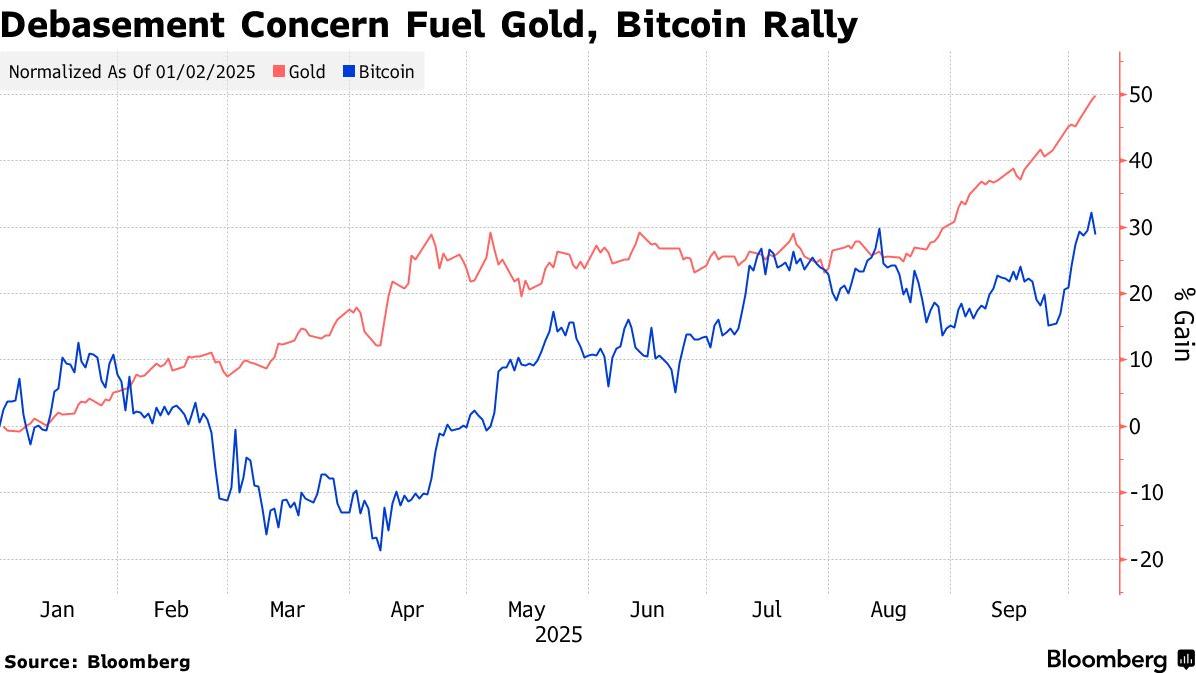
德银预测:到2030年,全球央行可能会持有大量比特币和黄金储备
Hua Er Jie Jian Wen· 2025-10-10 00:09
Group 1: Core Insights - The trend of de-dollarization and increased demand for safe-haven assets is leading to a significant shift in traditional central bank reserve allocations, with Bitcoin and gold expected to become important components by 2030 [1] - The report from Deutsche Bank highlights that the share of the US dollar in global reserves has decreased from 60% in 2000 to an estimated 41% by 2025, creating space for alternative reserve assets like gold and Bitcoin [1][2] - Gold's status as a traditional safe-haven asset is being reinforced, with central banks becoming net buyers since 2010, and the total amount of gold held in global central bank reserves exceeding 36,000 tons [2] Group 2: Bitcoin as a Reserve Asset - Bitcoin is gaining attention as a potential reserve asset, drawing parallels to the historical discussions surrounding gold, with analysts suggesting it could become a new "financial safety cornerstone" [3] - Despite the growing interest, the debate around Bitcoin's role in central bank reserve strategies remains contentious, with its performance as an asset prompting broader discussions [3] Group 3: Market Perspectives - Not all market observers agree with the optimistic outlook for Bitcoin and gold as reserve assets; analysts from JPMorgan suggest that stablecoins could unlock new demand for the US dollar, potentially adding $1.4 trillion in demand by 2027 [4] - Deutsche Bank's report maintains a cautious stance, emphasizing that neither Bitcoin nor gold will completely replace the US dollar, but rather serve as complementary tools in central bank reserve strategies [4]