
锂资源供需平衡

Search documents
锂行业推荐-重视供给端扰动
2026-03-30 05:15
Summary of Key Points from the Conference Call on the Lithium Industry Industry Overview - The lithium industry is currently facing significant supply disruptions, with 45% of global lithium resource capacity affected. Key disruptions include Zimbabwe's ban on lithium concentrate exports starting February 2026, delays in the resumption of production in Jiangxi Yichun, and potential diesel shortages in Australia threatening 26% of global supply [1][4]. Core Insights and Arguments - **Supply-Demand Balance Shift**: The supply-demand balance for lithium is expected to shift from a tight balance to a clear shortage by 2026. Initial expectations were for supply of 2.13 million tons versus demand of 2.05 million tons. However, due to the Zimbabwe ban and production delays in Jiangxi, the balance has been disrupted, and a 20% reduction in Australian output could lead to severe shortages [1][4]. - **Strong Demand Growth**: Demand for lithium is robust, with lithium battery production increasing by 42.6% year-on-year in January-February, and energy storage battery production surging by 84%. The average battery capacity for new energy vehicles reached 64.29 kWh, up 32.3% year-on-year, effectively offsetting fluctuations in sales [1][5]. - **Low Inventory Levels**: The entire lithium supply chain's inventory has dropped to historical lows, from 140,000 tons to 99,000 tons, sufficient for only 25-30 days of usage. This low buffer level means that supply disruptions will significantly amplify price volatility [1][5]. - **Severe Supply-Demand Mismatch Expected in Q2**: Major battery manufacturers are expected to ramp up production capacity in Q2, leading to a preemptive stockpiling. This, combined with the depletion of short-term inventory from Chile, is likely to create a severe supply-demand mismatch [1][5]. Additional Important Insights - **Macroeconomic Factors**: The Iranian oil crisis, while suppressing commodity prices, is accelerating the transition to electric vehicles and stimulating energy storage demand. As lithium carbonate serves as a substitute for oil, this situation may lead to an upward revision in demand forecasts [2][6]. - **Short-Term Supply Dynamics**: Despite tightening fundamentals, there is a temporary increase in supply due to Chile's concentrated shipments in early 2026. This is expected to lead to a short-term surplus in lithium carbonate imports to China, although this is not sustainable in the long term [6]. Investment Opportunities - In the context of ongoing supply tightness and rising prices, investment focus should be on companies with flexible production capacities, such as Zhongjin Lingnan Nonfemet Company and Guocheng Mining. Additionally, leading firms like Tianqi Lithium, Ganfeng Lithium, and Salt Lake Industry are also worth monitoring. Companies with resource capacities affected by the Zimbabwe export ban, such as Huayou Cobalt, Zhongjin Lingnan, and Shengxin Lithium Energy, should be watched for potential recovery [7].


碳酸锂专题-津巴布韦变化如何影响碳酸锂供需
2026-03-01 17:23
Summary of Key Points from the Conference Call on Lithium Carbonate Industry Overview - The global lithium demand is projected to reach 2.13 million tons of lithium carbonate equivalent in 2026, representing a year-on-year growth of 33%, primarily driven by demand from power batteries and energy storage [1][4] - The supply of global lithium resources is expected to be between 2.25 to 2.30 million tons of lithium carbonate equivalent in 2026, with a year-on-year increase of over 30% [1][4] - Major sources of supply growth include China, Argentina, Chile, and Australia, but domestic upstream supply expansion is slower than downstream demand [1][4] Key Insights and Arguments - The domestic lithium carbonate market in China is expected to be in a tight balance in 2026, with a surplus of approximately 15,000 to 20,000 tons and a turnover ratio of less than 5 days [1][5] - The price trend for lithium carbonate is expected to be strong, with seasonal lows likely in July-August and peaks in October-November [1][5] - If Zimbabwe's export ban lasts more than two months, it could lead to a monthly supply reduction of 10,000 to 15,000 tons in China, affecting about 10%-15% of domestic production [1][6] - The Zimbabwean government's export ban aims to strengthen control over non-compliant exports and promote local resource transformation, requiring companies to build lithium sulfate production lines locally [1][7] Supply Chain Dynamics - The current inventory cycle for upstream and downstream manufacturers is about 12-13 days, which is considered normal [2][3] - The proportion of long-term contracts for lithium salt plants and battery manufacturers has decreased from about 70% in 2025 to below 50% in 2026, leading to an increase in spot purchases [3] - The head brands in the upstream sector are reluctant to sell, with lithium salt plant inventories down to less than a week [3] Price Sensitivity and Market Reactions - If lithium salt prices stabilize around 150,000 CNY, downstream demand can be sustained; however, if prices exceed 200,000 CNY, it may lead to a decrease in demand and stimulate overseas mines to resume production [2][3] - The market is currently experiencing a recovery phase, with expectations of increased production from non-integrated production lines in March [2] Zimbabwe's Export Ban Implications - Zimbabwe is expected to contribute about 220,000 tons of lithium carbonate equivalent in 2026, accounting for approximately 10% of global lithium resource supply [5][6] - The ban's duration is a key variable affecting domestic supply; if it lasts more than two months, it could significantly impact domestic production and prices [6][11] - The ban is not expected to have a long-term impact on exports, as negotiations are ongoing between Chinese companies and the Zimbabwean government [11][12] Future Projections - The overall supply and demand balance for lithium carbonate in China is expected to remain tight, with a projected surplus of 15,000 to 20,000 tons in 2026 [5][6] - The price trend is expected to be strong, with potential seasonal fluctuations based on supply chain dynamics and external factors such as the Zimbabwean export ban [5][16] - The construction of lithium sulfate production lines in Zimbabwe is crucial for future supply stability, with only one company currently qualified to export under the new regulations [7][17] Conclusion - The lithium carbonate market is poised for significant changes due to supply constraints and regulatory shifts in Zimbabwe, which could impact global supply dynamics and pricing strategies in the coming years [1][5][11]
碳酸锂大涨 逼近15万元/吨
2 1 Shi Ji Jing Ji Bao Dao· 2026-01-08 05:02
Group 1 - The lithium carbonate market remains strong, with the main contract experiencing a jump of nearly 5% on January 8, reaching 146,000 yuan/ton, before settling at a 3.01% increase by 11:00 [1] - Since the beginning of 2026, the main contract for lithium carbonate has shown continuous gains, with a cumulative increase of over 21% year-to-date, making it one of the best-performing commodities [1] - The core factor driving the price increase of lithium carbonate is the tight balance between supply and demand in the energy storage sector [1] Group 2 - Industry leaders, including the chairman of Ganfeng Lithium, have expressed bullish sentiments regarding lithium prices, with predictions of a balanced supply and demand in the global lithium industry by 2026 [1] - Optimistic forecasts from futures institutions suggest that global lithium resource supply may grow to 2.03 million tons LCE by 2026, while demand could rise to 2.14 million tons LCE, resulting in an 110,000-ton demand gap [1] - A meeting held by multiple government agencies on January 7 addressed the need to regulate the competitive order in the power and energy storage battery industry due to irrational competition and blind construction practices [2]
“锂” 解2026:过剩退散,紧缺归来?
雪球· 2026-01-05 07:50
Global Lithium Supply Trends - By 2026, China's lithium resource capacity is expected to surpass Australia's, becoming the world's largest producer [4] - Key regions in China include the mature Qinghai salt lake, the scaling-up of Tibet salt lakes, and the transition of mining activities in Jiangxi, Sichuan, and Hunan [4] - Internationally, previous capital expenditures have led to supply releases, but many projects face financing challenges, with Chinese-led projects generally responding faster than foreign investments [4] Australian Mining Sector - Australian lithium miners have focused on cost reduction and efficiency improvements during the previous downturn, including high-grade area mining and equipment upgrades [6] - The Greenbushes project is set to add 65,000 tons of capacity, while the revival of closed mines depends on stable lithium prices [6] - The Pilbara high-cost Ngungaju project is a key candidate for rapid revival, with a preparation time of about four months [6] South American Mining Sector - Argentina's previous capital expenditures are expected to translate into supply releases by 2025, with new projects likely utilizing direct lithium extraction (DLE) technology [8] - Major players like Ganfeng and Rio Tinto are collaborating on regional development, with Ganfeng's long-term capacity reaching 250,000 tons and Rio Tinto's at 240,000 tons [8] African Mining Sector - Zimbabwe plans to ban the export of lithium concentrate starting in 2027, shifting towards exporting lithium in processed forms [12] - The U.S. is seeking partnerships with specific African nations to leverage their natural resources, with the Democratic Republic of the Congo being a focal point [12] - The geopolitical situation in Rwanda is affecting mining operations, particularly in the Manono lithium project area [13] Chinese Mining Sector - Yichun's lithium supply is constrained due to regulatory and environmental issues, impacting its existing capacity of 95,000 tons and future expansion plans [16] - Hunan is emerging as a significant player, with integrated projects expected to release 140,000 tons of capacity over the next three years [16]



碳酸锂大涨!“亚洲锂都”拟注销27个采矿权
Zhong Guo Zheng Quan Bao - Zhong Zheng Wang· 2025-12-17 04:29
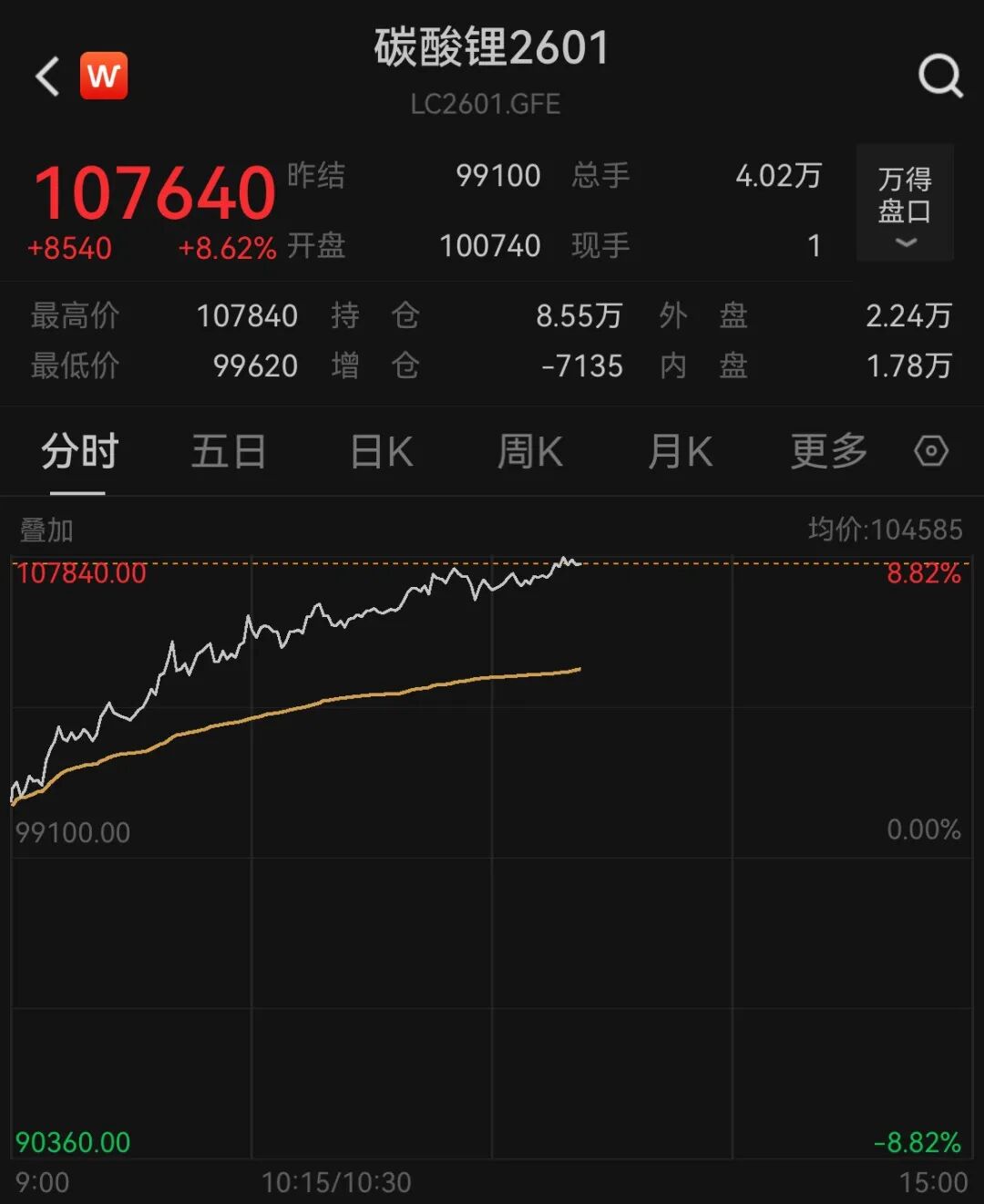
Group 1 - The core viewpoint of the news highlights a significant increase in lithium carbonate futures, with a rise of over 8.8% to a peak of 107,800 yuan/ton, marking the highest level since May 2024, and an overall increase of over 40% this year [1] - The Yichun Natural Resources Bureau announced plans to revoke 27 mining rights, which will require the original rights holders to fulfill ecological restoration obligations [2][3] - The revoked mining licenses include those for lithium-containing minerals, with 21 licenses having expired before 2020 and 5 licenses expiring in 2024 [3] Group 2 - Jiangte Motor, a listed company, has a mining license for lithium-containing ceramic stone in Yifeng County, Jiangxi Province, which is included in the revoked licenses [3] - The company has submitted an objection to the Yichun Natural Resources Bureau regarding the proposed revocation and is working on preparations for the production of the Qian坑 lithium mine [4] - Yichun is recognized as "Asia's Lithium Capital," with proven lithium oxide reserves exceeding 2.58 million tons, equivalent to approximately 6.36 million tons of lithium carbonate, accounting for about 40% of the national lithium mica reserves [5] Group 3 - Global lithium resource supply is expected to reach 1.502 million tons of lithium carbonate equivalent (LCE) by 2025, a year-on-year increase of 14.6%, with sources including spodumene, salt lakes, and lithium mica [4] - The chairman of Tianqi Lithium stated that due to the rapid growth in demand from renewable energy and electric vehicles, global lithium demand is projected to reach 2 million tons of lithium carbonate equivalent by 2026, indicating a potential balance in supply and demand [5]

供应冲击后,供需高弹性下平衡如何演绎?
Dong Zheng Qi Huo· 2025-09-29 06:36
Report Overview - Report Title: How Will the Balance Evolve under High Supply and Demand Elasticity after the Supply Shock? - Research Institute: Orient Futures Derivatives Research Institute - Date: September 2025 - Analyst: Chen Yixuan 1. Report Industry Investment Rating - Not provided in the report 2. Report's Core View - In the short term, the lithium market presents a combination of strong reality and weak expectations, with limited de - stocking and a surplus pattern. It is recommended to look for short - selling opportunities on price rallies and reverse spread opportunities for LC2511 - 2512. In the long term, although the static balance remains in surplus, the high - growth demand will ease the apparent inventory build - up pressure in 2026, and the trading strategy can gradually shift from shorting on rallies to buying on dips [61]. 3. Summary by Relevant Directory Q3 Market Review - Since the end of June, lithium prices have rebounded rapidly from the bottom to 90,000 yuan, then fluctuated after a spike. From late June to mid - July, demand expectation correction drove the price to stabilize and rebound; from mid - July to mid - August, supply - side risks led to a rapid price increase; since mid - August, after the market priced in the shutdown of Jianxiaowo, the price corrected to account for the increased supply stimulated by high prices [2][5]. Supply - Side Uncertainty - Since mid - July, mining license risks in Jiangxi and Qinghai have intensified. The shutdown of some projects raised concerns about domestic supply risks, and the expiration of Jianxiaowo's mining license in August triggered market sentiment. However, since late August, the resumption of previously shut - down projects has cooled market enthusiasm [6][8]. Supply Pressure and Inventory - High prices have accelerated the manifestation of supply pressure. After the price rebound, the output of spodumene processing increased rapidly, offsetting the reduction in mica supply. Since late August, the generation of warehouse receipts has accelerated. Currently, domestic ore inventory is still at a moderately high level, and imported ore flows in stably, with new projects expanding production capacity, so there is no significant constraint on lithium salt supply [9][11][12]. Lithium Salt Trade and Resource Output - In terms of lithium salt shipments, South American shipments are in line with capacity ramp - up expectations, and Indonesia has brought marginal increments. The regional premium has changed the trade flow of lithium salts. The revised global lithium resource supply in 2025 is expected to increase by 270,000 tons LCE year - on - year, and the impact of mining license disruptions is limited. In 2026, the project reserve is still sufficient, with an expected year - on - year increase of 300,000 tons LCE, but some mica capacity may face supply uncertainty [16][19][22]. Terminal Demand - In the power market, new - energy passenger vehicle sales in China, Europe, and the US from January to August increased by 36%, 28%, and 4% year - on - year respectively. The new - energy commercial vehicle market is a highlight, with sales in China from January to August increasing by 66% year - on - year. The domestic and overseas energy - storage markets have continuously exceeded expectations, with high growth in domestic large - scale energy - storage project bids and a significant increase in overseas exports [30][36][41]. Market Balance - In the short term, the market is in a de - stocking phase, but the de - stocking amplitude is limited. The fundamental situation supports prices in the short term but cannot drive prices up independently. In the long term, from 2025 to 2026, the global lithium resource market remains in surplus, but the apparent inventory build - up in 2026 may narrow, and the inventory - to - consumption ratio will decrease [48][51][55]. Strategy Recommendation - Short - term: Given the strong reality and weak expectations, limited de - stocking, and the expectation of project resumption, it is recommended to look for short - selling opportunities on price rallies and reverse spread opportunities for LC2511 - 2512. Long - term: As the demand growth will ease the inventory build - up pressure in 2026, the trading strategy can gradually shift from shorting on rallies to buying on dips [61].



宁德时代枧下窝矿区复产预期压制锂价 业内维持碳酸锂过剩判断
Feng Huang Wang· 2025-09-10 09:59
Core Viewpoint - The resumption plan for the Jiangxiawo lithium mine by CATL is expected to lead to a decrease in lithium carbonate prices, with the current price reported at 72,000 yuan/ton, down by 1,500 yuan from the previous day [1] Group 1: Company Developments - CATL's Jiangxiawo lithium mine was suspended due to the expiration of its mining license, but recent reports indicate that the approval process for the mining rights is progressing smoothly, with expectations for resumption sooner than anticipated [1] - The company aims to complete the resumption of operations by November 2023, although there is no definitive confirmation on whether this target will be met [1] - CATL has submitted the necessary application materials for the renewal of its mining rights to the local natural resources bureau and is optimistic about receiving approval [1] Group 2: Market Impact - The suspension of the Jiangxiawo mine has led to fluctuations in lithium carbonate prices, with the market previously reacting to the news by pushing prices close to 90,000 yuan/ton [2] - The current domestic lithium market is in a roughly balanced state, with the mine's suspension expected to reduce domestic lithium supply by about 1,000 tons per month, which is less than 4% of the domestic supply and under 1% of global supply [2] - Analysts suggest that the price support levels for lithium are at 78,000 yuan/ton for full costs and 68,000 yuan/ton for cash costs, with market expectations aligning around these figures [2] Group 3: Production Trends - Despite the suspension of the Jiangxiawo mine, domestic lithium carbonate production has reached historical highs due to increased output from spodumene and stable supply from recycling and salt lake lithium extraction [3] - Domestic lithium carbonate production is projected to be 82,800 tons in August 2025, reflecting an 8.1% month-on-month increase, with September expected to rise further to 85,400 tons, a 3.3% increase [3] Group 4: Industry Context - Other local mines with unclear mining qualifications are also under scrutiny, and if they do not complete necessary changes by September 30, the total potential supply impact could reach approximately 68,000 tons, reducing average monthly supply by 14,000 to 16,000 tons, which accounts for about 13% of current domestic monthly supply [4] - The domestic lithium resource supply chain is evolving into a model that prioritizes domestic production supplemented by overseas resources, focusing on high-quality lithium resource development and advanced extraction technologies [4]
碳酸锂日报-20250815
Guang Da Qi Huo· 2025-08-15 05:04
1. Report Industry Investment Rating No relevant content provided. 2. Core Viewpoints of the Report - On August 14, 2025, the 2511 contract of lithium carbonate futures rose 0.28% to 85,300 yuan/ton. The average price of battery - grade lithium carbonate increased by 1,000 yuan/ton to 82,000 yuan/ton, the average price of industrial - grade lithium carbonate rose by 950 yuan/ton to 79,750 yuan/ton, and the price of battery - grade lithium hydroxide (coarse particles) increased by 1,050 yuan/ton to 73,040 yuan/ton. The warehouse receipt inventory increased by 260 tons to 21,939 tons [3]. - In terms of supply, the weekly output increased by 424 tons to 19,980 tons. It is expected that the supply in August will increase by 3% to 84,200 tons. In terms of demand, the lithium consumption of two major cathode materials in August is expected to increase by 8% to 86,000 tons of LCE. In terms of inventory, the total social inventory decreased by 162 tons to 142,256 tons, with upstream destocking and restocking in other and downstream sectors [3]. - Against the background of anti - involution and sustained demand, short - term production suspension has boosted market sentiment. There is a risk of correction after the previous rapid rise, and the market may fluctuate in the short term. The production suspension of mines can adjust the supply - demand balance of lithium resources, but the suspension period needs attention. As prices rise, some enterprises may resume production, and overseas imports are expected to increase. Future focus should be on actual lithium salt supply, overseas import increments, terminal customer supply, and potential issues with other mining licenses [3]. 3. Summary by Directory 2. Daily Data Monitoring - Futures: The closing price of the main contract was 85,300 yuan/ton, up 200 yuan from the previous day; the closing price of the continuous contract was 73,480 yuan/ton, down 9,140 yuan [5]. - Lithium ore: The price of lithium spodumene concentrate (6%, CIF China) was 937 US dollars/ton, up 11 US dollars; the price of lithium mica (Li2O: 1.5% - 2.0%) was 1,300 yuan/ton, up 25 yuan; the price of lithium mica (Li2O: 2.0% - 2.5%) was 2,075 yuan/ton, up 45 yuan [5]. - Lithium salts and other products: Various lithium salts, lithium hydroxides, and other product prices showed different degrees of increase or remained stable, and there were also corresponding changes in price differences [5]. 3. Chart Analysis 3.1 Ore Prices - Charts show the price trends of lithium spodumene concentrate (6%, CIF), lithium mica (1.5% - 2.0%), lithium mica (2.0% - 2.5%), and lithium phosphate - aluminum ore (6% - 7%) from 2024 to 2025 [6][8]. 3.2 Lithium and Lithium Salt Prices - Charts present the price trends of metal lithium, battery - grade lithium carbonate average price, industrial - grade lithium carbonate average price, battery - grade lithium hydroxide price, industrial - grade lithium hydroxide price, and lithium hexafluorophosphate price from 2024 to 2025 [11][13][15]. 3.3 Price Differences - Charts display the price differences between battery - grade lithium hydroxide and battery - grade lithium carbonate, battery - grade lithium carbonate and industrial - grade lithium carbonate, CIF Japan - South Korea battery - grade lithium hydroxide and SMM battery - grade lithium hydroxide, etc., from 2024 to 2025 [18][19][21]. 3.4 Precursor & Cathode Materials - Charts show the price trends of ternary precursors and ternary materials, as well as the price trends of lithium iron phosphate, lithium manganate, and lithium cobalt oxide from 2024 to 2025 [23][26][29]. 3.5 Lithium Battery Prices - Charts present the price trends of 523 square ternary cells, square lithium iron phosphate cells, lithium cobalt oxide cells, and square lithium iron phosphate batteries from 2024 to 2025 [31][33]. 3.6 Inventory - Charts show the inventory trends of downstream, smelters, and other sectors from December 2024 to August 2025 [35][37]. 3.7 Production Costs - Charts display the production profit trends of lithium carbonate from different raw materials such as外购三元极片黑粉,外购磷酸铁锂极片黑粉,外购锂云母精矿, and外购锂辉石精矿 from 2024 to 2025 [39][40].
碳酸锂日报(2025年8月13日)-20250813
Guang Da Qi Huo· 2025-08-13 06:25
1. Report Industry Investment Rating No relevant content provided. 2. Core Views of the Report - The 2511 contract of lithium carbonate futures rose 2% to 82,520 yuan/ton yesterday. The average price of battery - grade lithium carbonate increased by 3,500 yuan/ton to 78,000 yuan/ton, the average price of industrial - grade lithium carbonate rose by 2,500 yuan/ton to 75,800 yuan/ton, and the price of battery - grade lithium hydroxide (coarse particles) increased by 2,200 yuan/ton to 69,690 yuan/ton. The warehouse receipt inventory increased by 1,440 tons to 20,829 tons [3]. - Yaobao Company's La Negra factory in Chile has resumed operation after an accident last week, and it is currently under investigation in Chile [3]. - On the supply side, the weekly output increased by 2,288 tons to 19,556 tons, with lithium extraction from spodumene, lepidolite, salt lakes, and recycled materials all increasing. It is expected that the supply in August will increase by 3% to 84,200 tons. On the demand side, the lithium consumption of two major cathode materials in August is expected to increase by 8% to 86,000 tons of LCE. In terms of inventory, the social inventory increased by 692 tons to 142,418 tons this week, with upstream and other links destocking and downstream restocking [3]. - Against the background of anti - involution and sustained demand, the short - term production suspension issue has boosted market sentiment. After a rapid rise, there may be a correction. The production suspension of mines can adjust the supply - demand balance of lithium resources, but the duration of the suspension is not clear. As prices strengthen, some enterprises start to resume production, and it is expected that overseas imports will gradually increase. In the future, attention should be paid to the actual supply of lithium salts, the increase in overseas imports (with a certain time lag), whether the terminal customer supply decreases, and whether there are subsequent problems with the mining licenses of other mines [3]. 3. Summary According to Relevant Catalogs 3.1 Research Views - Futures, spot prices, and warehouse receipt inventory changes of lithium carbonate and related products are presented [3]. - Information about the accident and resumption of operation of Yaobao Company's Chilean factory is reported [3]. - Supply, demand, and inventory situations in the lithium market are analyzed, and future market trends and points][3]. 3.2 Daily Data Monitoring - A table shows the prices and price changes of various products in the lithium - battery industry chain from August 11 - 12, 2025, including futures, lithium ores, lithium salts, and cathode materials. Another part shows the prices of some products from August 1 - 8, 2025, such as battery cells and batteries [5]. 3.3 Chart Analysis 3.3.1 Ore Prices - Charts display the price trends of lithium - related ores like spodumene concentrate, lepid][8]. 3.3.2 Lithium and Lithium Salt Prices - Charts show the price trends of metal lithium, battery - grade and industrial - grade lithium carbonate, battery - grade and industrial - grade lithium hydroxide, and lithium hexafluorophosphate [9][11][13]. 3.3.3 Spreads - Charts present the price spreads between different lithium - related products, such as the spread between battery - grade lithium hydroxide and battery - grade lithium carbonate, and the spread between battery - grade lithium carbonate and industrial - grade lithium carbonate, as well as other spreads and the basis [16][17][18]. 3.3.4 Precursor & Cathode Materials - Charts show the price trends of ternary precursors, ternary materials, lithium iron phosphate, lithium manganate, and lithium cobaltate [20][22][26]. 3.3.5 Lithium Battery Prices - Charts display the price trends of 523 square ternary battery cells, square lithium iron phosphate battery cells, lithium cobaltate battery cells, and square lithium iron phosphate batteries [28][30][31]. 3.3.6 Inventory - Charts show the inventory trends of downstream, smelters, and other links in the lithium carbonate market [32][34][36]. 3.3.7 Production Costs - A chart shows the production profit trends of lithium carbonate from different raw materials, such as外购三元极片黑粉,外购磷酸铁锂极片黑粉,外购锂云母精矿, and外购锂辉石精矿 [37].

碳酸锂日报-20250812
Guang Da Qi Huo· 2025-08-12 09:36
Report Industry Investment Rating - Not provided in the given content Core Viewpoints - On August 11, 2025, the 2511 contract of lithium carbonate futures rose 8% to 81,000 yuan/ton. The average price of battery - grade lithium carbonate increased by 2,600 yuan/ton to 74,500 yuan/ton, the average price of industrial - grade lithium carbonate increased by 2,500 yuan/ton to 72,300 yuan/ton, and the price of battery - grade lithium hydroxide (coarse particles) rose by 1,500 yuan/ton to 67,490 yuan/ton. The warehouse receipt inventory increased by 560 tons to 19,389 tons [2]. - CATL suspended mining operations after its mining license for the Yichun project expired on August 9 and is applying for a renewal, which has little impact on the company's overall operation [2]. - In terms of supply, the weekly output increased by 2,288 tons to 19,556 tons. It is expected that the supply in August will increase by 3% month - on - month to 84,200 tons. On the demand side, the lithium consumption of two major cathode materials in August is expected to increase by 8% month - on - month to 86,000 tons of LCE. The social inventory increased by 692 tons to 142,418 tons this week, with upstream and other links reducing inventory and downstream replenishing inventory [2]. - Against the backdrop of anti - involution and booming demand, short - term production suspension has pushed up market sentiment, driving up prices and volatility. However, the impact of the suspended mines on production is about 10,000 tons of LCE per month, and the suspension time is not clear. As prices rise, some enterprises are resuming production, and overseas imports may also gradually increase [2]. Summary by Directory 1. Research Viewpoints - **Price Changes**: The 2511 contract of lithium carbonate futures rose 8% to 81,000 yuan/ton. Battery - grade lithium carbonate, industrial - grade lithium carbonate, and battery - grade lithium hydroxide prices all increased, and the warehouse receipt inventory increased by 560 tons [2]. - **Company News**: CATL suspended mining operations in Yichun and is applying for a mining license renewal, with little impact on overall operations [2]. - **Supply - Demand - Inventory Situation**: Supply increased week - on - week and is expected to rise in August. Demand for cathode materials is expected to increase in August. Social inventory increased, with upstream de - stocking and downstream restocking [2]. - **Market Outlook**: Short - term production suspension boosts prices, but the impact of suspended mines is limited, and production resumption and increased imports may occur as prices rise [2]. 2. Daily Data Monitoring - **Futures and Mineral Prices**: The main and continuous contracts of lithium carbonate futures, as well as prices of various lithium ores, all increased from August 8 to August 11 [4]. - **Lithium Salt Prices**: Battery - grade and industrial - grade lithium carbonate, and lithium hydroxide prices all rose during the same period [4]. - **Price Spreads**: The price spreads between different lithium products showed various changes, and the prices of some precursors and cathode materials also increased [4]. - **Cell and Battery Prices**: Most cell and battery prices remained unchanged from August 1 to August 8 [4]. 3. Chart Analysis - **Ore Prices**: Charts show the price trends of lithium - related ores such as lithium spodumene concentrate, lithium mica, and phospho - lithium - aluminum stone from 2024 to 2025 [5][7]. - **Lithium and Lithium Salt Prices**: Charts display the price trends of metal lithium, battery - grade and industrial - grade lithium carbonate, lithium hydroxide, and lithium hexafluorophosphate [8][10][12]. - **Price Spreads**: Charts present the price spreads between different lithium products, including battery - grade lithium hydroxide and battery - grade lithium carbonate, and others [15][16]. - **Precursor & Cathode Materials**: Charts show the price trends of ternary precursors, ternary materials, lithium iron phosphate, lithium manganate, and lithium cobaltate [20][23][26]. - **Lithium Battery Prices**: Charts display the price trends of 523 square ternary cells, square lithium iron phosphate cells, cobalt - acid cells, and square lithium iron phosphate batteries [29][31]. - **Inventory**: Charts show the inventory trends of downstream, smelters, and other links from December 2024 to August 2025 [33][35]. - **Production Costs**: Charts present the production profit trends of lithium carbonate from different raw materials [37][38]. 4. Research Team Introduction - **Zhan Dapeng**: The director of the non - ferrous research department at Everbright Futures Research Institute, with over a decade of commodity research experience, and the team has won multiple industry awards [41]. - **Wang Heng**: A non - ferrous researcher at Everbright Futures Research Institute, mainly researching aluminum and silicon, and has made contributions in risk management for listed companies [42]. - **Zhu Xi**: A non - ferrous researcher at Everbright Futures Research Institute, focusing on lithium and nickel, and has written many in - depth reports [42].