
镍矿供应收紧

Search documents
镍&不锈钢 2026/3/10:稳步前行
Zi Jin Tian Feng Qi Huo· 2026-03-12 09:37
1. Report Industry Investment Rating No information provided regarding the report industry investment rating. 2. Core Viewpoints of the Report - The nickel market shows a trend of oscillation and strength. On March 9th, four Indonesian hydrometallurgical plants entered a shutdown and maintenance phase due to a landslide accident caused by improper tailings disposal last month. The expected shutdown period will last for several weeks. The four projects involved in the production cut have a combined annual capacity of about 150,000 metal tons, and the monthly production is expected to be affected by about 9,000 - 10,000 metal tons. The tightening supply and cost support resonate, providing a bottom - up effect on nickel prices. Policy - wise, although the Indonesian government's attitude towards quotas has been inconsistent, the quota increase expectation may not be confirmed before July, and the core logic of the tightening nickel ore supply remains unchanged. However, price fluctuations caused by the exit of speculative funds and the shift in macro - expectations need to be watched out for [3][4]. 3. Summary by Relevant Catalogs Nickel and Stainless Steel Market Overview - **Nickel Price**: The Shanghai Nickel main contract opened at 141,550 yuan/ton last week, closed at 137,140 yuan/ton, with a weekly high of 141,550 yuan/ton and a low of 134,480 yuan/ton, a weekly decline of 3.12% [9]. - **Nickel Ore Price**: As of March 6th, the CIF prices of Philippine laterite nickel ore with 0.9%, 1.5%, and 1.8% nickel content increased by 1, 3.5, and 6 US dollars/wet ton respectively compared to last week, reaching 31, 74, and 87.5 US dollars/wet ton. The ex - factory prices of Indonesian domestic trade nickel ore with Ni1.2% and Ni1.6% increased by 2 and 5 US dollars/wet ton respectively to 25 and 68.7 US dollars/wet ton [3][31]. - **Refined Nickel**: As of February 2026, China's electrolytic nickel monthly production decreased by 0.31 million tons to 3.46 million tons, a month - on - month decrease of 8.22% and a year - on - year increase of 22.18%. Last week, the pure nickel social inventory (including the SHFE) increased by 7,999 tons to 84,500 tons, a month - on - month increase of 10.45% [3][43][45]. - **Nickel Iron**: As of February 2026, Indonesia's nickel pig iron production decreased by 1.71 million tons to 115,000 nickel tons, a month - on - month decrease of 12.94%. As of March 6th, the average price of 8 - 12% high - nickel pig iron increased by 1.5 yuan/nickel point to 1,089 yuan/nickel point, a month - on - month increase of 0.14% [3][24][62]. - **Sulfuric Acid Nickel**: As of February 2026, China's sulfuric acid nickel monthly production decreased by 3,251 tons to 30,400 nickel tons, a month - on - month decrease of 9.67%. The demand for battery - grade sulfuric acid nickel is in a weak post - holiday recovery state [3][56]. - **Stainless Steel**: It is expected that in March 2026, China's stainless steel crude steel production will be 3.6335 million tons, a month - on - month increase of 32.69% and a year - on - year increase of 3.46%. As of March 6th, the stainless steel social inventory decreased by 22,700 tons to 1.15 million tons, a month - on - month decrease of 1.94% [3][72][75]. Industry News Updates - On March 9, 2026, four hydrometallurgical projects in the IMIP Park in Indonesia entered a shutdown and maintenance phase due to a landslide in the shared tailings treatment area in February, with the shutdown expected to last for several weeks. These four projects have a combined capacity of 150,000 nickel metal tons, and they produced 108,200 nickel metal tons of MHP in 2025 [7]. - On March 2, 2026, the Secretary of the Director of the Indonesian Ministry of Energy and Mineral Resources (ESDM) revealed that in calculating the country's non - tax revenue, the nickel ore production target for 2026 is 209 million tons, nearly 20% lower than the approved RKAB quota of 260 - 270 million tons [7]. - The Indonesian Nickel Miners Association (APNI) said that the revision of the 2026 Work Plan and Budget (RKAB) is expected to be approved in July. The revised RKAB is expected to increase this year's nickel production quota by up to 30% [7]. - On February 26, 2026, a fire broke out at the Indonesian Huafei Nickel Cobalt Company in the Indonesian Wedabay Industrial Park, caused by a small amount of rainwater seeping into the quicklime storage warehouse due to a sudden rainstorm. There were no casualties and the property loss was minimal [7]. - Jutai's refined nickel project has been officially put into production, with a capacity of 300,000 tons. It is expected to be launched in the market next month, with a planned output of 1,000 to 1,500 tons in March [7]. - The Indonesian Forest Area Management Working Group (PKH Working Group) imposed sanctions on four nickel mining companies in North Maluku Province for mining in forest areas without a forest area use permit (PPKH) [7].
印尼收紧镍矿供应,格林美、华友钴业回应:早有准备
Xin Lang Cai Jing· 2026-02-13 13:04
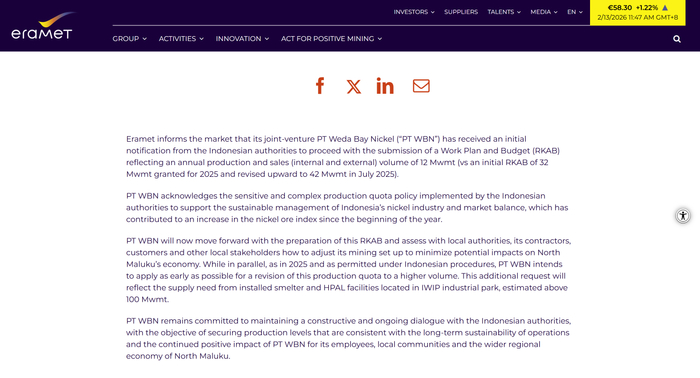
Group 1 - The core point of the news is that under Indonesia's tightening nickel supply policy, the joint venture PT Weda Bay Nickel has received preliminary notification from Indonesian authorities to submit an annual work plan and budget with a production quota of 12 million tons, significantly down from previous approvals [1][3] - The initial work plan approved for 2025 was 32 million tons, which was later raised to 42 million tons, indicating a reduction of over 71% in the current year's mining quota [3][4] - Indonesia is the world's largest nickel producer, and the annual work plan and budget (RKAB) must be approved by the government to regulate production quotas and operational arrangements [3][4] Group 2 - The Indonesian government plans to set the total nickel mining production quota for 2026 between 260 million and 270 million tons, which is a decrease of about 30% compared to 379 million tons in 2025 [4][5] - Analysts suggest that Indonesia's policy aims to "raise resource value" by tightening nickel supply to increase prices and attract more investors, especially in light of recent low nickel prices [5][6] - There is a projected gap of 30 million to 40 million tons in nickel supply for 2026, indicating a potential shift from a relatively loose market in 2025 to a systemic shortage if the Indonesian Ministry of Energy and Mineral Resources does not approve additional quotas [5][6] Group 3 - Companies like Greenmei have responded to the tightening supply by terminating plans for capital increases in their Indonesian subsidiary, which has a production capacity of 50,000 tons of high-nickel battery precursor materials [6][7] - Greenmei has secured long-term supply agreements with major nickel suppliers in Indonesia to ensure production needs are met despite the reduced quotas [6][7] - Huayou Cobalt has also indicated that its nickel supply will be secured through joint ventures and long-term supply agreements, with market-based procurement as a supplement [6][7] Group 4 - Despite expectations of supply shortages, nickel prices have not shown a sustained upward trend recently, with the main contract on the Shanghai Futures Exchange dropping by 3.66% to 135,200 yuan per ton [8][9] - Analysts note that while nickel prices have begun to rise, the market is still experiencing a slight supply-demand gap, suggesting a potential upward trend in prices over the long term [9]


印尼拟减产引发镍市震荡,下游雄心遭遇需求和替代化双重挑战
2 1 Shi Ji Jing Ji Bao Dao· 2026-01-10 02:24
Core Viewpoint - Nickel prices have surged significantly since mid-December 2022, driven by supply concerns from Indonesia and increased investment in China's metal market, although signs of cooling have emerged recently [1][2]. Group 1: Price Movements - On January 6, 2023, nickel futures prices surged by 10.5%, nearing $18,800 per ton, marking the largest single-day increase since late 2022 [1]. - As of January 9, 2023, nickel futures prices fell to $17,155 per ton, reflecting a cumulative increase of 3.3% since the beginning of the year [1]. - The Shanghai nickel contract reached a peak of 147,720 yuan per ton, with a significant increase of nearly 24,000 yuan per ton from its December 2022 low [2]. Group 2: Supply Dynamics - Indonesia controls approximately 70% of global nickel production and plans to reduce its production quota by about 34% to 250 million tons by 2026 [3]. - The Indonesian government is also adjusting the pricing formula for nickel and imposing taxes on cobalt, which is expected to increase production costs [3][7]. - Analysts suggest that Indonesia's shift from production expansion to active regulation aims to stabilize prices and address supply concerns [3][7]. Group 3: Market Sentiment and Investment Trends - The recent surge in nickel prices is partly attributed to a broader investment boom in the Chinese metal market, with trading volumes for nickel and other metals significantly increasing [4]. - Despite the recent price increases, there are indications that investor sentiment may be cooling, particularly in the precious metals market [4]. Group 4: Future Outlook - Analysts predict that without substantial coordinated production cuts or a significant recovery in demand, nickel prices are unlikely to remain high, with a forecast average price of $15,250 per ton by 2026 [1][9]. - The current oversupply situation in the nickel market is expected to persist, with projections indicating a surplus of 350,000 to 400,000 tons by 2026 [9]. - The effectiveness of Indonesia's production quota adjustments will be crucial in determining future nickel price trends, with strict implementation potentially leading to a tighter supply-demand balance [10].