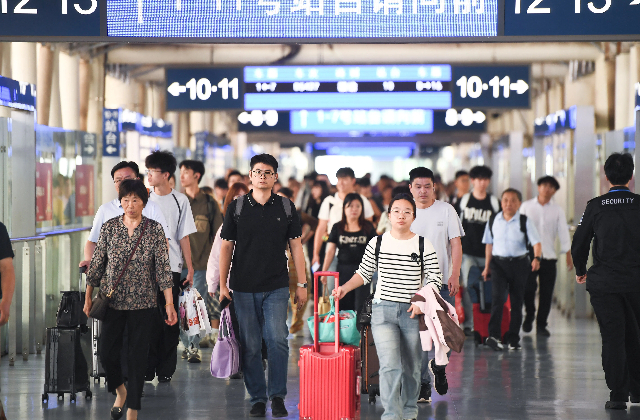
1小时通勤圈

Search documents
国家商贸物流中心,“五型”国家物流枢纽链接全球
Chang Jiang Ri Bao· 2025-12-27 03:10
Core Viewpoint - Wuhan is rapidly developing into a national trade and logistics center, leveraging its geographical advantages and enhancing its transportation network to boost domestic and international trade [1][8]. Group 1: Logistics and Transportation Development - On December 26, Wuhan set a new record by dispatching 11 China-Europe freight trains in a single day, reflecting the city's growing logistics capabilities [1]. - By June 2025, Wuhan will become the second city in China to have all five types of national logistics hubs, enhancing its transportation network across rail, road, air, water, and logistics [2]. - The construction of the Shuangliu Yangtze River Bridge aims to reduce travel time from 1.5 hours to just 5 minutes between specific districts, contributing to the development of a "one-hour commuting circle" [2]. - The expansion of highways from four to eight lanes is expected to improve traffic efficiency by 150% during peak hours [2]. - Wuhan's Tianhe Airport has entered a new phase with three runways, enhancing its cargo hub capabilities and global connectivity [3]. Group 2: Freight and Cargo Operations - As of December 16, 2023, Wuhan's China-Europe freight trains have operated 868 times this year, with a 21.6% increase in dispatches compared to the previous year [3]. - The port of Yangluo has seen a 53% increase in the number of inbound and outbound vessels, with container throughput expected to exceed 70,000 TEUs for the first time [3]. - Wuhan has opened 42 multimodal transport routes, significantly enhancing logistics efficiency through integrated transport methods [4][5]. Group 3: Consumer Market and Economic Growth - Wuhan has seen the opening of 398 new retail stores this year, contributing to a vibrant consumer market and reflecting a trend of consumption upgrades [6][8]. - The city has hosted over 1,600 promotional events, integrating consumption with culture, tourism, and sports, thereby enhancing its appeal as a shopping destination [7]. - In the first three quarters of 2023, Wuhan's total retail sales of consumer goods reached 629.97 billion yuan, marking a 5.5% year-on-year increase, the highest among 19 sub-provincial cities [8].
“十四五”轨道交通运营总里程全国第一 北京加速打造交通强国首都样板
Bei Jing Shang Bao· 2025-11-20 13:39
Core Insights - Beijing has made significant progress in transportation infrastructure during the "14th Five-Year Plan" period, with the opening of 19 new subway lines totaling 180 kilometers, contributing to a total rail network of 1,244 kilometers, the largest in the country [1][5] - The city aims to enhance its transportation system by focusing on integration, optimization, and efficiency, leveraging smart technology to create a model for a strong transportation capital [1][5] Transportation Network Development - The "Beijing-Tianjin-Hebei" region has achieved a "1 to 1.5-hour traffic circle," with major rail projects like the Beijing-Harbin High-Speed Railway and Beijing-Xiong'an Intercity Railway completed [3] - The highway network has expanded by 108 kilometers over five years, reaching a total of 1,276 kilometers, with a comprehensive national highway network centered around Beijing [3][6] Urban Sub-center Transportation - The transportation capacity of the urban sub-center has been enhanced with the extension of suburban rail lines and the construction of new roads, forming a "three fast two main" road system [4][5] Public Transport Integration - The integration of subway and bus services has improved, with 90% of subway stations within 50 meters of bus stops, and the introduction of 352 specialized bus lines catering to diverse travel needs [5][6] Slow Traffic System Improvement - The development of slow traffic corridors and the renovation of pedestrian spaces have been prioritized, with 22 slow traffic corridors established and non-motorized vehicle order management implemented [6][7] Comprehensive Traffic Governance - A comprehensive governance model has been established, focusing on traffic congestion and optimizing connections around key areas such as schools, hospitals, and commercial centers [7][8] Smart Technology in Transportation - The implementation of smart technologies, including autonomous driving regulations and smart traffic signal systems, has been a key focus, enhancing traffic efficiency and safety [9][10]

北京全市八大火车站将全部实现地铁接驳
Bei Jing Shang Bao· 2025-11-20 09:55
Core Points - The "14th Five-Year Plan" period aims to accelerate the realization of the "Railway on the Beijing-Tianjin-Hebei" initiative, with significant infrastructure developments including the completion of the Beijing-Harbin High-Speed Railway and the Beijing-Xiong'an Intercity Railway [1] - A major transportation network is being established, with a focus on creating a 1 to 1.5-hour travel circle between major cities in the Beijing-Tianjin-Hebei region and a one-hour commuting circle around Beijing [1] - The "Eight Stations and Two Airports" hub pattern is taking shape, enhancing the connectivity and accessibility of the dual airport network in Beijing [1] Transportation Infrastructure Developments - The completion of highways such as the Jingxiong and Jingwei Highways, along with the expansion plans for Jingping and Jingmi Highways, has added 108 kilometers of new highways over five years, bringing the total to 1,276 kilometers [1] - The regional road network is being strengthened with 76 connecting road segments and 39 inter-provincial bus lines operating regularly, covering key commuting areas in the Beijing-Tianjin-Hebei region [1] Urban Sub-center Transportation Enhancements - The urban sub-center is seeing improved transportation support, with enhancements to the capacity of Line 6 and the extension of suburban rail lines to strengthen connections with the central city [2] - New road constructions, such as the Guangqu Road East Extension and the Yunhe East Street, are forming a "Three Fast Two Main" road system between the sub-center and the central city [2] - The implementation of smart traffic control systems is being phased in to improve travel efficiency in the sub-center [2]
副中心站枢纽年底具备开通条件,北京八大火车站将全部通地铁
Xin Jing Bao· 2025-11-20 07:36
Core Insights - The Beijing Municipal Government has reported significant progress in transportation development during the "14th Five-Year Plan" period, achieving a basic realization of a "1 to 1.5-hour traffic circle" among major cities in the Beijing-Tianjin-Hebei region and establishing a preliminary "1-hour commuting circle" around Beijing [1][2] Transportation Development - The Beijing Municipal Transportation Committee has focused on the integration strategy of the Beijing-Tianjin-Hebei region, accelerating the integration of four rail transit networks and continuously upgrading comprehensive hubs [1] - Key rail projects such as the Beijing-Harbin High-Speed Railway and the Beijing-Xiong'an Intercity Railway have been completed, with the first intercity rail line (Line 22) under rapid construction [1] - By the end of this year, the comprehensive transportation hub in the sub-center will be ready for operation, and all eight major railway stations in Beijing will be connected to the subway [1] Road Network Expansion - The completion of highways such as the Jingxiong and Jingwei expressways has added 108 kilometers of new expressways over the past five years, bringing the total to 1,276 kilometers [2] - A national expressway trunk network centered around Beijing has been established, featuring seven radial lines, two longitudinal lines, and three transverse lines [2] - The regional road network has been enhanced with 76 connecting road segments and 39 inter-provincial bus routes operating regularly, improving cross-province travel efficiency [2] Urban Sub-center Transportation - The transportation capacity of rail transit lines, such as Line 6, has been improved, and the suburban railway line to the urban sub-center has been extended to enhance rapid connections with the central city [2] - New roads, including the eastern extension of Guangqu Road and the East Grand Canal Road, have been completed, forming a "three fast, two main" road system with the central city [2] - The implementation of smart traffic control systems is being phased in to improve travel efficiency in the sub-center [2]
都市圈同城化的底层逻辑:人口、产业、城镇、交通一体规划 | 都市圈2.0
Di Yi Cai Jing· 2025-10-15 11:22
Core Insights - The integrated planning focuses on both transportation and urban development, aiming to attract people and industries [1][5] - The core of regional planning is to coordinate three geographical variables (economic, cultural, and natural) and one changing variable (transportation) [1] - The study of industrial organization emphasizes the integration of industrial chains, supply chains, and innovation chains, with specific spatial patterns identified [1] Industrial Organization - Research indicates that innovation chains typically cluster within a 5-kilometer radius, industrial chains within 50 kilometers, and supply chains within 120 kilometers [1] - Different industries exhibit varying clustering characteristics, with emerging industries having shorter supply chains [1] Transportation Links - The National Development and Reform Commission defines urban agglomerations by a one-hour commuting radius, but this may not fully encapsulate the urban agglomeration concept [2] - Future urban planning should optimize multi-center and multi-hub systems, focusing on point-to-point connectivity rather than just travel time on rail [2] Urban Integration - Urban agglomeration planning should consider a "destination upon arrival" approach, segmenting cities into functional blocks with their own hubs [4] - Key nodes like the Hongqiao hub should serve both transportation and urban functions, becoming critical regional interfaces [4] Human-Centric Approach - The shift from "production-city-people" to "people-city-production" highlights the importance of attracting youth and addressing their needs for livability, employment, and entertainment [5] - Urban planning must integrate population, industry, urbanization, and transportation, moving away from isolated planning approaches [5] Overall Urban Development Logic - The foundational logic for urban agglomeration development includes creating multi-center cities to enhance resource allocation and integrate into urban agglomeration patterns [6] - Establishing functional regional nodes is essential for promoting an efficient and equitable urban structure, driving key areas of attraction [6]