
415X先进制造业集群

Search documents
最新名单公布!浙江这些市县“挑大梁”
Xin Lang Cai Jing· 2026-01-08 11:43
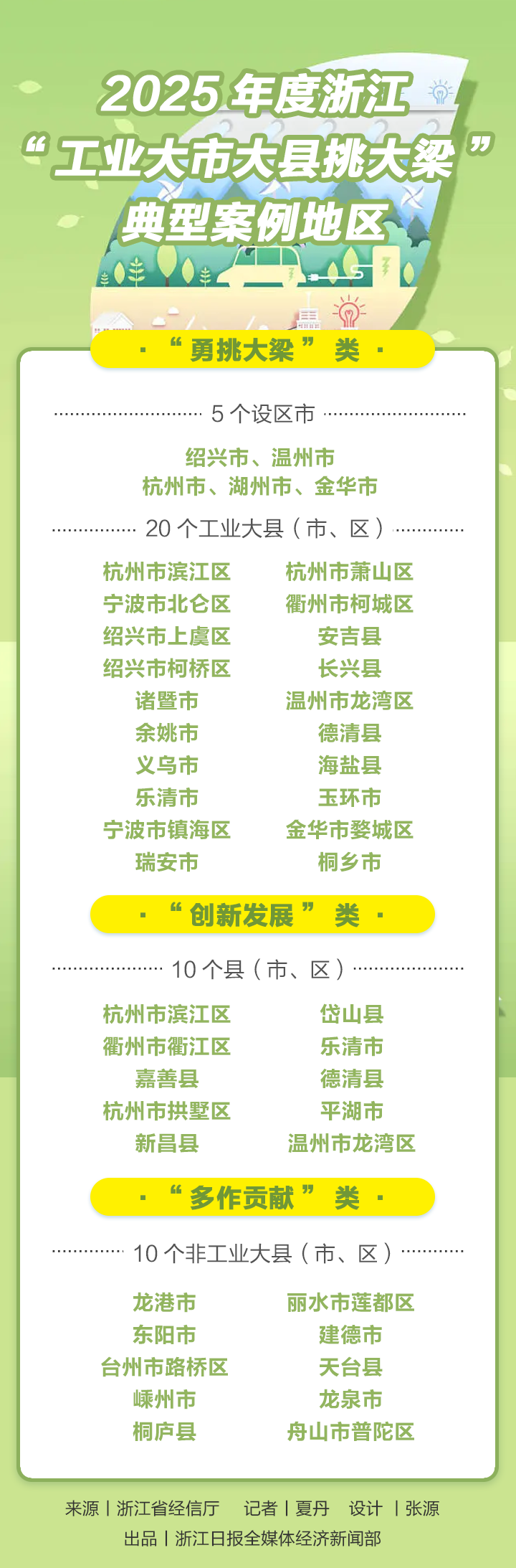
Core Viewpoint - Zhejiang's industrial economy is crucial for economic stability and growth, with significant contributions from key industrial cities and counties, as highlighted by the recent evaluation of "Industrial Cities and Counties Taking the Lead" [1][19]. Group 1: Industrial Cities and Counties Taking the Lead - Zhejiang has 45 industrial counties, representing half of the province's total counties, with 5 major cities and 20 counties recognized for their contributions [5][23]. - From January to November last year, these cities and counties contributed 58.5% and 52.6% to the province's growth, respectively, showcasing their leadership role [6][23]. - Notable cities like Shaoxing and Wenzhou achieved industrial value-added growth rates of 9.8% and 10.3%, significantly above the provincial average of 7.0% [6][23]. - Wenzhou has consistently outperformed, with 33 months of growth exceeding national and provincial rates, and signed major projects exceeding 100 billion yuan each quarter [6][23]. Group 2: Contributions from Industrial Counties - Among the 20 recognized counties, 8 reported growth rates above 10%, with Yiwu leading at 12.2%, demonstrating resilience in a challenging trade environment [8][25]. - Yiwu's focus on high-quality manufacturing and emerging industries has resulted in over 50% of its industrial output coming from new sectors [8][25]. - Newcomers like Kecheng and Wucheng also showed impressive growth rates of 12.5% and 12.4%, indicating a strong upward trend in industrial development [10][28]. Group 3: Contributions from Non-Industrial Counties - The evaluation identified 10 non-industrial counties making significant contributions, with Longgang City leading in manufacturing investment growth [29][30]. - Longgang's first major manufacturing project, a high-performance automotive wheel hub production base, is expected to generate an annual output value of 1 billion yuan [30][32]. - East Yang and Taizhou's Road Bridge District also made notable advancements in manufacturing investment, reflecting a broader trend of industrial growth across various regions [12][33]. Group 4: Innovation Development - The "Innovation Development" category recognized 10 counties excelling in innovation, with Hangzhou's Binjiang District and New Changxiang leading the way [16][34]. - Binjiang District achieved significant growth in high-tech and strategic emerging industries, maintaining double-digit growth rates [34]. - Emerging areas like Qujiang District and Daishan County are also making strides in innovation, focusing on enhancing product value and core competitiveness [36][36].

地方政府与城投企业债务风险研究报告:浙江省篇
Lian He Zi Xin· 2025-11-19 11:06
1. Report Industry Investment Rating No relevant information provided. 2. Core Views of the Report - Zhejiang Province has prominent regional advantages, a well - developed economy and finance, and a relatively low government debt burden. It is accelerating industrial transformation and upgrading and has received strong policy support [3][5]. - Although the general public budget revenues of all prefecture - level cities in Zhejiang Province have increased, the government - funded budget revenues have declined due to the real estate industry. The government debt scale of each city has increased, with Hangzhou having a relatively light debt burden [3]. - Zhejiang has a large number of urban investment enterprises with outstanding bonds and a large bond outstanding scale, mainly concentrated in the cities around the Hangzhou Bay Greater Area. Affected by the debt - resolution policy, the issuance scale of urban investment bonds in Zhejiang declined in 2024, and the financing was in a net outflow state. Since 2025, the issuance term has been further extended, and the financing has turned into a net inflow [3]. - The total debt of urban investment enterprises in Zhejiang has continued to grow, with the debt structure mainly relying on bank financing. In 2026, the maturity scale of urban investment bonds in Taizhou is relatively concentrated. In 2024, Huzhou and Shaoxing had relatively high regional debt pressures [4]. 3. Summary by Relevant Catalogs 3.1 Zhejiang Province's Economic and Fiscal Strength 3.1.1 Regional Characteristics and Economic Development in Zhejiang Province - Zhejiang has prominent regional advantages, with well - developed transportation infrastructure, a significant port economy, a continuous net inflow of permanent residents, and a high urbanization rate. In 2024, its GDP ranked fourth in the country, and its per - capita GDP ranked fifth. In the first half of 2025, its GDP continued to grow at a rate higher than the national average [5][7][8]. - The industrial structure is dominated by the secondary and tertiary industries, with the proportion of the tertiary industry continuously increasing. The province has a solid industrial foundation, a well - developed private economy, and is steadily developing new productive forces. It is accelerating the construction of the "415X" advanced manufacturing cluster and focusing on cultivating future industries [9][11][14]. - A series of policies have provided strong support for Zhejiang's economic development. The province has completed the "14th Five - Year Plan" with high quality. By the end of 2025, its economic aggregate is expected to reach about 9.5 trillion yuan, and the per - capita GDP is expected to exceed 20,000 US dollars [16][18]. 3.1.2 Fiscal Strength and Debt Situation in Zhejiang Province - Zhejiang has strong fiscal strength. In 2024, its general public budget revenue ranked third in the country, with high revenue quality and fiscal self - sufficiency rate. Although the government - funded revenue continued to decline, it still contributed significantly to the local comprehensive financial resources. In the first half of 2025, the general public budget revenue changed little year - on - year, but the revenue quality declined [20]. - The provincial government's debt burden is relatively low in the country. In recent years, the local government debt scale has been increasing, with the debt balance ranking fourth in the country at the end of 2024. The local government debt ratio and debt - to - GDP ratio have been rising [21]. - Zhejiang has continued to receive debt - resolution policy support. In 2024 and from January to September 2025, it issued special refinancing bonds of 10.9 billion yuan and 8.14 billion yuan respectively. In 2025, it applied for a new government debt quota of 378.8 billion yuan [23]. 3.2 Economic and Fiscal Strength of Prefecture - Level Cities in Zhejiang Province 3.2.1 Economic Strength and Industrial Situation of Prefecture - Level Cities in Zhejiang Province - Most prefecture - level cities in Zhejiang have a per - capita GDP higher than the national average, but the economic development elements are unevenly distributed, and the GDP gap between cities is large. The economic vitality increases from the southwest to the northeast. The pillar industries of cities around the Hangzhou Bay Greater Area are manufacturing, with many national industrial parks and listed companies [25]. - The cities around the Hangzhou Bay Greater Area and in the southeast mainly have manufacturing as their pillar industries, while those in the southwest mainly rely on the tertiary industry. Each city has its own dominant and emerging industries [27][29]. - In 2024, the GDP of Hangzhou and Ningbo exceeded 2 trillion yuan and 1.8 trillion yuan respectively, accounting for more than 44% of Zhejiang's GDP. Except for Hangzhou, the GDP growth rates of other cities were higher than the national average. The per - capita GDP of cities around the Hangzhou Bay Greater Area was significantly higher than that of other regions [32][33]. 3.2.2 Fiscal Strength and Debt Situation of Prefecture - Level Cities in Zhejiang Province - The general public budget revenues of all prefecture - level cities in Zhejiang have increased, but the scale gap is significant. Hangzhou and Ningbo lead by a large margin. Affected by the real estate industry, the government - funded budget revenues of all cities have declined. Cities with low fiscal self - sufficiency rates rely more on superior subsidies [34]. - The fiscal self - sufficiency rates of prefecture - level cities are highly polarized. In 2024, Hangzhou had a fiscal self - sufficiency rate close to 100%, while Quzhou and Lishui had rates of only 32% and 30% respectively [36]. - The government debt scale of each prefecture - level city has increased, with Hangzhou having a relatively light debt burden. Except for Hangzhou, the local government debt ratios of other cities exceeded 100% in 2024. Zhejiang is continuing to prevent and resolve local debt risks [38][41][43]. 3.3 Debt - Repayment Ability of Urban Investment Enterprises in Zhejiang Province 3.3.1 Overview of Urban Investment Enterprises in Zhejiang Province - As of the end of September 2025, there were 479 urban investment enterprises with outstanding bonds in Zhejiang, an increase of 22 compared to the end of October 2024. The administrative levels of these enterprises are mainly concentrated at the district - county level, and most are located in cities around the Hangzhou Bay Greater Area. The main credit ratings are AA and AA+ [44]. 3.3.2 Issuance and Outstanding Situation of Urban Investment Bonds in Zhejiang Province - Affected by the debt - resolution policy, the issuance scale of urban investment bonds in Zhejiang declined in 2024, but the outstanding scale remained large, mainly concentrated in cities around the Hangzhou Bay Greater Area. The financing of urban investment bonds showed a net outflow. Since 2025, the issuance term has been further extended, and the financing has turned into a net inflow [48]. - In 2024, the number and scale of urban investment bond issuances in Zhejiang decreased by 16.13% and 19.78% respectively compared to the previous year. From January to September 2025, the number and scale of issuances decreased by 11.04% and 17.65% respectively compared to the same period in the previous year [49]. - In 2024, the issuance term of urban investment bonds in Zhejiang shifted to long - term. From January to September 2025, the proportion of 5 - year bonds increased by 5.2 percentage points compared to the whole year of 2024 [50]. - In 2024, the net financing of urban investment bonds in Zhejiang turned negative, with a net outflow of about 2 billion yuan. From January to September 2025, it turned into a net inflow of 1.4051 billion yuan [52]. - As of the end of September 2025, the outstanding scale of urban investment bonds in Zhejiang was 200.61 billion yuan, with Hangzhou having the largest balance [55]. 3.3.3 Analysis of the Debt - Repayment Ability of Urban Investment Enterprises in Zhejiang Province - The total debt of urban investment enterprises in Zhejiang has continued to grow, with the debt structure mainly relying on bank loans. In 2026, the maturity scale of urban investment bonds in Taizhou is relatively concentrated. At the end of 2024, the coverage of short - term debt by cash - like assets decreased. Since 2024, the cash flow from financing activities has remained in a net inflow state, indicating strong financing ability [57]. - As of the end of 2024, the total debt of urban investment enterprises in Zhejiang reached 8.25 trillion yuan, a year - on - year increase of 11.9%. As of the end of June 2025, it increased by 6.6% compared to the end of 2024 [58]. - As of the end of 2024, bank financing accounted for 62.9% of the total debt of urban investment enterprises in Zhejiang, with the proportion continuously increasing. The proportion of bond financing in Shaoxing, Huzhou, and Zhoushan exceeded 30%, and the proportion of other financing in Jinhua and Zhoushan exceeded 15% [58]. - As of the end of September 2025, the scale of urban investment bonds due in 2026 and 2027 was about 700 billion yuan and 450 billion yuan respectively, accounting for about 36% and 23% of the total. The proportion of bonds due in Taizhou in 2026 was 46.7%, relatively concentrated [61]. - As of the end of June 2025, the total debt capitalization ratio of urban investment enterprises in each prefecture - level city increased, all exceeding 50%, with those in Shaoxing, Jinhua, and Taizhou exceeding 60% [61]. - At the end of 2024, the coverage of short - term debt by cash - like assets of urban investment enterprises in Zhejiang decreased compared to the end of 2023. As of the end of June 2025, the cash - to - short - term debt ratio of each city increased compared to the end of the previous year, but except for Ningbo and Wenzhou, it was still lower than that at the end of 2023 [63]. - In 2024, the cash flow from financing activities of urban investment enterprises in Zhejiang remained in a net inflow state, but the net inflow scale decreased year - on - year. In the first half of 2025, it still maintained a net inflow state, and the net inflow of Shaoxing, Quzhou, and Zhoushan exceeded the whole - year level of 2024 [63][64]. 3.3.4 Support and Guarantee Ability of Fiscal Revenues of Prefecture - Level Cities in Zhejiang for the Debt of Bond - Issuing Urban Investment Enterprises - Among the prefecture - level cities in Zhejiang, the scale of "local government debt + total debt of bond - issuing urban investment enterprises" in Hangzhou is the largest, followed by Ningbo, Shaoxing, Huzhou, and Jiaxing. The ratio of "local government debt + total debt of bond - issuing urban investment enterprises" to comprehensive financial resources in most cities exceeds 400%, with Shaoxing and Huzhou approaching 1000%, indicating relatively high regional debt pressures [65].
浙江出口今年有望破4万亿,高水平开放驱动“新外贸”
2 1 Shi Ji Jing Ji Bao Dao· 2025-11-03 10:47
Core Insights - Zhejiang's export share of the national total is projected to increase from 14% in 2020 to 15.3% in 2024, making it the second-largest exporter in China, with exports expected to exceed 4 trillion yuan this year [1][3] Group 1: Export Growth and Trade Transformation - The expansion of export scale is driven by continuous openness and trade transformation, with Zhejiang's market procurement exports accounting for 68.6% of the national total in 2024 [3] - Service trade and digital trade are expected to grow annually by 11% and 15.9%, respectively [3] - Zhejiang is focusing on a "stabilize, expand, adjust, and optimize" strategy to support affected enterprises and regain lost markets [3] Group 2: Strategic Initiatives - The "stabilize" aspect includes maintaining foreign trade, industrial chains, supply chains, enterprises, and employment [3] - The "expand" strategy emphasizes integrated planning for domestic and international markets [3] - The "adjust" approach aims to accelerate the transformation of trade methods, product structures, and market layouts [3] - The "optimize" focus is on improving services, environments, and policies [3] Group 3: E-commerce and Digital Trade - Zhejiang is promoting the integration of "live streaming + platforms + cross-border e-commerce," with over 500 cross-border e-commerce service events held, leading to a 29.3% increase in cross-border e-commerce exports in the first three quarters [3] Group 4: Future Planning - Looking ahead to the 15th Five-Year Plan, Zhejiang aims to enhance high-level openness through the "15th Five-Year Plan for Building a High-Energy-Level Open Province" [3] - The province is focused on promoting efficient internal and external linkages, deepening "four-port" connections, and improving resource allocation capabilities [3] Group 5: Industrial Integration - Zhejiang is advancing comprehensive reforms in international trade, particularly in Yiwu, to expand the import consumer goods positive list and accelerate market procurement trade reforms [4] - The province is implementing five major initiatives: large projects, large platforms, large collaborations, large clusters, and a favorable environment [4] - The "415X" advanced manufacturing cluster is expected to become a key player in global competition, with projected revenues exceeding 9.5 trillion yuan by 2025 [4]
这家省级母基金招人了
母基金研究中心· 2025-08-16 09:05
Core Viewpoint - Zhejiang Provincial Innovation Investment Group is positioned as a key player in promoting innovation and building a modern industrial system in Zhejiang, focusing on fund investment management and digital operations to create a leading provincial state-owned comprehensive investment platform [7]. Group Overview - Established in September 2012, Zhejiang Provincial Innovation Investment Group has total assets of 293.8 billion and net assets of 118 billion, ranking among the top provincial financial holding enterprises in China [6][7]. Investment Strategy - The group manages provincial government industrial funds with a total commitment of nearly 60 billion, having invested in over 1,600 projects, leveraging nearly 550 billion in various capital, and successfully listing 100 companies in the province [8]. - The group has strategically invested 16.6 billion in key financial institutions, ensuring their capital adequacy and stable development [9]. Digital Financial Innovation - The group is actively involved in the construction of digital government and digital finance in Zhejiang, creating platforms such as the digital government core support platform and the first government procurement cloud service platform in the country [10][11]. Recruitment Announcement - The group is recruiting for 6 management positions and 8 professional technical positions, focusing on areas such as industrial research, financial management, digitalization, risk compliance, and financial management [12][14].
浙江省创新投资集团有限公司2025年社会招聘公告
投中网· 2025-08-15 06:10
Company Overview - Zhejiang Innovation Investment Group Co., Ltd. was established in September 2012 with a registered capital of 12 billion yuan, fully owned by the Zhejiang Provincial Finance Department [4] - The group focuses on fund investment management, financial holding, and digital operations, aiming to create a first-class provincial state-owned comprehensive investment operation platform [4] - As of the end of 2024, the group has total assets of 293.8 billion yuan and net assets of 11.8 billion yuan, ranking among the top provincial financial holding companies in China [4] Investment and Achievements - The group manages provincial government industrial funds with a cumulative subscription of nearly 60 billion yuan, investing in over 1,600 projects and leveraging nearly 550 billion yuan in various capital [4] - It has successfully listed 100 provincial enterprises and has 24 companies awarded national and provincial science and technology awards [4] - The group has invested in notable projects such as Hangzhou's "Six Little Dragons," SMIC, Leap Motor, Changlong Airlines, and Blue Arrow Aerospace [4] Financial Stakeholding - The group strategically holds financial resources within the provincial fiscal system, being a major shareholder in several financial institutions, including Zhejiang Commercial Bank and Caizhong Securities, with a total strategic investment of 16.6 billion yuan [5] Digital Initiatives - The group is deeply involved in the construction of digital government and digital finance in Zhejiang Province, establishing key platforms such as Digital Zhejiang and the first government procurement cloud service platform in the country [6] - It has created a comprehensive financial service platform that integrates banking and insurance data, as well as a credit service platform covering all enterprises in the province [6] Recruitment Information - The group is recruiting for 6 management positions and 8 professional technical positions, focusing on areas such as industrial research, financial management, digitalization, and risk compliance [8] - The recruitment process includes public registration, qualification review, comprehensive assessment, medical examination, and research recruitment [10][11]
浙江制造精品名单再扩容 山区海岛县表现亮眼
Zhong Guo Xin Wen Wang· 2025-08-12 12:41
Core Insights - Zhejiang Province has announced a record 322 products on the "Zhejiang Manufacturing Excellence" list, showcasing the province's commitment to enhancing its manufacturing brand and competitiveness [1][2][3] Group 1: Product Categories and Characteristics - The selected products span diverse categories, including high-end new materials, core components for electric vehicles, modern textiles, and consumer goods, reflecting a broad spectrum of innovation [2][3] - Over 40% of the products belong to leading industries such as high-end new materials and electric vehicles, with 76.7% coming from key regional industrial clusters [2][3] Group 2: Strategic Alignment and Expansion - The expansion of application fields from 9 to 16 this year aligns with the "415X" advanced manufacturing cluster strategy, emphasizing a focus on clusterization, high-end manufacturing, and digitalization [2][3] - Core cities like Hangzhou, Taizhou, and Ningbo contribute significantly to the list, with 70% of products coming from high-quality enterprises recognized as "single champions" or "specialized and innovative small giants" [2][3] Group 3: Regional Development and Innovation - Mountainous and island counties have shown strong performance, with 28.9% of the selected products originating from these areas, indicating a balanced regional development approach [3] - Zhejiang is actively promoting industrial gradient transfer and resource sharing to reduce disparities and support the construction of a common prosperity demonstration zone [3] Group 4: Brand Building and Future Plans - Zhejiang has cultivated a total of 2,396 "Zhejiang Manufacturing Excellence" products, reflecting ongoing efforts to enhance brand strength and competitiveness [3] - Future initiatives will focus on policy support, nurturing brand awareness, and optimizing competitive strategies to further strengthen the Zhejiang manufacturing brand [3]