6G预研

Search documents
印尼电信市场新规实施,第一太平资产投产与宏观经济动向引关注
Jing Ji Guan Cha Wang· 2026-02-18 16:51
Industry Policy and Environment - The Indonesian Ministry of Communication and Information Technology issued Ministerial Regulation No. 469 on December 7, 2025, mandating that 187 types of telecommunications products must obtain DJID certification to enter the market, affecting smart appliances, IoT devices, and consumer electronics. This regulation will be enforced in 2026, impacting compliance progress and market adaptability of telecom equipment suppliers [1]. - Indonesia's GDP growth was 5.11% in 2025, with Q4 growth reaching 5.39%, exceeding expectations. Economic performance in 2026 will be influenced by the effectiveness of fiscal policies, commodity price fluctuations, and central bank monetary policies. Capital Economics predicts a potential 75 basis point rate cut by the central bank, which could enhance market liquidity [3]. - A trade agreement between Indonesia and the United States has reduced some export uncertainties, but concerns over commodity price volatility and fiscal sustainability may still affect market sentiment. Continuous monitoring is required to assess whether infrastructure investments, including telecommunications, are supported by fiscal expansion policies [5]. Company Project Progress - The Silangan copper-gold project under First Pacific is expected to commence production in Q1 2026, potentially releasing profit elasticity during a strong cycle in non-ferrous metal prices. Additionally, PLDT's fintech platform, Maya, achieved semi-annual profitability in 2025, with a focus on user growth and commercialization deepening in 2026 [2]. Industry Status - Global operators are accelerating resource allocation towards emerging fields such as computing networks and 6G research. As an emerging market in Southeast Asia, Indonesia's telecom operators need to be closely monitored for their progress in 5G coverage, green data center initiatives (e.g., PUE below 1.25), and AI computing power deployment [4].

【前瞻分析】2025年全球通信芯片行业细分市场及产业链分析
Sou Hu Cai Jing· 2026-01-06 10:27
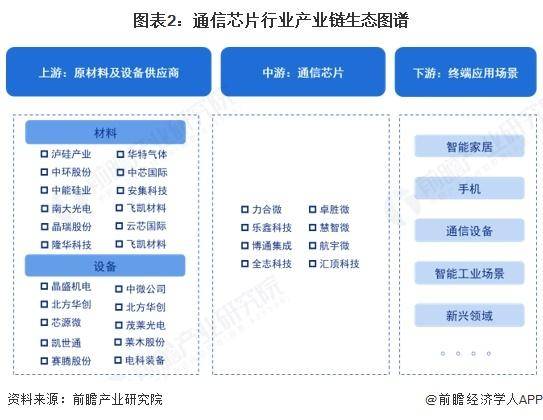
Core Insights - The communication chip industry is experiencing significant investment and development, with major companies actively expanding their production capabilities and focusing on advanced technologies [4][6][8]. Industry Overview - Key listed companies in the communication chip sector include Lihe Micro (力合微), Lexin Technology (乐鑫科技), Broadcom Integration (博通集成), and Allwinner Technology (全志科技) [1]. - The communication chip supply chain consists of upstream raw material suppliers like SMIC and North Huachuang, midstream chip manufacturers such as Lihe Micro and Lexin Technology, and downstream application service providers including Alibaba Cloud and Xiaomi [2]. Investment Trends - Lihe Micro is investing 5 billion yuan in the second phase of its Haining base, aiming to become the largest microwave RF chip production base in China, with a planned annual capacity of 360,000 6-inch chips by 2025 [4][6]. - Guangxun Technology is investing 6.75 billion yuan in a high-end optoelectronic and silicon photonic chip project, focusing on the development of high-speed optical modules for AI computing centers [4][6]. - Lemon Photon is initiating a semiconductor laser chip manufacturing project with an investment of 100 million yuan, expecting cumulative sales of over 340 million yuan in five years [4][6]. - Xincheng Semiconductor is investing 800 million yuan in an IDM production line in Suzhou, which is set to start mass production by December 2024, filling a gap in high-end optical chip manufacturing in China [4][6]. Market Dynamics - The global RF chip market is projected to reach approximately 23.7 billion USD in 2024, driven by technological advancements and the increasing importance of multi-band compatibility [8]. - Filters are becoming the most critical component in RF front-end modules, with their value share increasing from 33% in 3G devices to 57% in LTE devices, and expected to reach 66% in 2024 [7][8]. - The industry is witnessing a trend towards regional supply chain layouts due to geopolitical factors, with companies enhancing competitiveness through technology development and local production [8].

国博电子(688375):有源相控阵雷达领域保持稳定增长,积极拓展商业航天新兴市场
Soochow Securities· 2025-09-01 05:11
Investment Rating - The investment rating for the company is "Buy" (maintained) [1] Core Views - The company continues to consolidate its dual main business advantages in active phased array T/R components and RF integrated circuits, with no significant adverse changes in core competitiveness. Key technological breakthroughs have been achieved in W-band system-level packaging antennas and low-profile broadband millimeter-wave digital arrays, with multiple products delivered in small batches for low-orbit satellites and commercial aerospace [3][9] - The company has completed the industrialization project for RF chips and components, with surplus raised funds of 238 million yuan permanently replenishing cash flow. The second phase of the industrialization project is progressing as planned, with a budget of 698 million yuan and 266 million yuan already invested, expected to be put into production by the end of 2025, further solidifying the company's leading position in high-frequency and high-density components [3] Financial Performance Summary - In the first half of 2025, the company achieved operating revenue of 1.07 billion yuan, a year-on-year decrease of 17.82%, and a net profit attributable to the parent company of 201 million yuan, a year-on-year decrease of 17.66%. The decline in revenue and profit was mainly due to a decrease in orders for the two main products: T/R components and RF modules [1][9] - The sales gross margin remained stable, but the expense ratio increased. As of the end of the first half of 2025, cash and cash equivalents were 1.867 billion yuan, a decrease of 20.74% from the beginning of the year. Accounts receivable increased by 22.87% to 3.228 billion yuan, related to the elongation of military product payment cycles. Inventory increased by 29.82% to 333 million yuan as the company proactively stocked up to meet the delivery peak in the second half of the year [9] - The comprehensive gross margin for the first half of 2025 was 39.05%, an increase of 3.80 percentage points year-on-year, benefiting from a higher proportion of high-margin military products and a decline in raw material prices. The R&D expense ratio was 12.17%, a decrease of 1.64 percentage points due to reduced input as some R&D projects entered the acceptance stage [9] Earnings Forecast and Valuation - The company's performance aligns with market expectations. Considering the uncertainty of orders, the previous profit forecasts have been slightly adjusted downwards. The expected net profits attributable to the parent company for 2025 and 2026 are 533 million yuan and 597 million yuan, respectively, with a new forecast for 2027 at 811 million yuan, corresponding to P/E ratios of 72, 65, and 48 times [10]

春兴精工:扣非净利亏损收窄,主营微增显韧性,新能源爬坡静待放量
Zhong Jin Zai Xian· 2025-08-29 03:08
Core Viewpoint - The company reported a net loss of 129 million yuan in the first half of 2025, primarily due to the ramp-up of production capacity for new energy vehicle components and a planned provision for liabilities [1][2]. Financial Performance - The company's revenue for the first half of 2025 was 977 million yuan, with a year-on-year growth of 4.21% in main business income [1]. - The automotive components business saw a revenue increase of 7.36% and a gross margin increase of 1.59% year-on-year [2]. - The precision structural components business revenue rose by 12.77% [2]. - The overseas market revenue grew by 6.44% [2]. Strategic Positioning - The company is positioned at a critical juncture in the telecommunications sector, benefiting from the national "anti-involution" policy that encourages technological innovation and value creation [3]. - The company has developed miniaturized and lightweight filter products suitable for 5.5G base stations, successfully securing orders in this area [3]. - The company has established a presence in the Indian market, avoiding domestic homogenized competition and aligning with the differentiated development needs under the "anti-involution" policy [3]. Market Outlook - The global automotive parts market is projected to reach 5.8 trillion USD by 2025, with the Chinese market expected to exceed 2 trillion USD, and new energy vehicle components are anticipated to account for 35% of this market [4]. - The company's automotive components business performance reflects the strong demand in the Chinese automotive parts market [4]. Operational Challenges and Opportunities - The company needs to address historical issues and enhance core business capabilities to facilitate performance recovery [5]. - Cash flow is expected to improve as historical receivables are collected and production capacity for new energy vehicle components stabilizes [6]. - The new energy vehicle components business must overcome production capacity bottlenecks to convert revenue growth into actual profits [6]. Future Focus - The company should concentrate on maintaining stable relationships with existing core customers in the telecommunications sector while exploring product structure optimization once the new energy vehicle components business achieves stable profitability [6][7]. - The ability to resolve historical burdens and enhance production capacity will be crucial for the company's long-term sustainable development [7].

专家访谈汇总:台积电2nm良率突破90%
阿尔法工场研究院· 2025-06-05 22:10
Group 1: 5G and 6G Technology Transition - By 2025, the Chinese network connection device market is expected to reach 120 billion RMB, with an annual growth rate of 15%, and to exceed 210 billion RMB by 2030, with a CAGR of 11.8% [1] - Domestic companies like Huawei and Unisoc have made breakthroughs in 5G baseband and Wi-Fi 6/7 chips, but still rely on imported advanced processes below 7nm [1] - The global market share for domestic companies is projected to reach 30%, with significant advantages in 5G base stations and all-optical networks [1] Group 2: Motorcycle Industry Analysis - The motorcycle industry, while less focused on than automobiles and commercial aircraft, has a market size second only to these sectors, with China holding a significant position [2] - China is the largest motorcycle producer globally, with over 5 million units sold domestically and over 10 million exported annually, accounting for more than 30% of the global market [2] - Domestic motorcycle brands have improved their technology and product quality, particularly in the large-displacement motorcycle market, gradually surpassing joint venture brands [4] Group 3: Windsurf Acquisition and AI Coding Market - Windsurf, initially a GPU virtualization startup, transformed into an AI programming platform in 2022, attracting many developers [3] - OpenAI's planned acquisition of Windsurf for $3 billion in April 2023 faced challenges due to restrictions on access to the Claude model, impacting user experience [3] - The AI programming market is becoming increasingly competitive, with platforms like GitHub Copilot and Cursor still supporting the Claude model, but facing potential limitations due to tensions between OpenAI and Anthropic [3] Group 4: Huawei WATCH 5 Launch - Huawei's upcoming WATCH 5 is set to be the world's first 5G-enabled smartwatch, featuring a new Kirin chip and 5G eSIM communication module for high-speed connectivity [4][5] - The device supports dual-engine computing, offering powerful performance in "full mode" and extended battery life in "power-saving mode" [4] - The WATCH 5 also incorporates advanced features like Star Flash technology for improved connectivity and a smart assistant for precise health monitoring [6][7] Group 5: TSMC 2nm Process Yield - TSMC's 2nm process yield improved from 60% to 90% since risk production began in July 2023, leveraging experience from 3nm production [8] - By the end of 2025, TSMC is expected to produce 50,000 to 80,000 2nm wafers monthly, with demand significantly outpacing that for 5nm [8] - The N2 process offers a 10-15% performance increase at the same power level or a 25-30% power reduction at the same performance level, with a 1.7x increase in transistor density [8]