AI硬件化

Search documents
长江有色:美元走弱及科技需求回暖 26日锡价或上涨
Xin Lang Cai Jing· 2026-02-26 02:07
Core Viewpoint - The recent surge in tin prices is driven by a combination of macroeconomic factors, supply constraints, and structural demand growth in emerging sectors such as AI and renewable energy [2][3]. Group 1: Market Performance - Overnight, London tin prices rose by 7.19%, closing at $53,915 per ton, an increase of $3,615 from the previous trading day, with a trading volume of 884 contracts and an open interest of 21,849 contracts, up by 113 [1]. - The Shanghai Futures Exchange saw the main contract for tin (2603) close at 423,990 yuan per ton, up by 23,130 yuan, reflecting a 5.77% increase [1]. Group 2: Supply and Demand Dynamics - Supply constraints are evident due to maintenance schedules at major domestic smelting enterprises during the Spring Festival, leading to a contraction in overall output [3]. - Global supply remains tight, particularly in key production areas like Myanmar and Indonesia, which are experiencing slow recovery and strict mining regulations, respectively [3]. - Demand is showing structural growth, particularly in emerging sectors such as electric vehicles, AI infrastructure, and photovoltaics, which are becoming the main drivers for tin consumption [3]. Group 3: Price Outlook - Short-term forecasts suggest that tin prices will continue to exhibit a strong rebound, although the pace of increase may slow, with prices expected to fluctuate between 415,000 and 425,000 yuan per ton [3]. - The market is advised to be cautious of potential profit-taking that could lead to technical corrections, although the fundamental supply-demand imbalance is expected to limit the extent of any price pullback [3].


天猫「扶优」一年,新品牌迎来黄金时代
3 6 Ke· 2026-01-13 11:27
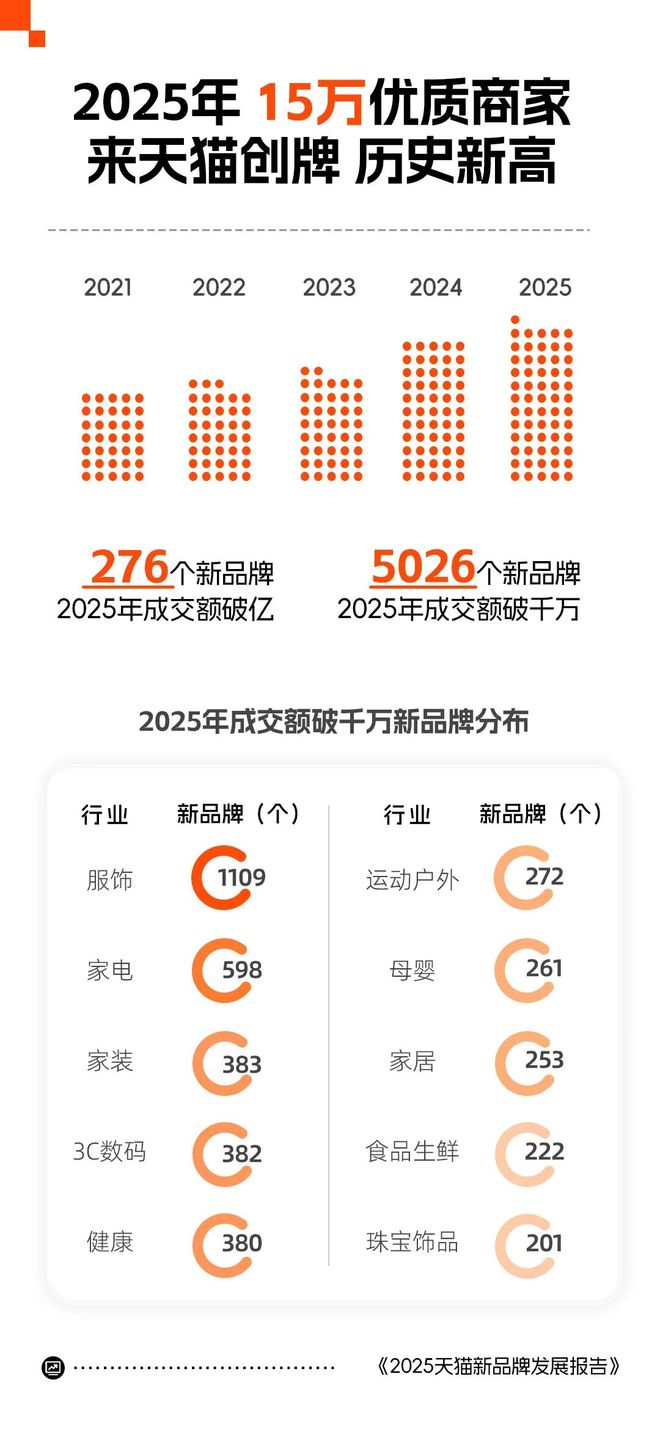
Core Insights - The report from Tmall indicates a strong performance in the new brand sector, contradicting the narrative of a declining consumer market, with 150,000 new merchants and 276 new brands achieving over 100 million in sales [1][8] - The data suggests that 2025 is a significant year for new brand entrepreneurship, showcasing a thriving environment for brands that focus on product quality rather than price competition [8][10] Group 1: Market Performance - Tmall's report highlights a historical high in the number of new brands achieving significant sales milestones within three years of establishment, with a year-on-year growth of over 40% for brands reaching 100 million in sales in their opening year [1][8] - The report emphasizes that the consumer market is not "cooling down" but rather becoming more selective, rewarding brands that focus on genuine product quality [13][30] Group 2: Brand Strategies - Successful brands are characterized by their commitment to product excellence, as seen in the case of brands like Xucuihua, which focuses on high-quality, plant-based cat litter, and CrzYoga, which tailors products to local consumer preferences [10][24] - The report identifies three main winning strategies among new brands: technology translation into user experience, pain point customization, and leveraging IP for sustained consumer engagement [23][24][26] Group 3: Consumer Trends - The evolving consumer demand is shifting towards a balance of emotional and practical value, with a consistent increase in the quality index of consumer goods over the past ten quarters [34][35] - The report suggests that the future growth opportunities lie in high-quality products that meet the evolving needs of consumers, particularly in sectors like AI hardware, smart accessories, and innovative home appliances [30][34]
突发,OpenAI 密谋65亿美金重磅收购,目标直指前苹果大佬Jony Ive,“AI iPhone”能否再创苹果奇迹?
3 6 Ke· 2025-05-22 04:15
Group 1 - OpenAI plans to acquire an AI hardware company co-founded by Jony Ive and SoftBank for up to $6.5 billion, aiming to create a revolutionary "AI iPhone" [1][2][6] - The acquisition represents a significant strategic move for OpenAI to extend its influence from software to hardware, aiming to control the entire ecosystem from models to end devices [6][18] - The project has received over $1 billion in initial investment commitments from SoftBank, highlighting the importance and ambition behind the initiative [6] Group 2 - OpenAI's CEO Sam Altman seeks to build a closed ecosystem that optimizes AI performance and enhances user experience by integrating hardware development [8][18] - Jony Ive aims to leverage AI to create groundbreaking products, potentially surpassing the impact of the iPhone, while focusing on user-centric design [12][19] - SoftBank's investment aligns with its strategy to capitalize on the AI wave, aiming for high returns and leveraging synergies within its technology portfolio [14][15] Group 3 - The envisioned "AI iPhone" is expected to be an AI-native device, fundamentally rethinking user interaction and potentially eliminating traditional app interfaces [16][18] - The device may feature advanced environmental sensing and proactive intelligence, providing personalized and anticipatory services [16] - The collaboration aims to redefine personal computing, with a focus on design excellence and user experience [16][19] Group 4 - OpenAI's shift to hardware is a strategic move to reduce dependency on existing platforms like iOS and Android, allowing for greater control over user data and experience [18] - The success of the "AI iPhone" could redefine human-computer interaction standards, similar to how the iPhone transformed mobile communication [18][24] - The potential challenges include the complexities of hardware manufacturing, market education, and competition from established tech giants like Apple and Google [21][20] Group 5 - The news of the acquisition has already created significant ripples in the tech industry, signaling a shift towards AI hardware as a critical strategic direction for leading AI companies [23] - If successful, the "AI iPhone" could disrupt the current tech landscape, challenging the dominance of existing players and potentially creating a new era in personal computing [24][25]



激进调仓!6只基金重仓股“大换血”,AI硬件化路线图曝光
Hua Xia Shi Bao· 2025-04-29 22:59
Core Insights - The first quarter of 2025 saw significant changes in the top holdings of several public funds, indicating a "big reshuffle" in heavy-weight stocks, particularly in the technology sector [1][2] - Fund managers are shifting their portfolios towards "AI hardware" themes, focusing on sectors such as humanoid robotics and smart driving, driven by regulatory changes and technological advancements [1][6] Fund Adjustments - The Ping An Advanced Manufacturing Theme Fund replaced 6 of its top 10 holdings, moving away from traditional automotive parts to focus on humanoid robotics and AI applications [2][4] - The Huafu Technology Dynamic Mixed Fund aggressively shifted from traditional actuator stocks to smart chassis system suppliers, indicating a transition in the smart driving sector [2][4] - The China Europe Prosperity Growth Mixed Fund executed a complete overhaul of its top holdings, emphasizing smart driving and humanoid robotics, with a focus on L3-level autonomous driving regulations [4] Investment Trends - There is a notable trend of increasing investment in Hong Kong tech stocks and the semiconductor industry, with funds like the Jiashi Technology Innovation Mixed Fund boosting their positions in major players like Alibaba and Tencent [4][5] - The Xinguang He Yi Fund has increased its stake in SMIC, reflecting the acceleration of domestic semiconductor substitution, while also investing in Xiaomi's AIoT strategy [5] - The Silver Hua Xinyi Flexible Allocation Fund has also increased its holdings in Hong Kong internet stocks, indicating a bullish outlook on the equity market for the year [5] Market Implications - The adjustments in fund holdings highlight two major trends: the internal "AI hardware" focus within tech stocks and the value reassessment of Hong Kong internet giants [6] - The industry is witnessing a transformation in the manufacturing value chain due to AI, with a strategic focus on components like robotic joints and sensors [6] - The demand for smart driving systems is expected to surge following the implementation of L3-level autonomous driving regulations, creating opportunities for related suppliers [6]