QT(量化紧缩)

Search documents
花旗:沃什将谨慎推进美联储缩表
Sou Hu Cai Jing· 2026-02-09 20:06
Core Viewpoint - The potential nomination of Walsh as the Federal Reserve Chair suggests a gradual approach to reducing the Fed's $6.6 trillion asset portfolio to avoid renewed tensions in the money markets [1] Group 1: Federal Reserve's Asset Reduction Strategy - Citi strategists indicate that any attempt to restart balance sheet reduction (QT) could pressure the $12.6 trillion repurchase market, making the threshold for such actions quite high [1] - The Fed under Walsh may consider various methods to reduce its asset size, including converting maturing long-term Treasury bonds into short-term debt to shorten the weighted average maturity of its holdings [1] - Other options include reducing the current monthly Treasury bill purchase rate of approximately $40 billion or allowing mortgage-backed securities to mature naturally [1] Group 2: Expected Changes in Bond Purchases - Citi anticipates that decision-makers will lower the bond purchase scale to about $20 billion per month starting mid-April and continue this until the end of the year [1]
申万宏源:QE时代或已终结 美联储扩表已经进入“新常态
Zhi Tong Cai Jing· 2026-02-03 22:32
Core Viewpoint - The report from Shenwan Hongyuan indicates that the Federal Reserve's resumption of Reserve Management Purchases (RMP) after the December 2025 FOMC meeting has sparked optimism for a "QE-style" liquidity easing, but the era of QE may be over until the next economic crisis [1] Group 1: Transition from Balance Sheet Normalization - Since the 2008 global financial crisis, the Federal Reserve's balance sheet has expanded significantly, with total assets reaching $6.6 trillion by November 2025, over seven times the level in early 2008 and 1.7 times the level at the end of the first round of quantitative tightening (QT1) in September 2019 [2] - The resumption of RMP in December 2025 marks the beginning of a "normalization expansion" phase, with an initial monthly purchase of $40 billion, potentially slowing to $20-25 billion after May [2] Group 2: Differences Between RMP and QE - RMP and QE differ fundamentally in terms of quantity, quality, and market implications; RMP operates under a framework of ample reserves and is not aimed at influencing monetary policy stance, while QE is a non-conventional tool aimed at lowering long-term interest rates [3] - The transition from a "shortage of reserves" to an "ample reserves" framework has changed how the Federal Reserve controls interest rates, with the latter allowing for less frequent open market operations [4] Group 3: End of the QE Era - The ability of the Federal Reserve to shrink its balance sheet post-QE depends on reserve demand and the duration of held securities; historically, zero interest rates have been a necessary condition for the implementation of QE or Yield Curve Control (YCC) [5] - The year 2026 is projected to be the final phase of a rate-cutting cycle for Western central banks, indicating that liquidity easing may not be as significant as previously thought [5] Group 4: Market Implications - The impact of RMP on capital markets is seen as indirect and defensive, potentially reducing the likelihood of stock sell-offs due to liquidity shocks, but not fundamentally bullish for the market [6]

美联储资产负债表分析框架:QE 时代的终结
Shenwan Hongyuan Securities· 2026-01-31 07:06
Group 1: Federal Reserve's Balance Sheet Evolution - Since the 2008 financial crisis, the Federal Reserve has undergone four rounds of quantitative easing (QE) and two rounds of quantitative tightening (QT), with total assets reaching $6.6 trillion by November 2025, which is over 7 times the level in early 2008 and 1.7 times the level at the end of QT1 in September 2019[3] - The Federal Reserve's balance sheet normalization has transitioned to a "new normal" phase, with the initiation of Reserve Management Purchases (RMP) in December 2025, starting at $40 billion per month, potentially slowing to $20-25 billion after May 2026[3][4] Group 2: RMP vs. QE - RMP is fundamentally different from QE in terms of quantity, quality, and market implications; RMP aims to maintain sufficient reserves without affecting monetary policy stance, while QE is designed to lower long-term interest rates under zero lower bound constraints[4][40] - The RMP's expansion speed is expected to align with nominal GDP growth, estimated at around 5%, which would require the Fed to increase its holdings of Treasury bills by approximately $300 billion annually, or $25 billion monthly[43] Group 3: Monetary Policy Framework - The shift from a "scarce reserves" framework to a "ample reserves" framework has altered how the Fed controls interest rates, with policy rates now serving as the primary indicator of monetary policy stance rather than reserve quantities[5] - The Fed's monetary policy framework faces a "trilemma" where it struggles to balance interest rate control efficiency, balance sheet costs, and frequency of open market operations[5] Group 4: Future Outlook - The end of the QE era suggests that the next opportunity for QE or Yield Curve Control (YCC) may only arise during the next economic crisis, as zero interest rates are a necessary condition for such measures[6] - The market implications of RMP are defensive rather than bullish, as it may reduce the likelihood of stock market sell-offs due to liquidity shocks but does not change the overall market direction[7]
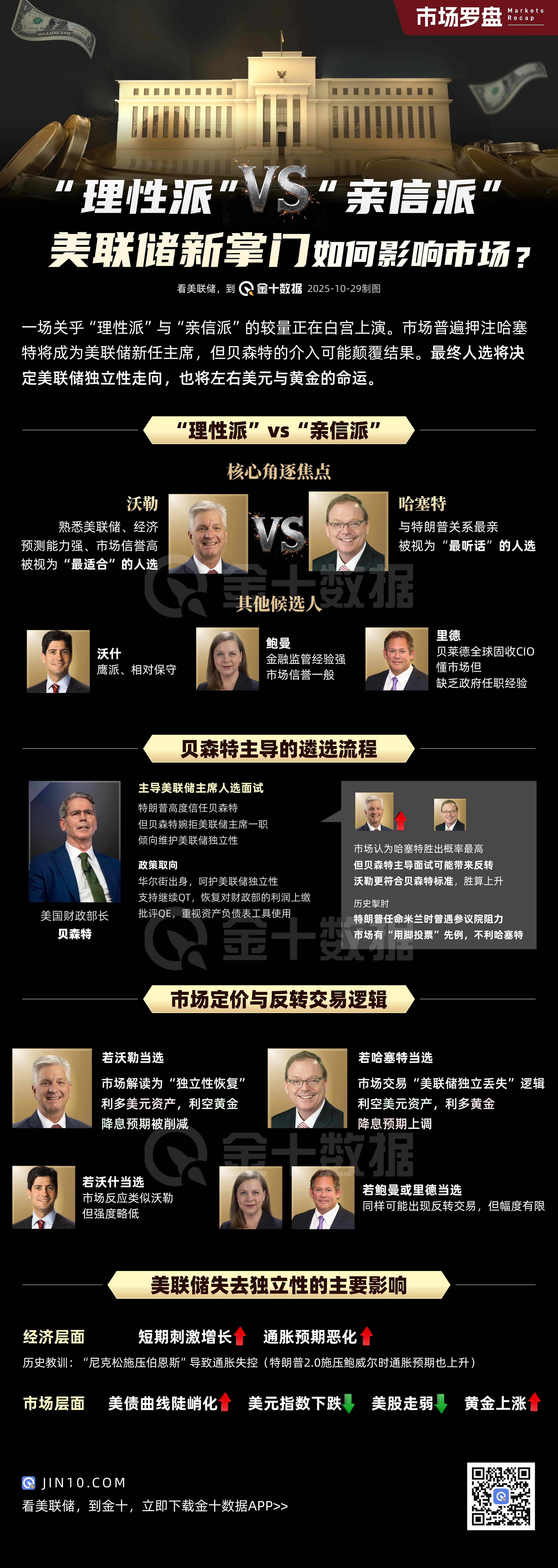
理性派vs亲信派:美联储新掌门人选将如何影响市场?| 市场罗盘
Jin Shi Shu Ju· 2025-10-29 03:58
Core Viewpoint - The selection of the new Federal Reserve Chair will significantly influence the independence of the Fed and its policy direction, impacting market expectations and economic stability [2][4]. Group 1: Candidates and Their Profiles - Waller is viewed as a strong candidate due to his familiarity with the Fed and strong economic forecasting abilities, making him a suitable choice [4]. - Waller is characterized as hawkish and relatively conservative, indicating a preference for tighter monetary policy [6]. - The market perceives Waller's potential appointment as a positive for dollar assets, with reduced expectations for interest rate cuts [15]. Group 2: Market Reactions - If Waller is appointed, the market is likely to interpret this as a sign of Fed independence, which would be bullish for dollar assets and diminish rate cut expectations [15]. - Should Washington be appointed instead, the market reaction would be similar to Waller's, but with slightly less intensity [17]. Group 3: Historical Context - Historical lessons, such as Nixon's pressure on Burns, highlight the importance of maintaining the Fed's independence to avoid adverse economic consequences [19].

英国国债收益率曲线陡峭,市场重新评估财政政策前景
news flash· 2025-07-02 13:22
Core Viewpoint - The UK bond yield curve is steepening as the market reassesses the outlook for fiscal policy, indicating a shift in expectations regarding public borrowing and potential government actions [1] Group 1: Market Reassessment - The market is evidently re-evaluating the prospects of UK fiscal policy, leading to a significant steepening of the bond yield curve [1] - A recent vote in the House of Commons has prompted a reconsideration of public borrowing possibilities [1] Group 2: Government Borrowing and Budget Expectations - The market has recognized that the government has deviated from its borrowing path and anticipates corrective measures in the budget [1] - If the current market trend continues, the government may need to announce measures on the revenue side rather than cutting public spending [1] Group 3: Central Bank Actions - The Bank of England is reportedly assessing Quantitative Tightening (QT) and may conclude asset sales by the fall [1]
美联储3月议息会议点评报告:美联储按下缩表减速键:3月决议如何重塑资产定价逻辑
中国银河· 2025-03-20 08:30
Group 1: Economic Projections - The projected GDP growth for 2025 is 3% in Q1 and 2.1% in Q4[8] - The PCE inflation rate is expected to be 2.7% in Q1 2025 and 2.5% in Q4 2026[8] - The unemployment rate is projected to be 4.4% in Q1 2025 and 4.3% in Q4 2026[8] Group 2: Interest Rate Expectations - The Federal Open Market Committee (FOMC) is expected to maintain interest rates between 4.25% and 4.50%[4] - By mid-2025, there is an 80.60% probability of rates being between 425-450 basis points[10] - The probability of rates being between 375-400 basis points is 86.00% by October 2026[10] Group 3: Market Insights - The report indicates a significant focus on inflation control and economic stability[4] - The analysis suggests that market participants are closely monitoring the FOMC's decisions regarding interest rates[10] - The overall sentiment reflects cautious optimism regarding economic recovery and growth prospects[4]
美联储减缓QT,美股有所反弹
GF SECURITIES· 2025-03-20 07:39
Investment Rating - The report does not explicitly provide an investment rating for the industry or specific companies [3]. Core Insights - The Federal Reserve's March 2025 FOMC meeting resulted in a unanimous decision to maintain the federal funds rate target range at 4.25-4.5%, marking the second pause since the rate cut cycle began in September 2024 [3][4]. - The Fed announced a slowdown in the pace of quantitative tightening (QT), reducing the monthly redemption cap on Treasury securities from $25 billion to $5 billion starting in April 2025 [4][6]. - The overall tone of the March FOMC statement was more dovish than expected, indicating increased uncertainty around the economic outlook and a more cautious approach to monetary policy [3][6]. - The Fed's economic projections for 2025 and 2026 show a downward revision in GDP growth to 1.7% and 1.8%, respectively, while inflation expectations have been adjusted upward [14][15]. Summary by Sections Federal Reserve Decisions - The FOMC decided to keep the federal funds rate unchanged and to slow down QT, reflecting a cautious stance amid rising economic uncertainty [3][4]. - The decision to reduce the monthly redemption cap on Treasury securities is aimed at managing liquidity in the banking system [6]. Economic Projections - The Fed's Summary of Economic Projections (SEP) indicates a slight increase in the unemployment rate forecast for 2025 to 4.4% and an upward revision of PCE inflation to 2.7% [14][15]. - The Fed maintains that the likelihood of a recession remains low, despite increased policy uncertainty [14][15]. Market Reactions - Following the FOMC meeting, U.S. stock markets experienced a rebound, with the S&P 500 rising by 1.08% and the Nasdaq by 1.41% [16]. - Market expectations for future rate cuts have also shifted, with probabilities for cuts in May and June 2025 increasing [16].
【广发宏观陈嘉荔】美联储减缓QT,美股有所反弹
郭磊宏观茶座· 2025-03-20 03:07
Core Viewpoint - The Federal Reserve's March 2025 FOMC meeting resulted in a unanimous decision to maintain the federal funds rate target range at 4.25-4.5%, marking the second pause since the rate cut cycle began in September 2024. The Fed also indicated a further slowdown in the pace of balance sheet reduction, with internal disagreements on the approach to controlling inflation amidst a lack of progress [1][5][7]. Group 1: Federal Reserve's Decisions - The FOMC statement was more dovish than expected, highlighting increased uncertainty in the economic outlook and an earlier-than-anticipated slowdown in quantitative tightening (QT) starting in April, with the monthly redemption cap on Treasury securities reduced from $25 billion to $5 billion [1][7][9]. - The Fed's decision to slow QT is seen as a response to potential volatility in bank reserves due to the U.S. debt ceiling situation, which could impact liquidity in the banking system [10][19]. Group 2: Economic Projections - The March Summary of Economic Projections (SEP) reflects a cautious outlook, with GDP growth forecasts for 2025 and 2026 revised down to 1.7% and 1.8%, respectively, while inflation expectations were adjusted upward [3][18]. - The unemployment rate forecast for 2025 was slightly increased to 4.4%, and the PCE and core PCE inflation forecasts were raised to 2.7% and 2.8%, respectively [3][18]. Group 3: Market Reactions - Following the FOMC meeting, U.S. equity markets rebounded, with the S&P 500 rising by 1.08%, and the Nasdaq increasing by 1.41%. The yield on the 10-year Treasury note fell slightly from 4.28% to 4.24% [21]. - Market expectations for rate cuts in May and June 2025 increased, with probabilities of 19.4% and 57%, respectively, reflecting a shift in sentiment towards a more dovish monetary policy outlook [19].