
QE(量化宽松)

Search documents
金银惊魂跳水!现货黄金跌超2%、现货白银一度跌超17%,中东局势降温+美数据强劲,历史级回调还是趋势反转?
Jin Rong Jie· 2026-02-05 04:05
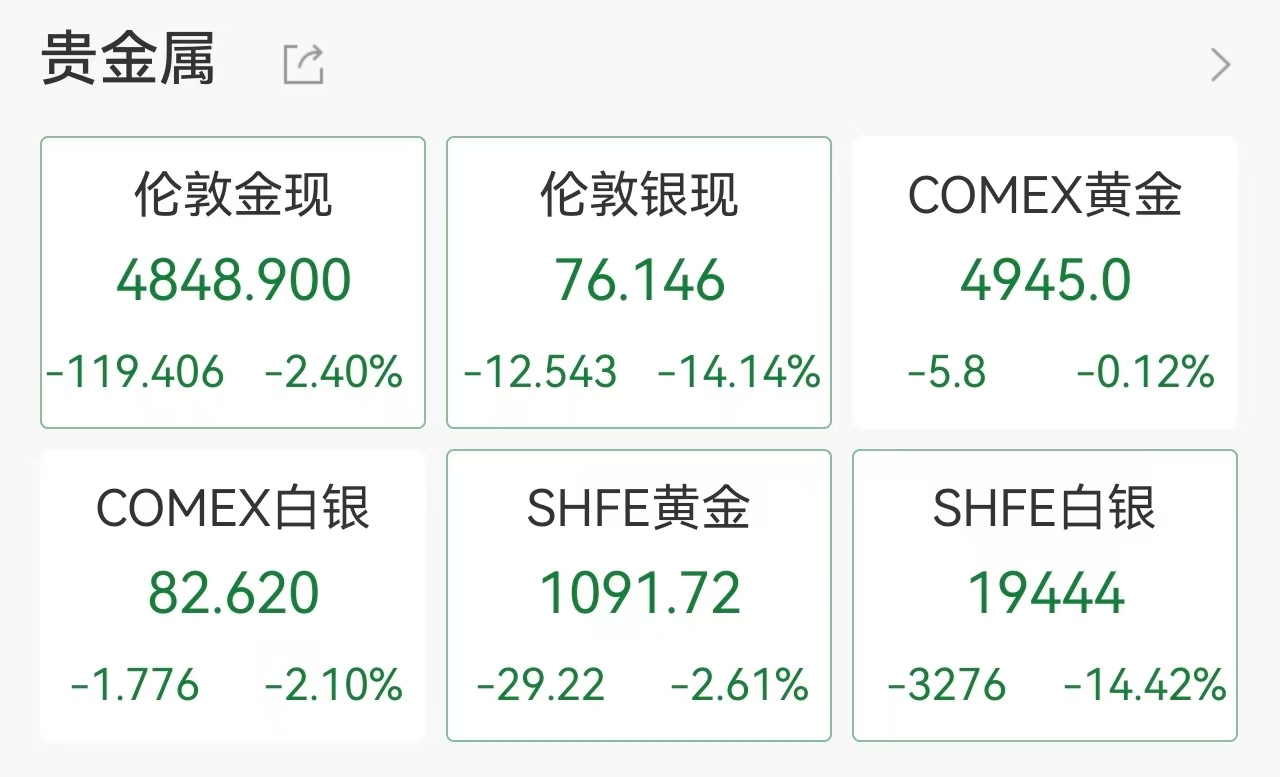
Core Viewpoint - The recent sharp decline in gold and silver prices is attributed to a combination of reduced geopolitical tensions and resilient U.S. economic data, which has diminished safe-haven demand [1] Group 1: Market Performance - As of the latest report, spot gold has dropped by 2.4% to $4848.9 per ounce, previously falling over 3.6% below $4800 per ounce; spot silver has decreased by 14.14% to $76.146 per ounce, having plummeted over 17% below $74 per ounce [1] - Last Friday marked the beginning of a significant downturn, with silver prices crashing by 26%, the largest drop in history, while gold fell by 9%, representing the worst single-day performance in nearly a decade [1] Group 2: Economic Indicators - Upcoming U.S. economic data to watch includes JOLTS job openings and initial jobless claims for the week ending January 31 [1] - The strengthening U.S. dollar and stable U.S. Treasury yields have also contributed to the downward pressure on gold prices [1] Group 3: Influential Factors - The nomination of Kevin Warsh as the next Federal Reserve Chairman by Trump has been identified as a catalyst for market panic, as Warsh is known for his hawkish stance on inflation and support for quicker interest rate cuts [1] - Warsh's views on excessive quantitative easing and support for balance sheet reduction may influence the narrative around de-dollarization and fiat currency proliferation [1] Group 4: Historical Context - Historical analysis indicates that significant price increases in gold typically require around six months to digest, with the current rapid price increases leading to a necessary correction to alleviate overbought conditions [2] - The report highlights that gold experienced 55 record highs in the previous year and surged over 20% in less than a month at the start of this year, indicating an unsustainable rate of increase [2]

申万宏源:QE时代或已终结 美联储扩表已经进入“新常态
Zhi Tong Cai Jing· 2026-02-03 22:32
Core Viewpoint - The report from Shenwan Hongyuan indicates that the Federal Reserve's resumption of Reserve Management Purchases (RMP) after the December 2025 FOMC meeting has sparked optimism for a "QE-style" liquidity easing, but the era of QE may be over until the next economic crisis [1] Group 1: Transition from Balance Sheet Normalization - Since the 2008 global financial crisis, the Federal Reserve's balance sheet has expanded significantly, with total assets reaching $6.6 trillion by November 2025, over seven times the level in early 2008 and 1.7 times the level at the end of the first round of quantitative tightening (QT1) in September 2019 [2] - The resumption of RMP in December 2025 marks the beginning of a "normalization expansion" phase, with an initial monthly purchase of $40 billion, potentially slowing to $20-25 billion after May [2] Group 2: Differences Between RMP and QE - RMP and QE differ fundamentally in terms of quantity, quality, and market implications; RMP operates under a framework of ample reserves and is not aimed at influencing monetary policy stance, while QE is a non-conventional tool aimed at lowering long-term interest rates [3] - The transition from a "shortage of reserves" to an "ample reserves" framework has changed how the Federal Reserve controls interest rates, with the latter allowing for less frequent open market operations [4] Group 3: End of the QE Era - The ability of the Federal Reserve to shrink its balance sheet post-QE depends on reserve demand and the duration of held securities; historically, zero interest rates have been a necessary condition for the implementation of QE or Yield Curve Control (YCC) [5] - The year 2026 is projected to be the final phase of a rate-cutting cycle for Western central banks, indicating that liquidity easing may not be as significant as previously thought [5] Group 4: Market Implications - The impact of RMP on capital markets is seen as indirect and defensive, potentially reducing the likelihood of stock sell-offs due to liquidity shocks, but not fundamentally bullish for the market [6]

美联储资产负债表分析框架:QE 时代的终结
Shenwan Hongyuan Securities· 2026-01-31 07:06
Group 1: Federal Reserve's Balance Sheet Evolution - Since the 2008 financial crisis, the Federal Reserve has undergone four rounds of quantitative easing (QE) and two rounds of quantitative tightening (QT), with total assets reaching $6.6 trillion by November 2025, which is over 7 times the level in early 2008 and 1.7 times the level at the end of QT1 in September 2019[3] - The Federal Reserve's balance sheet normalization has transitioned to a "new normal" phase, with the initiation of Reserve Management Purchases (RMP) in December 2025, starting at $40 billion per month, potentially slowing to $20-25 billion after May 2026[3][4] Group 2: RMP vs. QE - RMP is fundamentally different from QE in terms of quantity, quality, and market implications; RMP aims to maintain sufficient reserves without affecting monetary policy stance, while QE is designed to lower long-term interest rates under zero lower bound constraints[4][40] - The RMP's expansion speed is expected to align with nominal GDP growth, estimated at around 5%, which would require the Fed to increase its holdings of Treasury bills by approximately $300 billion annually, or $25 billion monthly[43] Group 3: Monetary Policy Framework - The shift from a "scarce reserves" framework to a "ample reserves" framework has altered how the Fed controls interest rates, with policy rates now serving as the primary indicator of monetary policy stance rather than reserve quantities[5] - The Fed's monetary policy framework faces a "trilemma" where it struggles to balance interest rate control efficiency, balance sheet costs, and frequency of open market operations[5] Group 4: Future Outlook - The end of the QE era suggests that the next opportunity for QE or Yield Curve Control (YCC) may only arise during the next economic crisis, as zero interest rates are a necessary condition for such measures[6] - The market implications of RMP are defensive rather than bullish, as it may reduce the likelihood of stock market sell-offs due to liquidity shocks but does not change the overall market direction[7]
热点思考 | 美债恐慌重演,市场误读了什么?——“大财政”系列之二(申万宏观·赵伟团队)
申万宏源宏观· 2026-01-25 07:33
Core Viewpoint - The article discusses the recent turmoil in the U.S. financial markets, characterized by a simultaneous decline in stocks, bonds, and the dollar, while highlighting the underlying issues of debt expansion and geopolitical risks that remain unresolved despite temporary market stabilization following Trump's statements at the Davos Forum [2][7]. Group 1: Market Turmoil and Immediate Responses - On January 20, a "triple kill" in the U.S. markets occurred, with significant sell-offs in U.S., European, and Japanese bonds, leading to a drop in risk assets and a rise in safe-haven assets like gold [3][8]. - Key triggers for this market turmoil included concerns over U.S.-European trade disputes, a Danish pension fund's exit from U.S. debt investments, and rising fiscal risks in Japan [3][13]. - Trump's remarks at the Davos Forum on January 21 helped to temporarily ease market fears by ruling out military action regarding Greenland and announcing a framework agreement with Europe [19][3]. Group 2: Long-term Fiscal Concerns - The U.S. fiscal deficit is projected to continue rising, with the 2026 deficit rate expected to reach 6.8%, driven by increased defense spending and immigration-related expenditures [4][66]. - Political motivations for fiscal tightening have weakened, with both parties showing a consensus on fiscal expansion, which may lead to a sustained increase in the deficit regardless of electoral outcomes [26][66]. - Geopolitical risks and tariff concerns are likely to persist, with Trump potentially using alternative tariff measures even if existing ones are deemed illegal [37][66]. Group 3: Structural Financial Measures - To mitigate debt risks, Trump may implement "structural" financial repression measures aimed at lowering real interest rates, although expectations for the Federal Reserve to adopt Yield Curve Control (YCC) are not advisable [5][67]. - The article emphasizes that developed countries with sovereign currencies have a lower likelihood of actual default, as their central banks can issue currency as needed [43][67]. - Proposed measures to address debt concerns include government involvement in interest rate guidance, expanding liquidity tools, and adjusting the structure of debt issuance to reduce long-term impacts [49][67].

【百利好黄金专题】QE再次开启 黄金上不言顶
Sou Hu Cai Jing· 2025-12-23 06:42
Group 1 - Gold prices have increased from $2,614 to $4,380 year-to-date, representing a rise of approximately 67%, making it one of the best-performing asset classes this year. The bullish trend in gold is expected to continue into 2026 due to the shift in the Federal Reserve's monetary policy [1] - The Federal Reserve has initiated a form of quantitative easing (QE) by announcing a $450 billion monthly purchase of short-term government bonds, with $200 billion aimed at meeting monetary demand and $250 billion for replenishing reserves. This move is seen as "invisible QE" despite the Fed's claims that it is merely a technical adjustment [3] - The liquidity gap in the U.S. is projected to reach $300 billion by 2026, indicating that merely halting the balance sheet reduction is insufficient to meet market liquidity needs. This could lead to inflationary pressures similar to those experienced during the pandemic, which previously triggered a bull market in gold [3] Group 2 - In 2025, the Federal Reserve, under Chairman Powell, executed three rate cuts totaling 75 basis points. However, the situation may change in 2026 with potential new leadership favoring lower interest rates [4] - Candidates for the new Federal Reserve chair, such as Kevin Hassett and Kevin Walsh, advocate for lowering rates below current levels, which could undermine the Fed's independence. This shift may align with President Trump's expansionary fiscal policies [4] - The Fed's dot plot indicates a potential rate cut in 2026, but weak employment and stable inflation may lead to two additional cuts, particularly in the first half of the year, with a lower bound around 3%. If the economy enters a recession, the Fed may tolerate inflation above 3% to support economic growth [4] Group 3 - Technically, gold is forming a bullish continuation pattern on the daily chart, approaching previous highs, but there are signs of overbought conditions. A potential pullback to around $4,230 is possible, while the overall outlook remains bullish with a target of $4,500 [5]

特朗普批准H200出口,美将鹰派降息,中美2026金融将合作?
Sou Hu Cai Jing· 2025-12-09 16:52
Group 1 - Trump approved the export of Nvidia's H200, which serves a dual purpose: supporting Nvidia's demand and supply ratio of 12 to 1, indicating no bubble [1][4] - The approval of H200 signifies that the U.S. needs the purchasing power of East Asia, which also supports the AI bubble [4] - The second purpose is profit generation, with Trump planning to take a 25% cut for the government [5] Group 2 - The likelihood of a rate cut by the Federal Reserve is approximately 89%, but it may still adopt a "hawkish" approach to rate cuts [6] - Powell is expected to express uncertainty about next year's situation and may adjust the dot plot from three to two rate cuts [7] - The new chairman, Hassett, emphasizes that future rate cuts must closely monitor data, attempting to counter market expectations of blindly following Trump [8] Group 3 - A minimum of three to five rate cuts is anticipated next year, but the most critical aspect is the restart of quantitative easing (QE), now referred to as Reserve Management Purchases (RMP) [9] - Regardless of whether the Fed buys long-term or short-term bonds, the capital must flow into the market to generate profits [10] Group 4 - Speculation about further financial cooperation between China and the U.S. by 2026 is emerging, distinguishing between stock and incremental measures [11] - Incremental measures correspond to domestic demand, such as issuing special bonds, which do not involve the dollar [12] - Stock measures can be cooperative, as U.S. money printing can help alleviate issues in sectors like real estate, with H200 representing stock and domestic alternatives representing incremental growth [13]


理性派vs亲信派:美联储新掌门人选将如何影响市场?| 市场罗盘
Jin Shi Shu Ju· 2025-10-29 03:58
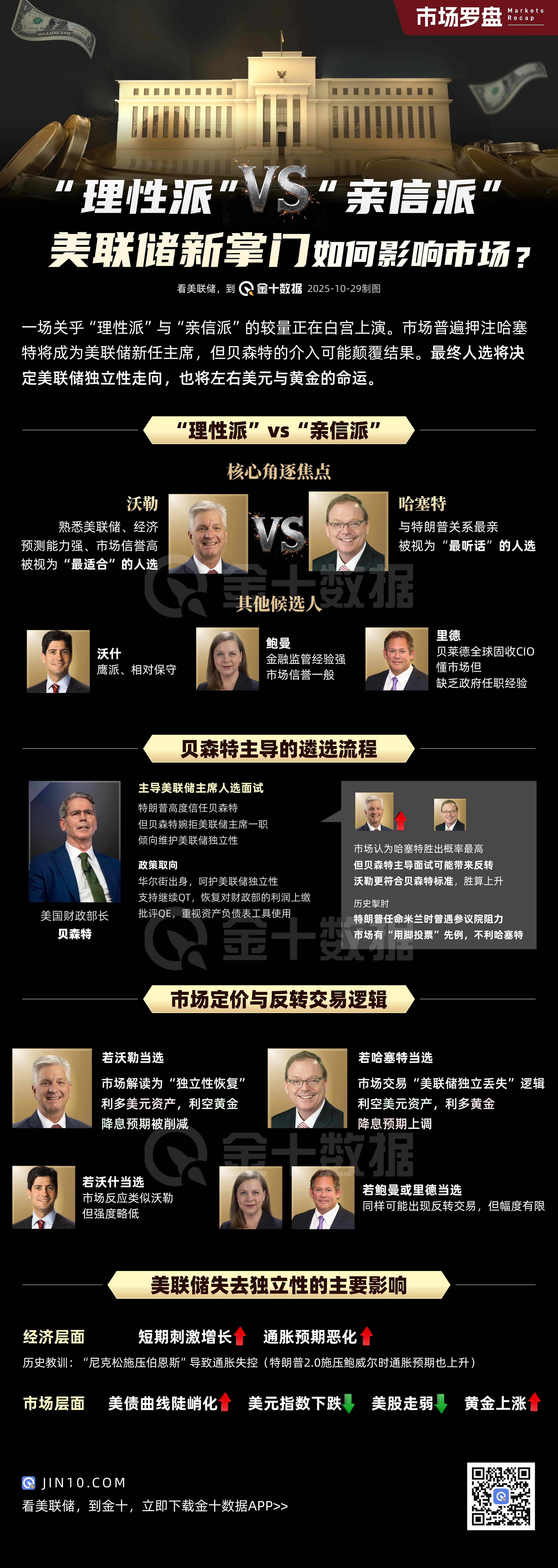
Core Viewpoint - The selection of the new Federal Reserve Chair will significantly influence the independence of the Fed and its policy direction, impacting market expectations and economic stability [2][4]. Group 1: Candidates and Their Profiles - Waller is viewed as a strong candidate due to his familiarity with the Fed and strong economic forecasting abilities, making him a suitable choice [4]. - Waller is characterized as hawkish and relatively conservative, indicating a preference for tighter monetary policy [6]. - The market perceives Waller's potential appointment as a positive for dollar assets, with reduced expectations for interest rate cuts [15]. Group 2: Market Reactions - If Waller is appointed, the market is likely to interpret this as a sign of Fed independence, which would be bullish for dollar assets and diminish rate cut expectations [15]. - Should Washington be appointed instead, the market reaction would be similar to Waller's, but with slightly less intensity [17]. Group 3: Historical Context - Historical lessons, such as Nixon's pressure on Burns, highlight the importance of maintaining the Fed's independence to avoid adverse economic consequences [19].
全球经济游戏:谁在操控?
Hu Xiu· 2025-06-16 01:06
Group 1 - The article discusses the concept of deflation in the context of a credit currency era, suggesting that temporary deflationary periods present opportunities for profit [1] - It highlights the dangers of reckless money printing, which can undermine currency credibility and lead to a situation where the currency is not accepted internationally [2][3] - The article references historical instances where the U.S. dollar lost its status, particularly in the 1970s when the South African rand was favored over the dollar due to its gold backing [2][4] Group 2 - The decline in South African gold production due to sanctions did not lead to an increase in gold prices, as the global market recognized the unsustainability of the gold standard [5] - The article argues that the U.S. dollar is not truly backed by oil or gold, and questions the transparency of the Federal Reserve's monetary policy [5][6] - It mentions the political dynamics surrounding the Federal Reserve and the influence of former President Trump, suggesting that his actions may undermine the Fed's authority [8][10] Group 3 - The article discusses the implications of rising oil prices on inflation and monetary policy, indicating that political motivations may drive decisions on interest rates [9][10] - It suggests that the introduction of stablecoins in oil transactions could challenge the Federal Reserve's control over currency issuance [12] - The potential for geopolitical tensions, particularly between Iran and Israel, could lead to significant increases in energy prices, impacting global markets [20][21] Group 4 - The article emphasizes the structural deflation issues faced by the U.S. economy, despite being the largest oil importer [24][30] - It argues that rising oil prices could benefit certain stakeholders, including oil producers and the U.S. economy, by stimulating demand [28][29] - The article concludes that Europe will bear the brunt of rising energy prices, exacerbating its economic challenges [31]
