Token 出海

Search documents
算电协同促绿电消纳,区域电力资产迎修复
CAITONG SECURITIES· 2026-03-13 04:30
Investment Rating - The industry investment rating is "Positive" (maintained) [1] Core Insights - The Open Claw trend is driving token and electricity consumption index growth, with a high tolerance for delays in the reasoning phase, leading to a significant increase in the usage of China's large models due to their "cost-effective" nature, promoting the trend of Chinese tokens going overseas [3][4] - The construction of ultra-large-scale intelligent computing centers in China is concentrated in the western region, with over 60% of the new computing power concentrated in eight national computing power hub nodes, which account for about 80% of the national total, creating favorable conditions for the consumption of wind and solar energy [3][4] - The essence of computing and electricity collaboration is the deep coupling of power information scheduling, green energy assets, and computing load, enabling real-time supply-demand matching for high-volatility, high-power computing loads and green energy assets [4] Summary by Sections Market Performance - The recent 12-month market performance shows a decline of 17% for the electricity equipment sector, while the CSI 300 index has seen a decline of 2%, with other sectors showing varying degrees of growth [2] Investment Recommendations - Suggested investment focuses include: - Digital grid companies: South Network Digital, South Network Energy, Xiexin Energy, Guoneng Rixin [4] - IDC with green electricity direct connection: Fuling Power, Jinkai New Energy, Gansu Energy, Jinko Technology, Datang New Energy [4] - Equipment system integrators: South Network Technology, Sunshine Power, Haibo Sichuang, Tongli Tianqi, Zhiguang Electric [4] - Undervalued northwest power and large storage companies: Longyuan Power, Electric Investment Energy, Jiantou Energy, Xintian Green Energy, Inner Mongolia Huadian, Datang Power Generation, South Network Energy Storage, Qianyuan Power [4]
Token出海专家访谈
2026-03-04 14:17
Summary of Token Outbound Expert Interview Industry Overview - The discussion revolves around the outbound token market, focusing on the collaboration between activation platforms, model vendors, and computing power providers. The outbound model is characterized by a three-way interaction among these entities, facilitating the commercialization of services to overseas clients [1][2]. Key Insights and Arguments - **Market Penetration and Cost Advantage**: Domestic models are gaining rapid penetration in overseas markets due to a significant price advantage, being approximately 1/8 to 1/10 of the cost of their overseas counterparts. This is particularly evident in Southeast Asia and other regions with smaller language requirements [1]. - **API Aggregation Platforms**: Independent API aggregation platforms, such as OpenRouter, are entering a growth phase, with an expected daily token output exceeding 50 trillion in Q1 2026, representing a 400% annual growth rate. These platforms are becoming essential for small and medium developers to reduce costs [1][8]. - **Token Consumption Projections**: The average daily token consumption in China is projected to reach 700-800 trillion in 2026, with expectations to grow fivefold to 3,500-4,000 trillion by 2027 due to advancements in agent technology and multi-modal evolution [1][20]. - **Cost Structure**: The cost structure of token generation is primarily composed of electricity (35%-45%) and computing power depreciation (25%-35%). Domestic models achieve superior inference efficiency through extreme sparse activation, leading to a 20% faster token generation speed compared to overseas models [1][17]. Pricing and Market Dynamics - **Pricing Discrepancies**: The pricing model for large models in the U.S. is significantly higher than in China, with U.S. prices being about eight times higher. Compliance and latency issues present barriers for models entering markets like Japan and Europe [3][4]. - **Regional Revenue Structure**: North America dominates the global large model revenue structure, accounting for over one-third of the market, followed by the Asia-Pacific region, which is the fastest-growing area. Europe holds about 15% of the market share, with a growth rate exceeding 31% [5]. - **Market Pathways**: The outbound token market has three main pathways: deploying models on overseas cloud platforms, using AWS for deployment, and leveraging activation platforms for customer acquisition and traffic aggregation [6]. Risks and Challenges - **Geopolitical Risks**: The primary risk factor is geopolitical uncertainty, which affects model output regions and trade relations. Other risks include hardware and electricity cost fluctuations, ecosystem lock-in by leading platforms, and the risk of technological lag in model iterations [3][23]. - **Compliance and Data Security**: Compliance barriers exist, particularly for high-risk scenarios requiring local data storage and processing. A mixed strategy is often employed to navigate these compliance challenges [10]. Future Opportunities - **Emerging Opportunities**: The outbound token market presents new pathways for Chinese computing power to expand internationally. Key variables to monitor include the proportion of overseas model usage, the types of domestic computing power utilized, and the distribution of electricity supply [21][22]. Conclusion - The outbound token market is poised for significant growth, driven by cost advantages of domestic models, the rise of API aggregation platforms, and increasing demand for multi-modal capabilities. However, stakeholders must navigate various risks, including geopolitical uncertainties and compliance challenges, to capitalize on these opportunities.
公用事业行业周报(20260301):25年发电量同比+4.8%,Token出海迎来板块性机会-20260301
EBSCN· 2026-03-01 12:07
Investment Rating - The report maintains a "Buy" rating for the public utility sector, indicating an expected investment return exceeding the market benchmark index by more than 15% over the next 6-12 months [4]. Core Insights - The public utility sector experienced a 1.89% increase this week, ranking 6th among 31 sectors, with significant gains in thermal power (8.93%), photovoltaic power (8.25%), and comprehensive energy services (12.37%) [14]. - The report highlights a rebound in domestic and imported coal prices, with domestic coal prices rising by 24 CNY/ton and imported coal prices increasing by 20-30 CNY/ton [8]. - The total installed power generation capacity in China reached 389,134 MW by the end of 2025, marking a 16.1% year-on-year growth, with notable increases in renewable energy sources such as wind (22.9%) and solar (35.4%) [2][7]. - The report emphasizes the investment opportunity in the "Token" sector, driven by a favorable electricity price advantage and increasing electricity demand, suggesting a focus on companies with competitive valuations in power operations [3]. Summary by Sections Market Overview - The public utility sector's performance this week was strong, with various sub-sectors showing significant growth, particularly in thermal and renewable energy [14]. - The average clearing prices for electricity in Shanxi and Guangdong increased significantly, indicating a tightening market [9]. Coal and Electricity Prices - Domestic coal prices have rebounded, with specific increases noted for various grades of coal, reflecting market dynamics [8]. - The report notes a nationwide decline in proxy electricity purchase costs, attributed to lower long-term thermal power prices and the entry of renewable energy into the market [9][10]. Installed Capacity and Generation - The report details the growth in installed capacity across different energy sources, with thermal power showing a modest increase while renewables like solar and wind are experiencing rapid growth [2][7]. Investment Recommendations - The report suggests focusing on companies involved in "computing electricity" and those with attractive valuations, recommending specific companies such as Funiu Co., Gansu Energy, and others for potential investment [3].
Token 出海,将中国电力卖给全世界
Xin Lang Cai Jing· 2026-03-01 03:27
Core Insights - The significance of the undersea cable network lies not in transmission speed but in the power structure it creates, where those who lay the cables can control information flow [1][2] - In 2026, Chinese AI models are capturing a significant share of the global developer market, with Chinese models accounting for 61% of token consumption on the OpenRouter platform [3][4] Group 1: AI Model Migration - As of February 24, 2026, the top ten models on OpenRouter consumed approximately 8.7 trillion tokens, with Chinese models dominating at 5.3 trillion tokens [4] - The leading model, MiniMax M2.5, consumed 2.45 trillion tokens, followed by Kimi K2.5 and Zhiyu GLM-5, all from China [4] - The introduction of OpenClaw, an open-source tool, has enabled AI to perform complex workflows, leading to exponential increases in token consumption for developers [6][9] Group 2: Cost Structure of Tokens - The cost structure of tokens primarily consists of computing power and electricity, with a single NVIDIA H100 GPU costing around $30,000 and consuming approximately 700 watts [11] - The process of a developer's API request involves data traveling from the U.S. to a Chinese data center, where GPU clusters operate, showcasing the cross-border flow of value through tokens [12][13] - China's electricity prices are about 40% lower than those in the U.S., contributing to the competitive advantage of Chinese AI models [15] Group 3: Strategic Implications - The migration of developers to Chinese models is driven by significant cost differences, with MiniMax M2.5 costing $0.3 per million tokens compared to $5 for Claude Opus 4.6 [8][9] - The transition to Chinese AI models is occurring globally, with developers increasingly relying on these models for their workflows, raising concerns about data sovereignty and compliance [28][30] - The competition in AI models and tokens is becoming a new strategic battleground between the U.S. and China, akin to the semiconductor and space races of the past [30][31]



高盛“正在收割”恒生科技?Token出海利好哪些行业?2026年2月27日 市场温度
Sou Hu Cai Jing· 2026-02-27 18:06
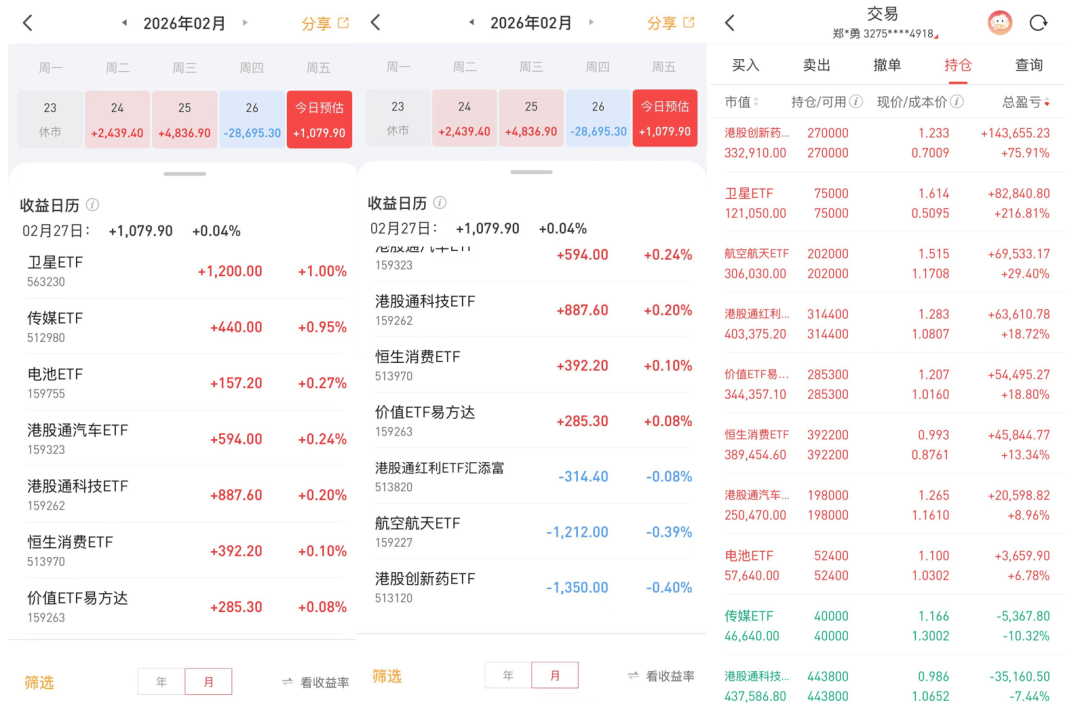
Group 1: Account Performance - The ETF account reported a profit of +0.1 million with total assets of 2.6 million [1] - The fund account showed a projected profit of +3.0 million with total assets of 5.5 million [1] - Combined estimated profit for both accounts is +3.1 million, with a profit-loss ratio of +0.39% [1] Group 2: Weekly Performance Summary - Weekly profits were +4.1 million on Tuesday, +3.9 million on Wednesday, -7.9 million on Thursday, and +3.1 million on Friday, totaling a weekly profit of +3.2 million [2] Group 3: AI-Resilient Basket Strategy - Goldman Sachs introduced the AI-Resilient Basket strategy, which is gaining traction in the market, particularly affecting the Hang Seng Tech Index [4] - The strategy involves a long-short approach, focusing on benefiting from the structural differentiation in the AI industry, where upstream sectors thrive while downstream sectors face challenges [5][6] - The strategy's implementation includes going long on AI upstream sectors like semiconductor and data center infrastructure while shorting downstream sectors vulnerable to AI disruption [6] Group 4: Token Export Opportunities - The concept of Token export is emerging as a significant opportunity for domestic internet giants, leveraging China's abundant computing resources [9] - Token refers to the smallest computational unit for AI models, and exporting Tokens allows for global API and cloud service access, enhancing China's technological and computational output [10] - Key beneficiaries of Token export include data centers, intelligent computing centers, and green electricity operators, primarily held by domestic internet companies [11][12] Group 5: Market Temperature - The current market temperature for A-shares is 71.63, indicating a slight increase of 0.4 from the previous trading day, while the Hong Kong market temperature is at 49.06, up by 0.8 [16] - The Hang Seng Tech Index has seen a decline of 39.02% year-to-date, reflecting the challenges faced by the sector [15]