
UE模型

Search documents
外卖大战2026,从“涨佣”开始
3 6 Ke· 2026-02-10 00:19
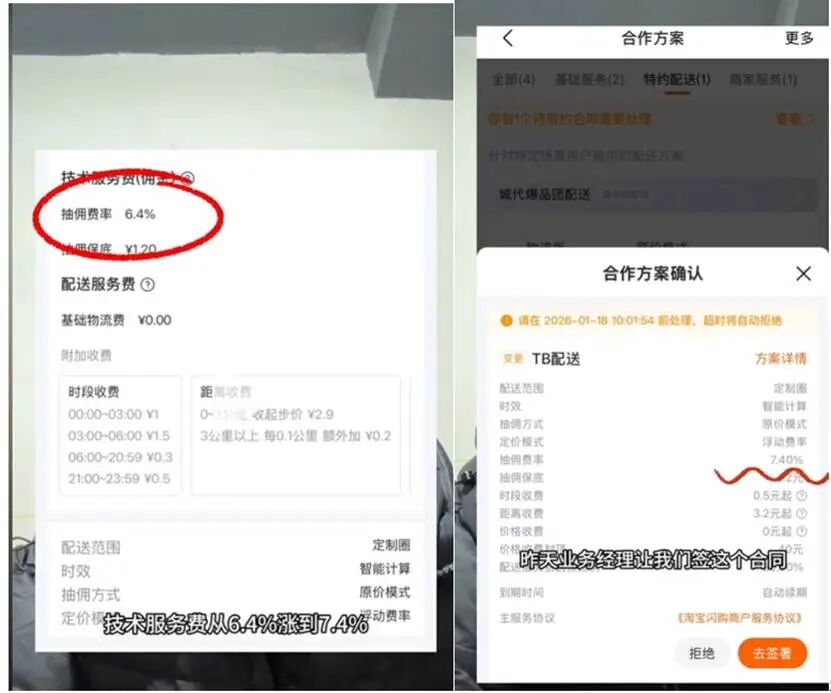
Core Viewpoint - The takeaway from the news is that the food delivery industry is transitioning from a phase of cash-burning expansion to one focused on profitability, as evidenced by the recent commission and delivery fee increases by Taobao Flash Purchase in various regions [1][2]. Group 1: Commission Adjustments - Taobao Flash Purchase has raised commission rates by approximately 0.2% to 1% and slightly increased delivery fees in regions like Guangdong and Jiangxi, with some self-delivery merchants seeing commissions reach around 20% [1][2]. - The adjustments are occurring amidst a highly competitive environment, indicating a strategic shift towards sustainable business models rather than continued heavy subsidies [2][3]. Group 2: Business and Strategic Analysis - From a business perspective, the unit economics (UE) model of Taobao Flash Purchase shows a significant gap compared to competitors like Meituan, necessitating improvements in financial efficiency [5][7]. - On a strategic level, Alibaba is facing increased capital expenditure pressures in AI, prompting a need to conserve funds by reducing subsidies in the food delivery sector, which is expected to become a cash cow to support AI investments [8][9]. Group 3: Market Dynamics and Merchant Impact - The recent regulatory environment aimed at reducing chaotic competition has led platforms to focus on improving profitability from the merchant side rather than the consumer side [13][19]. - Merchants are experiencing increased costs, but many are willing to accept higher commissions to maintain their order volumes, as switching platforms incurs significant sunk costs [19][20]. Group 4: Industry Trends and Future Outlook - The trend of increasing commissions is seen as a necessary evolution in the food delivery industry, moving towards a focus on operational efficiency and profitability [21][22]. - The current competitive landscape remains unstable, with merchants needing to adapt to changing cost structures while building resilience against reliance on single-channel revenue streams [23].



透视外卖账本:京东被「暴击」,阿里方向转移
雷峰网· 2025-11-24 10:57
Core Viewpoint - The fierce competition in the food delivery and instant retail sectors has led to significant financial losses for major players like Alibaba and JD.com, raising questions about the sustainability of their business models and strategies [2][5][6]. Group 1: Financial Performance and Losses - JD.com's new business segment reported a loss of 157 billion yuan in Q3, with daily losses in the food delivery sector reaching approximately 1.5 to 1.6 billion yuan [6][8]. - Alibaba's flash purchase segment is expected to incur losses of 350 to 400 billion yuan in Q3, contributing to an overall loss of around 450 billion yuan for the quarter [8][9]. - Analysts predict that Alibaba's overall EBITA will decline by 80% year-on-year, with significant losses in its instant retail segment [9][10]. Group 2: Market Dynamics and Competition - The competition has intensified, with Alibaba's GMV growth lagging behind that of Pinduoduo and Douyin, indicating a lack of synergy in its e-commerce operations [4][6]. - The market share for JD.com's instant retail has dropped from 11% to 8% within a quarter, highlighting the challenges it faces in maintaining its position [7][8]. - The food delivery market has seen a shift in dynamics, with Alibaba's aggressive subsidy strategy narrowing the market share gap with Meituan, although concerns remain about the sustainability of this approach [11][21]. Group 3: Strategic Implications - Alibaba's long-term goal is to generate an additional 1 trillion yuan in annual transactions through instant retail, but the effectiveness of its subsidy strategy remains uncertain as user engagement metrics show signs of slowing [15][23]. - The competition is expected to continue, with both Alibaba and Meituan focusing on high-value customers as the key battleground for profitability [22][24]. - Analysts suggest that the future of the food delivery war will depend on the ability of these companies to optimize their cost structures and improve operational efficiencies [19][26].


海外Robotaxi支付意愿或较强,国内关注To-B RoboX放量 | 投研报告
Zhong Guo Neng Yuan Wang· 2025-09-03 07:08
Core Insights - The report highlights the convergence of Robotaxi technology with passenger vehicles, indicating that Waymo is developing its VLA/world model based on Gemini, while Tesla's FSDV13 shows a significant gap in performance compared to Waymo [1][2] - In high purchasing power markets, the willingness to pay for Robotaxi services is stronger than for traditional ride-hailing services, with Waymo users prioritizing safety and showing lower price sensitivity [2] - Domestic markets may still view Robotaxi as a substitute for traditional taxis, while in regions like the Middle East, Europe, and North America, there is potential for high-end demand for Robotaxi services [2] Investment Highlights - The report suggests that the domestic To-B solutions, such as RoboTruck, RoboVan, RoboBus, and Robosweeper, may see faster commercialization compared to To-C Robotaxi due to the clear cost-reduction needs of businesses [2] - Companies that could benefit from the overseas Robotaxi market and the acceleration of domestic To-B solutions include WeRide, Pony.ai, Horizon Robotics, Black Sesame Technologies, Jingwei Hirain, and Desay SV [3] Technical Developments - The report emphasizes the need to monitor Tesla's V14 version experience and the performance of Robotaxi operations after removing safety drivers and opening to the public, as this could significantly impact the competitive landscape [1][2]
