
数字产业

Search documents
新闻发布厅丨河南省高质量完成“十四五”规划系列主题新闻发布会之七 河南数智强省建设交出“硬核”答卷
He Nan Ri Bao· 2025-09-27 00:09
Group 1: Core Insights - The overall digital economy in Henan is expected to grow at an average annual rate of over 8% during the "14th Five-Year Plan" period, with the core digital economy's value added accounting for an increased share of GDP by 2.5 percentage points, contributing over 50% to GDP growth [1][2] Group 2: Digital Transformation - Henan is promoting the application of digital technology across various industries, establishing 15 provincial digital transformation promotion centers and 25 development zone centers to support small and medium enterprises in their digital upgrades [2] - Benchmark enterprises have seen an average production efficiency increase of 49.5%, a reduction in operating costs by 17.8%, and a decrease in energy consumption per unit of output by 21.5% [2] Group 3: Data Infrastructure - The province has optimized its computing power infrastructure, achieving a total computing power scale of 9.8 EFLOPS, with 79.6% of this power coming from the "one core and four poles" regional distribution [3] - Henan has invested 50.8 billion yuan in 5G network construction, resulting in a total of 244,700 5G base stations, ensuring that all 450,000 administrative villages have 5G coverage [3] Group 4: Digital Government Development - The province is advancing digital government initiatives to enhance public data utilization and promote coordinated development of the digital economy, society, and ecology [4] - A unified and efficient digital government infrastructure has been established, integrating 59 government cloud resources and connecting over 40,000 access units through a comprehensive electronic government network [4]
河南:2025年全省数字经济规模预计突破2.2万亿元,较2020年增长超过四成
Sou Hu Cai Jing· 2025-09-26 11:28
Core Insights - The core viewpoint of the article highlights the significant growth and structural optimization of the digital economy in Henan Province since the start of the 14th Five-Year Plan, with projections indicating a robust future trajectory [1] Summary by Categories Digital Economy Growth - The total scale of the digital economy in Henan is expected to exceed 2 trillion yuan in 2024, accounting for over 30% of the province's GDP, maintaining a leading position in Central China [1] - By 2025, the digital economy scale is projected to surpass 2.2 trillion yuan, representing an increase of over 40% compared to 2020 [1] Annual Growth Rate - The average annual growth rate of the digital economy in Henan during the 14th Five-Year Plan period is anticipated to exceed 8% [1] Contribution to GDP - The added value of the core digital economy industries is expected to increase its share of GDP by a cumulative 2.5 percentage points [1] - The contribution rate of the digital economy to GDP growth is projected to exceed 50% [1]
投资贸易便利化升级,上海自贸区条例11年来首次大修
Sou Hu Cai Jing· 2025-09-26 10:09
Core Viewpoint - The first major revision of the "Shanghai Free Trade Zone Regulations" has been approved, set to take effect on September 29, 2025, reflecting significant changes in the operational environment and management system of the free trade zone over the past decade [1][2]. Group 1: Investment and Trade Facilitation - The revised regulations solidify existing practices such as the negative list for foreign investment, customs facilitation, and the "single window" for international trade, while also introducing new measures for emerging trade formats and cross-border digital trade [4]. - Future plans include broader foreign investment access, pilot programs for advanced telecommunications, and support for foreign investment in healthcare and vocational training sectors [4]. - The regulations aim to enhance the management of bonded maintenance services for high-tech equipment and promote the use of various fuels in international shipping [4]. Group 2: Financial and Data Flow - The regulations emphasize the development of financial infrastructure and the expansion of cross-border financial services, including support for technology, green, and digital finance [5]. - A mechanism for data security compliance and cross-border data flow is established, promoting high-quality data utilization and international cooperation in the digital economy [5][6]. - Plans to create an international data economic industrial park and enhance data processing capabilities are outlined [6]. Group 3: Innovation and Talent Development - The regulations promote the aggregation of innovative elements, support for cross-border technology transactions, and the development of key industries such as biomedicine and artificial intelligence [7]. - New policies for attracting foreign talent include streamlined visa processes and support for research institutions [8]. - The focus on integrated innovation in key industries aims to enhance Shanghai's position in emerging sectors like integrated circuits and advanced manufacturing [7].


刚刚!发改委,来利好!
Zhong Guo Ji Jin Bao· 2025-09-26 09:05
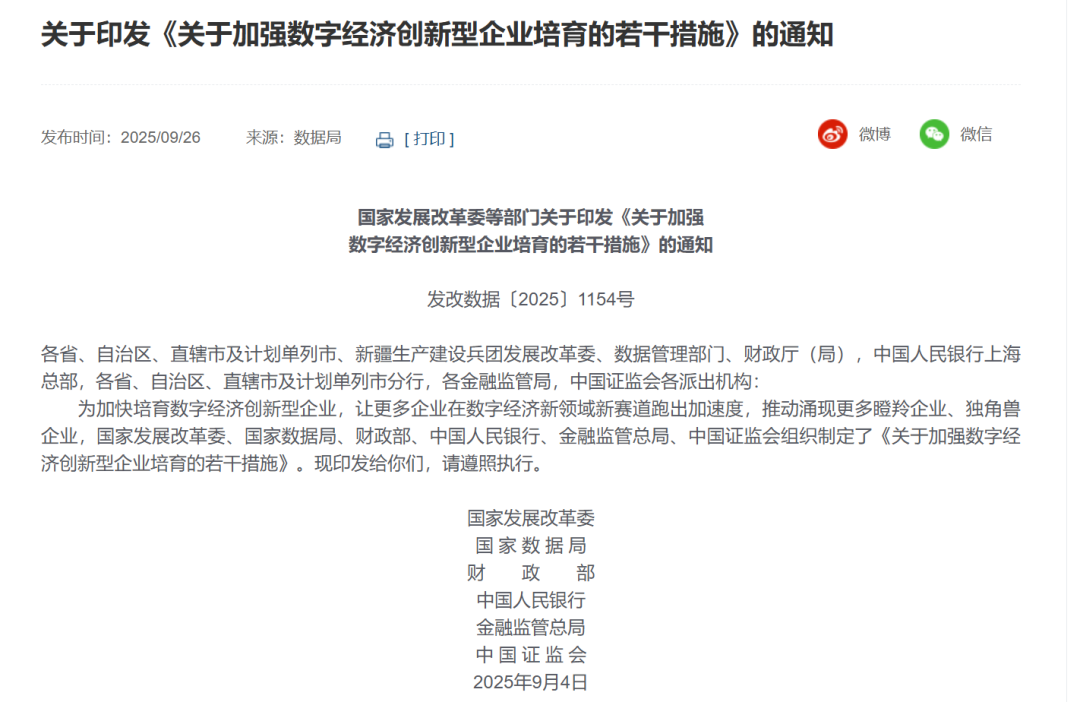
Core Viewpoint - The National Development and Reform Commission and five other departments have issued measures to strengthen the cultivation of innovative enterprises in the digital economy, aiming to accelerate the emergence of more "gazelle" and "unicorn" companies in this sector [18]. Group 1: Mechanisms and Support - Establish a mechanism for discovering innovative digital enterprises by creating a cultivation database that selects and categorizes enterprises with strong innovation capabilities and development potential annually [4][19]. - Strengthen multi-dimensional data usage guarantees by encouraging local governments to establish public data authorization and operational mechanisms, promoting sustainable supply and utilization of public data [5][20]. - Enhance computing power resource support through the implementation of the "East Data West Computing" project, optimizing the deployment of computing resources across key application areas [6][21]. Group 2: Innovation and Transformation - Improve original innovation capabilities by encouraging state-owned enterprises and industry leaders to lead collaborative innovation and share various innovation resources with digital enterprises [8][22]. - Establish a mechanism for the transformation of scientific and technological achievements, promoting deep integration of production, education, and research [10][22]. - Strengthen the supply of scenarios and opportunities by aligning urban digital transformation with market opportunities for enterprises, enhancing the availability of high-quality application scenarios [11][23]. Group 3: Internationalization and Financing - Enhance services for enterprises going abroad by supporting participation in international exhibitions and technology exchanges, showcasing innovative achievements [13][24]. - Optimize financing services by encouraging financial institutions to provide market-oriented financial services tailored to the needs of digital enterprises, and support qualified enterprises in going public [14][25]. Group 4: Regulatory Environment and Talent Development - Establish an open and prudent innovation environment by exploring "sandbox regulatory" models to minimize unnecessary disruptions to enterprise operations [15][26]. - Strengthen talent development by optimizing digital economy-related academic programs in higher education institutions and promoting a talent evaluation system [17][26].
第九届丝绸之路经济带城市圆桌会开幕
Xi An Ri Bao· 2025-09-25 02:29
Group 1 - The 9th Silk Road Economic Belt City Roundtable Conference opened in Xi'an on September 24, 2025, focusing on the theme of "Smart Connectivity and Shared Innovation" [1][2] - Xi'an Mayor Ye Niuping emphasized the importance of the digital economy in transforming urban governance, cross-border trade models, and business organization forms, providing vast opportunities for international city cooperation [1] - The city aims to leverage its advantages in the socialist system, establish a new infrastructure and regulatory framework for the digital economy, and become a pioneer in economic reform [1][2] Group 2 - The roundtable invited over 80 representatives from Xi'an's international friendly cities, international organizations, foreign affairs institutions, and enterprises to share opportunities in digital economy development [2] - The Xi'an Data Bureau presented the achievements and prospects of the digital economy, while the Digital Xi'an Group launched the International Friendly Cities Digital Alliance initiative to promote deep cooperation among digital-friendly cities [2][3]
减少无效投资 “放水养鱼”激活市场活力——专访深圳市前副市长唐杰
Zheng Quan Shi Bao· 2025-09-23 18:15
Group 1 - During the "14th Five-Year Plan" period, China's technological innovation capability has steadily improved, with R&D investment expected to exceed 3.6 trillion yuan in 2024, a 48% increase from 2020 [1] - Basic research funding has reached 249.7 billion yuan, over 70% growth compared to 2020, leading to significant original achievements in fields like quantum technology and life sciences [1] - The national comprehensive innovation capability ranking has improved from 14th in 2020 to 10th in 2024, with the Shenzhen-Hong Kong-Guangzhou cluster ranking first among global innovation clusters [1] Group 2 - The Shenzhen-Hong Kong-Guangzhou cluster is expected to surpass the Tokyo-Yokohama cluster in international patent applications and research paper publications by 2025, driven by enhanced research capabilities [2] - The Greater Bay Area focuses on the industrialization of scientific achievements, relying on foundational research from institutions in Beijing and Shanghai [2][3] - Local governments should tailor industrial policies to their unique industrial ecosystems, ensuring alignment with local development needs [3] Group 3 - Universities play a crucial role in innovation ecosystems, requiring time to develop their capabilities, as seen in Hefei's success linked to its universities [4][5] - Collaboration between universities and enterprises should involve resource sharing and a shift in evaluation systems to encourage diverse contributions from professors [5] - The establishment of "university park" ecosystems around universities can foster innovation and entrepreneurship, creating a closed loop of knowledge creation and industrial transformation [5] Group 4 - The success of companies like Shein is attributed to continuous technological iteration and a fully digitalized operation model that enhances efficiency and reduces waste [6] - Shein's business model integrates design, production, and sales, allowing for flexible production based on real-time demand, significantly lowering inventory costs [6] - Investment in training and a digital incentive mechanism for the workforce has improved production efficiency and profitability across the supply chain [6] Group 5 - Policy recommendations for the "15th Five-Year Plan" include shifting focus from "incremental" urbanization to "stock" development, enhancing productivity through efficiency rather than scale [7] - Encouraging the cross-regional flow of resources, including talent and technology, is essential for fostering a long-term innovative environment [7] - Establishing a unified platform for efficient utilization of idle resources can enhance overall productivity and economic output [7]
以全域党建赋能产业升级 润州激活产业链发展新动能
Zhen Jiang Ri Bao· 2025-09-21 23:40
Group 1 - The core initiative of Runzhou District focuses on enhancing industrial upgrades through comprehensive party building efforts, emphasizing organizational construction, joint party building, and the development of party member teams [1] - A new three-dimensional party building framework has been established, characterized by a collaborative approach that integrates point, block, and chain efforts to promote industrial development [1] - The "Red Chain Run Enterprise" brand has been created, leading to the establishment of four key industrial chain joint party committees and functional party branches in various industrial parks and projects [1] Group 2 - The "Digital Pioneer · Benefit Enterprise" event successfully facilitated face-to-face interactions for digital industry chain enterprises, significantly improving efficiency in addressing business needs [2] - Runzhou District has organized "chain-based" activities led by core enterprises' party organizations, focusing on resource integration and collaboration within the electronic communication, cultural tourism, and food industries [2] - The integration of fragmented policy information through the "Runxin Office" red service team has provided timely solutions to enterprises' urgent needs, enhancing support for local businesses [2] Group 3 - The "Runxin Office" red service team has been established to connect over 20 units, including government agencies and professional service firms, to deliver policies and resources directly to enterprises [3] - Eight party member investment teams have been formed to engage with local businesses, focusing on key sectors such as digital economy and intelligent manufacturing, resulting in over 200 investment trips [3] - A rapid response mechanism has been implemented to provide comprehensive support services for enterprises, leading to the signing of 28 industrial projects worth over 100 million yuan this year [3]
AI赋能新型工业化,金砖国家深化合作
Di Yi Cai Jing· 2025-09-18 04:38
Core Insights - The BRICS countries are focusing on industrial capabilities and digital transformation, with a particular emphasis on artificial intelligence as a key driver for industrialization and innovation [1][2][4] Group 1: Industrial Development and AI Integration - The BRICS New Industrial Revolution Partnership Forum highlighted the importance of new information technologies, such as AI, 5G, and cloud computing, in driving the transformation of the manufacturing sector [1] - The Chinese government is accelerating the integration of AI across all industrial processes, including design, production, and service operations, to enhance smart manufacturing capabilities [4] - The establishment of the BRICS Industrial Capability China Center aims to foster collaboration in technology innovation, digital transformation, and green low-carbon initiatives among BRICS nations [5] Group 2: Investment and Infrastructure - The BRICS New Development Bank is committed to supporting the development of digital infrastructure, vocational education, smart manufacturing, and green economy projects in developing countries [2] - The forum announced the expansion of the New Industrialization International Cooperation Initiative to include 19 countries, enhancing the potential for industrial collaboration within the BRICS framework [5] - A total of 14 industrial cooperation projects were signed, focusing on new materials, AI, green energy, and financial services, indicating a strong commitment to innovation and sustainable development [5]

如何适应和推动数字经济发展
Shang Hai Zheng Quan Bao· 2025-09-16 18:32
Group 1 - The digital economy is rapidly rising and becoming a key battleground for regional development, significantly impacting future competitive positions over the next two to three decades [1][2] - "Application scenarios" are identified as critical entry points for local development of the digital economy, allowing regions to create replicable and scalable digital applications tailored to their specific needs [1][8] - Data is the core element of the digital economy, serving as a foundational resource that determines a region's ability to seize opportunities in the digital transformation [1][13] Group 2 - The digital economy presents new challenges for local economic governance, requiring a shift from traditional models to accommodate the unique characteristics of digital industries [3][4] - Local governments face five systemic restructuring demands due to the digital economy, including the need to adapt their development strategies, governance models, and service capabilities [5][6] Group 3 - The digital economy is driving a profound transformation in industrial structures, moving from linear dependencies to platform-based collaborations, which creates significant opportunities for local development [7][8] - Regions with strong digital foundations should focus on developing core industries and transformation platforms, while those with weaker foundations should prioritize application scenarios that align with local characteristics [10][11] Group 4 - The spatial transferability of data resources offers new opportunities for traditionally underdeveloped regions, allowing them to leverage local advantages in energy and environment to build data infrastructure [12][14] - Local governments should focus on enhancing their digital capabilities by identifying and utilizing their unique resource endowments in the data economy [13][14] Group 5 - Promoting the digital transformation of small and medium-sized enterprises (SMEs) is crucial for enhancing local economic efficiency, as it provides a flexible and cost-effective path to improve competitiveness [15][16] - Local governments must address the challenges faced by SMEs in digital transformation, including funding, technical support, and tailored policies to facilitate their transition [16][17] Group 6 - The digital economy necessitates a rethinking of regulatory frameworks, as traditional approaches may not effectively address the complexities of platform-based markets and data-driven industries [18][20] - Local governments should innovate their regulatory strategies to adapt to the new market dynamics introduced by the digital economy, ensuring effective governance and oversight [19][20] Group 7 - Digital governance is essential for the modernization of government functions, transforming from passive regulation to proactive service delivery, thereby enhancing overall governance capabilities [21][23] - A unified approach to digital governance, including the integration of data and systems, is necessary to improve the efficiency and effectiveness of public services [22][23] Group 8 - The digital economy will serve as a critical dividing line for regional economic development during the "14th Five-Year Plan" period, necessitating a comprehensive reassessment of development strategies [24]
二〇二五年服贸会达成各类成果超九百项 共享开放合作机遇 共促服务贸易升级(走进服贸会)
Ren Min Ri Bao· 2025-09-14 22:07
Core Viewpoint - The 2025 China International Service Trade Fair highlighted the increasing importance of service trade in global trade, focusing on digitalization, intelligence, and sustainability, resulting in over 900 achievements across various sectors [1] Group 1: International Participation and Cooperation - The fair attracted over 80 countries and international organizations, with an internationalization rate exceeding 20%, showcasing new cooperation opportunities [2] - Latvia emphasized the importance of the fair for promoting its cultural and tourism products in China, aiming to enhance brand recognition [2] - Pakistan's participation led to new collaborations, with local businesses seeking opportunities in China's rapidly developing digital industry [2] - France noted the fair as a platform for project incubation and resource connection, facilitating joint innovation between French and Chinese enterprises [2][3] Group 2: Technological Innovation and Market Development - The fair featured nine thematic exhibition areas and over a thousand companies, showcasing advancements in digital innovation and green development [4] - Companies like Canva and Johnson & Johnson presented innovative products, highlighting the fair's role in supporting the entire cycle of innovation from development to market [4] - Czech company Bestar showcased a patented thermal energy storage technology, aligning with China's green development goals [5] Group 3: Reports and Insights on Service Trade - The fair released several authoritative reports, indicating a shift in China's service trade from traditional to high-value sectors, contributing to global service trade growth [6] - China is recognized as the world's second-largest service trade nation, maintaining stable growth and diversifying its service trade landscape [6] - The fair underscored China's role as a stabilizing force in global service trade growth and economic recovery, emphasizing sustainable cooperation through rule alignment and capacity building [7]