水产养殖

Search documents
金融活水赋能“一条鱼”!茂南区罗非鱼产业保险项目落地
Nan Fang Nong Cun Bao· 2025-06-13 12:32
Core Viewpoint - The implementation of the "Maonan Tilapia Industry Insurance" project aims to provide financial support and risk protection for the tilapia industry in Maonan District, enhancing the overall development of this key agricultural sector [5][6][19]. Group 1: Project Implementation - The insurance project was officially launched at a conference held on June 12, marking a significant step in providing financial empowerment to the tilapia industry [5][6]. - The project is a result of nearly a year of research and design under the Zen-Ma cooperation mechanism, addressing the industry's pain points such as price volatility and climate change impacts [17][18]. - The insurance model integrates "insurance + industry," creating a safety net for farmers [19]. Group 2: Industry Overview - Maonan District is recognized as the "Tilapia Capital of China," with a complete industry chain from seed breeding to processing and distribution [9]. - The district has a total aquaculture area of 50,800 acres, with tilapia farming occupying 48,600 acres, accounting for 95% of the total aquaculture area [10]. - By 2025, the district aims to produce 2 billion high-quality tilapia fry annually, with a coverage rate of over 93% for quality breeds [12]. Group 3: Economic Impact - The projected tilapia production for 2024 is 42,700 tons, with an estimated output value of 521 million yuan [13]. - The successful establishment of the National Modern Agricultural Park for tilapia in May 2023 has positioned the tilapia industry as a significant agricultural sector in Maonan District [14]. Group 4: Future Directions - Local leaders emphasized the importance of leveraging the insurance project to empower the tilapia industry and create a successful model for agricultural financial support [27][30]. - Financial institutions are encouraged to innovate products and ensure that support policies reach farmers effectively [28][29].


“安排24小时值班”!“蝴蝶”逼近,上市公司回应
Zhong Guo Xin Wen Wang· 2025-06-13 05:34
Group 1 - Typhoon "Butterfly" is currently located approximately 115 kilometers northwest of Sanya, Hainan, moving north at a speed of 5-10 kilometers per hour and gradually intensifying [3][7] - Companies in Hainan, such as Hainan Rubber, reported that their operations remain normal and they have activated emergency plans, with 24-hour duty arrangements in place [5][9] - The local government in Ledong Li Autonomous County has raised its flood and wind emergency response level from III to II, implementing measures such as suspending classes and closing scenic spots [6][8] Group 2 - Sanya Phoenix International Airport suspended flight operations starting from 22:00 on June 12, with a total of 153 flights executed and 77 flights canceled by 17:00 on the same day [7][8] - Other airports in Hainan, including Haikou Meilan Airport and Qionghai Boao Airport, also experienced significant flight cancellations due to the typhoon [8] - Companies like Guolian Aquatic Products and Guanhao High-tech reported no impact on their production and operations, indicating that their facilities are functioning normally despite the weather conditions [9]



AKVA group ASA: Targeting higher revenue growth and continued margin improvement
Globenewswire· 2025-06-12 06:00
Core Insights - AKVA group ASA has set a revenue target of NOK 5 billion and an EBIT target of 9% for 2027, with ambitions to reach NOK 7 billion by 2030, indicating a focus on profitable growth in the salmon farming industry [1][3] Financial Performance and Targets - AKVA generated revenue of NOK 3.5 billion in 2024 and has provided guidance for NOK 4 billion in 2025, aiming for NOK 5 billion in 2027 and NOK 7 billion by 2030, which represents a doubling of revenue from 2024 to 2030 [3] - The EBIT is projected to increase from 5% in 2024 to 6% in 2025, with a target of 9% in 2027 and an ambition to exceed 10% by 2030 [3] Segment Performance Targets - The Sea Based segment aims to grow revenues from NOK 2.8 billion in 2024 to NOK 3.4 billion in 2027, with an EBITDA margin improvement from 12% to 14% [4] - The Land Based segment targets more than double revenue from NOK 0.6 billion in 2024 to NOK 1.4 billion in 2027, with an EBITDA margin increase from 4% to 10% [4] - The Digital segment aims to grow revenue from NOK 137 million in 2024 to around NOK 250 million in 2027, with an EBITDA margin increase from 22% towards 40% [4] Strategic Initiatives - The company has made significant investments to strengthen its business fundamentals, enabling ambitious growth plans without major additional capital expenditure [5] - AKVA is committed to delivering long-term value to shareholders through share price gains and competitive direct returns, with expectations of increased dividend capacity due to a healthy financial position and improved free cash flow [5] Dividend Policy - The Board of AKVA has established a revised dividend policy, intending to return between 40% and 50% of cash flow after investments to shareholders, subject to business capital needs and market conditions [6]

东营|东营产业援疆绘出疏勒致富新图景
Da Zhong Ri Bao· 2025-06-12 01:22
Group 1 - The article highlights the innovative agricultural practices in Shule County, Xinjiang, focusing on the successful cultivation of sweet crayfish and edible mushrooms in previously saline-alkali land [1][2][3] - The introduction of 300,000 high-quality crayfish seedlings at the Shule Impression Fishing Center marks the launch of a unique fishing experience project, leveraging the region's mineral-rich water for aquaculture [2][3] - The cultivation of morel mushrooms has reached an impressive yield of over 2,000 pounds per acre, generating an estimated annual output value exceeding 800,000 yuan at the current market price of 160 yuan per kilogram [3] Group 2 - The Shule County modern agricultural industrial park is creating job opportunities and stable income for local residents, with hands-on training provided by technicians from Dongying [3][4] - A new 8 million yuan project is set to establish a modern mushroom seed production facility, expected to meet the seed demand for 1,000 acres of morel mushrooms and generate an annual output value of 8 million yuan [3][4] - The article emphasizes the ongoing efforts to enhance the local agricultural industry, including the expansion of fruit and vegetable production and the establishment of a comprehensive operational service center [4][5] Group 3 - The establishment of the Shule Qilu Data Service Industrial Park is attracting data service companies, creating over 380 local jobs and indicating a shift towards new economic opportunities [5][6] - Dongying's support in planning and developing the chemical industry cluster is aimed at elevating the Qilu Industrial Park to a national-level high-tech zone [5][6] - The Xinjiang textile and apparel industry chain has seen significant engagement, with 14 projects signed and a total planned investment of 3.094 billion yuan [6]
如何让“蓝色粮仓”丰富国民餐桌
Ke Ji Ri Bao· 2025-06-12 01:00
Core Insights - The article discusses the potential of marine resources, particularly deep-sea aquaculture, to enhance food supply and address challenges in the industry [1][2] - It emphasizes the need for advanced technology and sustainable practices to optimize marine farming and improve resilience against environmental risks [3][4] Group 1: Marine Aquaculture Development - The deep-sea aquaculture sector faces challenges such as equipment durability and environmental risks, particularly from typhoons [3][4] - There is a call for scientific assessment and careful site selection for marine ranching to ensure sustainability and effectiveness [4] - Advanced equipment, such as gravity cages and specialized fishing vessels, is crucial for the success of deep-sea aquaculture [5][6] Group 2: Environmental Impact and Sustainability - High-density farming can lead to environmental issues like nutrient accumulation, necessitating innovative solutions to mitigate these effects [7][8] - The article advocates for a green development approach, focusing on ecological balance and resource efficiency in marine farming [8] Group 3: Aquatic Breeding Innovations - The development of high-quality aquatic breeds is essential for the success of deep-sea aquaculture, with a focus on self-sufficiency in key species [9][10] - Modern molecular breeding techniques are highlighted as a means to enhance breeding efficiency and produce disease-resistant varieties [10][11] Group 4: Seafood Processing and Market Integration - China's seafood processing sector is underdeveloped compared to global standards, with a need for increased processing rates and value addition [13][14] - Experts suggest enhancing cold chain logistics and developing integrated supply chains to reduce waste and improve market access for seafood products [14][15] Group 5: Cross-Industry Collaboration - The article proposes the integration of marine ranching with other industries, such as tourism and renewable energy, to create synergistic benefits [15]
从40元一斤跌到15元一斤!小龙虾自由来了?
21世纪经济报道· 2025-06-11 07:45
4000亿市场规模 中国人一年吃掉300万吨小龙虾! 你能相信吗? 曾经的夜宵顶流, 如今价格大跌! 3月刚上市,中规格小龙虾批发价最高冲到40元一斤。进入6月,小龙虾更是开启了"产销两 旺"的最佳吃虾季,每斤小龙虾不到15元!大跌超过60%。我们的小龙虾自由已经来了? 为什么小龙虾价格突然下跌? 说白了,就是供大于求。 咱先来看组数据:20年前,我国小龙虾产量才5万多吨。到了2024年,一下子飙到300多万 吨。算下来, 相当于每天吃掉8200吨 。 具体到各地, 湖北、安徽、湖南、江苏、江西这五个省份承包了全国 90%的小龙虾 ,其中, 湖北是妥妥"虾界扛把子",这两年还研究出了四季养殖的法子,直接让小龙虾实现"全年供 货"。广西、四川、海南等地奋起直追,发展反季节养殖,黑龙江、宁夏、甘肃也在蠢蠢欲 动。 最近,电商平台在大打价格战——中号虾3斤不到50元,大号虾也才60元,还有"88元4斤"的 活动。 中国水产流通与加工协会副会长王雪光表示,接下来小龙虾价格还会降 。 虽然小龙虾产销狂飙,但餐饮市场就比较平淡了。 《中国小龙虾产业调查分析报告(2025)》显示,2024年小龙虾门店维持在7.3万家,专业 ...

江苏依托农技耘平台开展创新成果推介与创业经验交流
Xin Hua Ri Bao· 2025-06-10 23:32
Core Insights - The "New Farmers" initiative in Jiangsu is showcasing innovative agricultural practices and entrepreneurship through a series of live streaming events, promoting collaboration and knowledge sharing among farmers [1][2][3] - The program aims to enhance agricultural productivity and rural prosperity by leveraging technology and modern marketing strategies [2][3] Group 1: New Farmers Initiative - The Jiangsu Provincial Department of Agriculture and Rural Affairs has launched the "Cultivating 'New Farmers' Jiangsu in Action" series of live streaming events to promote innovative achievements and entrepreneurial experiences [1] - Successful stories from various regions, such as the transformation of farmers into industry leaders and the use of e-commerce to boost sales, highlight the impact of the "New Farmers" initiative [1][2] Group 2: Technological Integration - The introduction of IoT systems in crab farming has increased efficiency by 35%, demonstrating the benefits of integrating technology into traditional farming practices [2] - The initiative emphasizes the importance of modern marketing and brand development, as seen in the case of "Jianhu Rice," which achieved over 10 million yuan in annual sales [1][2] Group 3: Education and Training - Jiangsu is actively developing a talent pool for agriculture, with over 5,000 "New Farmers" being dynamically managed, and more than 51% holding a college degree [3] - Collaborative training programs with educational institutions have resulted in significant participation, with 207 young farmers engaged in vocational education [3] Group 4: Future Goals - The "New Farmers" initiative aims to cultivate 1,000 leading farmers and 10,000 supporting farmers by the end of 2027, establishing a well-structured and high-quality talent matrix [3]

福建连江:1200万只海马历经8个月培育 迎来收获季
Zhong Guo Xin Wen Wang· 2025-06-10 13:33
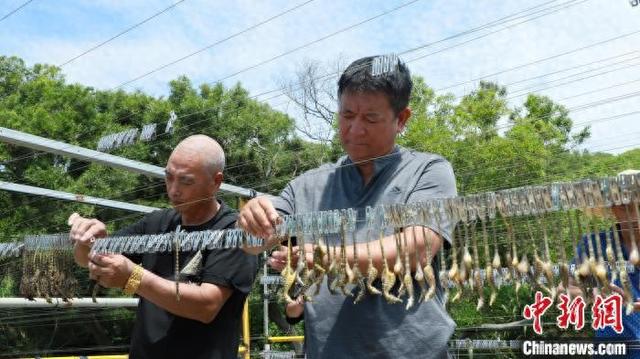
Core Viewpoint - The article highlights the ongoing sea horse harvesting and drying activities by fishermen in Lianjiang, emphasizing the successful cultivation and market potential of sea horses as a valuable medicinal resource [1][3]. Group 1: Sea Horse Cultivation - Lianjiang fishermen have cultivated 12 million sea horses over the past eight months, reaching market size [1]. - The sea horse farming base in Dinghai Village has a water area of approximately 10,000 cubic meters, featuring organized breeding pools [1]. - The sea horses, initially less than 1 cm, have grown to 8-9 cm with an average weight of about 6 grams [1]. Group 2: Harvesting and Processing - Fishermen utilize the unique resting behavior of sea horses to facilitate harvesting, where they gently shake the structures to collect the sea horses [1]. - After harvesting, the sea horses are cleaned with fresh water, straightened, and then hung on iron wires for drying [1]. Group 3: Market Demand and Pricing - Sea horses, known as "Southern Ginseng," are in high demand as a valuable medicinal material, rich in proteins and amino acids [3]. - The dried sea horses are primarily sold to pharmaceutical companies, with prices ranging from 3,000 to 7,000 yuan per kilogram depending on size [3]. - The Dinghai Village base has 5 million mature sea horses, expected to be fully harvested by the end of the month [3].
“海田”启新程 “蓝色产业”富万民
Jin Rong Shi Bao· 2025-06-10 03:23
Group 1 - The marine aquaculture industry in Dalian Changhai County is thriving, with modern farming techniques and significant financial support from Agricultural Bank [1][2] - Tang Lina, head of Dalian Yide Aquatic Products Co., has a farming area of over 20,000 acres and has received facility loans of 4 million yuan in 2024 and 9 million yuan in 2025 to support her operations [1] - The facility loans provided by Agricultural Bank are tailored to the needs of aquaculture and processing businesses, offering flexible repayment options without collateral [3] Group 2 - Fan Jie, head of Fengheyuan (Dalian Changhai) Aquatic Products Farming Co., received over 1.3 million yuan in loans from Agricultural Bank to alleviate financial pressure for purchasing seedlings and paying wages [2] - Jiang Mingchao from Dalian Changhai Guoshun Aquatic Products Co. reported a daily production of 20,000 jin of scallops and received a 600,000 yuan loan to expand production capacity [2] - As of the first quarter of 2025, Agricultural Bank Changhai Branch has issued 179 facility loans totaling 189 million yuan, benefiting numerous aquaculture and processing enterprises [3]

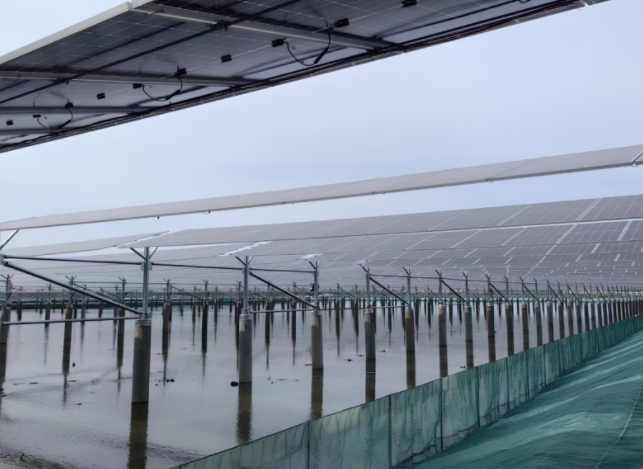
光伏+渔业 绿色能源与生态养殖的双赢探索
Yang Guang Wang· 2025-06-09 02:08
Core Viewpoint - The "Photovoltaic + Fishery" model developed by Jiangsu Academy of Agricultural Sciences represents an innovative approach to integrate renewable energy generation with aquaculture, addressing land resource constraints while promoting sustainable development and rural revitalization [1][5]. Group 1: Innovation and Development - The "Photovoltaic + Fishery" model combines photovoltaic power generation with modern aquaculture, allowing for efficient use of water surfaces without compromising ecological functions [1][2]. - The research team collaborates with leading renewable energy companies to establish a green production system for aquaculture, focusing on optimizing resource utilization and disease prevention [2][5]. Group 2: Technical Standards and Guidelines - A set of technical standards has been established for the construction of photovoltaic fishery ponds, covering site selection, planning, and construction processes [3]. - The standards emphasize the importance of operational maintenance and training to ensure the long-term stability of photovoltaic fishery systems [3]. Group 3: Future Prospects - The innovative model is being promoted across Jiangsu, with plans to deepen cross-disciplinary research and develop sustainable, low-carbon growth models for different regions [5].