生物医药

Search documents
旺山旺水-B午前涨超10%创新高 有研究发现VV116对尼帕病毒有治疗潜力
Xin Lang Cai Jing· 2026-01-27 03:58
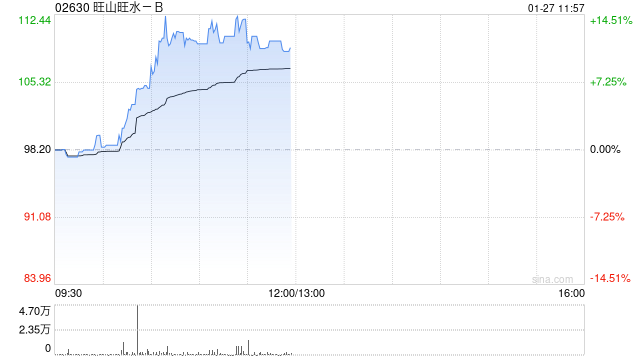
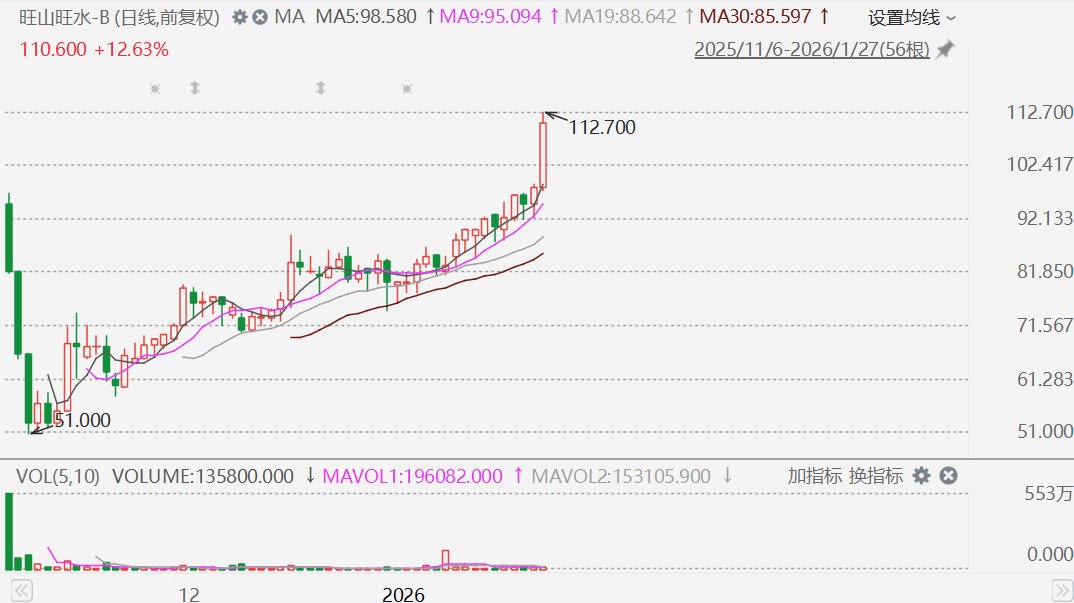
责任编辑:卢昱君 1月26日盘后,中国科学院武汉病毒研究所微信公众号发文称,近期,中国科学院武汉病毒研究所肖庚 富/张磊砢研究员团队、单超研究员团队联合上海药物研究所、旺山旺水生物医药股份有限公司胡天文 博士在国际期刊发表的重要研究成果,证实口服核苷类药物VV116对尼帕病毒具有显著的抗病毒活性, 为这一高致死性新发传染病的防治带来新希望。该成果首次证实VV116对尼帕病毒的治疗潜力,不仅可 作为医护人员、实验室工作者等高危人群的预防性用药,更可为应对当下和未来的尼帕病毒疫情提供了 一个现成的药物选择。 公开资料显示,旺山旺水成立于2013年,重点布局神经精神、生殖健康和病毒感染三大治疗领域。去年 12月,旺山旺水宣布与先声药业签订许可和合作协议。 热点栏目 自选股 数据中心 行情中心 资金流向 模拟交易 客户端 旺山旺水-B(02630)早盘一度涨超14%,高见112.70港元,创上市新高。截至发稿,股价上涨 10.59%,现报108.60港元,成交额2641.54万港元。 热点栏目 自选股 数据中心 行情中心 资金流向 模拟交易 客户端 旺山旺水-B(02630)早盘一度涨超14%,高见112.70港元, ...

旺山旺水新冠口服药有抑制尼帕病毒潜力,但距离应用还很远
Di Yi Cai Jing· 2026-01-27 03:54
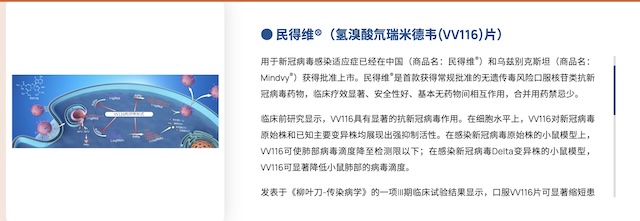
Core Insights - The emergence of Nipah virus cases in West Bengal, India, with a mortality rate exceeding 40%, has raised significant concerns [1] - The research published by the Wuhan Institute of Virology indicates that the oral nucleoside drug VV116 shows promising antiviral activity against Nipah virus, providing new hope for treatment [1][2] Group 1: Drug Development - VV116 is a novel oral nucleoside antiviral drug that has been approved for COVID-19 treatment in Uzbekistan and China [3] - In vitro studies demonstrate that VV116 and its active metabolites significantly inhibit Nipah virus, including Malaysian strain NiV-M and Bangladeshi strain NiV-B [3] - In a lethal dose infection model in golden hamsters, VV116 at a dosage of 400 mg/kg increased survival rates to 66.7% and significantly reduced viral loads in target organs such as the lungs, spleen, and brain [3] Group 2: Market Reaction - Following the announcement of VV116's potential against Nipah virus, the stock of its parent company, Wangshan Wangshui (02630.HK), surged over 10% on January 27 [4] - Despite the positive market reaction, VV116 is still in the preclinical research stage and requires human clinical trials, regulatory approval, and market launch before it can be used as a treatment [4] Group 3: Historical Context - Nipah virus is not a new virus, having caused outbreaks in Malaysia, Singapore, India, and Bangladesh since 1998 [4] - The lack of effective vaccines and therapies for Nipah virus over the years is attributed to insufficient funding for research and relatively low case numbers, despite its high mortality rate [4]
港股异动 | 君实生物(01877)再涨超5% 成功发行10亿元科技创新债券 助力公司研发创新
智通财经网· 2026-01-27 03:28
消息面上,君实生物发布公告称,公司已完成发行2026年度第一期科技创新债券,发行总额为人民币10 亿元,期限为3+2年,于2031年1月26日到期,发行利率为2.70%,募集资金预计将主要用于公司核心的 药物研发、科技创新及相关业务拓展,有助于进一步巩固其在生物医药领域的研发实力和市场竞争力, 符合其作为科技创新企业的战略发展需求。 君实生物(01877)再涨超5%,截至发稿,涨4.55%,报24.84港元,成交额1.79亿港元。 ...

绝对必要!热情!热切!他们要留在中国寻找更多合作机会……
Yang Shi Wang· 2026-01-27 03:25
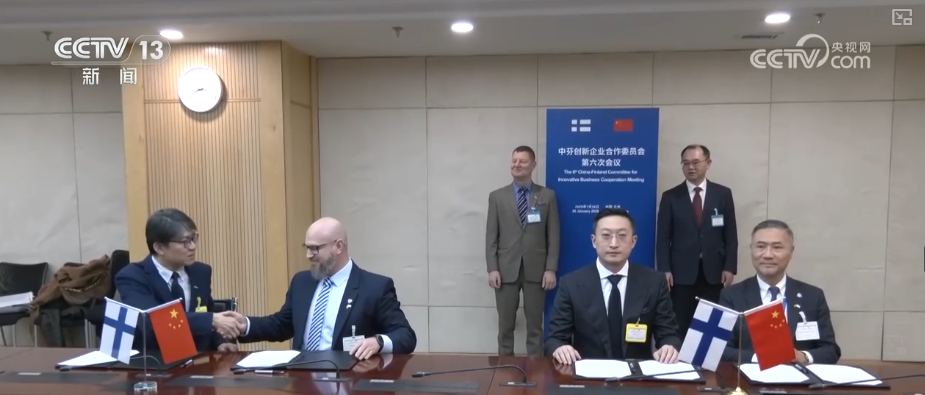
Group 1 - The sixth meeting of the China-Finland Innovation Enterprise Cooperation Committee was held in Beijing, attracting over fifty representatives from Chinese and Finnish companies, highlighting the enthusiasm for bilateral cooperation [1] - Multiple cooperation agreements were signed, covering advanced fields such as green building, biomedicine, and digital technology, indicating a shift from simple product manufacturing to joint research and service-oriented manufacturing [4] - Finnish companies expressed a strong interest in the Chinese pharmaceutical industry, citing the availability of professional resources and talent as key advantages for collaboration [6] Group 2 - The Asia-Pacific Vice President of Peikko Group emphasized the necessity of developing in China, as local partnerships can significantly reduce carbon emissions in the construction industry [8] - By 2025, the bilateral trade volume between China and Finland is expected to exceed 8 billion USD, with mutual investment stock surpassing 23 billion USD, reflecting a growing enthusiasm for mutually beneficial cooperation [10] - Many Finnish entrepreneurs indicated their intention to stay in China for extended periods to explore further collaboration opportunities, showcasing a proactive approach to business development [13] Group 3 - The Vice Chairman of Konecranes highlighted the importance of their business in China, noting the modernization of existing buildings as a driving force for developing new solutions in this market [15]
河南日报整版关注:许昌,这样抢开局!
Xin Lang Cai Jing· 2026-01-27 03:23
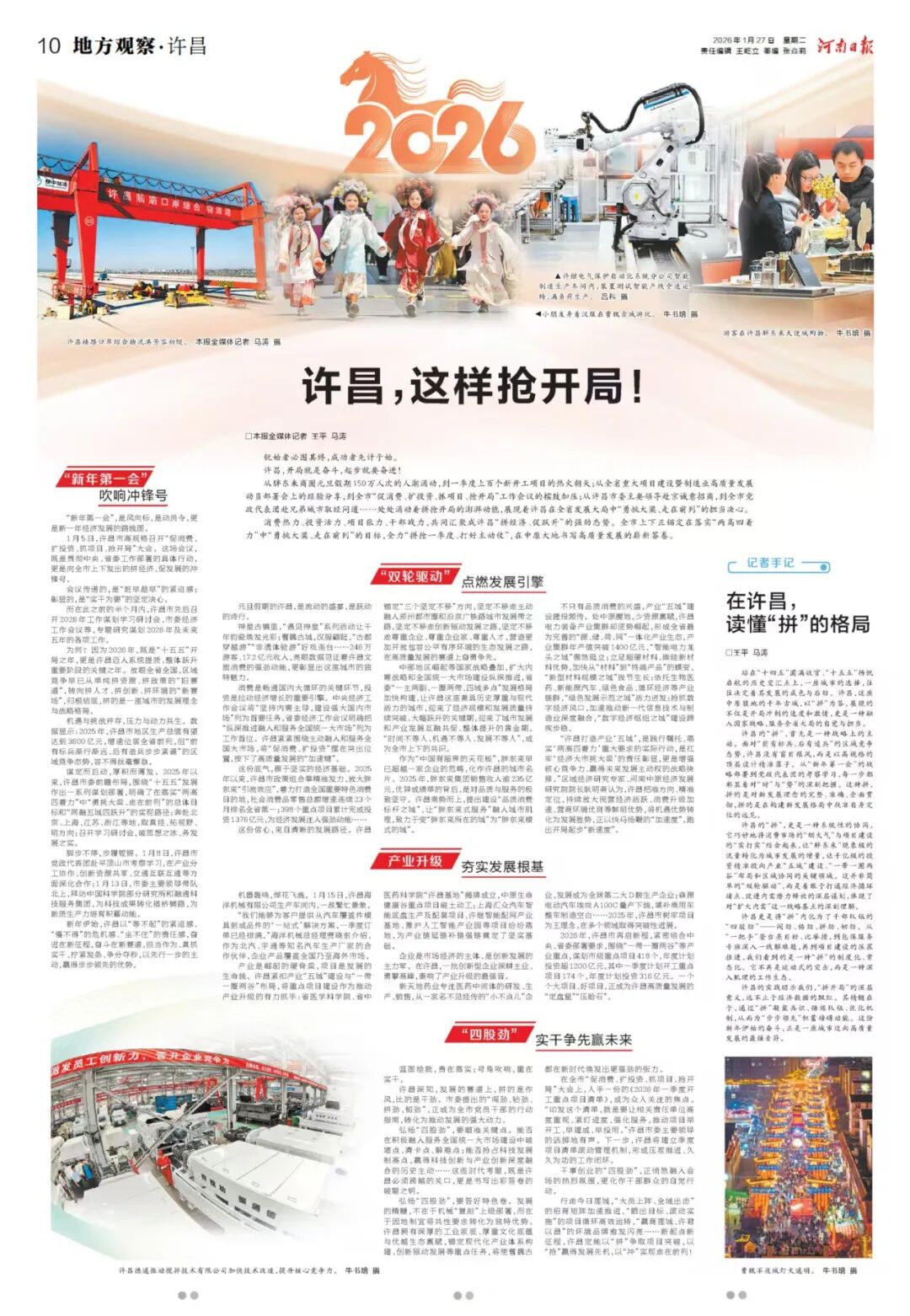
Core Insights - The article emphasizes the proactive approach of Xuchang in economic development, highlighting its determination to stimulate consumption, expand investment, and initiate projects to achieve a strong start in the first quarter of the year [1][5][7] Group 1: Economic Strategy - Xuchang's strategy includes a strong focus on consumer spending and investment as key drivers of economic growth, aligning with national and provincial directives to enhance domestic demand and integrate into the national market [13][14] - The city aims to leverage its unique advantages, such as a robust industrial base and cultural heritage, to foster a modern industrial system and innovation-driven development [20][21] Group 2: Project Development - Xuchang has planned 418 key projects for 2026, with an annual investment target exceeding 120 billion yuan, including 174 projects set to commence in the first quarter [18][21] - The city is actively engaging in partnerships and collaborations to enhance its industrial capabilities, as evidenced by the establishment of significant projects in various sectors, including healthcare and intelligent manufacturing [18][19] Group 3: Consumption and Investment - During the New Year holiday, Xuchang attracted 2.46 million tourists, generating 1.72 billion yuan in revenue, showcasing the city's strong consumer market and tourism potential [13][16] - The city has implemented policies that have resulted in a continuous increase in retail sales, maintaining the highest growth rate in the province for 23 consecutive months [16][18] Group 4: Leadership and Governance - The leadership in Xuchang has initiated a series of high-level meetings to outline economic goals and strategies for the upcoming years, emphasizing the importance of early action and practical implementation [7][9] - The city is fostering a culture of diligence and innovation among its officials, encouraging them to actively participate in economic development initiatives [20][21]
港股异动丨旺山旺水拉升涨近15%创上市新高,口服核苷药物VV116被证实对尼帕病毒有显著抗病毒活性
Ge Long Hui· 2026-01-27 02:50
Core Viewpoint - The stock of Wangshan Wangshui-B (2630.HK) surged nearly 15% to reach a historical high of HKD 112.7, with a market capitalization exceeding HKD 18.9 billion, following the announcement of significant research on the oral nucleoside drug VV116 for treating Nipah virus infection [1][2]. Group 1: Company Developments - Wangshan Wangshui Biopharmaceutical Co., Ltd. has collaborated with researchers from the Wuhan Institute of Virology and the Shanghai Institute of Materia Medica to publish important findings on VV116, demonstrating its significant antiviral activity against the Nipah virus [1]. - The research indicates that VV116 could serve as a preventive medication for high-risk groups such as healthcare workers and laboratory personnel, providing a ready option for addressing current and future Nipah virus outbreaks [1]. Group 2: Product Information - The oral nucleoside drug VV116 was developed collaboratively by the Shanghai Institute of Materia Medica and Junshi Biosciences, with ownership held by Shanghai Wangshi Biopharmaceutical Technology Co., Ltd. and production entrusted to Shanghai Diseno Biopharmaceutical Co., Ltd. [2]. - Wangshi Biopharmaceutical is a joint subsidiary of Junshi Biosciences' subsidiary Shanghai Juntao Biopharmaceutical Technology Co., Ltd. and Suzhou Wangshan Wangshui Biopharmaceutical Co., Ltd. [2].
省政协八届四次会议首场“委员通道”开启
Hai Nan Ri Bao· 2026-01-27 02:21
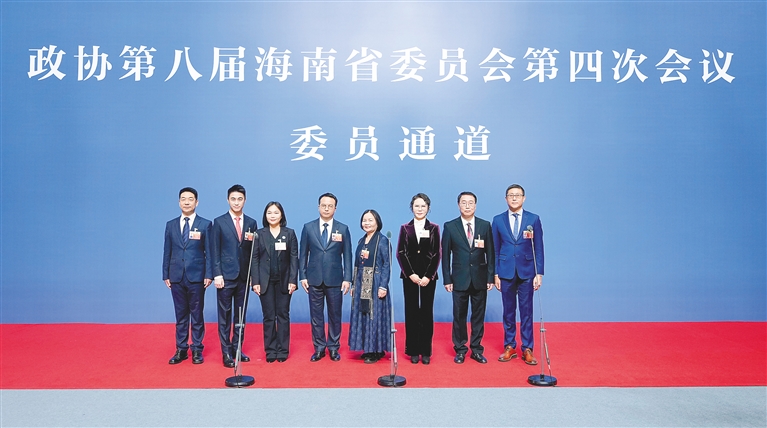
Group 1 - The Hainan Free Trade Port is viewed as a significant opportunity for investment and future development, with strong confidence expressed by various stakeholders [2] - The first session of the "Committee Channel" at the Hainan Provincial Political Consultative Conference featured discussions on the construction of the Hainan Free Trade Port, focusing on industry layout, innovation, talent cultivation, and cultural heritage [2] - The duty-free sales in Hainan reached 5.02 billion yuan in the first month after the closure, indicating the substantial economic potential driven by the duty-free sector [2] Group 2 - The integration of various industries is essential for enhancing Hainan's development, with suggestions for establishing a provincial coconut industry technology system and promoting the "coconut + culture and tourism" model [3] - The "play at sea" industry is proposed as a key driver for creating a billion-level industrial ecosystem, emphasizing the need for optimized regional layouts and the development of festival brands [3] - Hainan's artificial intelligence sector is developing, with over 20 companies attracted to the region, and recommendations for a collaborative approach to enhance the AI industry ecosystem [3] Group 3 - The life and health industry in Hainan is positioned for significant growth, supported by the region's natural resources and the success of its biomedical industry [4] - There is a growing demand for skilled talent in Hainan, prompting suggestions to enhance vocational education as a means to support the development of a modern industrial system [4] - Cultural heritage is highlighted as a vital component for nurturing talent, with calls to leverage historical figures' contributions to strengthen Hainan's cultural development [4]
1.27犀牛财经早报:证监会“1号罚单”直指操纵市场行为
Xi Niu Cai Jing· 2026-01-27 02:19
Regulatory Actions - The China Securities Regulatory Commission (CSRC) issued its first fine of the year targeting market manipulation, with individual Yu Han penalized over 1 billion yuan for manipulating the stock price of "Doctor Glasses" [1] - Zhejiang Securities Regulatory Bureau is investigating misleading statements in the restructuring plan of "Sunflower" [1] - The Shenzhen Stock Exchange is closely monitoring *ST Lifan and *ST Changyao for suspected false financial reporting, indicating a strong regulatory stance against market violations [1] Banking Sector - Several banks have reduced their operating loan interest rates, with some as low as 2.31%, reflecting a nearly 20 basis point decrease from the previous month [1] - The competition among banks for quality small and micro-enterprise clients has intensified, leading to a price war in the lending market [1] - The financial sector is under pressure to balance price competition with sustainable operations, particularly for smaller banks with weaker client bases [1] Consumer Loan Policies - The implementation period for the personal consumption loan interest subsidy policy has been extended to December 31, 2026, with adjustments made to include credit card installment plans [2] - Current consumer loan rates are reported to be as low as 3%, with funds primarily allocated for home renovations, vehicle purchases, and travel [2] Biopharmaceutical Industry - Over 50 A-share biopharmaceutical companies are expected to report profits in 2025, driven by improving industry conditions and favorable policies [3] - As of January 26, 2023, 53 companies have issued profit forecasts, with 14 companies expecting to double their net profits [3] Lithium Market - The lithium carbonate market is expected to return to a tight balance by 2026, despite recent volatility in futures contracts [4] - Supply chain improvements and new mining licenses are anticipated, although challenges remain in waste management [4] Aviation Industry - COMAC plans to increase the production and delivery of its C919 narrow-body aircraft, targeting the delivery of 28 or more units this year [4] Technology and Research - China has achieved a record in superconducting magnet technology with a field strength of 35.6 Tesla, marking a significant advancement in high-temperature superconductors [5] - A study from the National University of Singapore has identified a key protein, DMTF1, that can restore the regenerative capacity of aging neural stem cells, offering potential for new therapies against brain aging [5] Alcohol Industry - Moutai has relaxed its requirements for distributors regarding payment for sauce-flavored liquor, allowing orders based on actual conditions to prevent excessive inventory [6] Corporate Developments - JD Smart Manufacturing has submitted a listing application to the Hong Kong Stock Exchange [6] - Anta Sports plans to acquire a 29.06% stake in PUMA SE for approximately 12.278 billion yuan [6] - Youkeshu intends to change its name to "Xingyun Technology" to better reflect its strategic direction [7] - Fuyijie expects a significant loss for 2025, with specific shareholders planning to liquidate their holdings [8] - Sunny Optical Technology has submitted a listing application for the spin-off of its automotive optical business [8] - Huakong Saige anticipates a net loss of 97 million to 120 million yuan for 2025 due to various operational challenges [9] - Guoen Co., Ltd. has set a preliminary price range for its H-share issuance between 34 and 42 Hong Kong dollars [9] Stock Market Performance - U.S. stock indices closed higher, with the Nasdaq up 0.43%, the Dow Jones up 0.64%, and the S&P 500 up 0.5%, driven by strong durable goods data [10] - The U.S. dollar has seen a decline, while gold prices have reached historical highs, with significant fluctuations in the commodities market [10]
【长图·政府工作报告解读】一图速览“十四五”甘肃答卷
Xin Lang Cai Jing· 2026-01-27 02:17
Core Viewpoint - The "14th Five-Year Plan" period is a significant and extraordinary time for Gansu's development, marked by strong leadership from the central government and a focus on modernizing the province's economy and infrastructure [1][2]. Economic Performance - Gansu's GDP reached 13,697.5 billion yuan, an increase of 4,374.4 billion yuan from the end of the "13th Five-Year Plan," representing a growth of 33.6% [3]. - The economic growth rate has been above the national average for 16 consecutive quarters since 2022 [3]. Industrial Growth - The number of large-scale industrial enterprises increased from 1,832 to 3,382 [6]. - Industrial investment has maintained double-digit growth for 54 consecutive months, contributing 36.1% to the province's economic growth [6]. Sectoral Contributions - The non-ferrous metallurgy industry saw an average annual growth of 17.8%, while the petrochemical industry grew by 4.8% [9]. - The new materials industry experienced a remarkable growth of 195.6%, and the biopharmaceutical industry grew by 83.5% [9]. Energy Sector - The total installed capacity of new energy reached 80.416 million kilowatts, a growth of 2.4 times [10]. - Gansu has established a complete industrial chain for photovoltaic, wind, and thermal energy [10]. Investment and Trade - The province signed external projects with an average annual funding growth of 26.4% [16]. - The total value of foreign trade and exports exceeded 70 billion yuan for the first time, with an annual growth of 13.2% [20]. Infrastructure Development - Transportation investments totaled 499.9 billion yuan, with 639 kilometers of new railway lines added, including 370 kilometers of high-speed rail [22]. - New highways and rural roads were constructed, significantly improving connectivity [23]. Social Development - The average disposable income of residents grew by 6.89% annually, with the growth rate ranking in the top ten nationally [29]. - The province has made significant strides in poverty alleviation, with a risk elimination rate of 78.8% for monitored households [37]. Environmental and Quality of Life Improvements - The water quality of the Yellow River has been maintained at a stable level, with significant improvements in air quality and soil safety [51]. - The province has built numerous facilities to enhance public services, including healthcare and social security [46][43].

“三大经济”勃兴相连成势——云南打造发展“强引擎”
Xin Hua Wang· 2026-01-27 02:12
Core Viewpoint - Yunnan Province is leveraging its resources, industrial parks, and ports to accelerate economic development and enhance its industrial strength, creating a robust support system for economic transformation and high-quality growth [1]. Resource Empowerment and Industrial Quality Improvement - Yunnan has become a significant flower production area in China, with an annual output of over 20 billion fresh-cut flowers, accounting for 70% of the national market [2]. - The export value of Yunnan's fresh-cut flowers is projected to reach 1.22 billion yuan by 2025, marking a 60.5% year-on-year increase, maintaining the top position in national exports for seven consecutive years [2]. - Yunnan's unique geographical advantages have also led to the dominance of its tea, flower, nut, coffee, traditional Chinese medicine, and natural rubber industries, with coffee cultivation area accounting for 99% of the national total [4]. - The green aluminum production line in Yunnan's Heqing Industrial Park is expected to produce 432,600 tons of electrolytic aluminum with a value exceeding 8 billion yuan by 2025, with carbon emissions 15% lower than the industry average [4][5]. Industrial Park Aggregation Driving Strength - Yunnan is promoting the "three major economies" through industrial parks, enhancing the development of key industries and achieving industrial chain integration [6]. - The newly established Hushang Linport Kunming Science and Technology City has attracted 144 enterprises, focusing on advanced manufacturing, biomedicine, industrial internet, and new materials [8]. - The Anning High-tech Industrial Development Zone has seen significant growth in its economy, focusing on petrochemicals, metallurgy, and new energy, with its industrial output ranking among the top in the province [9]. Port Hub Reshaping Industrial Landscape - Yunnan's geographical location allows it to develop a port economy, transitioning from traditional "channel economy" to a comprehensive "port hub economy" that integrates logistics, trade, processing, and services [10]. - The Hekou Port is projected to handle 6.42 million inbound and outbound passengers and 4.3152 million tons of import and export goods by 2025, with respective year-on-year growth of 12% and 4.5% [12]. - The Menghan Port has become a crucial hub for goods and personnel, with a projected 19.51 million passengers and 24.48 million tons of goods transported by 2025, reflecting a 2.1% and 24.6% increase respectively [13].