
建筑

Search documents
中国红包附属一名董事暂时失去联系
Zhi Tong Cai Jing· 2025-09-03 14:20
Group 1 - The company announced that a director of its indirect wholly-owned subsidiary, Yuanwei New Materials Holdings Limited, has temporarily lost contact [1] - For the fiscal year ending March 31, 2025, the construction segment generated revenue of approximately HKD 46.2 million, accounting for about 57.1% of the group's total revenue [1] - The company has reported the incident to the Hong Kong police after discovering that all desktop computers and operational and accounting documents of Yuanwei were removed by unidentified individuals [1] Group 2 - Another director and executive director of Yuanwei is currently assessing the situation regarding the other assets and documents that were taken and is collecting necessary information [1] - An internal investigation is being conducted to identify the individuals responsible for the removal of the assets and documents [1] - The construction segment's operations have been suspended, and the company is seeking professional legal advice to mitigate potential losses [1]
中国红包(08316.HK):集团建筑分部业务已暂停
Ge Long Hui· 2025-09-03 14:12
格隆汇9月3日丨中国红包(08316.HK)公告,公司间接全资附属公司远为新材料控股有限公司("远为", 于香港注册成立并从事建筑业务)的一名董事伍跃翔暂时失去联系。截至2025年3月31日止年度,建筑分 部产生的收益约为46.2百万港元,占集团总收益约57.1%。集团已派员前往远为办公室,发现远为所有 台式电脑及营运以及会计文件均遭身份不明人士移走。集团已就此事向香港警方报案。 远为的另一名董事兼执行董事于华,现正评估远为的其他资产及文件遭取走的情况,并收集必要资料, 同时进行内部调查以查明可能移走该等资产及文件的人士。因此,集团建筑分部业务已暂停。集团亦正 寻求专业法律意见,包括但不限于为尽量减少集团潜在损失而采取的措施。 集团正积极调查此事,评估其对建筑业务及财务表现的影响程度,并将继续全力追讨相关资产及文件。 同时,董事会与各持份者(包括但不限于客户、供应商及员工)保持紧密沟通,以回应各方关注。公司将 于适当时候发出进一步公告,告知股东及投资者任何重大进展。 ...
4通道12位40G高速高精度射频直采ADC芯片尚未规模化销售!人工智能概念股发布股价异动公告|盘后公告集锦
Xin Lang Cai Jing· 2025-09-03 12:45
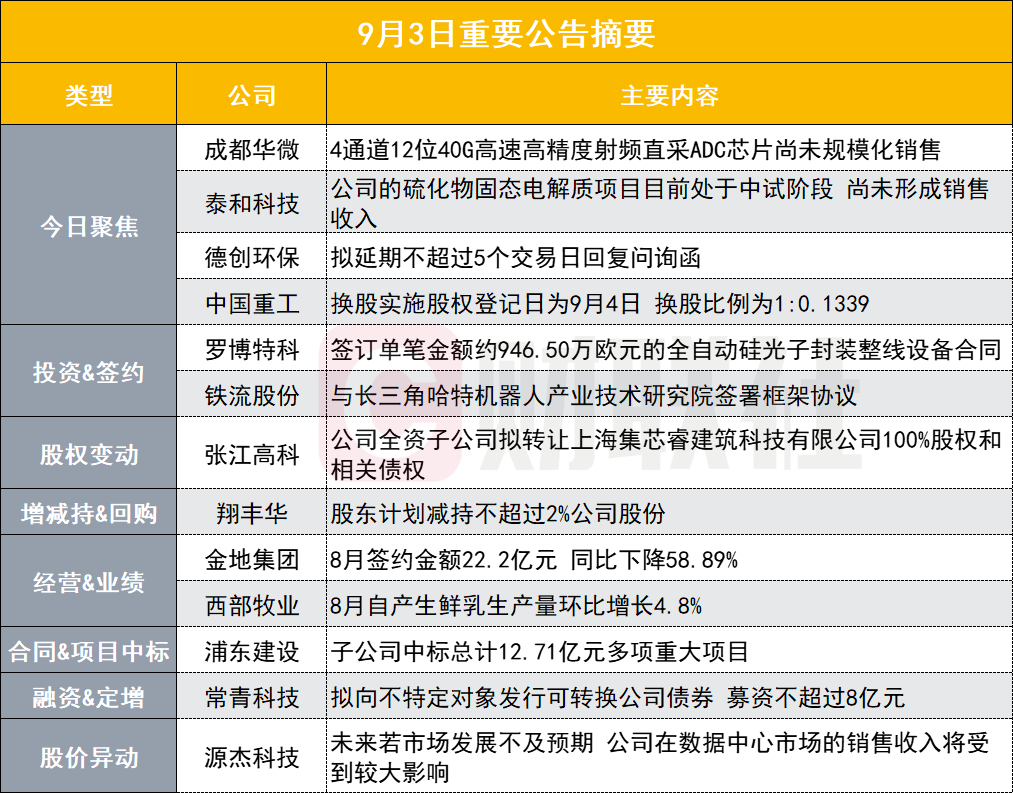
Company Announcements - Chengdu Huamei's 4-channel 12-bit 40G high-precision RF direct ADC chip has not yet achieved large-scale sales, with only sample deliveries to select customers and potential orders, indicating market demand uncertainty and risks of customer validation failure [1] - Taihe Technology's sulfide solid electrolyte project is currently in the pilot test stage and has not generated sales revenue [2] - Source Technology warns that if market development does not meet expectations, its sales revenue in the data center market will be significantly impacted [2] - Wen Tou Holdings states that its cinema and gaming businesses are still in the recovery phase post-restructuring, with potential uncertainties in operational performance [3] Financing & Capital Increase - Changqing Technology plans to issue convertible bonds to unspecified investors, raising no more than 800 million yuan, with proceeds intended for the first phase of a polymer new materials production base [4][5] Shareholding Changes - Xiangfenghua's shareholder plans to reduce holdings by no more than 2% of the company's shares, with the reduction period starting 15 trading days after the announcement [6] Contracts & Projects - Robotech signed a contract worth approximately 9.465 million euros for fully automated silicon photonic packaging equipment, which is expected to positively impact the company's financial performance [7] - Tieliu Co. signed a framework agreement with the Yangtze River Delta Hart Robot Industry Technology Research Institute [8] - Wanlima signed a significant contract worth approximately 44.6 million yuan for e-commerce procurement of labor protection products [9] - Zhangjiang Hi-Tech plans to transfer 100% equity and related debts of Shanghai Jixin Rui Construction Technology Co., Ltd. for no less than 151.34 million yuan [10] - Pudong Construction's subsidiaries won multiple major projects with a total bid amount of 1.271 billion yuan [15] Operational Performance - Jindi Group reported a signed amount of 2.22 billion yuan in August, a year-on-year decrease of 58.89%, with cumulative signed amounts for the year down 53.91% [11] - Western Animal Husbandry's self-produced fresh milk output in August increased by 4.8% month-on-month but decreased by 7.27% year-on-year [12] Other Announcements - China Shipbuilding Industry Corporation's stock conversion ratio is set at 1:0.1339, with the stock registration date on September 4 [13] - Dechuan Environmental Protection plans to delay its response to an inquiry letter by no more than five trading days [14]

9月3日晚间公告 | 罗博特科签下硅光子设备大单;爱仕达子公司将向鸿路钢构供应机器人
Xuan Gu Bao· 2025-09-03 12:07
Investment Cooperation and Operational Status - Robotech signed a contract for fully automated silicon photonic packaging equipment worth approximately €9.465 million [1] - Qianjiang Robotics, a subsidiary of Aishida, signed a framework cooperation agreement with Honglu Steel Structure to supply 1,888 welding robots, establishing a long-term partnership [1] - Gansu Energy plans to invest in a 1 million kilowatt wind-solar integrated project in Minqin, with a total dynamic investment of CNY 4.089 billion [1] - Wantong Development will steadily advance the integration of Beijing Shudu Information Technology Co., which is currently in a loss state, as part of its transformation strategy [1] - Yongzhen Co.'s wholly-owned subsidiary received CNAS laboratory accreditation [1] - Xinhua Medical's endoscope cleaning workstation obtained Class II medical device registration [1] - Changqing Technology plans to issue convertible bonds to raise no more than CNY 800 million for the first phase of its polymer new material production base in Taizhou [1] Technological Development - Tieliu Co. signed a framework agreement with the Yangtze River Delta Hart Robot Industry Technology Research Institute, focusing on the design of key robot components and advanced control technology research [2]

爱得威建设集团发布中期业绩 股东应占亏损1687.1万元 同比扩大98.16%
Zhi Tong Cai Jing· 2025-09-03 10:39
Group 1 - The company reported a revenue of 840,000 RMB for the six months ending June 30, 2025, representing a year-on-year increase of 326.4% [1] - The loss attributable to shareholders was 16.871 million RMB, which widened by 98.16% compared to the previous year [1] - The basic loss per share was 0.07 RMB [1] Group 2 - The company's shares remain suspended from trading [1]
爱得威建设集团(06189)发布中期业绩 股东应占亏损1687.1万元 同比扩大98.16%
智通财经网· 2025-09-03 10:36
Core Points - The company reported a revenue of 840,000 RMB for the six months ending June 30, 2025, representing a year-on-year increase of 326.4% [1] - The loss attributable to shareholders widened to 16.871 million RMB, an increase of 98.16% compared to the previous year [1] - The basic loss per share was reported at 0.07 RMB [1] - The company continues to be suspended from trading [1]
9.3犀牛财经晚报:多家品牌足金首饰价格上破1050元/克 宗馥莉名下又有两家公司拟注销
Xi Niu Cai Jing· 2025-09-03 10:31
Group 1: Oil Market - International oil prices have sharply declined, with WTI crude oil dropping by 1.81% to $64.402 per barrel and Brent crude oil falling by 1.65% to $67.998 per barrel [1] - OPEC+ is expected to consider increasing oil production at its upcoming meeting on Sunday [1] Group 2: Smartphone Market in Latin America - In Q2 2025, the smartphone market in Latin America saw a slight year-on-year increase of 2%, reaching 34.3 million units shipped [1] - Samsung led the market with 11 million units shipped, an 8% increase, with Galaxy A06 and A16 models accounting for over 60% of sales [1] - Xiaomi ranked second with 6.7 million units shipped, also an 8% increase, marking a historical high [1] - Motorola's shipments declined by 10% to 5.1 million units, while Honor and Transsion ranked fourth and fifth, respectively, with Honor increasing by 70% to 2.9 million units and Transsion decreasing by 23% to 2.4 million units [1] Group 3: Gold Jewelry Prices - Domestic prices for gold jewelry have surpassed 1,050 yuan per gram, with brands like Chow Tai Fook and Luk Fook reporting prices of 1,053 yuan per gram [1] - International gold prices have recently surged, reaching a historical high of $3,546.92 per ounce [1] Group 4: E-commerce and AI - Alibaba's international platform experienced a 33% year-on-year increase in transaction volume on the first day of its September procurement festival, attributed to the integration of AI capabilities [2] - The September procurement festival is a critical period for overseas buyers preparing for year-end shopping events [2] Group 5: Corporate Developments - ByteDance is reportedly implementing an option incentive plan for its Seed department, focusing on large model technology employees, with a total option amount potentially reaching millions [2] - Two companies under the name of Zong Fuli are set to be deregistered, with previous companies also applying for cancellation [2] - Shangdong West Dairy reported a 4.8% month-on-month increase in fresh milk production in August, totaling 2,540.33 tons, although down 7.27% year-on-year [6] - Yong'an Pharmaceutical announced that its actual controller and chairman, Chen Yong, has had his detention lifted, allowing him to resume normal duties [7] - Shengtun Mining plans to repurchase shares worth between 500 million and 600 million yuan, with a maximum repurchase price of 11.82 yuan per share [8] - Zhangjiang Hi-Tech intends to publicly transfer 100% equity and related debts of Shanghai Jixin Rui Construction Technology Company, with a minimum total price of 151 million yuan [9] - Shankai Intelligent won a procurement project for metering devices with a bid of 13.318 million yuan [10] - Pudong Construction's subsidiaries won multiple major projects totaling 1.271 billion yuan [11]
爱得威建设集团(06189)发布中期业绩,净亏损1687.1万元 同比增加98.16%
智通财经网· 2025-09-03 09:46
Core Points - The company reported a revenue of RMB 840,000 for the six months ending June 30, 2025, representing a year-on-year increase of 326% [1] - The company incurred a loss of RMB 16.871 million during the same period, which is an increase of 98.16% compared to the previous year [1] - The loss per share was reported at RMB 0.07 [1] - The increase in revenue is attributed to a rise in contract value [1]
西部水泥(02233):上半年海外销量大幅增长,继续看好出海成长性
Tianfeng Securities· 2025-09-03 05:14
Investment Rating - The report maintains a "Buy" rating for the company with a target price of HKD 3.82, based on a 12X PE for 2025 [4]. Core Views - The company achieved significant growth in overseas sales, with a net profit of HKD 7.5 billion in the first half of the year, representing a 93% year-on-year increase. This growth is attributed to the expansion of overseas capacity and recovery in domestic pricing [1][2]. - The report highlights the strong growth potential in Africa, driven by population growth and infrastructure development, which is expected to sustain cement demand [2]. - Domestic performance also showed recovery, with a 29% increase in domestic revenue to HKD 30.7 billion, despite an 8.3% decline in sales volume [3]. Summary by Sections Overseas Sales Performance - The company reported overseas revenue of HKD 23.5 billion, a 77.6% increase year-on-year, with overall overseas cement sales volume rising by 178% to 4.17 million tons. However, the average price and gross margin per ton decreased by 34.2% and 44.5%, respectively [2]. - In Africa, revenue from Ethiopia, Mozambique, and the Democratic Republic of Congo saw significant increases, with Ethiopia's sales volume growing by 363% [2]. Domestic Sales Performance - Domestic revenue reached HKD 30.7 billion, up 29%, driven by price increases, while sales volume fell by 8.3% to 6.65 million tons. The average price per ton increased by HKD 11, and gross margin improved by HKD 26 [3]. - The company is also focusing on capital expenditures, with a 40% increase to HKD 22.95 billion, and plans for ongoing projects in Mozambique and Uganda [3]. Financial Outlook - The company adjusted its net profit forecasts for 2025-2027 to HKD 15.8 billion, HKD 21.3 billion, and HKD 29.0 billion, respectively, due to a decline in overseas gross margins [1]. - The company is expected to gradually reduce debt repayment pressure, aided by cash flow contributions from overseas projects and the sale of assets in Xinjiang [3].
9.2犀牛财经晚报:8月A股新开户数同比增长165% 宇树科技将在四季度提交IPO申请
Xi Niu Cai Jing· 2025-09-03 05:04
Group 1: A-Share Market Activity - In August 2025, A-share new account openings reached 2.65 million, representing a year-on-year increase of 165% compared to 1 million in August 2024 [1] - Monthly comparisons show a significant rise from 1.57 million in January 2025 to 2.84 million in February, with a peak of over 3 million in March [1] - The new account openings in August 2025 exceeded the total for 10 months of the previous year [1] Group 2: Robotics Sector Developments - The robotics sector experienced a strong rebound on September 2, 2025, with Zhejiang Rongtai's stock hitting the limit up, attributed to a market rumor regarding a meeting with Tesla [2] - The rumor suggested that Tesla provided optimistic guidance for robot production capacity, expecting a weekly output of 10,000 units by Q3 2026 [2] - Zhejiang Rongtai confirmed awareness of the rumor but could not verify its accuracy, stating that no related meeting occurred on that day [2] Group 3: Fund Holdings and Industry Focus - The 2025 mid-year report from public funds indicated significant increases in holdings in the pharmaceutical, banking, and electronics sectors, while sectors like power equipment and food and beverage saw declines [3] - Notable individual stocks with increased fund holdings included Shutaishen, Anglikang, and Weichai Heavy Machinery, while Guotai Haitong, Shenghong Technology, and Zijin Mining led in fund holding value growth [3] Group 4: DRAM Industry Performance - The DRAM industry reported a total revenue of $31.63 billion in Q2 2025, marking a quarter-on-quarter increase of 17.1% due to rising contract prices and increased shipment volumes [3] - The average selling price (ASP) of DRAM products increased as demand from PC OEMs, smartphones, and CSP companies grew [3] Group 5: Corporate Announcements - Yushutech announced plans to submit an IPO application between October and December 2025, with sales from quadruped robots, humanoid robots, and components making up 65%, 30%, and 5% of revenue, respectively [5] - Huazhong Securities received approval to issue subordinate bonds totaling up to 10 billion yuan [6] - Lin Yang Energy was recommended as a candidate for a 2.44 billion yuan project with the Southern Power Grid [7] - Jinbei Automotive plans to invest 240 million yuan in establishing an automotive industry investment fund focusing on electrification and low-carbon initiatives [8] - Xiangxin Technology intends to apply for a total of 280 million yuan in bank credit [9] - Ningbo Construction's subsidiary won a construction project worth 729 million yuan [10] - Kuangda Technology announced a suspension of trading due to a planned change in control [12]