
医药

Search documents
泰凌医药2月11日复牌
Zhi Tong Cai Jing· 2026-02-11 00:57
Core Viewpoint - TaiLing Pharmaceutical (01011) announced that its shares will resume trading on February 11, 2026, at 9:00 AM [1] Group 1 - The company has made an official announcement regarding the resumption of its share trading [1]
道指新高!“中国金龙”,四连涨
Xin Lang Cai Jing· 2026-02-10 23:13
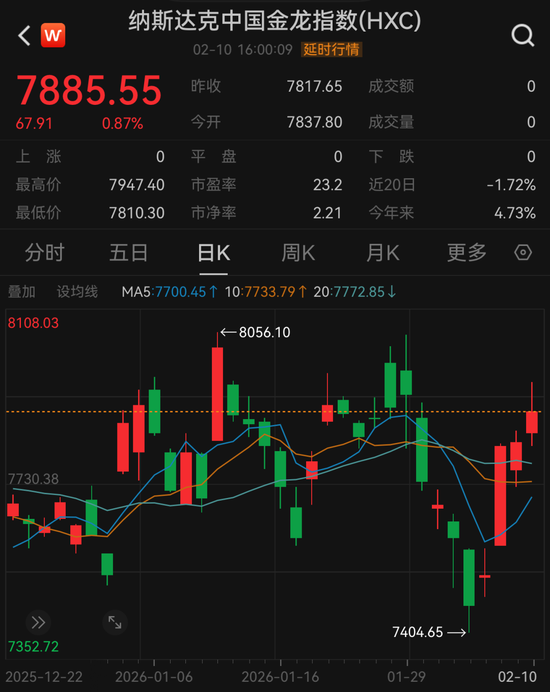
Market Performance - The Dow Jones Industrial Average reached a new all-time high, peaking at 50,512.79 points, closing up by 0.1% [3][16] - The Nasdaq and S&P 500 indices turned negative, with declines of 0.59% and 0.33% respectively [3][16] - Large-cap tech stocks showed mixed results, with Tesla rising nearly 2%, while Microsoft, Apple, Nvidia, Amazon, and Meta all declined [6][17] Chinese Stocks - The Nasdaq Golden Dragon China Index saw a continuous rise for four trading days, increasing by nearly 1% [2][19] - Notable gains were observed in companies such as Shengda Technology and Dingdong Maicai, both rising over 7% [19] Commodity Prices - International gold prices fluctuated around $5,000 per ounce, while silver prices hovered near $80 per ounce [4][20] - As of February 11, gold futures and spot prices fell by 0.6% and 0.71% respectively, while silver futures dropped over 2% [20][21] Oil Market - International oil prices experienced slight declines, with NYMEX crude oil futures at $64.19 per barrel and ICE Brent crude at $69.01 per barrel [20][21] - The oil market is transitioning from event-driven pricing to fundamental trading, with a higher likelihood of a trend towards oversupply pressure [22]

禾丰、桃李、东软医疗上榜2025年度中国消费名品名单
Xin Lang Cai Jing· 2026-02-10 21:07
Group 1 - The Ministry of Industry and Information Technology announced the 2025 China Consumer Brand List, with 276 brands selected nationwide, including 12 from Liaoning province [1] - Among the selected brands, three are from Shenyang, including He Feng, Tao Li, and Neusoft Medical, covering the food and pharmaceutical industries [1] - "China Consumer Brands" are defined as high-quality, innovative, and reputable consumer brands recognized through local recommendations and national certification, aimed at promoting high-quality development in the consumer goods industry [1] Group 2 - The Liaoning Provincial Department of Industry and Information Technology has implemented a gradient cultivation approach to systematically build a lineup of renowned consumer enterprises and products, creating a multi-level development structure [2] - The initiative focuses on key industries, collecting and screening quality products, and providing targeted support for brand development [2] - Efforts include enhancing cultural empowerment, exploring historical classics and trendy brands, and promoting digital technology integration to drive industry transformation and upgrading [2]
沈阳3个品牌上榜2025年度中国消费名品名单
Xin Lang Cai Jing· 2026-02-10 21:07
Core Viewpoint - The Ministry of Industry and Information Technology of China has announced the 2025 list of national consumer brands, featuring 276 brands, including 12 from Liaoning province, with three brands from Shenyang, namely He Feng, Tao Li, and Dongsoft Medical, covering the food and pharmaceutical industries [1] Group 1 - The "China Consumer Brand" initiative aims to establish a consumer brand system led by enterprise and regional brands, promoting high-quality development in the consumer goods industry [1] - The selected brands are recognized for their independent innovation, high quality, and good reputation [1]


每日钉一下(为啥这轮牛市,A股医药比较低迷,港股医药比较强势?)
银行螺丝钉· 2026-02-10 13:53
Group 1 - Fund investment plans are suitable for lazy investors, and it is essential to prepare and formulate a good investment plan before starting [2][3] - There are four methods of fund investment, and it is important to determine which one is most suitable for individual needs [2] - A free course is available to help understand fund investment strategies, including course notes and mind maps for efficient learning [2][3] Group 2 - The A-share pharmaceutical index has shown limited growth, underperforming compared to the China Securities North Pharmaceutical Index during the period from September 2024 to January 2026 [4] - The performance disparity between A-share and Hong Kong pharmaceutical stocks is attributed to differences in fundamental strengths, which affect index growth [5] - Currently, Hong Kong pharmaceuticals are in a prosperity cycle, with profit growth recovering and driving valuation increases [7] - A-share pharmaceuticals are in a recovery cycle, with profit growth showing some recovery since 2025, but not yet reaching significant growth levels [8] - Economic cycles are inherent characteristics, where downturns can lead to simultaneous declines in valuation and profits [9]

华润医药(03320.HK):东阿阿胶拟投资建设健康消费品产业园
Ge Long Hui· 2026-02-10 10:11
Core Viewpoint - China Resources Pharmaceutical (03320.HK) announced that its non-wholly owned subsidiary, Dong'e Ejiao Co., Ltd. (listed on Shenzhen Stock Exchange, stock code: 000423), has decided to invest in and construct a health consumer products industrial park [1] Group 1 - The proposed health consumer products industrial park is expected to include manufacturing facilities for health consumer products such as pharmaceuticals, traditional food, health supplements, and functional foods [1] - The industrial park will also feature supporting warehousing and logistics facilities, a quality inspection center, a new product incubation center, e-commerce sorting, and finished product warehouses [1]


东北第一霸总,给员工发40亿红包
盐财经· 2026-02-10 09:47
Core Viewpoint - Fangda Group, led by Fang Wei, is known for its generous employee benefits and significant wealth accumulation, showcasing a unique business model that balances employee welfare with aggressive capital expansion [6][9][50]. Group 1: Employee Welfare - Fangda Group has distributed nearly 4 billion yuan in cash bonuses to employees over the past decade, establishing a reputation for being exceptionally generous [6]. - The company has implemented a comprehensive welfare system that includes medical assistance, scholarships, and retirement benefits, creating a family-like support network for its 130,000 employees [12][18]. - Notably, Fangda Group provided 5 billion yuan worth of cars to employees, further emphasizing its commitment to employee satisfaction [15]. Group 2: Wealth Accumulation - Fang Wei's net worth surged to 52.5 billion yuan in 2025, a significant increase from 40.5 billion yuan in 2024, solidifying his position as a leading entrepreneur in Northeast China [8]. - The company's financial success is attributed to strategic acquisitions of state-owned enterprises, allowing for profitable turnaround operations [20][25]. Group 3: Acquisition Strategy - Fang Wei began his career in the iron ore business, leveraging early successes to accumulate capital for future acquisitions [22][24]. - The company has executed a series of successful acquisitions, including the restructuring of state-owned enterprises like Fushun Carbon and Nanchang Steel, which have become core assets [28]. - A notable acquisition was the 410 billion yuan deal for HNA Group, which transformed the struggling airline into a profitable entity within a few years [29][30]. Group 4: Recent Developments - Despite a failed attempt to acquire Sunwoda Group, Fangda Group continues to pursue new opportunities, including a strategic partnership with CATL in the zero-carbon business and a planned investment of 5 billion yuan in a healthcare project [44]. - The company also made headlines by acquiring a property in Shanghai for 456 million yuan, indicating confidence in core asset values amid economic challenges [46]. Group 5: Business Model and Philosophy - Fangda Group's business model is characterized by a blend of aggressive expansion and a strong focus on employee welfare, creating a unique corporate culture [50]. - The company aims to balance market-driven acquisitions with social responsibility, positioning itself as a significant player in the private sector of China [50].


港股传媒、医药股,大涨
第一财经· 2026-02-10 08:45
科网股多数上涨,地平线机器人涨超3%,商汤、比亚迪股份涨超2%,京东集团涨近2%,中芯国际、阿里巴巴、小米集团涨超1%。 | 名称 | 涨跌幅 ▼ | 现价 | 涨跌 | | --- | --- | --- | --- | | 地平线机器人-W | 3.75% | 8.570c | 0.310 | | 商汤-W | 2.52% | 2.440c | 0.060 | | 片亚迪股份 | 2.41% | 95.800c | 2.250 | | 京东集团-SW | 1.95% | 110.000c | 2.100 | | 美的集团 | 1.82% | 89.750c | 1.600 | | 联想集团 | 1.74% | 9.350c | 0.160 | | 中村国际 | 1.71% | 71.550c | 1.200 | | 阿里巴巴-W | 1.65% | 160.500c | 2.600 | | 快手-W | 1.59% | 70.400c | 1.100 | | 零跑汽车 | 1.32% | 44.500c | 0.580 | | 理想汽车-W | 1.18% | 72.800c | 0.850 | | 小米 ...

Club Med营业额翻三倍、创新药出海突破,复星新年发展势头稳健
Feng Huang Wang Cai Jing· 2026-02-10 07:37
Core Insights - Fosun has reported significant growth in its core sectors, including tourism, pharmaceuticals, and insurance, with notable achievements in early 2026 [1][2][3] Tourism Sector Performance - Fosun's Club Med resorts in China saw a threefold increase in inbound revenue compared to the same period last year, with a 33% revenue growth during the New Year period [1][2] - The company launched three major product lines in 2025, resulting in 14 project signings, including five super resorts and eight super tourism zones [2] - The average occupancy rate for three ice and snow resorts exceeded 97%, while two sunshine resorts doubled their revenue [2] Pharmaceutical Sector Developments - Fosun Pharma's subsidiary signed a global exclusive licensing agreement with Pfizer for a GLP-1 drug, with potential total payments exceeding $2 billion [3] - The company is also collaborating with Clavis Bio for innovative therapies, with potential payments up to $7.25 billion [3] - Fosun's innovative drugs are expected to achieve significant market breakthroughs in 2026, with several products anticipated to receive regulatory approvals [3] Insurance Sector Growth - Fosun's insurance companies reported substantial growth, with Fosun United Health Insurance's revenue reaching 7.84 billion yuan, a 50% increase year-on-year [3][4] - Fosun Baodexin Life Insurance achieved a 36.2% revenue growth, totaling 12.6 billion yuan, with a net profit increase of over 450% [3][4] Financial Health and Strategy - Fosun has maintained a strong financial position, with a debt-to-capital ratio of 53% and a decrease in debt costs [5][6] - The company successfully executed significant equity sales, raising substantial funds to support its core business focus [6] - Fosun plans to reduce interest-bearing debt by approximately 10 billion yuan annually over the next two to three years, aiming for an "investment-grade" rating [6] Future Prospects - Fosun is preparing for potential IPOs of two subsidiaries, which could enhance strategic synergies and investment returns [7] - The company is well-positioned to capitalize on opportunities in the aging population and the growing demand for health and wellness, as well as tourism in emerging markets [7][8]


多地医院已下通知,要求医生退讲课费,20多亿!
Xin Lang Cai Jing· 2026-02-10 06:16
Core Viewpoint - Multiple hospitals are auditing doctors' accounts and demanding refunds for non-compliant lecture fees and case collection fees, with amounts varying by hospital and doctor, ranging from thousands to tens of thousands [1][6][7] Group 1: Definition of Fees - Lecture fees, also known as academic promotion fees or expert service fees, are payments made by pharmaceutical companies, medical device companies, or academic institutions to medical experts for delivering lectures or training on recent advancements in specific drugs or medical devices [2][8] - Case collection fees are payments made by pharmaceutical companies to doctors for systematically observing and recording patient data related to specific treatments, which is then anonymized and submitted for research or marketing purposes [2][8] Group 2: Compliance Issues - While lecture fees and case collection fees may seem legitimate, many instances are deemed non-compliant due to their misuse, where pharmaceutical representatives organize events that deviate from their intended purpose [3][9] - Some lectures are conducted by doctors reading pre-prepared slides created by pharmaceutical companies, with little genuine academic content, leading to questions about the legitimacy of the fees received [3][9] Group 3: Discovery of Issues - The issues surrounding these fees came to light due to audits revealing non-compliance, as many companies used third-party agencies to organize events, mistakenly believing this would shield them from scrutiny [5][11] - The reliance on third-party companies has proven unreliable, leading to demands for refunds from doctors who participated in these non-compliant activities [5][11]