物流

Search documents
接续奋斗 实干争先 奋力开创常山高质量跨越式发展新局面
Xin Lang Cai Jing· 2025-12-29 17:12
Core Viewpoint - The article emphasizes the strategic blueprint for economic development in Changshan County, focusing on innovation, industrial strength, investment, and improving living standards to contribute to the high-quality development of Quzhou [1]. Group 1: Industrial Development - The county aims to strengthen the integration of "double innovation" to promote industrial upgrades, focusing on high-quality development in manufacturing and optimizing service systems for industrial chains [1]. - Key industries include high-end equipment components, deep processing of local agricultural products, and new materials, with a goal to cultivate three major industrial clusters worth over 100 billion [1]. - The county will enhance collaborative innovation between enterprises and research institutions, utilizing platforms like Xiuhu Future Science and Technology Valley to accelerate the transformation of scientific achievements [1]. Group 2: Market Activation - The strategy prioritizes domestic demand, emphasizing private investment, industrial projects, and technological innovation to boost project execution [2]. - The county plans to enhance fixed asset investment, particularly in industrial sectors, by leveraging central and provincial funding policies [2]. - Efforts will be made to upgrade consumption structures and develop new economic growth points through cultural and tourism integration, focusing on local attractions [2]. Group 3: Urban-Rural Integration - The county will focus on urban-rural integration to reduce disparities, guided by the "Ten Thousand Projects" initiative [2]. - High-level planning will be implemented to create a modern park city, with significant projects like urban renewal and road expansions [2]. - The aim is to narrow the income gap between urban and rural areas to below 1.63 through comprehensive development strategies [2]. Group 4: Governance and Leadership - The county emphasizes the importance of practical action and strong leadership in driving development, promoting a culture of hard work and commitment [3].
【环球财经】“人工智能时代”领衔德国年度十大热词
Xin Hua She· 2025-12-29 15:15
Group 1: Core Themes - The term "Artificial Intelligence Era" reflects the rapid integration of AI into German society, becoming a tool for work, learning, and information access, while also raising concerns about job displacement and ethical risks [2][3] - The term "TikTokification" indicates the influence of social media on the perception of information among the youth, highlighting a shift in how public discourse is shaped by technology [3] Group 2: Economic Pressures - The term "Loss of Living Standards" signifies a decline in public sentiment regarding economic security, as Germany faces consecutive economic contractions in 2023 and 2024, with rising bankruptcy and layoffs [4] - "Punitive Tariffs" and "Deal" reflect external pressures on the German economy, particularly from U.S. tariffs that are impacting German exports and contributing to economic stagnation [4][5] Group 3: Security Considerations - The term "Draft Lottery" emerges in discussions about security policy, as Germany reassesses its defense capabilities amid increasing strategic autonomy in Europe, sparking debate over fairness and individual rights [6] - "Climate Fatigue" illustrates a growing weariness among certain social groups regarding climate protection issues, particularly as living costs rise [7] Group 4: Policy and Governance - The "Special Fund" term highlights a significant fiscal policy initiative, with a proposed €500 billion fund aimed at infrastructure and climate protection, though its effectiveness has been criticized [5]

六部门联合印发《现代物流标准化重点工作计划(2025—2027年)》
Zheng Quan Ri Bao Wang· 2025-12-29 12:55
Core Viewpoint - The National Market Supervision Administration, along with several other government bodies, has issued the "Modern Logistics Standardization Key Work Plan (2025-2027)" to enhance the logistics sector and support the construction of a unified national market. Group 1: Logistics Infrastructure - The plan focuses on improving logistics infrastructure functionality, targeting national logistics hubs, logistics parks, and warehousing and distribution centers, with an emphasis on developing standards for infrastructure design, service capacity, and digital evaluation to enhance connectivity [1][2] - The goal is to establish a modern logistics operation system characterized by "channels + hubs + networks" [1] Group 2: Logistics Equipment Innovation - The initiative aims to develop a comprehensive standard system for logistics equipment such as pallets, turnover boxes, containers, and loading devices, promoting the circular use of logistics loading tools and facilitating efficient connections across different transportation modes [1][2] Group 3: Logistics Data Interconnectivity - The focus is on creating standards for logistics data infrastructure, data interaction and sharing, and data management for logistics enterprises, enhancing the application of information collection technology standards like barcodes and QR codes in logistics to support digital transformation and intelligent upgrades [1][2] Group 4: Quality Improvement in Logistics Services - The plan emphasizes accelerating the development of standards related to cold chain logistics, pharmaceutical logistics, multimodal transport, and mandatory national standards for hazardous goods transportation, thereby enhancing the resilience and safety of supply chains [2] Group 5: Strengthening Logistics Industry Foundation - The initiative includes improving standards for logistics documentation, enterprise classification and capability assessment, and industry statistical monitoring, while also focusing on the training of logistics standardization professionals to elevate the overall standardization level in the logistics sector [2] Group 6: Recent Achievements - Since the 14th Five-Year Plan, the National Market Supervision Administration has released 207 national standards in the logistics field, covering key areas such as logistics parks, multimodal transport, green packaging for express delivery, traceability of imported cold chain food, electronic data exchange for containers, and cargo drones [2] Group 7: Future Implementation - The National Market Supervision Administration will collaborate with relevant departments to implement the "Modern Logistics Standardization Key Work Plan (2025-2027)" and continue to upgrade the logistics standard system to ensure effective implementation of the standards [2]
中创物流:董事会同意聘任李涛先生为公司副总经理
Zheng Quan Ri Bao· 2025-12-29 12:28
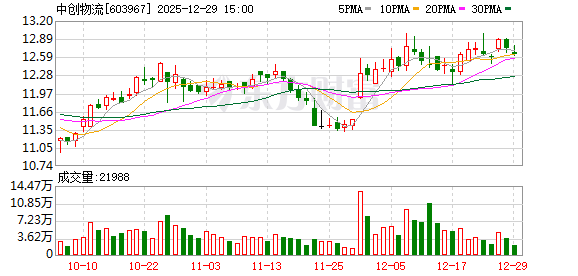
Group 1 - The core point of the article is the appointment of Mr. Li Tao as the Vice General Manager of Zhongchuang Logistics, which was approved by the company's board of directors [2]

六部门联合印发现代物流标准化重点工作计划
Yang Shi Wang· 2025-12-29 11:44
Core Viewpoint - The article discusses the joint issuance of the "Modern Logistics Standardization Key Work Plan (2025-2027)" by several Chinese government agencies, aiming to enhance the logistics sector through the development of national standards across five major areas and 101 tasks, supporting the construction of a unified national market [1][2]. Group 1: Logistics Infrastructure - The plan focuses on improving logistics infrastructure functionality, targeting national logistics hubs, logistics parks, and warehousing and distribution centers, with an emphasis on developing standards for infrastructure design, service capabilities, and digital evaluation [1]. - The goal is to enhance the connectivity of logistics infrastructure and establish a modern logistics operation system characterized by "channels + hubs + networks" [1]. Group 2: Logistics Equipment Innovation - The initiative aims to establish a comprehensive standard system for logistics equipment such as pallets, turnover boxes, containers, and loading devices, promoting the circular use of logistics loading tools and facilitating efficient connections across different transportation modes [1][2]. Group 3: Data Interconnectivity - The focus is on developing standards for logistics data infrastructure, data interaction and sharing, and data management for logistics enterprises, which will support the digital transformation and intelligent upgrade of logistics [1]. Group 4: Service Quality Improvement - The plan emphasizes accelerating the development of standards related to cold chain logistics, pharmaceutical logistics, multimodal transport, and mandatory national standards for the transportation of hazardous goods, enhancing the logistics sector's role in improving the resilience and safety of supply chains [2]. Group 5: Industry Foundation Enhancement - The initiative includes improving standards for logistics documentation, enterprise classification and capability assessment, and industry statistical monitoring, while also strengthening the training of logistics standardization talent to elevate the overall standardization level in the logistics industry [2]. Group 6: Recent Achievements - Since the 14th Five-Year Plan, the market regulatory authority has released 207 national standards in the logistics field, covering key areas such as logistics parks, multimodal transport, green packaging for express delivery, traceability of imported cold chain food, electronic data exchange for containers, and cargo drones [2]. - The next steps involve the implementation of the "Modern Logistics Standardization Key Work Plan (2025-2027)" and continuous upgrades to the logistics standard system to ensure effective application of these standards [2].
海程邦达:从2024年下半年开始,公司已在部分业务场景中逐步推广AI技术应用
Zheng Quan Ri Bao· 2025-12-29 11:44
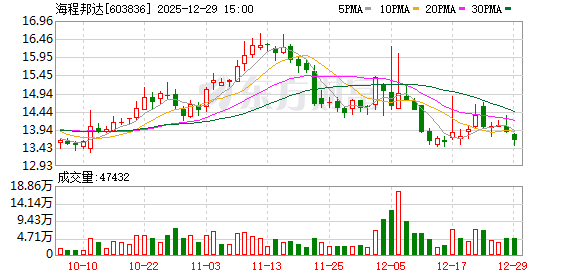
Group 1 - The company, Haicheng Bangda, plans to gradually promote the application of AI technology in certain business scenarios starting from the second half of 2024 [2] - The focus areas for AI implementation include customs affairs, documentation, and reconciliation, primarily in operational tasks [2] - The deep application of AI technology is expected to effectively reduce repetitive labor, achieve reasonable cost reductions, and steadily improve service quality [2]

六部门联合印发现代物流标准化重点工作计划 明确五方面内容
Yang Shi Xin Wen· 2025-12-29 11:34
Group 1 - The core viewpoint of the news is the joint issuance of the "Key Work Plan for Modern Logistics Standardization (2025-2027)" by multiple government agencies to support the construction of a unified national market through the development of 101 national standards across five major areas [1][2][3] Group 2 - In the area of logistics infrastructure enhancement, the focus is on developing standards for the design, service capacity, and digital evaluation of key logistics facilities such as national logistics hubs and distribution centers to improve connectivity and establish a modern logistics operation system [1] - For logistics equipment innovation, the plan emphasizes the establishment of a standard system for pallets, turnover boxes, containers, and other logistics loading tools to promote their circular use and efficient connection across different transport modes [1] - Regarding logistics data openness and interconnectivity, the initiative aims to develop standards for logistics data infrastructure, data sharing, and enterprise data management to support the digital transformation and intelligent upgrade of logistics [1] - In terms of improving logistics service operations, the focus is on developing standards related to cold chain logistics, pharmaceutical logistics, and multi-modal transport, as well as mandatory national standards for hazardous goods transportation to enhance the resilience and safety of supply chains [1] - The logistics industry will also see improvements in standardization through the enhancement of logistics documentation, enterprise classification, and statistical monitoring, alongside the cultivation of logistics standardization talent to elevate the overall standardization level in the sector [2] - Since the 14th Five-Year Plan, the market regulatory authority has issued 207 national standards in the logistics field, covering key areas such as logistics parks, multi-modal transport, green packaging for express delivery, and electronic data exchange for containers [2]
跨省最快7小时送达,解锁“一站式”冰雪寄递新体验
Zhong Guo Jing Ji Wang· 2025-12-29 10:22
Core Viewpoint - The logistics industry is increasingly focusing on the winter sports economy, with companies like SF Express enhancing their services to meet the needs of snow sports enthusiasts, thereby contributing to the growth of the ice and snow economy [1][6]. Group 1: Logistics Innovations - SF Express has developed a specialized snow equipment delivery service, addressing the pain points of transporting snow gear, which is often cumbersome and prone to damage [1][4]. - The company offers a rapid delivery service, achieving cross-province delivery in as fast as 7 hours, ensuring that snow gear arrives almost simultaneously with the customers [4]. - SF Express provides customized packaging and real-time tracking for high-value snow equipment, enhancing the safety and reliability of the transportation process [4][7]. Group 2: Enhanced Customer Experience - The introduction of a 999 yuan snow season storage card by SF Express includes 15 free delivery services, allowing customers to easily switch between popular ski resorts without the hassle of repeated shipping [5]. - SF Express has created a closed-loop service network that includes door-to-door pickup and direct delivery to ski resorts, eliminating the need for customers to wait at airports for gear pickup [4][6]. Group 3: Industry Growth and Integration - The ice and snow industry in China is projected to exceed 1 trillion yuan by 2025, driven by the increasing popularity of winter sports [6]. - SF Express is extending its services beyond just snow gear delivery to encompass the entire ice and snow travel experience, including local specialty product delivery and the establishment of themed stores at ski resorts [6][7]. - The company is positioning itself as a key partner in the ice and snow industry, supporting events and activities with tailored logistics solutions, thereby enhancing its brand influence in the cultural and tourism sectors [7][8].


重磅利好!国务院官宣2026关税大调整,935项商品降价,这4大行业或成超级风口!
Jin Rong Jie· 2025-12-29 10:20
Core Viewpoint - The State Council's Tariff Policy Committee has announced the "2026 Tariff Adjustment Plan," effective from January 1, 2026, aimed at optimizing import tariffs to promote high-quality development and meet the growing needs of the population [1][2]. Group 1: High-end Manufacturing and Technology Industry - The industry will benefit directly from reduced import tariffs on key components and advanced materials, such as hydraulic cushions and composite connectors, which will lower import costs and enhance supply stability [4]. - The tariff reduction is expected to alleviate financial pressure on companies importing critical semiconductor equipment, thereby accelerating domestic substitution processes and fostering a favorable development environment [4]. Group 2: Healthcare Sector - The tariff adjustments will lower import tariffs on medical products like artificial blood vessels and diagnostic kits, reducing procurement costs for domestic healthcare institutions and improving access to quality medical resources [4]. - The ongoing optimization of tariff policies will further decrease operational costs for healthcare companies, enhancing their market competitiveness [4]. Group 3: Foreign Trade and Retail - Foreign trade enterprises, particularly those engaged in cross-border operations, will benefit from tariff reductions, with products like coffee beans and automotive engines included in the "zero tariff" list [5]. - The rising demand in the duty-free shopping market, exemplified by a 54.9% year-on-year increase in Hainan's duty-free shopping amount, will drive growth in related industries such as shipping and logistics [5]. Group 4: Green Energy - The green energy sector will see advantages from reduced import tariffs on resource products, such as recycled black powder for lithium-ion batteries, lowering production costs for new energy battery manufacturers [5]. - The easing of tariffs is expected to provide more certainty for global investments in the new energy sector, further reducing export costs for China's photovoltaic and new energy vehicle industries [5].
物流板块12月29日跌1.01%,厦门国贸领跌,主力资金净流出6.18亿元
Zheng Xing Xing Ye Ri Bao· 2025-12-29 09:06
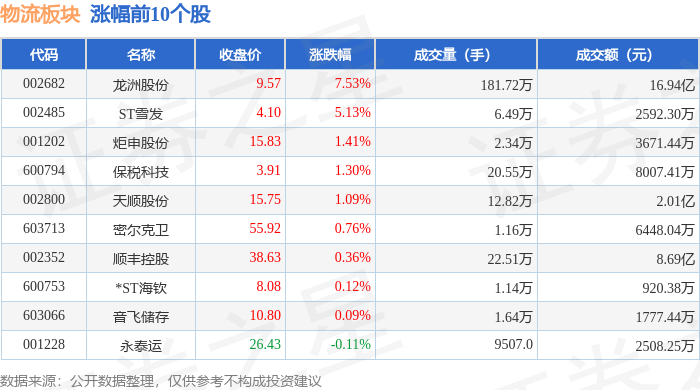
Group 1 - The logistics sector experienced a decline of 1.01% on December 29, with Xiamen Guomao leading the drop [1] - The Shanghai Composite Index closed at 3965.28, up 0.04%, while the Shenzhen Component Index closed at 13537.1, down 0.49% [1] - Notable gainers in the logistics sector included Longzhou Co., which rose by 7.53% to a closing price of 9.57, and ST Xuefa, which increased by 5.13% to 4.10 [1] Group 2 - Major losers in the logistics sector included Xiamen Weimao, which fell by 9.98% to 7.85, and Ruiwu Tong, down 4.88% to 3.51 [2] - The logistics sector saw a net outflow of 618 million yuan from institutional investors, while retail investors contributed a net inflow of 413 million yuan [2] Group 3 - In terms of capital flow, SF Holding had a net inflow of 128 million yuan from institutional investors, but saw outflows from retail and speculative investors [3] - The data indicates that while institutional investors withdrew funds, retail investors were actively buying into certain stocks within the logistics sector [3]