跨境电商

Search documents
三态股份跌3.20%,成交额1.27亿元,近3日主力净流入-3783.12万
Xin Lang Cai Jing· 2025-11-21 07:49
Core Viewpoint - Shenzhen SanTai E-commerce Co., Ltd. is experiencing a decline in stock price, with a 3.20% drop on November 21, 2023, and a total market capitalization of 6.91 billion yuan [1] Company Overview - Shenzhen SanTai E-commerce Co., Ltd. specializes in cross-border e-commerce retail and third-party logistics for cross-border e-commerce, with main revenue sources being 76.14% from cross-border e-commerce product sales and 23.80% from logistics services [7] - The company was established on January 7, 2008, and went public on September 28, 2023 [7] Business Developments - The company has launched an AI-driven intellectual property risk detection tool named "RuiGuan·ERiC," which aims to provide flexible, low-cost, and accurate risk monitoring solutions for businesses [2][3] - The company is also developing an AIGC project that utilizes Stable Diffusion to generate high-quality images, enhancing operational efficiency and reducing production costs [2] Financial Performance - For the period from January to September 2025, the company reported a revenue of 1.252 billion yuan, reflecting a year-on-year growth of 0.15%, while the net profit attributable to shareholders decreased by 25.94% to 31.8471 million yuan [8] - As of November 10, 2023, the company had 29,000 shareholders, with a slight decrease of 1.76% from the previous period [8] Market Position - The company benefits from the depreciation of the Chinese yuan, with overseas revenue accounting for 99.98% of total revenue as of the 2024 annual report [3] - The stock is categorized under the retail trade - internet e-commerce - cross-border e-commerce sector, and is associated with concepts such as small-cap stocks, intellectual property, and logistics [8]
源头工厂带来拳头产品,知名跨境电商平台带来配套服务这场供需对接活动,打通“四川造”产销对接“最后一公里”——活动已结束,不少参会者舍不得离开
Si Chuan Ri Bao· 2025-11-21 07:09
Core Insights - The "Sichuan-made" products are rapidly expanding into international markets, with a significant increase in recognition and demand [2][3][4] - The cross-border e-commerce pilot zone in Sichuan has achieved a coverage rate of 43%, with an annual transaction growth rate exceeding 20% [1][4] - Various departments are collaborating to enhance the policy environment for industrial and trade development, supporting digital transformation and talent cultivation in cross-border e-commerce [1][5] Group 1: Market Expansion - Over 200 source factories participated in a recent supply-demand matching event, indicating a strong push for "Sichuan-made" products to enter global markets [2][4] - Chengdu Xinxinan Ceramics Co., a participant, reported a 200% year-on-year increase in export volume for their handmade artistic tiles [2] - Chengdu Lianchuang Precision Machinery Co. is adapting its products to meet overseas customer demands, emphasizing the importance of diversifying market outreach [3] Group 2: E-commerce Development - The event attracted major global e-commerce platforms like Amazon and Alibaba, facilitating connections between Sichuan enterprises and international markets [4] - Sichuan Kexian Advertising Co. has expanded its foreign trade business through Alibaba International, exporting products to over 80 countries [4] - Sichuan Aixiang Technology Co. has established an independent online platform to address challenges in B2B order fragmentation and rising costs, focusing on brand communication [5] Group 3: Government Support - The Sichuan government is committed to optimizing the policy environment for trade and industry, enhancing logistics, payment, and certification services [1][5] - The government aims to support the digital transformation of enterprises and strengthen cross-border e-commerce talent training [1][5] - The initiative seeks to elevate local brands to become new international market representatives for Sichuan [5]
全球跨境产业基地在杭启幕
Mei Ri Shang Bao· 2025-11-21 06:59
Group 1 - Zhejiang's foreign trade has shown steady progress this year, with cross-border e-commerce continuing to grow, particularly in Hangzhou, which has become a key hub for this sector [1] - The "Global Cross-Border Industry Base" was officially launched at the "AI Cross-Border Industry Ecosystem Conference" on November 18, aimed at helping more SMEs transition from "Made in China" to "Global Brands" [1] - The base includes various facilities such as a cross-border e-commerce live streaming exhibition hall, selection center, shared live streaming room, comprehensive service hall, entrepreneurial incubation center, and international talent service center, providing a full-cycle entrepreneurial service platform [1] Group 2 - The Binjiang Alibaba Center is establishing a "Source Quality Product Library" to promote direct connections with production areas and quality control traceability, integrating resources to support cross-border enterprises [2] - The center offers a "Y/our Space" shared office community, providing a unique "AI + Cross-Border" positioning for entrepreneurs, with monthly rental costs of only 500 yuan for a dedicated workspace [2] - Comprehensive lifecycle services are provided, including business setup, policy application, financial and legal support, and investment financing connections, along with activities like entrepreneurial salons and technical training [2] Group 3 - The Director of Hangzhou Municipal Bureau of Commerce expressed congratulations on the establishment of the base and emphasized the promotion of the integration of "live streaming + platform + cross-border e-commerce" to upgrade local industries from "Hangzhou Manufacturing" to "Hangzhou Intelligent Manufacturing" [3]

晶采观察丨有“量”有“质” 中西部地区外贸“新”潮涌动
Yang Guang Wang· 2025-11-21 06:33
Core Insights - The article highlights the significant growth of cross-border exports in Zhengzhou, with a nearly fourfold increase in value in the first ten months of the year, reflecting the robust development of foreign trade in China's central and western regions [1] - The total import and export value of goods in the central and western regions reached 6.68 trillion yuan, leading the national foreign trade growth rate [1] - The regions are focusing on both quantity and quality improvements in foreign trade, supported by upgraded logistics and favorable policies [1][2] Group 1: Quantity Growth - The central and western regions are experiencing a notable increase in foreign trade volume, driven by continuous upgrades in transportation and logistics [1] - Zhengzhou has established an efficient cross-border logistics network through the "Air Silk Road" and the China-Europe Railway Express, enhancing trade efficiency [1] - Policy incentives, such as the establishment of cross-border e-commerce pilot zones, have simplified customs processes and reduced operational costs for businesses [1] Group 2: Quality Improvement - The transformation of foreign trade in the central region is shifting from quantity to quality, with a focus on industrial upgrades and brand development [2] - Local industries are moving from passive order-taking to proactive international expansion, exemplified by brands like Xuchang wigs and Luoyang steel cabinets [2] - The export structure is optimizing, with "new three types" of products seeing a 47.35% increase, and electric vehicles experiencing a remarkable growth rate of 125.39% [2]
如何理解“因地制宜发展新质生产力”?
Di Yi Cai Jing· 2025-11-21 05:54
(付一夫为苏商银行高级研究员) 当前,我国经济正处于高质量发展的关键转型期,而大力发展新质生产力已然成为推动经济结构优化、 培育增长新动能的核心抓手。然而,新质生产力并非放之四海而皆准的标准化模式,其本质是技术革命 性突破、生产要素创新性配置与产业深度转型升级的有机统一,而"因地制宜"正是实现这一统一的前提 条件。 正因如此,我们有必要深入理解"因地制宜发展新质生产力"这一重要命题。 一、新质生产力与"因地制宜"的内在逻辑 要理解"因地制宜发展新质生产力",首先需厘清两大核心概念的内涵及其耦合关系。 从本质上看,新质生产力区别于传统生产力的关键在于"新质"——它不再依赖单纯的要素投入增量,而 是以科技创新为核心驱动力,通过数据、技术、人才等要素的重构,推动产业从规模扩张向质量效益跃 迁。例如,深圳的新能源汽车产业之所以能领跑全国,不仅在于电池技术的突破,更在于其构建了"研 发设计→核心零部件→整车制造→智能服务"的全要素协同生态,这正是新质生产力"要素重构"特征的 典型体现。 而"因地制宜"的核心,则是在于尊重区域发展的差异性与特殊性,将新质生产力的发展规律与地方资源 禀赋、产业基础、区位条件深度融合。这里的 ...
金融助力中国企业“走出去”报告
第一财经研究院· 2025-11-21 05:51
Investment Rating - The report indicates a positive investment outlook for Chinese enterprises going global, with a projected increase in foreign direct investment (FDI) to 1.16 trillion RMB in 2024, reflecting an 11.30% year-on-year growth [8]. Core Insights - Chinese enterprises are actively exploring new pathways for international expansion, adapting strategies in response to geopolitical challenges and evolving market conditions [4][8]. - The ASEAN region has emerged as a key destination for Chinese investment, with its share of China's outbound investment rising from 6.34% in 2014 to 17.88% in 2024 [8]. - The structure of China's outbound investment is shifting, with significant increases in the wholesale, retail, and manufacturing sectors, indicating a deeper integration into global value chains [8][52]. Summary by Sections Part A: Challenges and Pathways for Chinese Enterprises Going Global - The Chinese government is committed to high-quality outbound investment, emphasizing the importance of maintaining a stable international economic environment despite rising geopolitical tensions [18][19]. - The share of China's exports in global trade is projected to reach 14.64% in 2024, maintaining its position as the world's largest exporter [19][23]. - Chinese enterprises are increasingly focusing on the ASEAN region for investment, with a notable rise in direct investment since the implementation of the RCEP [44][52]. Part B: Financial Support for Outbound Expansion - Chinese financial institutions are enhancing their overseas presence, with major banks establishing branches in numerous countries to support outbound enterprises [9]. - There is a strong emphasis on integrating domestic and international resources, with banks providing cross-border credit and financing solutions for projects under the Belt and Road Initiative [9][11]. - Innovative financial products and services are being developed to support overseas investments, including specialized loans for infrastructure projects and comprehensive solutions for cross-border e-commerce [9][11]. Part C: Future Outlook and Recommendations - Recommendations include optimizing overseas network construction, enhancing multi-tiered financial service systems, and expanding the use of cross-border RMB [12][13]. - A comprehensive risk management system is suggested to help enterprises navigate geopolitical uncertainties and market volatility [12][13]. - Strengthening collaboration between financial institutions and industries is crucial for supporting enterprises in their global expansion efforts [12][13].




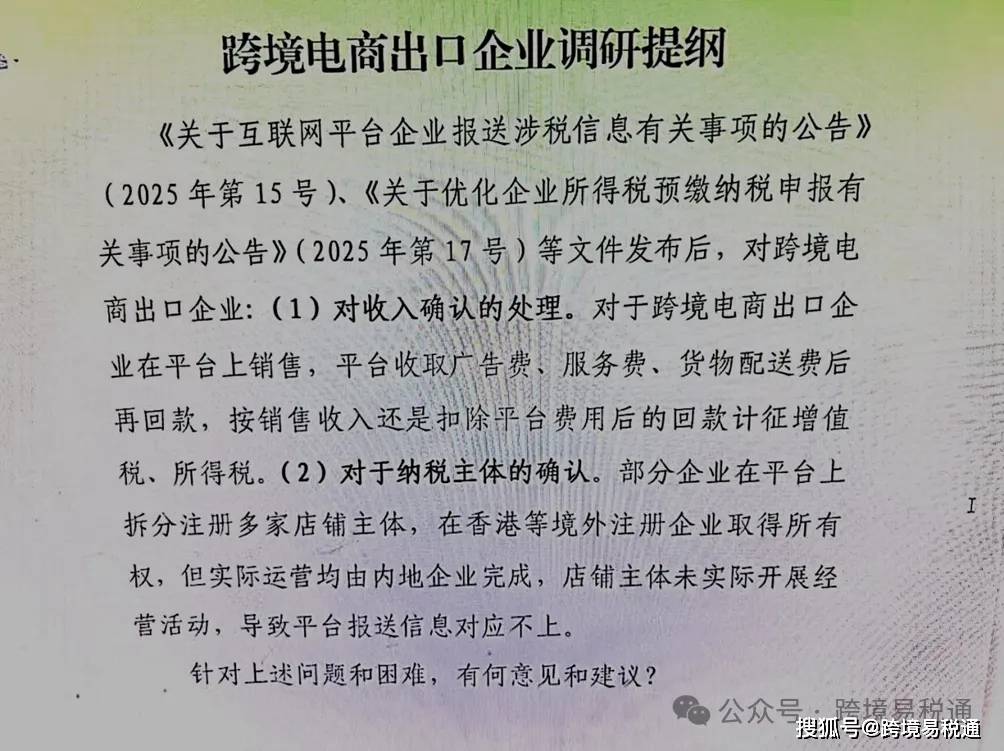
《跨境电商调研提纲》来了,不是“危”是“机”!你的回复将决定跨境电商未来的生存方式
Sou Hu Cai Jing· 2025-11-21 04:58
Core Insights - The article highlights a critical window for cross-border e-commerce companies to comply with tax regulations as the tax authority actively seeks to understand industry pain points and solutions [1][3]. Group 1: Revenue Recognition Issues - There is a discrepancy between the total sales reported by platforms and the actual income received by sellers, leading to confusion in revenue recognition [3][15]. - For example, a product sold for $100 may result in a net income of only $40 after deducting platform fees, while the platform reports the total sales of $100 [3][4]. - According to the 2025 No. 15 announcement, platforms report total sales, which does not reflect the actual income of cross-border sellers, causing potential tax inquiries due to significant income gaps [15][12]. Group 2: Taxpayer Identification Challenges - Many sellers operate multiple store fronts under different entities, complicating the identification of the actual taxpayer [12][16]. - The tax authority is unclear about the relationships between these entities and their actual operations, leading to compliance challenges [12][16]. - The article suggests that the tax authority should consider the operational realities of cross-border sellers and their compliance structures [28][30]. Group 3: Recommendations for Tax Authority - The industry suggests that the tax authority should clarify revenue recognition standards and allow for net income reporting [33][31]. - A transitional policy is recommended to help businesses adjust to historical data discrepancies [33]. - The article advocates for the tax authority to provide clear guidelines on tax treatment for cross-border e-commerce to avoid undue burdens on compliant businesses [30][34]. Group 4: Industry Response and Support - The article emphasizes the importance of industry participation in the tax authority's research process, encouraging businesses to engage actively [36][37]. - Companies are advised to prepare for the survey and present their operational realities and policy suggestions effectively [36][37]. - The article positions the consulting firm as a strategic partner for compliance transformation, offering tailored solutions for revenue recognition and taxpayer identification issues [36][37].



共建全球良性产业生态,海内外品牌加速入驻SHEIN平台
Huan Qiu Wang· 2025-11-21 03:00
Core Viewpoint - Guangzhou's foreign trade import and export value reached 1.02 trillion yuan in the first ten months of this year, marking a historical high and a year-on-year increase of 12.1%, with exports growing by 20.5%, leading among major foreign trade cities in China and Guangdong province [1] Group 1: Cross-Border E-Commerce Growth - Cross-border e-commerce has become a significant engine for China's foreign trade transformation and upgrading, with Guangzhou promoting itself as a "cross-border e-commerce city" through collaborations with companies like SHEIN, Amazon, and AliExpress [1] - The city has maintained double-digit growth in cross-border e-commerce imports and exports, driven by various industry activities [1] Group 2: SHEIN's Role and Initiatives - SHEIN is enhancing industry and international cooperation while empowering domestic supply chains and leading industrial upgrades, exemplified by its "SHEIN Xcelerator" brand incubation program and a service open platform for global developers [1][10] - The company has invested over 15 billion yuan in building a smart supply chain system centered in Guangzhou, covering surrounding cities [4] Group 3: Supplier Empowerment and Training - SHEIN's "Five-Year 500 Million Yuan" supplier empowerment plan has led to significant upgrades in factory environments and extensive training programs, with nearly 1,400 training sessions conducted [3] - The company has invested approximately 300 million yuan in technological innovation and lean construction in the first half of 2023 [3] Group 4: Global Brand Collaborations - Numerous global brands, including Funko and The Children's Place, have joined the SHEIN platform, attracted by its extensive reach and influence among young consumers [7] - French fashion brand Pimkie and British footwear brand Clarks are among those collaborating with SHEIN to enhance their market presence and sales through tailored services [8] Group 5: SHEIN's Open Platform and Ecosystem - SHEIN's service open platform aims to provide digital value-added services to sellers, with over 3,000 independent software partners in discussions for collaboration [10] - The platform supports sellers and brands in achieving high-quality, sustainable development in global markets, fostering a harmonious global industrial chain ecosystem [10]


企业突围、政策赋能、数字破冰——广州外贸突破万亿的创新密码
Guang Zhou Ri Bao· 2025-11-21 01:42
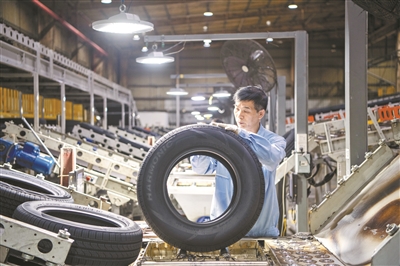
Core Viewpoint - Guangzhou's foreign trade has achieved a historic breakthrough, with a total import and export value of 1.02 trillion yuan in the first ten months of the year, marking a 12.1% year-on-year increase and representing 13.1% of Guangdong's total foreign trade [1][2]. Group 1: Trade Performance - In the first ten months, Guangzhou's foreign trade grew at a rate of 12.1%, with exports increasing by 20.5%, leading among the top ten foreign trade cities in China [2]. - Guangzhou's foreign trade scale has surpassed one trillion yuan for the first time in history during this period [1]. Group 2: Company Innovations - GAC Group reported a significant increase in automobile exports, with 15,400 vehicles exported in October, a 69.2% year-on-year growth, and a 36% increase in self-owned brand exports from January to October [2]. - Wanli Tire has seen a double-digit growth in exports, attributed to strategic market expansion and product innovation, with a focus on the replacement market [3][4]. Group 3: Digital and E-commerce Initiatives - Guangzhou has launched a "global cross-border e-commerce battery goods data service platform," which has pre-reviewed 180,000 battery SKU products, addressing industry bottlenecks [5]. - The city has established a comprehensive online and offline wholesale market platform linked to an 80,000 square meter overseas exhibition center in Milan, facilitating direct access to the European market [6]. Group 4: Policy Support - The introduction of a "dual pre-inspection" system at Baiyun Airport has improved logistics efficiency, increasing daily cargo handling capacity by 200 tons and reducing costs for enterprises by 20% [9]. - The "departure tax refund" policy allows companies to pre-apply for tax refunds based on export declarations, significantly shortening the refund cycle from an average of 45 working days to immediate post-departure [10]. Group 5: Overall Economic Impact - Guangzhou is transforming institutional innovations into competitive advantages for enterprises, leveraging digital empowerment to drive new trade dynamics [10].