货物贸易

Search documents
外汇局:8月我国国际收支货物和服务贸易顺差710亿美元
Zheng Quan Ri Bao Wang· 2025-09-26 11:47
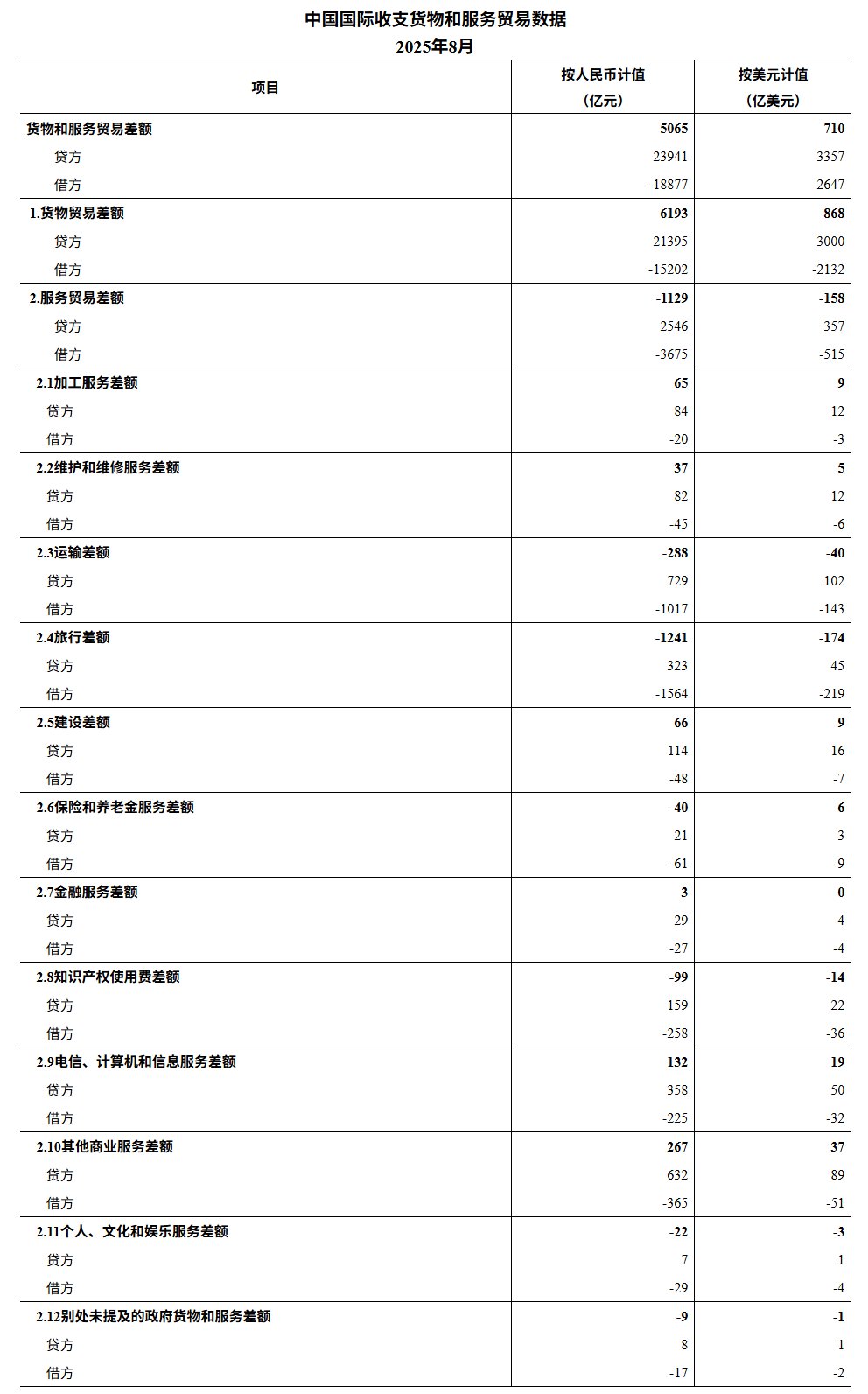
Core Insights - In August 2025, China's international balance of payments for goods and services trade reached a total import and export scale of 42,818 billion yuan, marking a year-on-year growth of 2% [1] Trade Data Summary - Goods trade exports amounted to 21,395 billion yuan, while imports were 15,202 billion yuan, resulting in a surplus of 6,193 billion yuan [1] - Service trade exports totaled 2,546 billion yuan, with imports at 3,675 billion yuan, leading to a deficit of 1,129 billion yuan [1] Service Trade Breakdown - Major components of service trade included: - Travel services with an import and export scale of 1,887 billion yuan - Transportation services with an import and export scale of 1,745 billion yuan - Other commercial services with an import and export scale of 996 billion yuan - Telecommunications, computer, and information services with an import and export scale of 583 billion yuan [1] Dollar Value Summary - In USD terms, exports for August 2025 were valued at 3,357 million USD, imports at 2,647 million USD, resulting in a surplus of 710 million USD [1]
国家外汇局:8月我国国际收支货物和服务贸易进出口规模42818亿元 同比增长2%
智通财经网· 2025-09-26 09:14
Core Insights - In August 2025, China's international balance of payments for goods and services trade reached a total import and export scale of 42,818 billion yuan, marking a year-on-year increase of 2% [1] - The goods trade surplus was 6,193 billion yuan, with exports at 21,395 billion yuan and imports at 15,202 billion yuan [1] - The services trade recorded a deficit of 1,129 billion yuan, with exports at 2,546 billion yuan and imports at 3,675 billion yuan [1] Goods Trade Summary - Total goods trade exports amounted to 21,395 billion yuan (3,000 billion USD) and imports were 15,202 billion yuan (2,132 billion USD) [2] - The goods trade surplus was 6,193 billion yuan (868 billion USD) [2] Services Trade Summary - Total services trade exports were 2,546 billion yuan (357 billion USD) and imports were 3,675 billion yuan (515 billion USD) [2] - The services trade deficit was 1,129 billion yuan (158 billion USD) [2] - Major components of services trade included: - Travel services: exports of 323 billion yuan (45 billion USD) and imports of 1,564 billion yuan (219 billion USD), resulting in a deficit of 1,241 billion yuan (174 billion USD) [4] - Transportation services: exports of 729 billion yuan (102 billion USD) and imports of 1,017 billion yuan (143 billion USD), leading to a deficit of 288 billion yuan (40 billion USD) [4] - Other commercial services: exports of 632 billion yuan (89 billion USD) and imports of 365 billion yuan (51 billion USD), resulting in a surplus of 267 billion yuan (37 billion USD) [4]

时评:3.5%!外贸稳增长彰显中国经济韧性与活力
Sou Hu Cai Jing· 2025-09-26 05:41
Core Viewpoint - China's foreign trade has shown steady growth in the first eight months of 2025, with a total import and export value of 29.57 trillion yuan, reflecting a year-on-year increase of 3.5% and maintaining the growth level consistent with the first seven months [2] Group 1: Trade Performance - In August, both exports and imports increased, marking the third consecutive month of "double growth" following June and July [2] - Private enterprises remain the largest import and export entities, with a total import and export value of 16.89 trillion yuan, growing by 7.4% and accounting for 57.1% of the total [3] - Trade with ASEAN, EU, and the US are significant, with ASEAN being the largest trading partner at 4.93 trillion yuan (up 9.7%), followed by the EU at 3.88 trillion yuan (up 4.3%), and the US at 2.73 trillion yuan (down 13.5%) [3] Group 2: Policy Support - A series of policies have been implemented to stabilize foreign trade, including optimizing the business environment, reducing costs, enhancing financial support, and expanding market channels [4] - Customs reforms such as the "single window" system have improved clearance efficiency, significantly shortening the time for goods to pass through customs [4] - Financial support for foreign trade enterprises has increased, with innovative financial products like export credit insurance and trade financing being introduced [4] Group 3: Structural Changes - The structure of China's foreign trade is undergoing positive changes, with mechanical and electrical products showing strong export performance, totaling 10.6 trillion yuan (up 9.2%) and accounting for 60.2% of total exports [5] - Notable growth in exports of integrated circuits and automobiles, with growth rates of 23.3% and 11.9% respectively, indicates a shift towards higher value-added products [5] - New business models such as cross-border e-commerce are thriving, contributing significantly to foreign trade growth, with cross-border e-commerce imports and exports continuing to grow rapidly [5]
保持外贸量增质提好态势
Jing Ji Ri Bao· 2025-09-22 23:24
Core Insights - The article emphasizes the need to enhance the structure of foreign trade in China, encouraging high-end development and the internationalization of "Chinese services" to better support high-quality economic growth [1][2]. Trade Performance - From January to July, China's total goods trade reached 25.7 trillion yuan, a year-on-year increase of 3.5%. In July alone, the total trade value was 3.91 trillion yuan, growing by 6.7% [1]. - High-tech and high-value-added products have become the main drivers of trade growth, with significant progress in diversifying markets, particularly in Southeast Asia and Africa [1][2]. Regional Contributions - Zhejiang province's total import and export volume reached 2.73 trillion yuan in the first half of the year, a 6.6% increase, with exports surpassing 2 trillion yuan [2]. - Fujian province led the nation in lithium battery exports, totaling 76.461 billion yuan from January to July, marking a 23.96% increase [2]. Challenges and Risks - Despite positive growth, challenges such as high export market concentration, similar industrial structures, and intense competition remain significant issues for China's foreign trade [2]. - The article notes that while there have been steady advancements in talent and technology-intensive industries, establishing a solid competitive advantage will take time, with some core technologies still being constrained [2]. Strategic Recommendations - The article suggests enhancing the technological content of products and promoting high-end foreign trade structures through increased R&D support and financing for strategic emerging industries [3]. - It advocates for the integration of "Chinese services" with goods trade, encouraging enterprises to establish regional manufacturing centers abroad and improve local service capabilities [3]. Regulatory and Governance Enhancements - The establishment of a public service platform for free trade agreements is recommended to provide comprehensive support for enterprises, including information on trade friction and compliance requirements [4]. - The article calls for active participation in global economic governance to enhance China's influence in international trade rule-making, particularly through multilateral dialogues and cooperation on trade facilitation [4].
加快服务贸易创新发展
Sou Hu Cai Jing· 2025-09-21 21:41
Core Viewpoint - The significant changes in China's international trade environment, particularly due to the U.S. tariffs, have led to a notable increase in service trade growth, which is expected to provide more certainty to overall trade dynamics [1] Group 1: Service Trade Growth - From 2022 to 2024, China's service trade import and export total is projected to grow at rates of 12.9%, 10%, and 14.4% respectively, while goods trade growth rates are significantly lower at 7.6%, 0.2%, and 5.0% [1] - The proportion of knowledge-intensive service trade is expected to rise from 34.68% in 2019 to 38.5% in 2024, indicating a structural optimization in service trade [1] Group 2: Economic Development and Service Trade - China's economy, with a total GDP of nearly $19 trillion and a per capita GDP of $13,500, has the potential to attract global resources, enhancing domestic economic circulation and high-quality development through service trade [2] - Service trade can facilitate the cross-border flow of production factors, enhancing domestic service efficiency and supporting the transformation of manufacturing through services like brand management and market marketing [2] Group 3: Cross-Border E-commerce - Cross-border e-commerce in China has grown from 1.06 trillion yuan in 2018 to 2.71 trillion yuan by 2024, increasing its share of total goods imports and exports from 3.46% to 6.2% [3] - The growth of cross-border e-commerce exemplifies how service exports can drive goods trade exports, showcasing a new model of service export [3][4] Group 4: Cultural Exchange through Service Trade - Service trade is increasingly playing a role in the international dissemination of Chinese culture, with inbound tourism and media content creation gaining traction [5] - The overseas box office for "Nezha 2" has surpassed $55 million, and the revenue from Chinese online literature in overseas markets is expected to reach nearly 5 billion yuan in 2024, reflecting the growing international competitiveness of Chinese cultural services [5] Group 5: Innovation and Future Development - There is a need to expand service trade through institutional openness and align with international trade standards, particularly in sectors like health, tourism, and culture [6] - The integration of digital technology with various industries is essential for developing new forms of service trade, focusing on digital service exports to create a vibrant and efficient service trade landscape [6]
中国外贸迎来新拐点!5506亿顺差背后,民营企业突围与全球贸易新布局
Sou Hu Cai Jing· 2025-09-20 04:16
Core Insights - China's total import and export value in the first quarter reached 10.3 trillion yuan, a slight increase of 1.3% year-on-year, with exports at 6.13 trillion yuan (up 6.9%) and imports at 4.17 trillion yuan (down 6%) [1][10] Group 1: Private Sector Performance - Private enterprises showed remarkable performance with a 5.8% increase in import and export value, now accounting for 56.8% of the total [3][5] - These enterprises have demonstrated flexibility and rapid response to market changes, allowing them to adapt more quickly than larger, traditional firms [3][5] Group 2: Trade with the United States - The trade surplus with the U.S. reached 550.6 billion yuan (approximately 76.6 billion USD), with exports to the U.S. hitting a record high of 830.4 billion yuan while imports were only 279.8 billion yuan [5][6] - The disparity in trade figures is attributed to the nature of goods traded, with China exporting consumer goods and low to mid-end manufacturing products while importing resource-based and high-tech products from the U.S. [5][6] Group 3: Strategic Shifts in Imports - A strategic shift in import channels has occurred, with a 1.4% decline in imports from the U.S. as China increasingly sources soybeans and natural gas from Brazil and Australia [6][14] - This shift reflects a proactive approach to ensure stable supply and pricing, demonstrating a well-planned response to external pressures [6][15] Group 4: Impact of Tariffs - Despite high tariffs imposed by the U.S., China's exports to the U.S. have not only remained stable but have also increased, highlighting the resilience of consumer demand for Chinese goods [7][8] - The burden of tariffs has largely fallen on American consumers, with estimates suggesting an additional annual cost of 1,800 USD per household due to increased prices [8][20] Group 5: Technological and Resource Resilience - China's advancements in technology, particularly in integrated circuits, and its dominance in rare earth resources are key factors contributing to its economic resilience [9][20] - The interplay between technological innovation and resource management is crucial for maintaining competitive advantages in the global market [9][20] Group 6: Regional Trade Dynamics - Exports to ASEAN countries grew by 8.1% and to the EU by 3.7%, indicating a warming trend in these markets [13][20] - The Regional Comprehensive Economic Partnership (RCEP) has facilitated trade by standardizing rules and reducing costs, benefiting private enterprises that diversify their manufacturing and sourcing strategies [13][20]
北方国际:9月19日召开董事会会议
Mei Ri Jing Ji Xin Wen· 2025-09-19 10:30
Group 1 - The company, Northern International, announced the convening of its ninth board meeting on September 19, 2025, via teleconference to discuss the establishment of a branch in Guangzhou [1] - For the first half of 2025, the company's revenue composition was as follows: engineering construction and services accounted for 46.02%, goods trading for 39.54%, metal packaging container sales for 9.19%, power generation income for 4.83%, and other businesses for 0.42% [1] - As of the report date, Northern International's market capitalization was 11.9 billion yuan [1]

今年前8个月苏州货物贸易进出口达1.76万亿元 创同期历史新高
Zhong Guo Xin Wen Wang· 2025-09-19 08:57
Core Insights - In the first eight months of this year, Suzhou's goods trade import and export reached 1.76 trillion yuan, marking a historical high for the same period, with a year-on-year growth of 5.4% [1] - Exports accounted for 1.11 trillion yuan, increasing by 7.1%, while imports totaled 655.72 billion yuan, up by 2.7% [1] Trade Composition - General trade exports reached 531.81 billion yuan, growing by 14%, which contributed 6.3 percentage points to the overall export growth [1] - Processing trade exports were 429.21 billion yuan, making up 38.8% of total exports, while bonded logistics exports increased by 5.8% [1] Export Products - In terms of export goods, Suzhou exported electromechanical products worth 857.87 billion yuan, a growth of 6.5%, representing 77.6% of total exports [1] - The "new three items," including lithium batteries, saw a significant increase of 39.9%, while household appliances grew by 18.4% [1] Belt and Road Initiative - Suzhou's trade with countries and regions involved in the Belt and Road Initiative reached 791.17 billion yuan, a growth of 15.1%, contributing 6.2 percentage points to the overall trade growth [2] - Trade with ASEAN countries amounted to 339.6 billion yuan, increasing by 27%, with exports to ASEAN in August alone reaching 35.27 billion yuan, a remarkable growth of 61.2% [2]
活力“高”涨,旺盛!出口“含金量”跃升 企业核心竞争优势明显
Yang Shi Wang· 2025-09-16 02:25
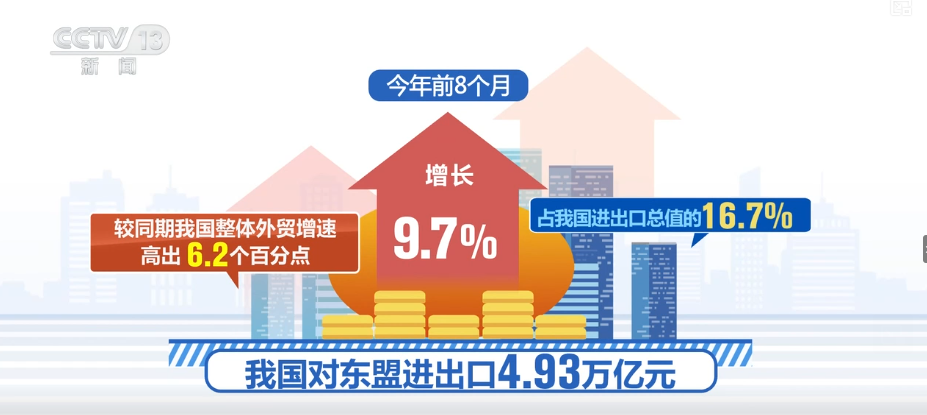
Group 1 - The core viewpoint is that China's trade with ASEAN has shown significant growth, maintaining ASEAN as China's largest trading partner, with a 9.7% increase in imports and exports in the first eight months of 2025 [1][2] - In the first eight months of 2025, China's total trade with ASEAN reached 4.93 trillion yuan, which is 16.7% of China's total trade value, and this growth rate is 6.2 percentage points higher than the overall foreign trade growth rate [2][4] - The trade growth has been consistent, with nearly double-digit growth for 18 consecutive months, indicating a strong and stable trade relationship [4] Group 2 - The Beijing-Tianjin-Hebei region's import and export volume reached 3.06 trillion yuan, with exports growing by 4.3%, marking five consecutive months of growth [6] - In the Guangdong-Hong Kong-Macao Greater Bay Area, the import and export volume of the nine cities reached 5.98 trillion yuan, accounting for 20.2% of the national total, with a 4.5% growth [8] - High-tech product exports from the Beijing-Tianjin-Hebei region approached 200 billion yuan, showcasing a significant increase in export value and competitive advantage [6]
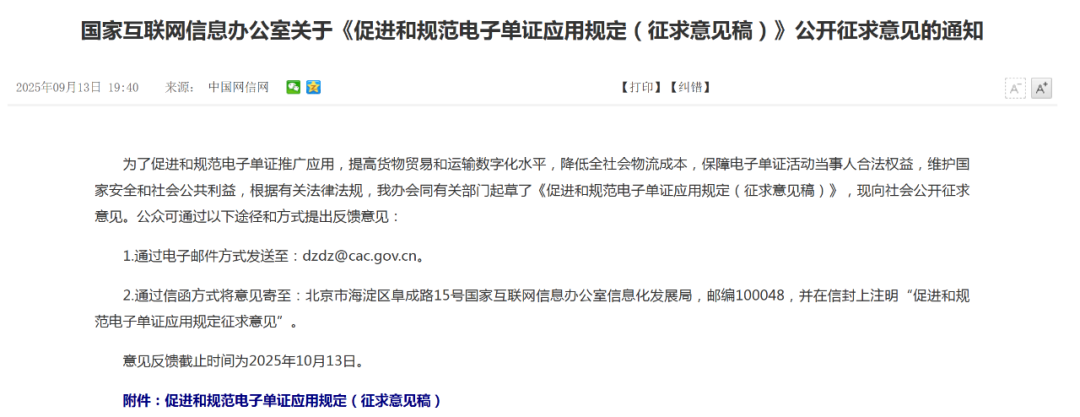
涉及数字人民币等跨境支付,国家网信办公开征求意见
Zhong Guo Zheng Quan Bao· 2025-09-14 04:18
Core Viewpoint - The National Internet Information Office of China, in collaboration with relevant departments, has drafted the "Regulations on Promoting and Standardizing the Application of Electronic Documents" to enhance the digitalization of goods trade and transportation, reduce logistics costs, and protect the legal rights of parties involved in electronic document activities [1][4]. Group 1: Promotion of Electronic Documents - The regulations emphasize the dual focus on development and security, encouraging the adoption of electronic documents across various sectors such as goods trade, logistics, and finance to enhance digital application levels and improve industry efficiency [3][4]. - Financial institutions are encouraged to explore the use of digital RMB and other new payment methods for cross-border payments, provided they comply with legal and risk management requirements [4]. Group 2: Reliability and Security of Electronic Document Systems - The regulations advocate for the use of reliable electronic document systems for activities such as issuance, storage, modification, transfer, and circulation of electronic documents, ensuring traceability and immutability of information [5]. - Reliable electronic document systems must ensure the uniqueness of documents, maintain exclusive control from generation to expiration, and facilitate the transfer of control during document transfer [5]. Group 3: Standardization and Collaboration - National authorities are tasked with strengthening the standardization of electronic documents, encouraging industry associations and enterprises to participate in the development of national and international standards [4][5]. - Collaboration among enterprises, research institutions, industry organizations, and public service institutions is encouraged to innovate in electronic document technology and share practical experiences [4].