
食品加工

Search documents
全聚德:公司未涉及太空食品的研发、投资或相关技术布局
Zheng Quan Ri Bao Wang· 2026-01-08 14:09
证券日报网讯1月8日,全聚德(002186)在互动平台回答投资者提问时表示,公司每年会根据市场情况 推出不同的营销活动。目前公司主营业务聚焦餐饮服务与食品加工主业,未涉及太空食品的研发、投资 或相关技术布局,也未与商业航天企业开展合作。2025年公司与北京航空食品有限公司合作,推出两款 定制月饼。同时,公司与中国国际航空公司联合推出机上餐食,将全聚德美食推向万米高空。未来公司 将持续聚焦餐饮和食品主业,积极探索符合战略定位的合作机会,对包括商业航天在内的新兴场景合作 机会保持开放态度。 ...

若特朗普在最高法院败诉,进口商或将掀起1500亿美元关税退款争夺战
Xin Lang Cai Jing· 2026-01-08 12:52
Core Viewpoint - The U.S. Supreme Court is expected to rule on the legality of tariffs imposed by former President Donald Trump, which could lead to a $150 billion refund battle for importers seeking to reclaim previously paid tariffs [1][9]. Group 1: Legal Context and Implications - Trump is the first U.S. president to impose tariffs under the International Emergency Economic Powers Act (IEEPA), typically used for sanctions against hostile nations [2][11]. - As of December 14, tariffs imposed under this act have generated approximately $133.5 billion in revenue, nearing $150 billion based on recent averages [2][11]. - The Supreme Court's ruling could invalidate these tariffs, but there are concerns that the government may resist refunding the collected amounts [1][9]. Group 2: Refund Process and Electronic Reforms - The U.S. Customs and Border Protection (CBP) announced a shift to electronic refunds starting February 6, which aims to streamline the refund process [3][12]. - This electronic system is expected to reduce errors and fraud, although it does not guarantee a fully automated refund process [3][12]. - The potential scale of refunds is unprecedented for the CBP, which typically manages large tax refunds but has not dealt with such a significant tariff refund scenario [3][12]. Group 3: Legal Actions and Market Reactions - Some companies, including Costco and others, have preemptively filed lawsuits to secure their rights to refunds, fearing that without judicial intervention, they may not recover the tariffs paid [6][14]. - Smaller companies are opting to sell their refund claims in a burgeoning secondary market at steep discounts, with some claims selling for as low as 9% of their face value [7][15]. - Companies are advised to maintain detailed transaction records and act quickly to ensure they can claim refunds if the Supreme Court rules in their favor [7][15]. Group 4: Industry Perspectives - Executives express skepticism about the likelihood of receiving refunds, citing concerns over government reluctance to return funds [1][10]. - The trade representative indicated that even if tariff revenues decline, the government could introduce new tariffs under different legal authorities to compensate for lost revenue [4][13]. - Companies are preparing for a potentially lengthy wait for refunds, with expectations that processing could take years [8][16].
龙大美食:公司及控股子公司无逾期对外担保情况
Zheng Quan Ri Bao Wang· 2026-01-08 12:44
Group 1 - The company, Longda Food (002726), announced that it and its controlling subsidiaries have no overdue external guarantees [1]

宝立食品:公司上市以来已累计现金分红46601.17万元(含税)
Zheng Quan Ri Bao Wang· 2026-01-08 11:45
Core Viewpoint - Baoli Food (603170) emphasizes its commitment to value management and has consistently returned value to investors through cash dividends since its listing [1] Group 1: Dividend Policy - The company has cumulatively distributed cash dividends of 466.01 million yuan (including tax) since its listing [1] - The cash dividend amounts for the fiscal years 2022, 2023, and 2024 represent 46.43%, 49.83%, and 68.60% of the net profit attributable to shareholders, respectively [1] Group 2: Business Performance - Recent periodic reports indicate that the company has maintained a steady growth trajectory in its operations [1] - The company plans to continue optimizing its operational results to enhance intrinsic value and boost market confidence [1] Group 3: Information Disclosure - The major shareholder will fulfill its obligations regarding the disclosure of share reduction progress and changes in equity, and the company will provide timely updates through announcements [1]

惠发食品:公司注重海外市场拓展
Zheng Quan Ri Bao Wang· 2026-01-08 11:45
证券日报网讯1月8日,惠发食品(603536)在互动平台回答投资者提问时表示,公司注重海外市场的拓 展,对外投资等重大事项请以公司公告为准。 ...

紫燕食品:股价连续3日异常波动,25年前三季营收25.14亿
Xin Lang Cai Jing· 2026-01-08 10:26
紫燕食品公告称,公司股票于2026年1月6 - 8日连续3个交易日内日收盘价格涨幅偏离值累计超20%,属 异常波动。经自查,公司生产经营正常,未发现应披露未披露重大信息、影响股价的传闻概念等,实控 人、董高在异常波动期间无买卖股票情况。2025年1 - 9月公司营收25.14亿元,同比降6.43%;净利润 1.94亿元,同比降44.37%。公司提醒投资者注意交易及业绩下滑等风险。 ...

金字火腿1月8日现1笔大宗交易 总成交金额1565.2万元 溢价率为-10.27%
Xin Lang Cai Jing· 2026-01-08 09:51
Group 1 - The stock of Jinzi Ham is up by 0.32%, closing at 6.23 yuan, with a significant block trade occurring, totaling 2.8 million shares and a transaction value of 15.652 million yuan [1] - The first transaction price was 5.59 yuan for 2.8 million shares, resulting in a transaction value of 15.652 million yuan, with a premium rate of -10.27% [1] - The buyer was Huatai Securities Co., Ltd., and the seller was CITIC Securities Co., Ltd. [1] Group 2 - Over the past three months, there has been one block trade for this stock, with a total transaction value of 15.652 million yuan [1] - In the last five trading days, the stock has increased by 3.66%, with a net inflow of main funds amounting to 762,900 yuan [1]

把握新机遇 开拓新市场——民营企业发展活力持续激发
Xin Hua Wang· 2026-01-08 09:43
Group 1 - The core viewpoint emphasizes the proactive strategies of private enterprises in China, focusing on market expansion and innovation to enhance competitiveness [1][2][3][4]. - Anhui Laoxiangji Food Co., Ltd. is upgrading its processing and logistics base to establish an efficient cold chain delivery network, directly serving 5,000 restaurants [1]. - Henan Yinjinda Group is advancing its functional polyester film project, aiming for a complete closed-loop industrial chain that includes recycling and green production, with a projected annual output of 50,000 tons [1]. - Meituan is leveraging drone technology to expand its delivery capabilities, having deployed 65 routes across major cities and completed over 740,000 commercial orders [2]. - Xpeng Motors is launching its global model, the P7+, in 36 countries, with a focus on localizing production and enhancing brand recognition in Europe and Southeast Asia [3]. - Private enterprises have become the main force in China's exports, with a reported import and export value of 23.52 trillion yuan, reflecting a year-on-year growth of 7.1% [3]. Group 2 - Many private enterprises are actively engaging in social responsibility initiatives, such as FOTILE Group's employment program for disabled individuals and donations to improve local education [4]. - The manufacturing sector shows positive market expectations, with the Purchasing Managers' Index (PMI) rising to 50.1%, indicating expansion for the first time since April [5]. - The "14th Five-Year Plan" aims to support the growth of the private economy through legal and institutional measures, ensuring fair market participation and protection of rights [5].
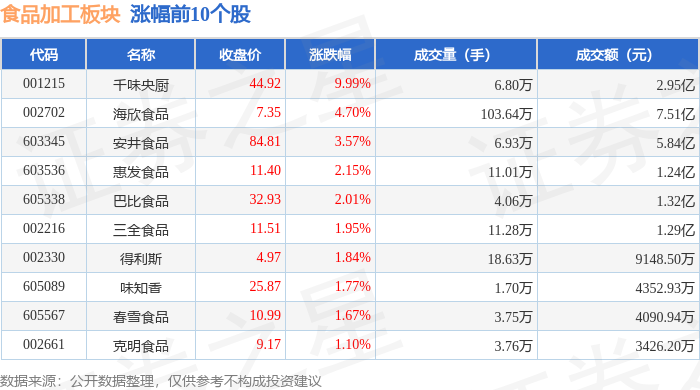
食品加工板块1月8日涨0.71%,千味央厨领涨,主力资金净流出2094.03万元
Zheng Xing Xing Ye Ri Bao· 2026-01-08 08:51
Group 1 - The food processing sector increased by 0.71% on January 8, with Qianwei Yangchu leading the gains [1] - The Shanghai Composite Index closed at 4082.98, down 0.07%, while the Shenzhen Component Index closed at 13959.48, down 0.51% [1] - Qianwei Yangchu's stock price rose by 9.99% to 44.92, with a trading volume of 68,000 shares and a transaction value of 295 million [1] Group 2 - The food processing sector experienced a net outflow of 20.94 million from institutional investors, while retail investors saw a net inflow of 17.72 million [2] - The stock of Anjifen experienced a significant net outflow of 32.99 million from institutional investors, while it had a net inflow of 30.40 million from retail investors [3] - The stock of Delisi had a net inflow of 12.69 million from institutional investors, indicating positive interest from this group [3]


媒体:网友嗑瓜子吃出疑似老鼠干尸,生产厂家否认
Xin Lang Cai Jing· 2026-01-08 08:42
1月8日,网友孟先生向齐鲁晚报·齐鲁壹点记者反映,其购买了江西一食品厂生产的瓜子,在食用时吃 出了疑似老鼠的异物。 从孟先生提供的视频和图片可以看到,一袋已开封的瓜子中,明显有一个轮廓和毛发都和老鼠相似的异 物,该瓜子外包装上则是印有"乡吧佬香瓜子"的字样。 据孟先生透露,昨天晚上,他在打游戏的过程中拆开了这袋瓜子,伸手抓时忽然摸到了一个软绵绵的东 西。"我以为是瓜子结块了,但又想不可能这么软,就把它拿了出来,拿出后还掉了一撮毛下来。"孟先 生心生疑虑,于是用手电筒一照,确认是只老鼠。 孟先生表示,这袋瓜子是在他家楼下小超市购买的,并不知道店家在哪里进的货,"我买的时候以为是 恰恰瓜子,昨天晚上看了才知道是另一个品牌,只不过包装长得有点像"。 "我可以担保这绝对是老鼠,都被加工过了,在里面已经变成了'干尸'",孟先生说,吃出来的异物并非 鼠头,而是整只小老鼠,看起来已经被"腌入味"。他表示,发现异物后,他联系了包装上标注的生产厂 家,厂家否认异物源自其产品,但随后厂家又表示可以赔偿50元,孟先生未能与其协商一致。 8日下午,记者尝试联系孟先生提供的生产厂家,相关工作人员对此表示:"我们瓜子都经过层层筛选 的, ...