
智能制造

Search documents
2025X-Fusion“全球创新者聚变大会”在深启幕
Nan Fang Du Shi Bao· 2025-07-31 00:48
Group 1 - The X-Fusion Global Innovators Conference, hosted by Shenzhen Zero One Academy, focuses on major challenges in fields such as "Future Intelligent Manufacturing," "Future of Life," and "Intelligent Society" [1][2] - The event features over 30 prominent figures from top research institutions, universities, and leading companies, who act as "big mentors" to address significant challenges for the next 5 to 10 years [1][2] - The conference aims to cultivate innovative talents through interdisciplinary approaches and advanced research, emphasizing the importance of problem-driven education [2][4] Group 2 - The "Future Intelligent Manufacturing" section includes challenges like "decoding urban flight safety" and "overcoming limits in neuromorphic computing," focusing on breakthrough technologies in micro-nano fields [3] - The "Future of Life" segment addresses core health challenges, exploring topics such as the role of human proteomics in health and new solutions for disease diagnosis and intervention [3] - The "Intelligent Society" challenges aim to leverage open-source ecosystems to enhance social innovation and break down technological barriers [3] Group 3 - The conference also includes high-level roundtable discussions among experts from academia, industry, and policy research, fostering collaboration and idea exchange [4] - Shenzhen Zero One Academy signed a strategic cooperation memorandum with Xi'an Jiaotong University to enhance innovative talent cultivation systems [4][5] - The event is part of a broader initiative to create a three-dimensional talent cultivation system that connects "X-type students," "X-type problems," and "X-type mentors" [5][6]
2025H1中国一级市场已披露融资额同比腰斩50%;全球独角兽新增41家,中国占6家;江苏领跑最热投资地丨投融资半年报
创业邦· 2025-07-31 00:08
Core Viewpoint - The first half of 2025 saw a significant decline in financing events and amounts in China's primary market, indicating a challenging investment environment [4][8]. Group 1: Financing Events Overview - In the first half of 2025, China experienced 3,982 financing events, a decrease of 12% from the previous half and 25% year-on-year [4][8]. - The total disclosed financing amount was 194.8 billion RMB, down 25% from the last half and 50% from the same period last year [4][8]. - The most active sectors for financing included intelligent manufacturing (995 events), artificial intelligence (548 events), and healthcare (486 events), with intelligent manufacturing seeing a 7% decline from the previous half [4][11]. Group 2: Investment Stages - The distribution of financing events by stage showed that early-stage investments dominated with 3,106 events (78%), followed by growth-stage with 739 events (18.56%), and late-stage with 137 events (3.44%) [5][18]. - In terms of disclosed financing amounts, early-stage accounted for 981.36 billion RMB (50.85%), growth-stage for 640.30 billion RMB (33.17%), and late-stage for 308.42 billion RMB (15.98%) [18]. Group 3: IPO Market Analysis - A total of 130 Chinese companies completed IPOs in the first half of 2025, marking a 1% increase from the previous half and a 33% increase year-on-year [6][46]. - The total amount raised through these IPOs was 126.06 billion RMB, which is a 6% increase from the last half and a 161% increase from the same period last year [46]. - The leading sectors for IPOs included traditional industries (29 companies), healthcare (14), and consumer goods (14) [49]. Group 4: M&A Market Analysis - In the first half of 2025, there were 237 M&A events in China, a decrease of 43% from the previous half and 45% year-on-year [55]. - The total disclosed amount for these M&A events was 68.145 billion RMB, down 48% from the last half and 62% from the same period last year [55]. - The top sectors for M&A activity included traditional industries (41 events), intelligent manufacturing (29), and healthcare (24) [57]. Group 5: Large Financing and Unicorn Analysis - Globally, there were 246 new large financing events in the first half of 2025, with China contributing 44 events, accounting for 18% of the global total [6][25]. - China saw the addition of 6 new unicorns in the first half of 2025, bringing the total to 504, which represents 27% of the global unicorn count [33][34].


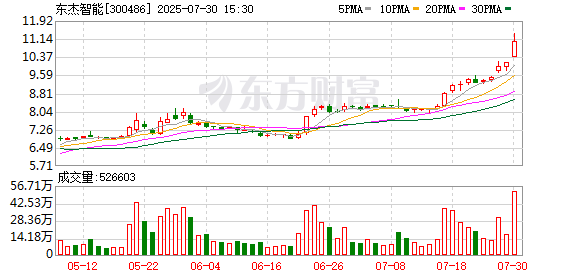
东杰智能实控人或变更
Zheng Quan Shi Bao· 2025-07-30 18:55
Group 1 - The core point of the news is that Dongjie Intelligent (300486) announced a potential change in its actual controller due to the transfer of 99% of the fund shares held by its major shareholder, Zibo Jiangtu Hengsong Holdings Co., Ltd. [2] - As of the announcement date, Zibo Jiangtu holds approximately 120 million shares of Dongjie Intelligent, accounting for 29.35% of the total share capital [2] - The company is currently in the planning stage regarding this matter, which carries uncertainties [3] Group 2 - Dongjie Intelligent focuses on providing comprehensive solutions for "logistics + information flow" in intelligent manufacturing, including smart production systems, intelligent logistics warehousing systems, and smart parking systems [3] - In the 2024 annual report, the company indicated that its main business revenue decreased and gross profit margin declined due to weak demand from some downstream customers, intensified industry competition, and cost overruns on certain projects, leading to operating losses [3] - Despite significant operational pressure, the company improved its net cash flow from operating activities by 65.19% year-on-year through cost control and cash flow management, demonstrating strong risk response capabilities [3] Group 3 - In May of this year, during an institutional survey, the company stated that it has sufficient orders on hand and that overall production and operation are normal [3] - The company's strategy to expand into international markets has begun to yield results, with large overseas project orders expected to be signed by the end of 2024 and early 2025 [3] - The company plans to steadily advance the implementation of these project orders and enhance its profitability and operational performance through increased project delivery and digital technology empowerment [3]

中央政治局会议释放八大信号!权威解读→
Shang Hai Zheng Quan Bao· 2025-07-30 14:53
Core Viewpoint - The meeting of the Central Political Bureau emphasizes the importance of economic work in the second half of the year to achieve the goals set for the "14th Five-Year Plan" and focuses on stabilizing employment, enterprises, markets, and expectations [1] Macro Policy - Macro policies need to continue to exert force and be adjusted as necessary, with a focus on maintaining policy continuity and stability while enhancing flexibility and foresight [2] - The meeting reiterates the need for a more proactive fiscal policy and moderately loose monetary policy to fully unleash policy effects [2][3] Fiscal Policy - The meeting calls for accelerating the issuance and utilization of government bonds to improve fund efficiency and ensure the "three guarantees" at the grassroots level [3] - As of the end of June, the budget for special bonds has reached 658.3 billion yuan, indicating a strong push for fiscal policy [3] Monetary Policy - Monetary policy should maintain ample liquidity and promote a decline in overall financing costs [4] - The meeting does not mention new structural monetary policy tools but emphasizes the effective use of existing ones to support small and micro enterprises, consumption, and foreign trade [4][5] Domestic Demand - The meeting highlights the need to effectively release domestic demand potential, with domestic demand contributing 68.8% to GDP growth in the first half of the year [6] - Measures to boost consumption include implementing special actions to stimulate consumption and expanding service consumption [6][7] Investment - The meeting stresses the importance of high-quality investment in infrastructure and stimulating private investment through reduced market access barriers and financial support [7] Technological Innovation - The meeting emphasizes the integration of technological innovation and industrial innovation as a core strategy for high-quality development [8] - Focus areas include strategic emerging industries and future industries, with a goal of fostering new supply to create new demand [8][9] Foreign Trade and Investment - The meeting underscores the need to stabilize foreign trade and foreign investment, with policies to support affected foreign trade enterprises [10][11] - The foreign trade sector showed resilience, with imports and exports maintaining a scale of over 20 trillion yuan in the first half of the year [11] Capital Market - The meeting calls for enhancing the attractiveness and inclusiveness of the domestic capital market to consolidate the positive momentum [12] - Reforms should focus on market-oriented, rule-of-law, and internationalization to improve capital allocation efficiency [12] Unified National Market - The meeting proposes deepening the construction of a unified national market to optimize market competition order and address current market pain points [13][14] Urban Renewal - The meeting emphasizes high-quality urban renewal as a means to ensure stable economic development, with a focus on transforming old urban areas and improving existing housing stock [15][16] - Urban renewal is seen as a key driver to stimulate housing demand and mitigate risks in the real estate sector [16]
上海:优化提升上海航空口岸物流通关效率
news flash· 2025-07-30 13:24
Core Viewpoint - The Shanghai government is accelerating the development of intelligent manufacturing through the "AI + Manufacturing" initiative, optimizing logistics efficiency at the Shanghai aviation port, and promoting the full-chain development of the high-end medical device industry [1] Group 1: Intelligent Manufacturing - The Shanghai government is implementing the "AI + Manufacturing" action to enhance the intelligence of the manufacturing sector [1] - The initiative aims to integrate artificial intelligence into manufacturing processes to improve productivity and innovation [1] Group 2: Logistics Efficiency - A work plan has been approved to optimize and enhance the logistics clearance efficiency at the Shanghai aviation port [1] - The government plans to learn from domestic and international best practices to redesign the logistics clearance process for faster clearance and improved business environment [1] - The focus will be on optimizing the port operation chain, emphasizing intelligence and standardization [1] Group 3: High-end Medical Devices - The government is promoting the full-chain development of the high-end medical device industry [1] - This includes enhancing regulatory efficiency and supporting innovation within the sector [1]
上海:要放大创新策源的研发优势,持续推进“研发+临床+制造+应用”全链条加速
news flash· 2025-07-30 13:14
Core Viewpoint - The Shanghai municipal government is implementing the "AI + Manufacturing" initiative to accelerate the intelligent development of the manufacturing industry [1] Group 1: High-end Medical Devices - The meeting approved the "Action Plan for Promoting the Full Chain Development of High-end Medical Device Industry in Shanghai" [1] - The rapid iteration and upgrade of high-end medical devices necessitate leveraging R&D advantages and focusing on key product directions [1] - There is an emphasis on accelerating the entire chain of "R&D + Clinical + Manufacturing + Application" to enhance the speed of review and approval processes [1] Group 2: Support for Local Innovation - The plan aims to support local innovative enterprises to grow stronger and cultivate internationally competitive leading companies [1] - There is a push for Shanghai-produced innovative medical devices to enter global markets [1] - The establishment of industrial clusters is prioritized to foster innovation and development in the medical device sector [1]
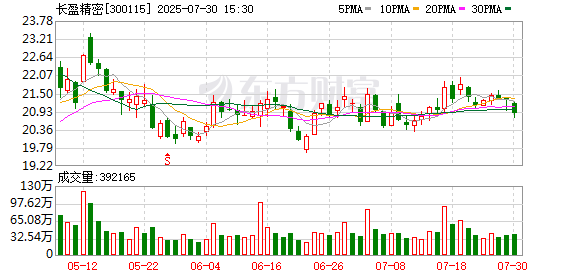
长盈精密:机器人智能制造产业园项目预计2025年年底投入使用
Mei Ri Jing Ji Xin Wen· 2025-07-30 12:40
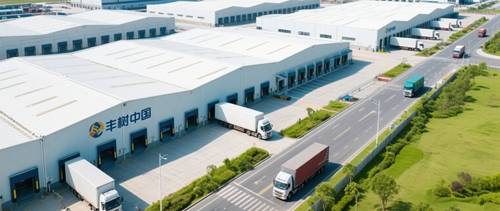
Group 1 - The company is developing a robotics intelligent manufacturing industrial park located at the intersection of Guangming District and Baoan District in Shenzhen [2] - The project includes the construction of headquarters, R&D center, production workshops, and supporting facilities for precision parts, ultra-precision connectors, and high-end intelligent manufacturing [2] - The expected operational date for the project is by the end of 2025 [2]


淘汰落后产能 | 2025年7月产业园区暨基础设施投资发展报告
Sou Hu Cai Jing· 2025-07-30 11:21
Group 1 - The core viewpoint emphasizes that upgrading traditional industries and resolving outdated production capacity is crucial for enhancing total factor productivity rather than merely shutting down facilities [3][5][8] - Recent policy dynamics focus on promoting new productive forces and industrial upgrades, with a notable meeting of the Central Financial Committee highlighting the need for a unified national market and orderly competition [6][5] - Concerns about overcapacity persist, prompting a shift towards industrial intensification as a key solution to chaotic competition, which can enhance resource efficiency and reduce costs for individual enterprises [12][14] Group 2 - Investment events are primarily centered around high-end intelligent manufacturing, with a reported peak in financing activities during the period, including 10 investment events and 13 financing events [19][20] - The average occupancy rate for industrial park REITs stands at 82.67%, with a monthly rental price of 77.61 yuan per square meter, indicating a mixed performance among different REITs [22][25] - Specific projects such as the Zhongguancun (Beijing West) AI Technology Park and Yantai Zhongdian Zhigu Industrial Park are highlighted for their significant investments and expected contributions to local economies [15][16][18]
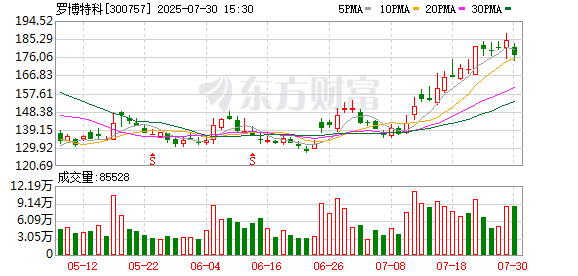
罗博特科:ficonTEC具备提供光纤预制设备全流程生产线的技术,目前产线单产效率高
Mei Ri Jing Ji Xin Wen· 2025-07-30 10:56
Group 1 - The company Robotech (300757.SZ) has developed automated production lines for fiber optics, which can enhance labor efficiency [2] - Robotech confirmed that ficonTEC has the technology to provide a complete production line for fiber optic preform, achieving high production efficiency [2] - The production line can efficiently integrate the entire process of FA-MT components, improving assembly precision and yield rate [2]

上海临港新片区首创试点新增四类租赁物
Xin Lang Cai Jing· 2025-07-30 09:49
Core Viewpoint - The Shanghai Lingang New Area has launched a new policy to promote high-level institutional openness and support the high-quality development of the leasing industry, specifically through the expansion of the business scope for financial leasing project companies [1] Group 1: Policy Announcement - The "Financial Leasing Project Company Business Scope Expansion Pilot" policy was officially announced during the event held on July 17 [1] - The pilot program expands the leasing objects to include four types of equipment: new energy, power batteries, intelligent manufacturing, and industrial mother machines [1] - This expansion aligns with the strategic frontier industries of the Lingang New Area, providing richer support for financing leasing services to the real economy [1] Group 2: Implementation and Impact - The business entities are now allowed to set up Special Purpose Vehicles (SPVs) for financial leasing across the country, broadening the scope of operations [1] - This initiative is seen as a significant innovative measure supported by the National Financial Regulatory Administration to enhance the development of financial leasing in the Lingang New Area [1]
