
Funds

Search documents
亏掉200亿、跑了5个副总,千亿信达澳亚还能买吗?
阿尔法工场研究院· 2025-07-30 00:57
Core Viewpoint - The article discusses the challenges faced by Xinda Australia Fund, highlighting significant losses for investors while the fund management continues to earn substantial management fees. The frequent turnover of senior management and poor fund performance are central issues affecting the company's reputation and investor confidence [4][30][37]. Group 1: Management Changes - Xinda Australia Fund has experienced significant turnover in its senior management, with five vice presidents leaving in just one year, including the upcoming departure of Vice President Wang Jianhua [10][12]. - Wang Jianhua's tenure as a fund manager has been marked by poor performance, with all three funds he managed recording losses, the largest being a 37% decline [5][14]. - The instability in management is seen as detrimental to the company's operational effectiveness and team cohesion [9]. Group 2: Fund Performance - Over the past three years, Xinda Australia Fund has incurred losses exceeding 20 billion yuan for investors, while the company has collected over 2 billion yuan in management fees [6][30]. - Wang Jianhua's managed funds have shown significant declines, with total returns of -20.24%, -36.93%, and -7.22% for different funds [14][30]. - The overall performance of the fund has led to a drastic reduction in assets under management, with the scale dropping from 420 billion yuan at its peak to approximately 137.45 billion yuan by the end of 2024 [36]. Group 3: Financial Performance - The company's revenue has been on a downward trend for three consecutive years, with reported revenues of 1.067 billion yuan in 2022, 937 million yuan in 2023, and 644 million yuan in 2024 [33]. - Despite the losses incurred by investors, the management fee income for Xinda Australia Fund has remained high, with estimates suggesting it exceeded 2.6 billion yuan over the past three years [30][33]. - The management fee income accounted for 99% of the company's total revenue in 2024, indicating a reliance on fees rather than performance [33]. Group 4: Market Outlook - The article questions whether Xinda Australia Fund can leverage the recent market recovery to improve its performance and regain investor trust [38]. - The company is facing challenges in retaining talent and maintaining a strong product lineup, which could hinder its ability to compete effectively in the market [37].


再见了!又一知名APP宣布:关停!
Sou Hu Cai Jing· 2025-07-30 00:40
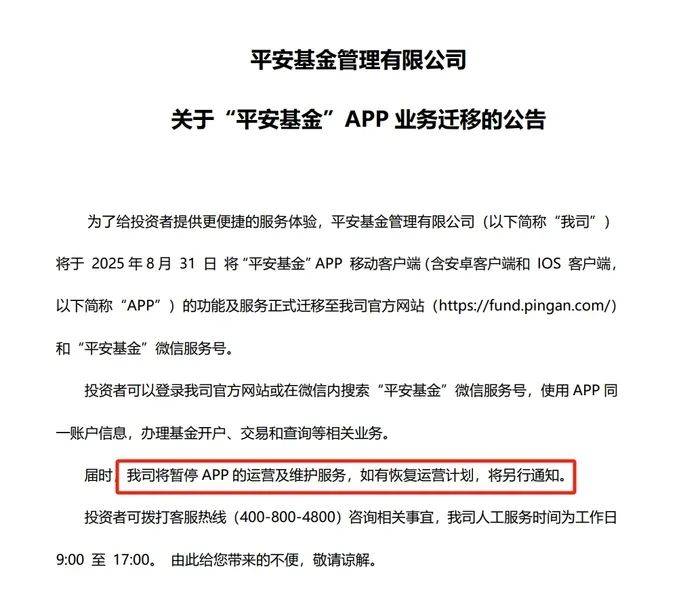
Core Viewpoint - Ping An Fund announced the migration of its "Ping An Fund" APP services to its official website and WeChat service account, effective August 31 this year, leading to the suspension of the APP's operation and maintenance [1][2]. Company Overview - Ping An Fund was established in 2011, headquartered in Shenzhen, with a registered capital of 1.3 billion RMB. It is controlled by Ping An Group [4]. - The fund has three shareholders: Ping An Trust Co., Ltd. (68.19%), Dahua Asset Management Co., Ltd. (17.51%), and Sanya Yingwan Tourism Co., Ltd. (14.3%) [4]. - As of the second quarter of this year, Ping An Fund's managed public fund scale reached 660.225 billion RMB, with a significant portion (403.739 billion RMB) in money market funds, accounting for 61.15% of the total [4]. Industry Context - The decision to shut down the APP is attributed to the high operational costs associated with direct sales APPs, which have low download and usage rates among individual investors [6]. - The operational cost of maintaining an APP is estimated to be between 2 to 3 million RMB annually, while the funds generated from the APP are minimal, leading to an unfavorable cost-benefit ratio [6]. - The competitive landscape shows a trend where third-party distribution giants dominate, making it increasingly difficult for small and medium-sized public funds to conduct direct sales [7]. - In response to high operational costs, some public funds are shifting towards lower-cost alternatives like podcasts to engage with investors and enhance brand recognition [7].
债市“冲击波”:谁在偷笑?谁在颤抖?基金公司打出应对“组合拳”
Zhong Guo Zheng Quan Bao· 2025-07-30 00:11
Core Viewpoint - The bond fund industry is experiencing a significant redemption wave, with large-scale outflows triggered by market conditions, particularly following a notable decline in the bond market on July 24, leading to the largest single-day redemption since last year's "9.24" event [1][2]. Group 1: Redemption Trends - On July 24, the bond market saw a substantial pullback, resulting in a record single-day redemption for public bond funds, with net bond sales exceeding 120 billion yuan over three consecutive trading days [1][2]. - Since July 21, the net subscription index for public bond funds has remained negative, reaching -29.2 on July 24, indicating significant outflows [2]. - In July, over 40 bond funds had to adjust their net asset value precision due to large redemptions, a notable increase compared to previous months [2]. Group 2: Market Dynamics - The "stock-bond seesaw" effect is evident, with funds flowing from bond markets to equity markets as stock and commodity markets perform well [1][4]. - The low yield environment for bond funds has diminished their attractiveness, leading to increased risk appetite among investors, which further exacerbates outflows from bond funds [4][5]. Group 3: Fund Manager Responses - Fund managers are proactively managing redemption pressures by reducing bond holdings' leverage and duration to mitigate net asset value fluctuations [6]. - Communication with institutional investors is prioritized to encourage staggered redemptions, thereby minimizing impact [6]. - Many bond funds have resorted to dividend distributions to retain investors, with 924 pure bond funds announcing dividends since June, compared to 848 in the same period last year [6]. Group 4: Future Outlook - Compared to previous redemption waves, the current situation is characterized by a shorter duration and manageable impact, with net bond sales and related product pullbacks remaining within controllable limits [7]. - Some institutions are taking advantage of the market pullback to buy into bond funds, suggesting a balanced flow of capital [8].
沪指站上年内高点,基金为何大笔自购
Mei Ri Jing Ji Xin Wen· 2025-07-29 13:25
Group 1 - Fangzheng Fubon Fund announced its second self-purchase of equity public funds in 2025, starting from July 24, with a total amount of no less than 25 million yuan [2][4] - The self-purchase coincided with the Shanghai Composite Index reaching its annual high of 3600 points on July 24, indicating a positive market sentiment [2][3] - A total of 126 public fund companies have initiated self-purchases in 2025, reflecting a growing trend among institutions to invest in equity assets [4][7] Group 2 - The self-purchase behavior aligns the interests of fund companies with fund performance and investor interests, showcasing confidence in their investment research capabilities [2][6] - Analysts suggest that the self-purchases signal a positive outlook for the market, especially during periods of market volatility or tight liquidity [7] - The core drivers for the A-share market in the second half of 2025 are expected to be "policy easing, asset scarcity, and industrial upgrades," with a focus on new productivity, overseas expansion, and cost-effective consumption [3][7]
年内225只基金涨超50%,近两成限购!绩优基金“闭门”为哪般?
Sou Hu Cai Jing· 2025-07-29 11:01
Core Viewpoint - The recent trend of fund subscription limits reflects a response to significant performance gains in the active equity fund sector, with many funds experiencing substantial inflows and subsequently implementing restrictions to manage investor behavior and maintain stability [1][2][5]. Fund Subscription Limits - Da Cheng Fund has reduced the subscription limit for its Da Cheng Global USD Bond Fund's RMB share to 50,000 yuan as of July 29 [1]. - A total of 225 funds have seen year-to-date growth exceeding 50%, with 12 funds currently suspended from subscriptions and 21 funds limiting large subscriptions [2]. - Notable funds like Huatai-PineBridge Hong Kong Advantage Select have reported year-to-date returns of 134.72% and 135.08% for their A and C classes, respectively [2]. Performance and Market Trends - The active equity fund sector has rebounded significantly, with many funds experiencing over fivefold growth in size during the second quarter [2]. - Small-cap stocks have outperformed large-cap stocks in the first half of 2025, driven by favorable industry trends and macroeconomic conditions [2]. - Despite the positive performance, some funds are limiting subscriptions to prevent investors from chasing high returns and to manage volatility [2][4]. Fund Management Strategies - Funds like Nuon Multi-Strategy have focused on small-cap stocks, which have contributed to their net value growth, although they also exhibit higher volatility [3][4]. - The strategy of limiting subscriptions is aimed at maintaining portfolio stability and preventing forced adjustments due to large inflows [5]. - Some funds have implemented subscription limits to mitigate the impact of large institutional investments and to avoid dilution of returns [5].
公募FOF调仓动向曝光,“专业买手”如何加仓
2 1 Shi Ji Jing Ji Bao Dao· 2025-07-29 10:12
Group 1 - The core viewpoint of the article highlights the continued growth of public FOF (Fund of Funds) in the second quarter of 2025, following a recovery in the first quarter, with a total scale of approximately 165.7 billion yuan, reflecting a quarter-on-quarter increase of about 14.6 billion yuan, or 9.68% [1][2] - The demand for stable FOFs has significantly increased, with the proportion of stable debt-mixed FOFs reaching 31% of the total public FOFs, while the issuance of new public FOFs in the second quarter amounted to approximately 18.6 billion yuan [2][3] - The net subscription of bond-type FOFs has seen substantial growth, with the most significant increase in the fund shares of the bond-type FOFs, indicating a preference for stable investment options [4][5] Group 2 - The enthusiasm for ordinary FOF products among public fund managers is high, with 85 institutions managing FOFs, and the top ten managers holding 60.8% of the market share [6] - The asset allocation strategy of public FOFs has shifted towards increasing the proportion of passive bond funds while reducing the allocation to pure index stock funds, reflecting a trend towards multi-asset allocation and passive investment [7] - The FOFs have shown a preference for solid performance funds, particularly in the fixed income category, with notable increases in holdings of passive bond and short-term pure bond funds [8][9]
NDMO: Diversified Municipal CEF Reliant On Lower Interest Rates
Seeking Alpha· 2025-07-29 09:09
Company Overview - Nuveen Dynamic Municipal Opportunities (NYSE: NDMO) operates as a closed-end fund that provides investors with exposure to a diverse range of municipal securities [1] Investment Strategy - The fund aims to invest in securities that can generate income from various sources, focusing on high-quality dividend stocks and other assets that offer potential for long-term growth [1] - The investment approach combines classic dividend growth stocks with Business Development Companies, REITs, and Closed-End Funds to enhance investment income while achieving total returns comparable to traditional index funds [1] Performance Insights - The company has developed a hybrid system that balances growth and income, successfully capturing total returns that align with the performance of the S&P [1]

数量突破300支!养老金基金能否 “养老”,相关产品收益几何?
Sou Hu Cai Jing· 2025-07-29 07:52
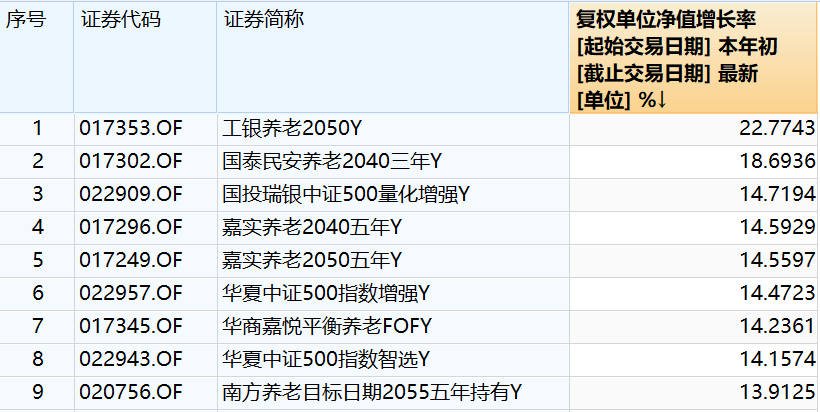
Group 1 - The core viewpoint of the article highlights the expansion of personal pension funds in China, with the number of products exceeding 300, indicating a growing interest in retirement planning among investors [1][2] - The introduction of new funds from five asset management companies marks a significant development in the personal pension fund landscape, reflecting increased competition and product diversity [2][3] - As of July 28, all personal pension funds (Y shares) have achieved positive returns this year, with an average net value increase of over 6.5%, showcasing the effectiveness of these investment vehicles [2][3] Group 2 - The top-performing personal pension funds have shown impressive returns, with the best fund, 工银养老2050Y, achieving over 20% growth this year, indicating strong performance in the market [2][3][4] - Historical performance data reveals that over 270 personal pension funds have positive returns since inception, with nearly 20% of products seeing net value increases exceeding 10%, demonstrating the long-term viability of these funds [3][4] - The article notes that the overall performance of pension funds has outpaced major indices like the沪深300 and 上证50, suggesting that these funds are a favorable investment option compared to traditional market benchmarks [4] Group 3 - The low-interest-rate environment in China has led to a shift in investor preference from savings products to fund investments, as the attractiveness of traditional savings accounts diminishes [7][10] - The article emphasizes the tax benefits and low fee advantages of personal pension accounts, which can enhance long-term investment returns for individuals [11][12] - The characteristics of index funds, including clear benchmarks and stable styles, make them suitable for retirement planning, particularly for investors seeking sustainable long-term returns [12]
6千亿公募撤退!平安基金APP 8月底关停 直销渠道收缩潮来袭
Xin Lang Ji Jin· 2025-07-29 07:28
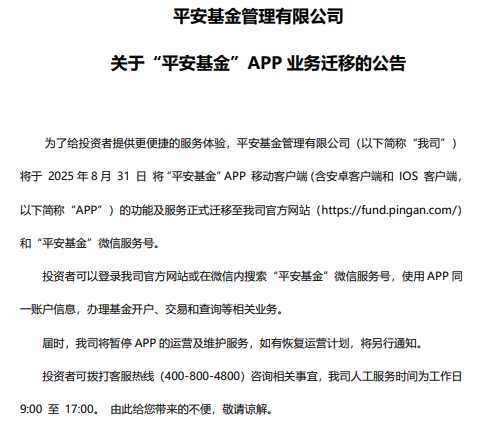
Core Viewpoint - The announcement by Ping An Fund to cease operations of its mobile app reflects a broader trend in the public fund industry, where several small and medium-sized institutions are shutting down their independent mobile applications due to cost pressures and declining user engagement [1][3][7]. Group 1: Industry Trends - Ping An Fund will officially stop its app operations on August 31, 2025, following other public fund companies like Guoshou Anbao Fund and Qianhai Kaiyuan Fund, marking a significant shift in the industry [3][5]. - Since 2019, there has been an accelerated trend of public funds shutting down their mobile applications, with at least six companies doing so in 2024 alone, indicating a clear exit wave in the industry [3][5]. - The closure of the app is part of a strategic retreat as the industry faces challenges from high operational costs and low user engagement, particularly among smaller fund companies [5][7]. Group 2: Financial Performance - As of the end of Q2 2025, Ping An Fund managed assets totaling 660.225 billion yuan, ranking 24th among 162 fund companies, but its business structure is heavily skewed towards money market funds, which account for 61.52% of its total assets [3][5]. - The fund's largest money market product, Ping An Daily Increase A, has a scale exceeding 200 billion yuan, while only five out of 109 actively managed equity funds have scales over 1 billion yuan [3][5]. Group 3: Operational Challenges - The annual cost of maintaining a fund app is estimated to be between 2 to 3 million yuan, covering all aspects from regulatory approval to content operation, which is not justified by the low user engagement and funds generated [5][6]. - The user activity levels of smaller fund apps are significantly lower compared to leading fund apps, which further exacerbates the financial viability of maintaining such platforms [5][6]. Group 4: Strategic Shifts - The decision to shut down the app signifies a strategic restructuring in the public fund industry, moving from a heavy asset model to a more lightweight operational approach as companies refocus their resources [7]. - The dominance of third-party platforms in traffic acquisition has led fund companies to reassess their value propositions, shifting from self-built channels to more pragmatic resource allocation [7].
科创债ETF鹏华(551030)单日成交额超141亿元,位居同类第一
Zhong Guo Jing Ji Wang· 2025-07-29 01:10
Core Viewpoint - The liquidity of ETFs is crucial for their success, and the recent launch of the first batch of 10 Sci-Tech Bond ETFs has significantly reshaped the bond ETF market landscape in China [1][2]. Group 1: ETF Liquidity - On July 28, the Penghua Sci-Tech Bond ETF (551030) achieved a trading volume of 14.199 billion yuan, ranking first among similar products, with a turnover rate of 105.32% and a latest scale of 13.507 billion yuan [1]. - The fund manager of Penghua Sci-Tech Bond ETF emphasized that both asset liquidity and ETF liquidity are interdependent, and prioritizing high liquidity underlying assets is essential for maintaining overall portfolio liquidity [1]. - Penghua's fixed income team has established a highly coordinated mechanism for ETF market-making, client trading collaboration, and compliance management, effectively supporting the market circulation efficiency of new ETF categories [1]. Group 2: Market Development - To enhance market liquidity, Penghua issued over 10 announcements on July 17, adding several securities firms to provide market-making services for the Penghua Sci-Tech Bond ETF [2]. - According to a report by CICC, the introduction of the first batch of 10 Sci-Tech Bond ETFs has redefined the bond ETF market structure, with a total of 39 bond ETFs now available as of July 22, 2025, including 21 credit bond ETFs [2]. - The Penghua fixed income team noted that the Sci-Tech Bond ETF has vast market potential and will continue to enhance the liquidity of bonds issued by technology innovation companies, promoting the healthy development of the bond market [2].