
虚拟现实

Search documents
PICO与Blender基金会达成合作伙伴关系
news flash· 2025-07-23 07:35
Core Viewpoint - PICO has officially partnered with the Blender Foundation, becoming the first XR platform to collaborate with Blender, aiming to enhance immersive VR and MR experiences through ongoing contributions to the Blender project [1] Group 1 - PICO is the first XR platform to collaborate with Blender [1] - The partnership will promote the adoption of the OpenXR standard to ensure cross-platform compatibility [1] - PICO will continue to invest in the Blender project to enhance immersive experiences [1]
石景山区支持打造有空间、有资金、有服务青年人才创新创业基地
Bei Jing Shang Bao· 2025-07-22 12:40
Group 1 - The Shijingshan District Youth Talent Innovation and Entrepreneurship Development Conference aims to create a top-tier, internationally influential base for young talent innovation and entrepreneurship [1] - The district focuses on two major trillion-yuan industries: information technology and modern finance, while also developing four key sectors: artificial intelligence, science fiction, industrial internet, and virtual reality [1] - The "Jingxian Plan" is implemented to attract global top tech talent and cultivate local innovative talent, enhancing the environment for youth development [1] Group 2 - Financial support for young talent includes up to 500,000 yuan per year for research projects, and up to 20,000 yuan in startup subsidies for eligible graduates starting their first business in the district [2] - A 200 million yuan fund is established to support early-stage hard tech companies, with differentiated funding strategies for seed, angel, and A-round investments [2] - The first phase of the base can accommodate 100 youth innovation and entrepreneurship teams, providing comprehensive support to address common startup challenges such as funding shortages and high office costs [2]

戴上VR眼镜 “穿越”万年体验中华文明
Ke Ji Ri Bao· 2025-07-17 23:37
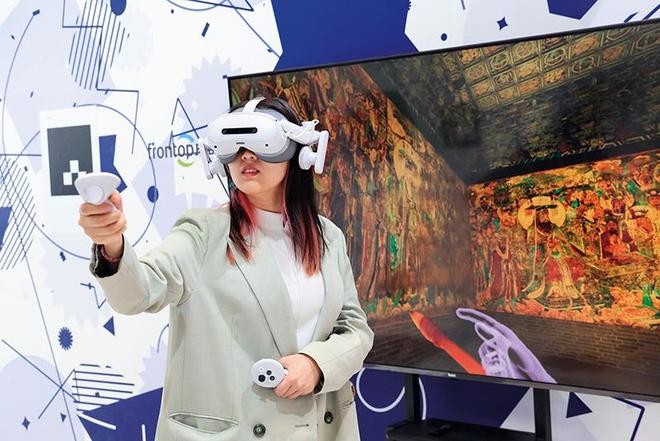
Core Viewpoint - The third China International Supply Chain Promotion Expo showcased an immersive VR experience that allows participants to engage with ancient Chinese civilization through advanced AI technology [1][2]. Group 1: Event Overview - The event featured the launch of an AI-powered immersive VR project by Peking University Wuhan Artificial Intelligence Research Institute, attracting significant attention from attendees [1]. - The "Civilization for Ten Thousand Years: Intelligent Society Experience Hall" drew large crowds, with many international visitors expressing amazement at the 360-degree immersive experience [1]. Group 2: Technological Innovation - The project includes a 30-minute immersive VR experience designed by a multidisciplinary team, allowing participants to explore digitally recreated ancient settings such as rice fields and examination halls [2]. - The use of LBE (Location-Based Entertainment) and VR technology creates an interactive environment that enhances the audience's engagement with historical narratives [2]. Group 3: Cultural Impact and Expansion - The "Civilization for Ten Thousand Years" products have been replicated in various locations across China and are in discussions for international projects in Europe, the Middle East, and Southeast Asia [2]. - The team aims to promote Chinese culture globally through innovative technology, making the experience of ancient civilization accessible to a wider audience [3].
ABeam|中国科技趋势2025系列篇之4——沉浸式互动的新革命
Sou Hu Cai Jing· 2025-07-14 14:55
Core Insights - Immersive interaction is a technology-driven experience that enhances user engagement through various modalities, tracing its roots back to the 1960s with the development of the first computer graphics-driven head-mounted display [2] - The concept of the metaverse in 2021 led to a surge in global shipments of head-mounted devices, surpassing 10 million units for the first time, marking a significant industry trend [2] - The launch of Apple Vision Pro in 2023 represents a major breakthrough in spatial computing technology, attracting widespread industry attention [2] - In China, competitive head-mounted device manufacturers like PICO and DPVR have emerged, and VR large spaces are set to become a new offline entertainment method by 2024, integrating immersive experiences with cultural IP [2] Group 1: Key Technologies of Immersive Interaction - Extended Reality (XR) technology, encompassing VR, AR, and MR, is a crucial driving force in the development of immersive interaction [4] - The four core elements of XR technology are undergoing significant upgrades: - Display technology is evolving towards thinner, lighter devices with improved clarity [7] - Chip technology is advancing towards high computing power, low power consumption, and multifunctionality [7] - Interaction technology is integrating gesture recognition, eye tracking, voice interaction, and brain-computer interfaces for a multimodal experience [7] - Acoustic technology is enhancing sound source localization and creating a multi-sensory immersive experience [8] Group 2: Industry Applications of Immersive Interaction - XR technology has matured in various sectors in China, with active applications in entertainment, sports, cultural tourism, and industrial fields [8] - In the entertainment sector, XR technology is being integrated into gaming, live streaming, and film, with over 21,000 content pieces available on major VR platforms by the end of 2024 [11] - The sports industry is leveraging XR technology to innovate sports experiences, enhancing audience engagement through interactive viewing platforms [14] - In cultural tourism, XR technology is being used for smart guiding, immersive space creation, and digital preservation of cultural heritage, aligning with consumer demand for deep experiences [17] - The industrial sector is utilizing XR technology across various stages, including R&D design, production assembly, quality inspection, and maintenance, improving efficiency and reducing costs [20] Group 3: Future Trends - Generative AI is revolutionizing 3D content production, enabling efficient creation of models, scenes, and animations, and enhancing interactive capabilities [21] - Brain-computer interfaces are expected to deepen immersive experiences by allowing direct communication between the brain and external devices [24] - Spatial computing is emerging as a new paradigm, merging physical and virtual worlds to create seamless interactions and expand user experiences [25][27]

瞭望 | 抢占虚拟现实技术高地
Xin Hua She· 2025-07-14 09:05
Core Insights - China has transitioned from being a "standard taker" to a "standard maker" in the virtual reality (VR) standards field, enhancing its global influence in the VR sector [6][7] - The Qingdao Metaverse Pilot Platform, established in 2022, is one of the largest platforms globally, playing a crucial role in VR hardware development, component iteration, production process optimization, and industry standard formulation [1][3] Group 1: Technological Advancements - The Qingdao Metaverse Pilot Platform is essential for overcoming key technological bottlenecks and building a self-controlled industrial ecosystem [1] - The platform significantly reduces the design verification cycle from 6-8 months to 2-3 months, accelerating product iteration compared to international peers [4] - The platform's testing capabilities allow for systematic verification of critical parameters such as refresh rate, resolution, latency, and positioning accuracy, which are vital for establishing relevant standards [6] Group 2: Development Tools and Ecosystem - The platform has developed a set of real-time 3D interactive content development tools that are compatible with domestic VR hardware, addressing the need for self-controlled development tools in the metaverse industry [5] - This initiative aims to replace imported software and create a self-innovative ecosystem, enhancing the usability and compatibility of 3D digital content [5] Group 3: Market Application and Industry Dynamics - The platform supports a full-process trial production capability, creating a closed-loop innovation system that addresses the "chicken-and-egg" dilemma in the metaverse industry [8][9] - By providing a "safe testing ground" for new technologies, the platform facilitates the verification of innovative results, thus promoting a virtuous cycle in the industry [9] - The establishment of specialized pilot testing capabilities is crucial for building a complete innovation system from core technologies to industry standards and application ecosystems [9]
VR大空间要找到自己的艺术语言(坚持“两创”·关注新时代文艺)
Ren Min Ri Bao· 2025-07-03 21:46
Core Insights - The article highlights the potential of VR large spaces as a new medium that integrates content, evolving towards diverse directions in future tourism, cinema, gaming, and amusement parks [1][5]. Industry Development - Since the beginning of 2023, over 200 VR large space projects have been launched across various scenic spots, shopping malls, and cultural institutions in China, showcasing a significant growth in the application of VR technology in the tourism and entertainment sectors [1][2]. - VR large spaces are seen as a "potential stock" in the cultural tourism industry, leveraging digital technology to bring resources to life, allowing users to experience immersive environments without traditional interaction devices [2][3]. User Experience - The immersive experience of VR large spaces allows users to naturally walk through digital realms, witnessing historical events or exploring natural landscapes, enhancing the cultural experience [2][3]. - The simplicity of the "walk and see" format in VR can transcend mere tourism, evolving into various thematic journeys such as spiritual, legendary, investigative, growth, emotional, and educational experiences [5]. Challenges and Opportunities - Despite the positive growth, the industry faces challenges such as a tendency towards homogenization and formulaic projects, where some creators replicate existing models without innovation, leading to a lack of engagement [3][4]. - For VR large spaces to thrive, there is a need to explore narrative methods and fully utilize the potential of VR as a medium, creating meaningful experiences that resonate with users [4][5].
新方法显著提升三维形貌重建精度
Ke Ji Ri Bao· 2025-07-03 00:52
Core Insights - The research team led by Professor Qian Yuhua from Shanxi University has made significant advancements in the field of three-dimensional shape reconstruction, with their findings published in the prestigious journal IEEE Transactions on Pattern Analysis and Machine Intelligence [1] - The study introduces a novel framework called SAS (Sequence Association-guided Universal 3D Shape Reconstruction), which emphasizes the importance of multi-view consistency in enhancing reconstruction accuracy [2] Group 1 - The research theoretically proves a generalized error bound for multi-view fusion methods in three-dimensional shape reconstruction, highlighting that the performance relies on the consistency among multiple views rather than their complementarity [1] - The study identifies three major challenges in macro/micro cross-scale three-dimensional shape reconstruction: significant imaging feature differences, insufficient generalization ability of existing deep learning methods, and limitations in traditional methods regarding spatiotemporal information utilization [1][2] - The SAS framework integrates semantic information from macro scenes with detailed features from micro scenes, overcoming traditional methods' limitations in cross-scale reconstruction [2] Group 2 - Experimental validation across various macro and micro data scenarios demonstrates that the SAS framework outperforms advanced model design methods and exhibits superior generalization compared to mainstream deep learning methods, particularly in open-world macro/micro scenarios [2] - The research has successfully advanced three-dimensional reconstruction accuracy to sub-micron optical imaging limits, providing new technological means for precision manufacturing and biomedical applications [2]
北京:拟支持引入放映虚拟现实电影 支持企业向国家电影局申请虚拟现实电影“龙标”
news flash· 2025-06-27 02:07
Core Viewpoint - The document outlines measures to support the construction of an innovative experimental zone for future digital spaces in Beijing, emphasizing the integration of advanced technologies in various sectors such as culture, commerce, tourism, and sports [1] Group 1: Technology Integration - The initiative aims to enhance the application of cutting-edge technologies, including virtual reality, spatial computing, and AI, to create immersive offline experiences [1] - It supports the establishment of large-scale immersive projects like LBE XR spaces, digital art exhibitions, and digital performances, as well as the construction of a national sci-fi park [1] Group 2: Innovation and Standards - The plan encourages the development of humanoid robots and embodied intelligence through innovation experience stores and demonstration application scenarios [1] - It includes the establishment of data testing standards for humanoid robots and spatial intelligence across multiple scenarios, with applications showcased at major events like the Service Trade Fair and the China Science Fiction Conference [1] Group 3: Film and Entertainment - The document promotes research in virtual reality film technology and applications, including the construction of a sci-fi film experience center [1] - It supports the introduction of virtual reality films and encourages companies to apply for the "Dragon Mark" from the National Film Administration for virtual reality films, as well as participation in the standard-setting for virtual reality films and games [1]
北京:支持未来数字空间创新试验区建立出口游戏国内上线等审批便捷通道
news flash· 2025-06-27 02:07
Core Viewpoint - The article discusses the measures proposed to support the construction of the Beijing Future Digital Space Innovation Pilot Zone, aiming to enhance the global influence of the area and facilitate the development of the digital economy [1] Group 1: Policy Measures - The proposal includes establishing a game version number application and filing service center within the pilot zone to support enterprises with approval, guidance, and testing services for game version numbers [1] - It suggests creating an "Overseas Service Zone" to streamline the approval process for exporting games and provide consulting and intermediary services for companies looking to expand internationally [1] - The initiative also supports the establishment of a comprehensive service window for virtual reality films, offering policy consultation, promotional services, and screening opportunities for works [1]
让新科技赋能美好生活
Ren Min Ri Bao· 2025-06-24 22:01
Group 1: Event Overview - The 18th UAE-China Export Brand Exhibition showcased various innovative products, including smart sorting robots and AI glasses, attracting significant attention [1][2] - The exhibition featured nearly 700 companies from China and the UAE, covering multiple sectors such as textiles, building materials, home appliances, and sports goods [2] Group 2: Technology and Innovation - The "Little Yellow Man" smart sorting robot, used by several logistics companies in the UAE, enhances efficiency by automatically identifying addresses and planning routes [1] - AI glasses capable of real-time translation in over 120 languages were highlighted, addressing language barriers for Chinese companies in international trade [1] Group 3: Cultural and Educational Aspects - Virtual reality (VR) experiences were offered, allowing participants to explore ancient Egypt and appreciate Chinese culture, aiming to reshape traditional cultural experiences through technology [2] - The exhibition utilized AI technologies for improved services, including buyer queries, translation, and meeting summaries, enhancing overall efficiency for exhibitors [2]