信托

Search documents
银行理财产品与信托产品区别何在?
Sou Hu Cai Jing· 2025-07-18 01:50
Core Viewpoint - Understanding the differences between bank wealth management products and trust products is crucial for investors to make informed asset allocation decisions [1] Group 1: Issuing Entities - Bank wealth management products are issued by commercial banks or other financial institutions, leveraging their extensive customer base and financial strength [1] - Trust products are issued by trust companies, which manage and utilize trust assets professionally under the principle of "entrusted by others, managing finances for others" [1] Group 2: Investment Thresholds - Bank wealth management products generally have a lower investment threshold, with minimum investment amounts ranging from a few thousand to tens of thousands of yuan, making them accessible to more ordinary investors [1] - In contrast, trust products typically require a higher investment threshold, with common minimum investment amounts starting at 1 million yuan or more [1] Group 3: Investment Directions - The investment direction of bank wealth management products is broad, covering money market instruments, bond markets, and credit markets, allowing for risk diversification and achievement of return objectives [2] - Trust products also have diverse investment areas but focus on large infrastructure projects, real estate projects, and corporate financing, supporting the development of the real economy [2] Group 4: Risk and Return Characteristics - Bank wealth management products are categorized by risk levels, offering a range from low to high risk, with low-risk products providing stable but relatively lower returns [2] - Trust products usually offer higher returns, which correspond to their higher investment thresholds and associated risks, with returns dependent on the operational status of the trust projects and market conditions [2] Group 5: Regulatory Framework - Both bank wealth management products and trust products are under strict regulatory oversight, ensuring compliance in product design, sales, and investment operations to protect investors' rights [3] - Regulatory policies for trust products include guidelines for the establishment, operation, and risk management of trust companies to ensure the healthy and stable development of the trust market [3]
东航物流:联想控股质押5200万公司股份
news flash· 2025-07-17 08:37
Group 1 - Eastern Airlines Logistics (601156) announced that its shareholder, Legend Holdings Corporation, holds 179 million shares, accounting for 11.29% of the company's total share capital [1] - As of the announcement date, Legend Holdings has pledged a total of 80.8 million shares, which represents 45.08% of its holdings and 5.09% of the company's total share capital [1] - The current pledge involves 52 million shares, making up 29.01% of its holdings and 3.28% of the company's total share capital, with the pledge starting on July 16, 2025, and expiring on July 16, 2027 [1] Group 2 - The pledge is secured by Industrial International Trust Co., Ltd., and the funds raised from the pledge will be used to repay interest-bearing liabilities [1]

筑信托行业高质量发展文化根基:《信托文化建设指引》正式发布
Jing Ji Guan Cha Bao· 2025-07-17 07:35
Core Viewpoint - The article discusses the release of the "Trust Culture Construction Guidelines," aimed at promoting high-quality development in the trust industry by fostering a distinctive Chinese trust culture [1][2]. Summary by Sections General Principles - The guidelines aim to cultivate a Chinese trust culture, guiding trust companies to return to their fiduciary roles and support social governance needs [3]. - Trust culture is defined as a value system and behavioral norms that prioritize the maximization of beneficiaries' legal interests while leveraging the advantages of the trust system [3]. - The guidelines apply to all trust companies that are members of the China Trust Industry Association [3]. - The construction of trust culture should combine legal and moral governance, emphasizing honesty, prudent behavior, and compliance [3]. Trust Culture Content - The trust culture content has been revised to include six core values: integrity, prudence, professionalism, diligence, compliance, and service [2][4]. - Trust companies are required to adhere to these values in their operations, ensuring that they act in the best interests of beneficiaries and maintain transparency [4][5][6][7][8]. Trust Culture Construction - Trust companies must integrate trust culture into their overall strategy, governance, and operations, ensuring that leadership is committed to these principles [7][8]. - There is an emphasis on the importance of training and educating board members and senior management on trust culture [7][8]. - Companies are encouraged to establish internal controls and risk management mechanisms that align with trust culture principles [8][9]. Self-Regulation - Trust companies are required to report their annual work summaries and future plans to the association, which will evaluate their adherence to the guidelines [13][14]. - The association will collect and promote exemplary cases of trust culture construction to enhance the industry's positive image [13][14]. Appendices - The guidelines will take effect after being approved by the association's member meeting and will be subject to future revisions by the association [15].
昆仑信托上半年净利润激增420%背后:手续费佣金下滑40%
Jing Ji Guan Cha Wang· 2025-07-17 06:17
Company Performance - Kunlun Trust reported a net profit of 108 million yuan for the first half of 2025, a significant increase of over 420% compared to the same period in 2024 [2] - The company achieved operating revenue of 280 million yuan, representing a year-on-year growth of 99.0%, despite a 40.8% decline in net commission income [2] - The notable improvement in profitability is attributed to a turnaround in fair value changes, which shifted from a loss of 218 million yuan in 2024 to a gain of 78 million yuan in 2025 [2] Business Development - In the first half of 2025, Kunlun Trust added nearly 200 new trust projects, with asset management business scale increasing by over 70% year-on-year [2] - The company successfully reversed two consecutive years of losses in 2024, achieving a net profit of 22.69 million yuan and a 219% increase in operating revenue to 680 million yuan, with managed assets exceeding 340 billion yuan [2] Industry Challenges - Despite strong performance, Kunlun Trust faces challenges such as declining commission income and volatility in investment returns, reflecting pressures from industry transformation and changes in fee structures [3] - The company’s investment returns are subject to uncertainties due to market fluctuations and interest rate changes, testing its asset allocation and risk management capabilities [3] Company Background - Kunlun Trust, established in 1986 and controlled by China National Petroleum Corporation, has a registered capital of 10.2 billion yuan, positioning it among the industry leaders [3] - The company went public in February 2017, alongside other financial enterprises under China National Petroleum [3]



信托产品风险如何评估?
Sou Hu Cai Jing· 2025-07-17 05:34
Core Insights - Trust products play a significant role in the investment and financial management sector, making accurate risk assessment crucial for investors [1][2] Group 1: Understanding Trust Products - Understanding the background and purpose of trust projects is essential, as different investment areas such as infrastructure, real estate, or business operations face varying market environments and risk factors [1] - The reputation and strength of trust companies should be evaluated, as reputable companies typically have stricter standards and more experience in project selection and risk management [1][2] Group 2: Risk Assessment Dimensions - The transaction structure of trust products is a key dimension for risk assessment, including the analysis of credit enhancement measures such as collateral and guarantees [2] - Risk control measures established by trust companies, including fund supervision, early warning mechanisms, and stop-loss measures, are critical for minimizing potential losses [2] - Monitoring macroeconomic conditions and regulatory changes is vital, as fluctuations in the economy and updates in policies can significantly impact trust projects [2]
上海全球资管中心建设|中保投资副总裁陈子昊:私募股权投资在上海国际金融中心建设中的功能发挥
Sou Hu Cai Jing· 2025-07-17 00:44
Group 1 - Private equity investment serves as a crucial bridge connecting the innovation needs of the real economy with the effective supply of social capital, playing an indispensable role in enhancing the global resource allocation capability of Shanghai as an international financial center [2][29] - The recent Central Financial Work Conference emphasized accelerating the construction of a financial powerhouse, focusing on five key areas: technology finance, green finance, inclusive finance, pension finance, and digital finance, which will guide the future development of the financial industry in China [2][8] - Shanghai aims to become a leading global financial center by 2035, characterized by an open modern financial market system and a global RMB asset allocation center, competing with New York and London [2][9] Group 2 - Private equity investment is a vital component of the direct financing system, guiding social capital towards the real economy, particularly innovative enterprises and strategic emerging industries [3][4] - The development level and activity of private equity investment are important indicators of the maturity and competitiveness of an international financial center [3][4] - Private equity investment enhances corporate governance and operational efficiency by actively participating in major decisions of invested companies, promoting the establishment of standardized governance structures [7] Group 3 - The "five key areas" outlined in the recent financial strategy highlight the historical mission of private equity investment to support national strategies, including technological self-reliance, green low-carbon development, and regional coordinated development [8][21] - Private equity investment must return to its core purpose of enhancing the quality and efficiency of financial services to the real economy, avoiding short-term speculation [8][21] - Promoting the healthy development of private equity investment is essential for preventing and mitigating financial risks, which includes improving fundraising, investment, management, and exit mechanisms [8][21] Group 4 - Shanghai's financial market is characterized by a high concentration of financial resources, talent, information, and technology, providing favorable conditions for private equity fund operations [9] - The city has been at the forefront of financial innovation in China, implementing pilot programs for qualified foreign and domestic limited partners, which fosters a conducive policy environment for private equity investment [9] - Strategic emerging industries in Shanghai, such as integrated circuits and biomedicine, offer a rich pool of quality investment targets for private equity [9][13] Group 5 - Private equity investment can significantly contribute to the development of technology finance by providing funding support across the entire chain of technological innovation [10][11] - The focus on "hard technology" projects in key sectors like integrated circuits and artificial intelligence is essential for Shanghai's goal of becoming a global technology innovation center [10][11] - Private equity investment should enhance post-investment support and management for technology enterprises, facilitating their growth and addressing challenges [11] Group 6 - Private equity investment plays a critical role in promoting green finance by directing capital towards environmentally sustainable projects and supporting the transition to a low-carbon economy [12] - Establishing green-themed funds and participating in carbon markets are key strategies for private equity firms to engage in green finance [12] - The transformation of traditional industries towards greener practices can be facilitated through private equity investment, which can help upgrade production methods [12] Group 7 - Private equity investment is essential for inclusive finance, aiming to provide affordable financial services to underserved groups, including small and micro enterprises [14][15] - Collaborating with government-led funds can enhance the reach of private equity investment in the inclusive finance sector [14][15] - Focusing on specific areas of inclusive finance, such as agricultural modernization and community businesses, can further support social equity [14] Group 8 - The development of pension finance is crucial for addressing the aging population in Shanghai, with private equity investment playing a role in creating specialized funds for the elderly care industry [16][17] - Collaborating with insurance capital to invest in the pension sector can leverage resources for better outcomes [16][17] - Exploring asset securitization in the elderly care sector can improve capital efficiency and support the development of sustainable pension services [17] Group 9 - Digital finance is a strategic focus for Shanghai, aiming to enhance the efficiency and inclusivity of financial services through technological innovation [19][20] - Private equity investment can support the digital transformation of traditional financial institutions and invest in foundational technologies for digital finance [19][20] - Engaging in the development of digital financial infrastructure is essential for creating a robust digital finance ecosystem [20]
来了!首批10只,明日上市!
Sou Hu Cai Jing· 2025-07-16 15:09
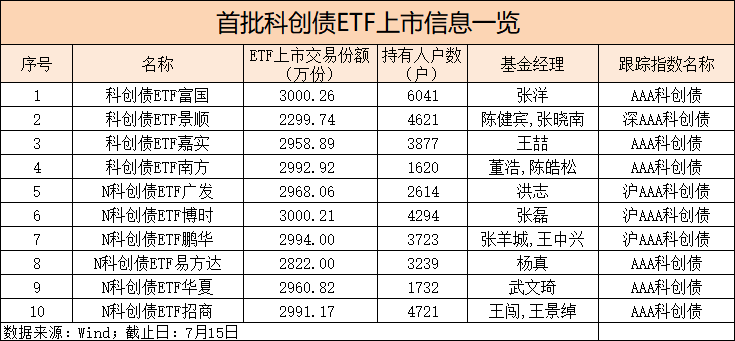
Group 1 - The first batch of 10 Science and Technology Innovation Bond ETFs (科创债ETF) collectively listed on July 17, 2023, attracting nearly 30 billion yuan in subscriptions, indicating strong market interest [1][2] - The rapid launch process, from application to listing in just one month, reflects the capital market's robust support for technology finance and the high engagement from fund companies [2][3] - Institutional investors are the primary subscribers for the first batch of Science and Technology Innovation Bond ETFs, with over 90% of holdings in most ETFs being held by institutions [3][4] Group 2 - The top ten holders of the ETFs are all institutional investors, including banks, securities firms, and pension products, with Industrial Bank being the largest holder across multiple ETFs [5] - The ETFs are designed to cater to various types of investors, aiming to assist in asset allocation strategies and timing strategies [6] - The introduction of these ETFs is expected to enhance liquidity and activity in the market, with a T+0 trading mechanism and physical redemption model to meet investor needs [8]
来了!首批10只,明日上市!
中国基金报· 2025-07-16 15:00
Core Viewpoint - The first batch of 10 Science and Technology Innovation Bond ETFs (科创债ETF) was collectively listed on July 17, attracting nearly 30 billion yuan in subscriptions, providing investors with an efficient investment tool for the science and technology bond market [2][5]. Group 1: Launch and Market Response - The launch of the first batch of Science and Technology Innovation Bond ETFs was completed in just one month, from product submission to listing [5]. - The rapid pace of the launch reflects strong support from the capital market for technology finance and highlights the high level of engagement from fund companies and other participants [5]. - Institutional investors were the main subscribers for the first batch, with over 90% of holdings in eight of the ETFs being held by institutions [6][7]. Group 2: Investor Composition and Strategy - The top ten holders of the ETFs are all institutional investors, including trusts, brokerages, banks, and pension products, with Industrial Bank being the largest holder of five ETFs [7]. - The ETFs primarily consist of AAA-rated credit bonds, allowing institutions to easily allocate funds without the need for extensive credit research, thus reducing operational costs [7]. - Despite being primarily subscribed by institutions, these ETFs are suitable for various types of investors, as they aim to assist in asset allocation strategies [8]. Group 3: Market Impact and Future Outlook - The listing of the Science and Technology Innovation Bond ETFs is expected to enhance liquidity and attract more investors, thereby increasing market activity [10]. - The ETFs will operate under a T+0 trading mechanism and a physical redemption model, which will efficiently meet investors' allocation and trading needs [10]. - There is an anticipated increase in demand for credit bonds following the launch, with expectations of continued subscription activity in the near term [11].

激活“知产”变“资产” 陕国投A助力中西部首单“双标识”知识产权ABS落地
Zheng Quan Ri Bao· 2025-07-16 06:11
Group 1 - The core viewpoint of the news is the successful issuance of the first "dual-label" intellectual property asset-backed securities (ABS) in the central and western regions of China, which is significant for innovation and demonstration [1] - The issuance scale of the Huake Chuanghe ABS Phase 1 is 100 million yuan, with a coupon rate of 2.79%, backed by intellectual property from eight high-tech enterprises [1] - Shaanxi Guotou A has actively participated in this project by establishing an intellectual property asset service trust, which opens a new path for financial support to technology innovation enterprises [1] Group 2 - Shaanxi Guotou A has previously engaged in the exploration of intellectual property ABS to help technology innovation enterprises broaden financing channels and enhance their innovation capabilities [2] - The company's 2024 annual report outlines a clear operational plan for 2025, focusing on innovative products like intellectual property service trusts to form a differentiated product system [2] - The company aims to leverage its trust advantages to continuously improve the intellectual property financial service system and support technology innovation and transformation of technological achievements [2]

百亿争产案成糊涂账?家族信托如何避免破防
Bei Jing Shang Bao· 2025-07-15 14:55
Core Viewpoint - The recent family dispute involving the founder of Wahaha Group, Zong Qinghou, highlights the complexities and challenges surrounding family trusts in wealth inheritance, raising questions about their effectiveness as wealth protection tools [1][3]. Group 1: Family Trust Disputes - Three individuals claiming to be Zong Qinghou's children have filed lawsuits against the new head of Wahaha, Zong Fuli, involving a $2.1 billion offshore family trust and demands for $700 million each from the trust assets [3]. - The inheritance dispute underscores the difficulties in asset distribution within family businesses and brings family trusts back into public focus [3][4]. Group 2: Understanding Family Trusts - A family trust is designed primarily for wealth protection, inheritance, and management, allowing for customized services in asset planning and risk isolation [3]. - The core principle of family trusts is "asset independence," where assets are managed by a trustee, thus protecting them from the grantor's debts and personal circumstances [4]. Group 3: Legal Framework and Challenges - Family trusts offer more flexibility in beneficiary designation compared to traditional inheritance methods, but conflicts between trusts and wills often lead to legal disputes [4][5]. - The effectiveness of a family trust can be compromised if the grantor retains too much control over the assets, leading to potential legal challenges [6][11]. Group 4: Growth of Family Trusts in China - The family trust market in China has grown rapidly since its inception in 2012, with the scale expected to reach approximately 790 billion yuan by June 2025, reflecting a compound annual growth rate of about 38% [7]. - The diversification of assets included in family trusts has increased, with a growing proportion of insurance trusts and corporate equity being integrated into these structures [7][8]. Group 5: Comparison with Offshore Trusts - There are significant differences between domestic and offshore family trusts, particularly in terms of asset isolation and legal frameworks, with offshore trusts offering more robust protection against control retention by the grantor [8][12]. - Offshore trusts often provide better confidentiality and tax advantages, but they also require strict compliance with local laws and regulations [9][12]. Group 6: Recommendations for Effective Trust Management - To ensure family trusts function as intended, compliance in establishment and operation is crucial, including clear legal frameworks and avoidance of excessive control by the grantor [10][13]. - Experts recommend that high-net-worth individuals focus on legal compliance, choose licensed trust institutions, and avoid retaining too much control over trust assets to prevent legal challenges [13].