
网络安全

Search documents
迪普科技: 对外投资管理制度(2025年8月)
Zheng Quan Zhi Xing· 2025-08-04 16:36
杭州迪普科技股份有限公司 对外投资管理制度 第一章 总 则 第一条 为了加强公司对外投资活动的管理,保证对外投资活动的规范性、合法性 和效益性,切实保护公司和投资者的利益,依照《中华人民共和国公司法》(以下简称 "《公司法》")等法律法规、规范性文件以及《杭州迪普科技股份有限公司章程》 (以下 (一)必须遵循国家相关法律、法规的规定,符合国家的产业政策; (二)必须符合公司发展战略和规划要求,投资公司主营业务及产业链相关业务, 有利于增加公司竞争力,有利于合理配置企业资源,有利于拓展公司主营业务,扩大再 生产,有利于公司的可持续发展; (三)必须坚持效益优先的原则,进行可行性研究论证,以利于提高公司的整体经 济利益; (四)必须注重投资风险,保证资金的安全运行。 第四条 本制度适用于公司及公司所属全资子公司、控股子公司(以下统称"子公 司")的一切对外投资行为。 第二章 分工及授权 第五条 公司对外投资实行专业管理和逐级审批制度。 简称"《公司章程》")的有关规定,结合公司的实际情况,制定本制度。 第二条 本制度所称的对外投资是指公司为获取未来收益而将一定数量的货币资金、 股权以及经评估后的实物或无形资产或其 ...

迪普科技: 董事会提名委员会议事规则(2025年8月)
Zheng Quan Zhi Xing· 2025-08-04 16:35
第二条 董事会提名委员会是董事会按照股东会决议设立的专门工作机构,主要负 责对公司董事和经理人员的人选、选择标准和程序进行选择并提出建议。 第二章 人员组成 第三条 提名委员会成员由3名董事组成,独立董事占2名。 杭州迪普科技股份有限公司 董事会提名委员会议事规则 第一章 总 则 第一条 为规范公司领导人员的产生,优化董事会组成,完善公司治理结构,根据 《中华人民共和国公司法》、《上市公司治理准则》、《公司章程》及其他有关规定, 公司特设立董事会提名委员会,并制定本议事规则。 第四条 提名委员会委员由董事长、二分之一以上独立董事或者全体董事的三分之 一以上提名,并由董事会选举产生。 第五条 提名委员会设主任委员(召集人)一名,由独立董事委员担任,负责主持委 员会工作;主任委员在委员内选举,并报请董事会批准产生。 第六条 提名委员会任期与董事会任期一致,委员任期届满,连选可以连任。期间如 有委员不再担任公司董事职务,自动失去委员资格,并由委员会根据上述第三至第五条 规定补足委员人数。 第三章 职责权限 第七条 公司董事会提名委员会负责拟定董事、高级管理人员的选择标准和程序, 对董事、高级管理人员人选及其任职资格 ...
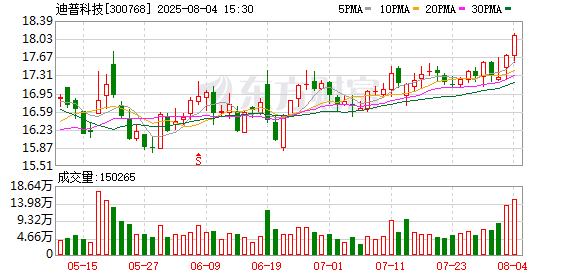
迪普科技:2025年半年度净利润约5215万元,同比增加0.17%
Mei Ri Jing Ji Xin Wen· 2025-08-04 11:06
(文章来源:每日经济新闻) 迪普科技(SZ 300768,收盘价:18.11元)8月4日晚间发布半年度业绩报告称,2025年上半年营业收入 约5.51亿元,同比增加9.59%;归属于上市公司股东的净利润约5215万元,同比增加0.17%;基本每股收 益0.08元,同比增加0%。 ...

聚焦芯片安全问题:天融信首提建立分层防御体系
Zheng Quan Zhi Xing· 2025-08-04 07:51
据了解,天融信已形成覆盖主流网络安全产品类别的业内最全信创安全产品体系,即天融信昆仑.信创 网络安全产品体系,型号数量始终保持行业领先优势,目前已经具备了云计算、大数据、工业互联网、 车联网安全、密码应用安全等多个领域的信创能力,在党政、能源、交通、教育、医疗等近30个行业实 现规模化、深度化应用,全面赋能行业数智化转型。 天融信认为,需要建立分层防御体系,筑牢硬件资产安全防线,战略级资产防护是关键。具体来看,从 支撑国家战略安全能力的核心设备,到保障行业运转的关键基础设施,再到渗透日常场景的消费级产 品,不同类型的硬件资产在安全权重、威胁暴露面及防护需求上存在显著分别。该分层防御体系的核心 优势在于更高效的资源分配,能够将更高级别的安全防护和投入集中在战略层,同时保持对外围消费级 资产的普遍覆盖。 分析人士认为,作为国产算力发展的根基,硬件安全的重要性不仅体现在算力领域的自主可控,更延伸 至整个信创产业的安全底座构建。 据人民日报消息,近日,英伟达算力芯片被曝出存在严重安全问题。此前,美议员呼吁要求美出口的先 进芯片必须配备"追踪定位"功能。美人工智能领域专家透露,英伟达算力芯片"追踪定位""远程关闭"技 ...

【机构调研记录】银河基金调研翱捷科技、长华集团等4只个股(附名单)
Zheng Quan Zhi Xing· 2025-08-04 00:08
Group 1: Aojie Technology - Aojie Technology has made significant progress in ASIC business, RedCap chips, and 4G/5G smartphone chips [1] - The ASIC business is focused on smart wearables, edge SOC, RISC-V, and cloud inference chips, with expected substantial revenue growth by 2026 [1] - RedCap chips are commercially available in the IoT market, and the company has production capabilities for smart wearables [1] - The company has successfully commercialized 4G quad-core chips and is making progress on 4G octa-core, 6nm 4G octa-core, and 6nm 5G octa-core chips [1] - Aojie Technology plans to control the growth of operating and R&D expenses to no more than 15% [1] Group 2: Changhua Group - Changhua Group has successfully produced new iterative samples of planetary roller screw, but the product is still in the R&D stage and has not generated revenue [2] - The company plans to supply carbon-ceramic brake disc metal structural parts to new energy vehicle companies by the end of 2024, with a total sales amount expected to exceed 100 million yuan [2] - As of July 2025, the company has announced new customer contracts worth 2.013 billion yuan, indicating strong order backlog and expected significant increase in capacity utilization [2] - Changhua Group is actively acquiring land and increasing capacity to enhance profitability [2] Group 3: Haohan Depth - Haohan Depth's convertible bond (118052) is set to be listed on April 7, 2025 [3] - The company has established a "Low-altitude Airspace Safety Technology Innovation Joint Laboratory" in collaboration with several institutions [3] - Haohan Depth's DPI technology and related cybersecurity solutions are designed to detect risks, identify threats, block attacks, and protect data and privacy, enhancing overall security in the Internet of Vehicles [3] Group 4: Chongda Technology - Chongda Technology anticipates positive growth in the global PCB market by 2025, with strong order demand and rising product prices [4] - The company's capacity utilization rate is at 85%, with new production capacities including multiple factories in Zhuhai and a production base in Thailand [4] - To improve profitability, Chongda Technology is focusing on high-value customers, optimizing sales structure, and enhancing cost management [4] - The company is implementing a structural price increase strategy to cope with rising raw material costs [4] - The U.S. market accounts for 10% of the company's revenue, and it is adopting strategies to diversify markets and optimize customer cooperation in response to tariff policy changes [4] Group 5: Galaxy Fund - Galaxy Fund was established in 2002, with total assets under management of 105.976 billion yuan, ranking 58th out of 210 [4] - The fund's non-monetary public fund assets amount to 75.871 billion yuan, ranking 56th out of 210 [4] - The fund manages 162 public funds, ranking 47th out of 210, with 25 fund managers, ranking 54th out of 210 [4] - The best-performing public fund product in the past year is the Galaxy Innovation Growth Mixed A, with a latest net value of 6.62 and a growth of 52.02% over the past year [4]

遭受海外网络攻击,我国或将加大力度维护网络安全
Xuan Gu Bao· 2025-08-03 23:14
Group 1: Cybersecurity Landscape - The Chinese Cyberspace Security Association reported that the U.S. government has used countries like Germany, South Korea, Singapore, and the Netherlands as platforms to launch cyberattacks against China, with over 600 cyberattack incidents targeting important Chinese units by foreign APT organizations in 2024 [1] - The Chinese Ministry of Foreign Affairs stated that China will continue to take necessary measures to safeguard its cybersecurity [1] Group 2: Importance of Critical Information Infrastructure - Critical information infrastructure includes essential sectors such as public communication and information services, energy, transportation, water resources, finance, public services, e-government, and national defense technology, which, if compromised, could severely threaten national security and public interests [1] Group 3: AI in Cybersecurity - Northeast Securities indicated that security operations are the most in need of deep transformation through AI in the cybersecurity industry, highlighting the significant advantages and potential of AI large models in areas such as alert noise reduction, attack assessment, and automated response and handling [1] - AI-enabled traditional security products primarily include threat detection products (malware detection, attack traffic detection, user and entity behavior analysis, and encrypted traffic analysis), data security, and firewalls [1] - According to Statista, the global AI security market is projected to grow at a compound annual growth rate of 27.60% from 2023 to 2030, with the market size expected to reach $134 billion by 2030 [1] Group 4: Companies Mentioned - Companies highlighted by Northeast Securities include: Green Alliance Technology, Tianrongxin, and Qihoo 360 [2]
中美相互出手,英伟达连夜发布声明,美国微软也坐不住了
Sou Hu Cai Jing· 2025-08-02 03:05
Group 1 - The core viewpoint is that the future of US-China relations will be characterized more by competition than cooperation, as evidenced by the recent extension of punitive tariffs and ongoing negotiations [1] - The US and China reached a consensus to extend the suspension period of the 24% punitive tariffs by 90 days until November 12, allowing Chinese goods to continue entering the US with a 10% base tax plus a 20% fentanyl special tax [1] - The extension of the tariff suspension is seen as a strategic move for both countries, with the US aiming to alleviate inflation pressures and China seeking to expand exports, particularly to Central and Eastern Europe, where trade reached a record 522.8 billion yuan [1] Group 2 - The cybersecurity landscape is evolving, with recent incidents highlighting the risks associated with chip technology, particularly after the US allowed Nvidia to sell AI chips to China, which raised concerns about potential backdoor risks [4] - Nvidia's H20 chip, which accounts for 80% of its revenue from China, faces scrutiny after being linked to potential security vulnerabilities, leading to a significant loss of $13.5 billion when previously banned [4] - Chinese companies are increasingly focusing on self-reliance in chip production, with Huawei's Ascend chips outperforming Nvidia's H20 by 1.7 times and domestic chip market share rising to 28% [4] Group 3 - Recent cyberattacks by US intelligence agencies on Chinese military enterprises demonstrate a new form of competition, with over 600 attacks targeting military and research institutions in the past year [6] - The attacks included significant breaches, such as the theft of missile design documents from a major military enterprise, indicating a high level of sophistication and intent [6] - The ongoing tensions are reflected in various domains, including trade negotiations, cybersecurity, and technological competition, with the 90-day tariff countdown symbolizing the precarious nature of US-China relations [6][8]
*ST国华: 关于重大诉讼的进展公告
Zheng Quan Zhi Xing· 2025-08-01 16:35
Group 1 - The company, Shenzhen Guohua Network Security Technology Co., Ltd., is involved in a significant lawsuit due to a revised performance forecast for the year 2021, with a total of 350 plaintiffs and a cumulative litigation amount of 40.8662 million yuan [1][2] - As of the date of the announcement, the Shenzhen Intermediate People's Court has made rulings on 348 related cases, with the company required to compensate a total of 22.4368 million yuan and bear litigation costs of 405,600 yuan [1][2] - The company has received civil judgments and rulings for 113 cases, with a total compensation amount of 12.7399 million yuan and litigation costs of 207,400 yuan, while 25 cases were resolved by the plaintiffs withdrawing their lawsuits [2] Group 2 - The company has recognized estimated liabilities based on the first-instance judgments of the series of cases, but the impact on current and future profits remains uncertain until the second-instance judgments are made [2] - The company will comply with the disclosure requirements of the Shenzhen Stock Exchange regarding the progress of the lawsuit and urges investors to be aware of investment risks [3]

山石网科大宗交易成交504.68万元,买方为机构专用席位
Zheng Quan Shi Bao Wang· 2025-08-01 13:49
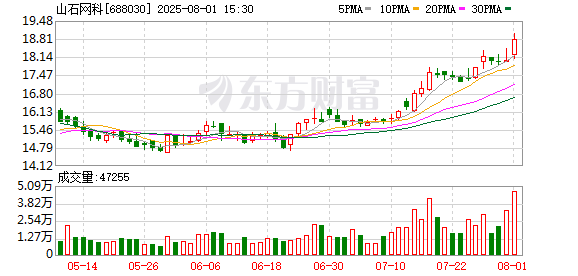
Summary of Key Points Core Viewpoint - The recent block trade of Shanshi Network Technology on August 1 indicates significant trading activity, with a notable discount compared to the closing price, suggesting potential interest from institutional investors [2]. Trading Activity - A block trade occurred on August 1 with a volume of 310,000 shares and a transaction value of 5.0468 million yuan, at a price of 16.28 yuan, which is a 13.45% discount relative to the closing price of the day [2]. - Over the past three months, Shanshi Network has recorded a total of four block trades, amounting to 12.5512 million yuan [2]. Stock Performance - The closing price of Shanshi Network on the day of the report was 18.81 yuan, reflecting a 4.33% increase, with a turnover rate of 2.62% and a total trading volume of 87.9081 million yuan [2]. - In the last five days, the stock has increased by 5.97%, although there has been a net outflow of funds totaling 4.7042 million yuan [2]. Margin Financing - The latest margin financing balance for Shanshi Network is 52.4535 million yuan, which has increased by 2.9706 million yuan over the past five days, representing a growth rate of 6.00% [2].

永信至诚(688244.SH):奇安创投拟减持不超过4%股份
Ge Long Hui A P P· 2025-08-01 11:58
Core Viewpoint - Yongxin Zhicheng (688244.SH) announced that Qi'an Venture Capital plans to reduce its shareholding due to funding exit needs, with a maximum reduction of 6.0385 million shares, accounting for no more than 4% of the total share capital [1] Summary by Relevant Sections - **Share Reduction Plan** - Qi'an Venture Capital intends to reduce its holdings through centralized bidding and block trading methods, with the reduction period starting 15 trading days after the announcement and lasting for 3 months [1] - The company will comply with reduction regulations, limiting the total number of shares sold through centralized bidding to no more than 1% of the total shares in any consecutive 30-day period, and through block trading to no more than 2% of the total shares in any consecutive 30-day period [1]
