黄酒

Search documents
黄酒行业深度:老树生新芽,行业向上空间大
2025-09-28 14:57
Summary of Huangjiu Industry Conference Call Industry Overview - The Huangjiu industry benefits from a favorable tax policy, with net profit margins superior to Baijiu under similar gross margins. Leading companies like Kuaijishan have achieved gross margins exceeding 60%, while Jimo Laojiu and Wuzhanmao have net profit margins of 18% and 15% respectively. If product structures stabilize and gross margins approach 70%-80%, net margins could easily reach 20% [1][2] Key Points and Arguments - **Market Size and Consumption Habits**: The Huangjiu market is relatively small, with consumption habits being regionally strong, primarily concentrated in Jiangsu, Zhejiang, and Shanghai. The lack of clear consumption scenarios, as Huangjiu is often viewed as a staple or cooking ingredient, poses a significant challenge for consumer education [1][4] - **High-End Development Strategies**: Leading companies are pushing for high-end development through product innovation and channel reform. For instance, Kuaijishan has launched the Benniang series, while both Kuaijishan and Guyuelongshan are actively promoting high-end strategies, achieving significant results through consumer engagement and high-end cultivation [1][5] - **Kuaijishan's Strategic Moves**: Since the shareholder change in 2022, Kuaijishan has restructured its organization, enhanced its sales team, and refined its product structure. The company has established a dual-brand strategy with Kuaijishan and Lanting, focusing on nationalization, high-end, and youth-oriented development [1][6] - **Current Policy Environment**: The current policy environment has a limited impact on Huangjiu, particularly high-end products like Lanting, which are not significantly affected by policy restrictions. However, the overall cautious consumption environment may slow the speed of new partnerships, although growth potential remains in the second half of the year [1][8] Challenges Facing the Industry - The Huangjiu industry faces challenges such as a small market size, strong regional consumption habits, and a lack of distinct consumption scenarios compared to Baijiu and beer, which have much larger market scales [4] Company Performance and Future Expectations - Kuaijishan's sales volume has reached last year's total, with the Lanting series benefiting from a high-profile strategy that provides profit margins for group buyers, leading to high channel enthusiasm. The 1,743 series has a clear positioning and good sales rhythm, expected to become a major profit source [3][9] - Guyuelongshan is integrating dispersed production facilities to reduce costs and improve efficiency. The company is also innovating products to attract younger consumers and expanding brand influence through platforms like Douyin [3][12] Future Growth Prospects - The Huangjiu industry shows a trend of upward development, with potential for significant improvement in net profit margins. If net profit margins gradually reach 20% or higher by 2026-2027, the industry could see a doubling of current profit levels [15][16] - New consumption attributes are emerging in the Huangjiu industry, with recent reforms attracting market attention. The upcoming peak season, especially around the Spring Festival, is expected to accelerate growth, supported by channel expansion and improved consumer demand [17]


新华锦控股股东母公司占用4亿资金寄望6.65亿向青岛啤酒“卖酒”还债
Xin Lang Cai Jing· 2025-09-24 21:04
Core Viewpoint - Xinhua Jin (600735.SH) is facing significant financial challenges, including a large amount of non-operating fund occupation by its controlling shareholder, Xinhua Jin Group, totaling 406 million yuan [2][3]. Financial Situation - As of the latest report, Xinhua Jin's revenue for 2024 was 1.637 billion yuan, a decrease of 30.97% year-on-year, with a net profit of -134 million yuan, down 354.59% [7]. - In the first half of 2025, the company reported revenue of 669 million yuan, a decline of 24.92% year-on-year, and a net profit of 12.87 million yuan, down 39.45% [7]. Fund Occupation and Regulatory Actions - Xinhua Jin Group and its affiliates have not returned the occupied funds, leading to regulatory scrutiny and potential administrative measures, including stock suspension and delisting warnings if the funds are not recovered within six months [3][4]. - The company is actively pursuing the recovery of these funds and is urging Xinhua Jin Group to expedite the disposal of other assets to raise the necessary capital [4]. Shareholder Actions and Agreements - Qingdao Beer announced a share transfer agreement with Xinhua Jin Group and Lu Jin Group for 100% equity of Jimo Yellow Wine, with a total consideration of 665 million yuan [2][6]. - However, four months after the announcement, there has been no update on the progress of the share transfer [2][6]. Business Operations - Xinhua Jin's business primarily focuses on "new trade and new materials," including the export of hair products and textiles, as well as graphite processing [7]. - The company has faced challenges in its operations, particularly in the second-hand car segment, which was divested in late 2024, impacting revenue [7].

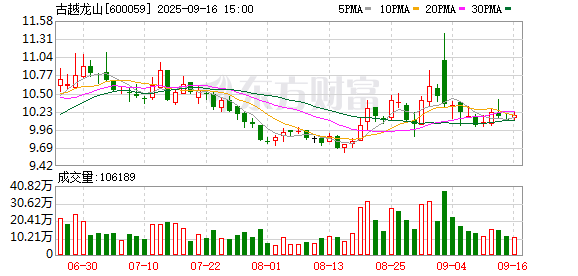
古越龙山(600059):深度报告:古往今来,越酒复兴
Changjiang Securities· 2025-09-24 15:23
Investment Rating - The report maintains a "Buy" rating for the company [11]. Core Insights - The yellow wine industry has seen a significant improvement in market concentration, with the top three companies (CR3) exceeding 40% in 2023, up from approximately 18% in 2016, indicating a more stable industry structure [3][7]. - The leading companies are actively exploring new consumption scenarios, demographics, and regions for yellow wine, which is expected to expand future market potential [3][7]. - The company is positioned to benefit from the activation of its system and the gradual release of brand potential, with anticipated growth contributions from the national market [9]. Company Overview - Zhejiang Guyue Longshan Shaoxing Wine Co., Ltd. is a leading player in the Chinese yellow wine industry and the first listed company in this sector. It owns several well-known brands, including Guyue Longshan, Shen Yonghe, and Daughter Red [6][19]. - The company has experienced various development phases since its establishment, with significant revenue growth expected as it activates its internal systems and enhances brand potential [6][20]. Industry Analysis - The yellow wine industry has not fully capitalized on the branding cycle over the past decade, with the average ex-factory price of yellow wine increasing from 10.4 yuan/liter in 2016 to 12.8 yuan/liter in 2024, reflecting a compound annual growth rate (CAGR) of only 2.7% [7][41]. - The industry is now stabilizing, with leading companies achieving strategic synergies and entering a new price increase cycle for traditional flagship products by 2025 [7][51]. Company Strategy - The company has established a development strategy focused on "premiumization, youthfulness, globalization, and digitalization" [8][55]. - It has enhanced its product offerings through collaborations with Jiangnan University, improving the health and flavor quality of its yellow wine [56]. - The company is expanding its sales network across major cities in China, with a focus on refined management and regional breakthroughs planned for 2025 [8][55]. Financial Forecast and Valuation - The company is projected to achieve earnings per share (EPS) of 0.24 yuan and 0.26 yuan for the years 2025 and 2026, respectively, corresponding to price-to-earnings (PE) ratios of 40 and 37 times [9].
绍兴越城 古城醉中秋与您共赴风雅团圆
Huan Qiu Wang· 2025-09-24 02:43
Core Viewpoint - The article highlights the upcoming "Ancient City Drunken Mid-Autumn Festival" event in Yuecheng, Shaoxing, which aims to promote local culture, tourism, and consumption through a series of activities from October 1 to October 8, 2025 [4][5][6]. Group 1: Event Overview - The main venue for the event will be the Yuecheng Urban Square, featuring various activities such as lantern festivals, drone shows, and traditional performances [5][6]. - The event will include multiple sub-venues, each offering unique activities, such as light shows and cultural exhibitions [5][6]. - The festival is designed to attract visitors and enhance the cultural experience of the ancient city, emphasizing its historical significance and local traditions [4][7]. Group 2: Cultural Significance - Shaoxing is recognized as a key location for Song culture, with the festival coinciding with the 900th anniversary of poet Lu You's birth, enhancing its cultural relevance [7]. - The event will showcase traditional Shaoxing yellow wine, integrating it into various activities and highlighting its importance in local customs [6][7]. - Visitors will have opportunities to engage in immersive experiences that reflect the rich cultural heritage of the region, including traditional wedding ceremonies and local folklore [7][8]. Group 3: Activities and Attractions - Daily activities will include performances, parades, and interactive events, ensuring a diverse experience for attendees [8][9]. - Special attractions will feature themed performances, such as traditional operas and modern music, catering to a wide audience [8][9]. - The festival will also incorporate modern elements, such as drone light shows and interactive installations, blending tradition with contemporary culture [5][6].

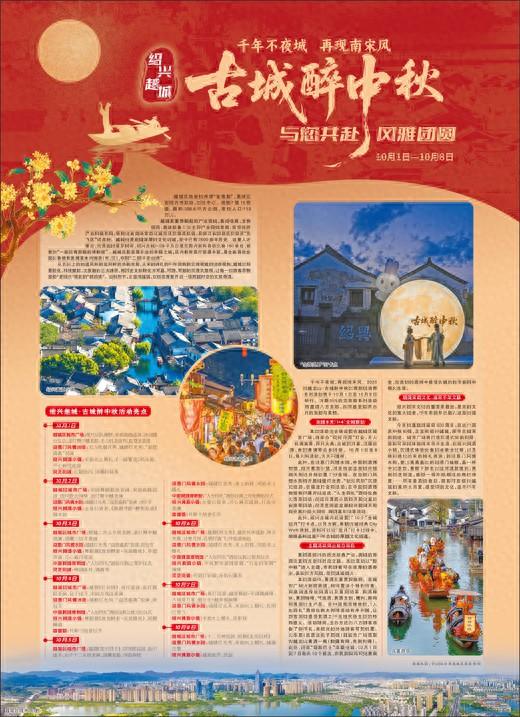
千年不夜城 再现南宋风 绍兴越城 古城醉中秋与您共赴风雅团圆 10月1日—10月8日
Ren Min Ri Bao· 2025-09-23 22:08
Core Insights - The article highlights the cultural and economic significance of Yuecheng District in Shaoxing, Zhejiang Province, emphasizing its historical heritage and modern industrial development [1][5]. Economic Development - Yuecheng District is positioned as an emerging industrial hub with three main industries: integrated circuits, biomedicine, and high-end equipment [1]. - The district has been approved for the first regular urban low-altitude logistics route in the province, marking it as a pilot area for low-altitude economy [1]. Cultural Heritage - Yuecheng boasts a rich cultural history of over 2,500 years, with more than 160 cultural relics within the 9.09 square kilometer area of Shaoxing Ancient City, earning it the title of "a museum without walls" [1]. - The district is recognized as a significant site for Song culture, with various activities planned to celebrate the 900th anniversary of poet Lu You during the upcoming holiday [5]. Tourism and Events - A series of cultural and commercial tourism events titled "Drunken Mid-Autumn Festival" will take place from October 1 to October 8, 2025, featuring diverse activities such as lantern festivals, drone shows, and traditional performances [2][3]. - The main venue for the events will be the Yuecheng Urban Square, with additional activities at various sub-venues, including the China Yellow Wine Museum and Shaoxing Yellow Wine Town [3][4]. Local Products and Experiences - The events will prominently feature Shaoxing's traditional yellow wine, with various themed markets and tasting experiences available for visitors [4]. - Attendees can enjoy a range of yellow wine-related products, including yellow wine milk tea and yellow wine coffee, enhancing the cultural experience [4]. Community Engagement - The festival aims to engage both locals and tourists, with free shuttle services and special gifts for visitors arriving by train or plane [4]. - The activities are designed to create an immersive experience that connects visitors with the historical and cultural essence of Shaoxing [5].
国金证券:白酒临近旺销 关注结构性景气配置
Zhi Tong Cai Jing· 2025-09-22 07:57
Group 1: Key Insights on Baijiu Industry - Demand for banquets has been released in July and August, with a focus on business hospitality and gift-giving ahead of the Mid-Autumn Festival and National Day [1][2] - External risk events have had a decreasing impact on baijiu consumption scenarios, but overall consumption sentiment remains lower compared to the same period last year, leading to an estimated 20% year-on-year decline in sales [2][3] - The baijiu sector is expected to stabilize and recover as consumer sentiment improves, supported by ongoing consumption promotion policies and a gradual recovery in demand [2][3] Group 2: Investment Recommendations - The report suggests focusing on high-end baijiu brands with strong market positions, such as Kweichow Moutai and Wuliangye, as well as Shanxi Fenjiu, which is benefiting from upward channel momentum [3] - Potential cyclical recovery candidates include national brands like Gujing Gongjiu and Luzhou Laojiao, along with innovative companies like Zhenjiu Lidu and Shede Liquor [3] Group 3: Insights on Other Alcoholic Beverages - Beer demand is recovering steadily, with companies diversifying into non-drinking channels and soft drinks, indicating a positive outlook for the sector [4] - The yellow wine sector is expected to see improved competitive dynamics due to price increases among leading brands, with potential for marginal catalysts as the peak season approaches [4] Group 4: Insights on Non-Alcoholic Beverages and Snacks - The soft drink sector is experiencing growth in high-demand segments like energy drinks and sugar-free tea, while traditional categories face some pressure [5] - The snack industry is seeing an increase in store openings and revenue recovery, with specific products like nut gift boxes expected to see improved demand ahead of the holidays [4][5]

白酒指数下挫2.64%,迎驾贡酒遭遇业绩、股价“双杀”|酒市周报
Xin Lang Cai Jing· 2025-09-21 10:34
Group 1 - The traditional liquor industry is under pressure, affecting market optimism for the recovery of the liquor sector, with the Wind liquor index declining by 2.64% this week [1] - Only Kuozi Jiao had a slight rebound of 0.32% this week, while other liquor stocks, including Yingjia Gongjiu and Gujing Gongjiu, saw declines exceeding 5% [1] - The liquor industry is currently in a phase of bottoming out, with expectations for gradual improvement in the fundamentals by 2026 [1] Group 2 - The beer, wine, and yellow wine sectors also experienced poor performance this week, with only a few companies like Yanjing Beer and Chongqing Beer showing gains [2] - Yingjia Gongjiu has faced a significant decline in both performance and stock price, with a year-to-date drop of 17.86% as of September 19 [2] - Yingjia Gongjiu's revenue for the first half of 2025 was 3.16 billion yuan, a year-on-year decrease of 16.89%, and net profit fell by 18.19% [2][3] Group 3 - The mid-to-high-end products of Yingjia Gongjiu saw a revenue decline of approximately 14%, while ordinary liquor revenue plummeted by 32.47% [3] - The company is facing challenges due to the underperformance of mid-to-low-end products, weak expansion outside Anhui province, and inventory pressure [3] - There is potential for recovery in the second half of the year if sales improve during the peak season, alongside industry recovery expectations [3]

大众品板块2025年中报业绩综述:分化依旧,把握结构性景气
Minsheng Securities· 2025-09-18 13:45
Investment Rating - The report provides a positive investment rating for the low-alcohol and beverage sectors, recommending specific companies based on their performance and market positioning [2]. Core Insights - The report emphasizes the structural recovery in the consumer goods sector, highlighting the importance of channel dynamics and product innovation in driving growth [2][25]. - It identifies key players in the beer segment, such as Yanjing Beer and Zhujiang Beer, which are expected to outperform due to their strong regional presence and operational efficiency [2][11]. - The report also notes the challenges faced by the seasoning and food supply sectors, particularly due to weak downstream demand, but suggests potential for recovery as the restaurant industry stabilizes [2][26]. Summary by Sections Beer Sector - The beer sector experienced a revenue of 41.73 billion yuan in the first half of 2025, with a year-on-year growth of 2.8% [7]. - Major companies like Qingdao Beer and China Resources Beer showed mixed performance, with Qingdao Beer achieving a revenue increase of 1.9% [11][12]. - The report highlights the impact of channel structure on revenue performance, with companies like Yanjing and Zhujiang benefiting from a higher proportion of non-immediate sales channels [11][12]. Yellow Wine Sector - The yellow wine sector reported a revenue of 1.93 billion yuan in the first half of 2025, reflecting a year-on-year growth of 3.4% [26]. - Kuaijishan, a leading player, achieved a double-digit growth rate of 11% in the same period, driven by its high-end and youth-oriented strategies [26][27]. - The report indicates a trend of market share concentration among leading companies, with Kuaijishan and Guyue Longshan capturing a larger portion of the market [31]. Seasoning and Food Supply Sector - The seasoning and food supply sector faced revenue pressure due to weak restaurant demand, but companies that successfully launched new products or expanded channels showed resilience [2][26]. - The report suggests that a recovery in restaurant demand could lead to increased supply chain needs, benefiting leading companies in the sector [2][26]. Beverage Sector - The beverage sector is highlighted for its high growth potential, particularly for companies like Dongpeng Beverage, which is expanding its national presence [2]. - The report recommends focusing on companies that are effectively navigating the competitive landscape and capitalizing on emerging consumer trends [2][26].





非遗活化为产业IP:山西代州黄酒的文化变现方程式
Zhong Guo Xin Wen Wang· 2025-09-17 13:44
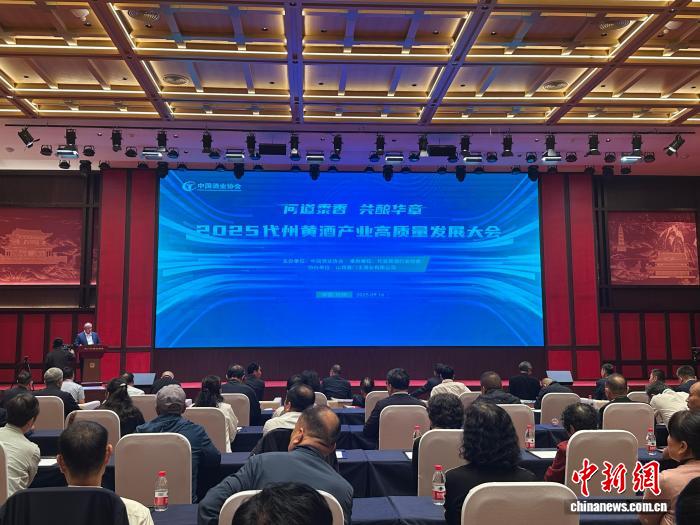
Core Viewpoint - The article discusses the revitalization of traditional culture into an industrial IP through the development of the Daizhou Huangjiu industry in Shanxi Province, highlighting its historical significance and future growth potential [1][3]. Industry Development - The Daizhou Huangjiu industry aims to establish itself as a "world-class specialty wine region" and "hometown of Huangjiu" in China, leveraging the opportunities presented by the construction of specialized towns in Shanxi Province [2][6]. - In 2022, Daizhou Huangjiu was recognized as one of the first ten provincial key specialized towns in Shanxi, prompting the county to implement various supportive policies to encourage enterprise growth and market expansion [6][7]. Historical Significance - Daizhou Huangjiu has a rich history, originating from the Yangshao culture, flourishing during the Han and Tang dynasties, and becoming renowned in the Song and Yuan dynasties, earning the title of a typical representative of northern Huangjiu [3][6]. - The "Daizhou Huangjiu Production Technique" was included in Shanxi's intangible cultural heritage list in 2011, and a geographical indication trademark was registered in 2024, showcasing its cultural and regional significance [3][6]. Economic Growth - The number of market entities in the Daizhou Huangjiu specialized town doubled from 102 to 208, while the number of Huangjiu production enterprises increased from 27 to 68, reflecting a growth of over 150% [7]. - Total production capacity surged from 18,000 tons to 130,000 tons, a 620% increase, and annual output value rose from 120 million yuan to 551 million yuan, marking a 360% growth [7]. Innovation and Collaboration - The county promotes a "company + cooperative + farmer" model for raw material base construction, encouraging farmers to cultivate 10,000 acres of millet [9]. - Collaborative agreements have been established with various regions, including a strategic partnership with the Fenyang production area and a cooperation agreement with Shaoxing City, enhancing regional synergy and development [10]. Future Goals - The county aims to achieve a comprehensive output value of over 1 billion yuan by 2025 and exceed 2 billion yuan by 2027, establishing itself as a leading Huangjiu brand and a distinctive industrial town [10].
黄酒半年报丨古越龙山“一哥”地位险被超 会稽山增收难增利
Xin Jing Bao· 2025-09-16 09:43
Group 1: Market Competition - The competition among the three listed yellow wine companies is intensifying, with Gu Yue Long Shan's revenue lead over Kuaiji Mountain narrowing year by year [2][3] - In the first half of this year, Gu Yue Long Shan achieved a revenue of 0.76 billion yuan more than Kuaiji Mountain, but Kuaiji Mountain surpassed Gu Yue Long Shan in net profit [2][3] - Kuaiji Mountain's revenue grew by 11.03% year-on-year in the first half of this year, marking three consecutive years of double-digit growth, although its net profit growth slowed to 3.41% [2][6] Group 2: Financial Performance - Gu Yue Long Shan reported a revenue of 0.893 billion yuan, a slight increase of 0.40%, while its net profit decreased by 4.72% to 90.31 million yuan [3][4] - Kuaiji Mountain's net profit growth has been affected by a significant increase in sales expenses, which reached 0.215 billion yuan, up 53.69% year-on-year [6][7] - Jin Feng Wine's revenue declined by 9.04% to 0.216 billion yuan, with a loss of 7.136 million yuan, although the loss has narrowed compared to previous periods [5] Group 3: Strategic Initiatives - The yellow wine industry is focusing on high-end, youthful, and national strategies to capture market share, with both Gu Yue Long Shan and Kuaiji Mountain launching products aimed at younger consumers [8][9] - Kuaiji Mountain has increased its marketing efforts, including collaborations with celebrities to promote its products, which has led to significant sales during promotional events [6][7] - Jin Feng Wine is also pursuing a high-end and youthful brand strategy but acknowledges that the full effects of these initiatives will take time to materialize [9] Group 4: Regional Sales Dynamics - In the competitive Jiangsu and Zhejiang markets, Gu Yue Long Shan and Kuaiji Mountain are experiencing fluctuating sales, with Gu Yue Long Shan's revenue in Zhejiang at 0.259 billion yuan and Kuaiji Mountain's at 0.518 billion yuan [10] - Jin Feng Wine's performance in its home market of Shanghai has seen a decline, with a revenue drop of 6.38% [10] Group 5: Future Outlook - Analysts believe that the push for high-end and youthful products, along with national expansion, will require sustained investment and time to cultivate new markets and consumers [11] - The current price range of yellow wine is around 20 yuan, indicating potential for product upgrades, but there are uncertainties regarding market acceptance of high-end products [11]