电池

Search documents
固态电池行业深度报告:材料和工艺设备体系革新,固态电池产业化加速
Shanghai Aijian Securities· 2025-12-31 06:24
Investment Rating - The report rates the solid-state battery industry as "stronger than the market" [3]. Core Insights - The core insight of the report emphasizes the acceleration of solid-state battery industrialization driven by innovations in materials and processes, particularly the solidification of electrolytes, which enhances energy density and safety [3]. Summary by Sections 1. Solid-State Battery: Solid Electrolyte, Multi-Dimensional Performance Improvement - The key difference in constructing solid-state batteries lies in the solid electrolyte, which transmits lithium ions and isolates the positive and negative electrodes without a separator [9]. - Solid-state batteries can be classified into four types based on electrolyte types: oxides, sulfides, polymers, and halides, with bulk sulfide solid-state batteries being the trend [13]. - The commercial testing of solid-state batteries began overseas, with rapid advancements in domestic technology and commercialization [17]. 2. Demand: Global Downstream Applications and Policy Synergy Drive Rapid Growth - The Asia-Pacific region is expected to account for over 50% of the solid-state battery market by 2024, benefiting from China's complete lithium battery supply chain and policy support [23]. - The demand for solid-state batteries is driven by large-scale applications in power batteries, with domestic semi-solid battery installation volumes showing rapid growth [30]. - The penetration rate of consumer batteries is expected to exceed 10% by 2030, as they serve as a testing ground for the commercialization of solid-state batteries [31]. 3. Supply: Clear Capacity Planning by Leading Enterprises, Accelerating Restructuring of the Market - China is projected to provide over 80% of global solid-state battery capacity by 2025, supported by a complete supply chain and policy backing [18]. - Major enterprises have clear plans for mass production, with significant advancements in semi-solid production lines [19]. - Domestic battery manufacturers are already establishing mass production lines for semi-solid batteries while focusing on the research and development of full solid-state batteries [19]. 4. Material Landscape: Electrolytes Converging Towards Sulfides, Focus on Silicon-Based and Lithium Metal Anodes - The sulfide route is expected to dominate the market, with a projected market share exceeding 40% by 2035 due to its high conductivity and flexibility [24]. - Silicon-based anodes are rapidly industrializing, while lithium metal anodes are anticipated to become a key development direction due to their higher energy density [24]. 5. Process Landscape: Integrated Line Suppliers to Benefit First, High Technical Barriers in Sub-Segment Equipment - New equipment will open up incremental space, with integrated line equipment suppliers expected to benefit first in the industrialization process [5]. - The solid-state battery manufacturing process differs significantly from traditional lithium batteries, necessitating upgrades in various equipment [5].





首个国标划定硬指标,固态电池产业化提速
Huan Qiu Wang Zi Xun· 2025-12-31 04:51
Core Viewpoint - The release of the first national standard for solid-state batteries in China marks a significant milestone in the industry's development, establishing clear definitions and high thresholds for key performance indicators, which is expected to facilitate the industrialization of solid-state battery technology [1][6]. Group 1: Definition and Standards - The new standard categorizes batteries into three types: liquid batteries, hybrid solid-liquid batteries, and solid-state batteries, eliminating the previously used term "semi-solid battery" [2]. - A critical performance indicator set by the new standard is that the weight loss rate of solid-state batteries must not exceed 0.5%, a significant tightening from the previous requirement of less than 1% [2][6]. - The standard aims to clarify the market and promote genuine technological innovation, thereby purging the market of "pseudo-solid" products [6]. Group 2: International Competition and Market Dynamics - The standard categorizes solid-state batteries based on electrolyte types and ion conduction types, which is expected to enhance China's competitive edge in the global solid-state battery technology race [4]. - The establishment of the national standard is seen as a strategic move to unify domestic technical interfaces and gain a voice in international regulations [4]. - Capital investment in the solid-state battery sector is increasing, with significant funding events indicating strong market recognition of this technology [5]. Group 3: Industry Impact and Investment Opportunities - Major companies are actively pursuing funding and investments to support the transition from laboratory to large-scale production of solid-state batteries [5]. - The market has seen a surge in institutional interest, with 22 solid-state battery concept stocks receiving institutional research in the fourth quarter [5]. - Companies with substantial technological reserves in core electrolyte routes and those achieving significant production capabilities are expected to benefit from the "Matthew effect" in the upcoming industrial wave [6].



大摩:新一年电动车国补出台 电池行业不确定性消除
Zhi Tong Cai Jing· 2025-12-31 03:25
Group 1 - The core viewpoint of the article is that the introduction of the new national subsidy policy in mainland China for 2026 will alleviate market concerns regarding the sustainability of subsidies for electric passenger vehicles, ensuring continued growth in the electric vehicle battery industry [1] - The new subsidy policy links the subsidy amount to vehicle prices, differing from the fixed subsidy of 2025, but maintains similar subsidy caps and eligible vehicle models [1] - The continuation of subsidies is expected to secure high single-digit growth for the electric vehicle battery industry in 2026, with strong performance in electric trucks and energy storage systems further enhancing industry profitability [1] Group 2 - If strong demand leads to sustained increases in battery material prices, the company believes that CATL (宁德时代) will be able to pass on cost pressures through pricing strategies [1] - The target price for CATL's A-shares is set at 490 RMB, with an "overweight" rating, positioning it as a top choice in the industry [1]
大行评级|大摩:电动车“国补”延续可确保明年电池行业有高单位数增长 行业首选宁德时代
Ge Long Hui· 2025-12-31 02:43
Group 1 - The core viewpoint of the article is that the introduction of the "national subsidy" policy in mainland China in 2026 will link subsidy amounts to vehicle prices, differing from the fixed subsidy of 2025, but the subsidy cap and covered vehicle models will remain largely unchanged [1] - The continuation of subsidies for electric passenger vehicles is expected to ensure high single-digit growth in the electric vehicle battery industry in 2026 [1] - Strong performance in electric trucks and energy storage systems is anticipated to further enhance industry profitability [1] Group 2 - If strong demand leads to a sustained increase in battery material prices, the company believes that CATL will be able to pass on cost pressures through pricing strategies [1] - The target price for CATL's A-shares is set at 490 yuan, with an "overweight" rating, positioning it as the industry favorite [1]
2026商品年度报告碳酸锂:储能高景气,碳酸锂开启新周期
Zhong Hui Qi Huo· 2025-12-31 01:39
1. Report Industry Investment Rating No information provided in the content. 2. Core Viewpoints of the Report - In 2026, lithium carbonate will shift from oversupply to a tight - balance pattern. The significant decline in the industry's inventory coverage days will push up the price center. In the long - term, the peak of the current cycle's production cycle has passed, and the support for energy storage from countries around the world strengthens optimistic expectations, leading to strong speculative demand in the market. However, due to the high supply elasticity, the price increase will be tortuous. The annual price is expected to fluctuate between 90,000 - 200,000 yuan/ton [2][99]. 3. Summary According to the Directory 3.1 Market Review - The main contract of lithium carbonate showed a trend of hitting the bottom and then rebounding. As of December 25, LC2605 closed at 123,520 yuan/ton, a 59% increase from the beginning of the year. The quotes of battery - grade and industrial - grade lithium carbonate were 115,000 yuan/ton and 113,000 yuan/ton respectively, with increases of 52% and 55% from the beginning of the year [6]. - In the first quarter, pre - Spring Festival restocking by downstream and the advancement of demand due to tariff implementation led to a tight spot market. After the Spring Festival, the early resumption of work by leading manufacturers and slow downstream resumption put pressure on the market. In the second quarter, the price dropped rapidly due to the off - season of terminal demand and cost collapse. In the third quarter, the price fluctuated sharply. In the fourth quarter, the price trended upwards due to supply growth being slower than demand growth and the continuous destocking of total inventory [6][7]. 3.2 Demand Side of Lithium Carbonate 3.2.1 New Energy Vehicle Market - In 2025, from January to October, global new energy vehicle sales reached 17.78 million, a 28.1% year - on - year increase, with a penetration rate of 22.7%. The Chinese market maintained growth, with a penetration rate of 46.7%. The European market showed an increasing penetration rate, while the North American market was affected by subsidy withdrawal, with a slowdown in growth [11]. - In 2026, the European new energy vehicle market is expected to maintain high growth, with a year - on - year growth rate of over 30%. The US market will experience a painful period of policy withdrawal and demand adjustment, with an expected sales decline of 10% - 20% and a penetration rate within 10%. The Chinese market is expected to slow down in growth but optimize in structure, with the penetration rate expected to exceed 60% [15][20][29]. 3.2.2 Energy Storage Market - In 2025, the global energy storage market experienced explosive growth, with an expected annual installed capacity demand of 329GWh, an 87% year - on - year increase. The expected compound growth rate from 2025 - 2027 is 86% [30]. - In 2026, the domestic installed capacity is expected to reach 300GWh. The US and European markets also have strong growth potential, and emerging markets such as the Middle East are also growing rapidly [35][38][39]. 3.2.3 Battery Market - In the first three quarters of 2025, the global lithium - battery shipments exceeded 1.2TWh, a 60% year - on - year increase. It is estimated that the shipments in 2025 will exceed 1.7TWh [43]. - In 2026, the total demand for global power and energy - storage batteries is expected to reach 2600 - 2700GWh, a year - on - year increase of over 30%. The demand for energy - storage batteries will grow faster than that of power batteries [46]. 3.2.4 Cathode Materials - In the first three quarters of 2025, the shipments of Chinese cathode materials were expected to be 3.5 million tons, a 53% year - on - year increase. Lithium iron phosphate led the growth, with shipments of 2.575 million tons, a 60.8% year - on - year increase. Ternary materials also increased by 20% [52]. - In 2026, lithium iron phosphate is expected to continue high - growth, with an expected output of 5.8 million tons, a 50% increase from 2025. The demand for high - nickel ternary materials and precursors will also increase [53][60]. 3.3 Supply Side of Lithium Carbonate 3.3.1 Lithium Ore Supply - In 2026, Australian mines are expected to have a 15% year - on - year output increase to 503,000 tons LCE. African mines will benefit from the recovery of lithium prices, and South American salt lakes also have certain production increases. Domestic lithium ore supply is expected to be about 100,000 tons LCE, and the output of domestic salt - lake lithium extraction is expected to be about 228,000 tons LCE [76][78][79]. 3.3.2 Lithium Carbonate Supply - In 2026, new lithium carbonate production capacity will be significantly slowed down, with only 45,000 tons of new capacity to be put into production, mainly in the second half of the year. From January to November 2025, the cumulative domestic lithium carbonate output reached 871,200 tons, a 44% year - on - year increase [81][82]. 3.3.3 Cost and Profit - As of December 19, the average production cost of lithium carbonate was 84,551 yuan/ton. The industry profit was 15,830 yuan/ton. The cost mainly comes from raw material procurement, accounting for over 85% of the production cost [85]. 3.4 Import, Export, and Inventory 3.4.1 Import and Export - In November 2025, China's lithium carbonate import volume was about 22,055 tons, a 8% month - on - month decrease and a 15% year - on - year increase. From January to November, the cumulative import volume was 219,000 tons, a 5.8% year - on - year increase [92]. 3.4.2 Inventory - As of December 24, the sample inventory of lithium carbonate was 109,773 tons. The inventory structure has improved, with upstream inventory gradually transferred to downstream and intermediate links. In 2026, attention should be paid to the sustainability of destocking [96].
固态电池首个国家标准征求意见 固态产业化持续推进(附概念股)
Zhi Tong Cai Jing· 2025-12-31 00:55
媒体记者从全国汽车标准化技术委员会获悉,12月30日,固态电池首个国家标准——《电动汽车用固态 电池 第1部分:术语和分类》公开征求意见。 征求意见稿明确了固态电池的相关术语、分类、编码等基础内容,标志着固态电池技术开始由实验室走 向产业化。 据高工产业研究院(GGII)不完全统计,2025年我国锂电产业链全环节公开投资项目(含锂电池及主要材 料、固态电池、钠电池)超282个,总投资额超8200亿元,同比增长超74%。 随着固态电池技术的快速发展,概念股备受机构关注。统计显示,四季度以来共有22只概念A股获得机 构调研,其中16股调研机构家数在10家及以上。 近日,媒体记者从全国社会保障基金理事会相关人士处获悉,全国社会保障基金理事会曾对多家固态电 池企业开展过调研与考察。 招商证券研报表示,传统锂电方面,储能需求爆发,带动电池扩产加速。 固态电池方面,固态产业化持续推进,目前固固界面问题是新技术生产工艺核心难点。 2025年,产业链上下游围绕固固界面问题,在材料端、制造端等提出多种解决方案,包括在电解质中引 入碘离子、等静压设备的持续迭代、ALD技术实现界面改性等。随着工艺成熟和降本持续推进,固态 电池量产 ...
港股概念追踪|固态电池首个国家标准征求意见 固态产业化持续推进(附概念股)
智通财经网· 2025-12-31 00:46
媒体记者从全国汽车标准化技术委员会获悉,12月30日,固态电池首个国家标准——《电动汽车用固态 电池 第1部分:术语和分类》公开征求意见。 征求意见稿明确了固态电池的相关术语、分类、编码等基础内容,标志着固态电池技术开始由实验室走 向产业化。 智通财经APP获悉,据高工产业研究院(GGII)不完全统计,2025年我国锂电产业链全环节公开投资项目 (含锂电池及主要材料、固态电池、钠电池)超282个,总投资额超8200亿元,同比增长超74%。 随着固态电池技术的快速发展,概念股备受机构关注。统计显示,四季度以来共有22只概念A股获得机 构调研,其中16股调研机构家数在10家及以上。 近日,媒体记者从全国社会保障基金理事会相关人士处获悉,全国社会保障基金理事会曾对多家固态电 池企业开展过调研与考察。 招商证券研报表示,传统锂电方面,储能需求爆发,带动电池扩产加速。 2025年,产业链上下游围绕固固界面问题,在材料端、制造端等提出多种解决方案,包括在电解质中引 入碘离子、等静压设备的持续迭代、ALD技术实现界面改性等。随着工艺成熟和降本持续推进,固态 电池量产进程有望加速。 固态电池目前正处于由实验室、小试走向中试交 ...

固态电池首个国家标准出炉 机构扎堆调研股名单梳理
Xin Lang Cai Jing· 2025-12-31 00:17
Core Viewpoint - The first national standard for solid-state batteries has been publicly solicited for opinions, marking a significant step towards the industrialization of solid-state battery technology [1] Industry Summary - The national standard titled "Solid State Batteries for Electric Vehicles Part 1: Terminology and Classification" was released for public consultation on December 30 [1] - This standard clarifies the terminology, classification, and coding related to solid-state batteries, indicating a transition from laboratory research to industrial application [1] - A total of 54 listed companies in the A-share market are involved in the solid-state battery industry chain, reflecting growing interest and investment in this sector [1] Company Summary - In the fourth quarter, 22 concept stocks related to solid-state batteries have been investigated by institutions, with 16 of these stocks receiving attention from 10 or more research institutions [1] - Companies such as Rongbai Technology, Dandefluorine, and Dangseng Technology have attracted the most institutional research, with 267, 183, and 157 institutions respectively conducting investigations [1]
固态电池“标尺”来了,首个国家标准出炉,门槛大提升(附股)
Zheng Quan Shi Bao· 2025-12-31 00:11
Core Viewpoint - The first national standard for solid-state batteries has been publicly solicited for opinions, marking a significant step towards the industrialization of solid-state battery technology [1][2]. Group 1: National Standard Development - The national standard titled "Solid-State Batteries for Electric Vehicles Part 1: Terminology and Classification" has been released for public consultation, defining key terms, classifications, and coding related to solid-state batteries [2]. - The standard will be developed in four parts: terminology and classification, performance specifications, safety specifications, and lifespan specifications [4]. - The draft categorizes solid-state batteries based on the type of electrolyte, ion conduction type, and application area, including categories such as sulfide, oxide, polymer, and halide solid-state batteries [6]. Group 2: Stricter Classification and Standards - The draft specifies that solid-state batteries must have a weight loss rate of no more than 0.5%, which is stricter than the previous group standard of less than 1% [6]. - The standard aims to eliminate the concept of semi-solid batteries, focusing on clear definitions and classifications [5]. Group 3: Industry Implications - The establishment of a national standard is expected to unify technical standards, enhance industry collaboration, and strengthen China's position in international regulations, facilitating the transition from laboratory to mass production [7][8]. - The solid-state battery industry in China is experiencing significant capital investment, with major companies completing substantial financing rounds, indicating strong market confidence in the technology [9]. Group 4: Market and Investment Trends - A total of 54 listed companies in A-shares are involved in the solid-state battery supply chain, attracting institutional interest [10]. - In the fourth quarter, 22 concept stocks received institutional research, with companies like Rongbai Technology and Dandeng Technology being the most frequently researched [12]. - Companies are increasing their R&D investments, with several solid-state battery stocks reporting significant growth in R&D expenses as a percentage of revenue [13][14].
重磅!固态电池“标尺” 来了 首个国家标准出炉 门槛大幅提升(附股)
Zheng Quan Shi Bao Wang· 2025-12-31 00:06
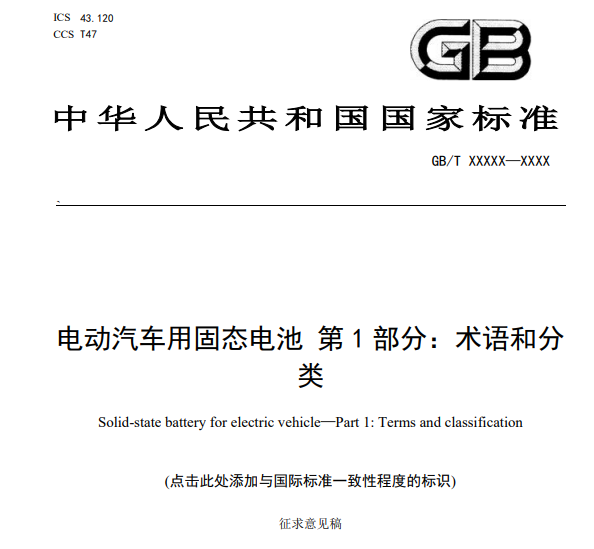
固态电池首个国家标准公开征求意见,标志着固态电池技术开始由实验室走向产业化。 固态电池首个国家标准出炉 证券时报·数据宝从全国汽车标准化技术委员会获悉,12月30日,固态电池首个国家标准——《电动汽车用固态电池第1部分:术语和分类》公 开征求意见(以下简称"征求意见稿")。征求意见稿明确了固态电池的相关术语、分类、编码等基础内容。 据悉,《电动汽车用固态电池》系列标准拟分为4个部分进行编制,包括术语和分类、性能规范、安全规范、寿命规范。此外,《电动汽车固 态电池用固体电解质技术规范》目前也已进入起草阶段。 固态电池分类明确,判定标准更加严格 上述征求意见稿显示,根据电池单体内部传递离子方式不同,将电池分为液态电池、混合固液电池和固态电池。这与此前中国汽车技术研究中 心透露的消息一致,即不再有半固态电池的说法。 另外,征求意见稿对固态电池根据电解质种类、传导离子种类、应用领域不同再次分类。 根据固体电解质种类不同,分为硫化物固态电池、氧化物固态电池、聚合物固态电池、卤化物固态电池、复合电解质固态电池等;根据传导离 子种类不同,分为固态锂离子电池、固态钠离子电池等类型;根据应用领域不同,分为高能量固态电池、高功率 ...