
乘用车

Search documents
行业周报:晶圆代工厂涨价,深蓝首批L3车辆上路-20251228
KAIYUAN SECURITIES· 2025-12-28 07:44
Investment Rating - The industry investment rating is "Overweight" (maintained) [1] Core Insights - The report highlights that the semiconductor foundry price increases have alleviated market concerns regarding the demand for mature processes in 2026, primarily due to improved competitive dynamics and rising raw material costs [5][14] - The automotive sector is experiencing continued pressure on retail sales, with the first batch of L3 autonomous vehicles from Deep Blue officially registered and on the road [6][30] - In the tools sector, TTI has terminated its HART business to strengthen mid-term profitability, while SBD's divestiture of its aerospace segment is expected to significantly reduce debt and optimize leverage ratios [31][43] Summary by Sections Electronics - Semiconductor foundries have raised some production capacities, leading to a 5.4% increase in the electronics index, outperforming the Hang Seng Technology Index [5][14] - Notable stock performances include SMIC and Hua Hong Semiconductor, which rose by 9.2% and 5.5% respectively [5][14] Automotive - Retail sales in the passenger car market are under pressure, with a 19% year-on-year decline in retail volume for December 2025 compared to December 2024, although there was a 5% month-on-month increase [25][26] - The first L3 autonomous vehicles from Deep Blue were officially registered on December 26, 2025, marking a significant milestone in autonomous driving technology [30] Tools - TTI's termination of the HART business aims to enhance mid-term profitability, while SBD's sale of its aerospace business for $1.8 billion is expected to reduce debt significantly [41][43] - The divestiture is projected to create approximately $405 million to $415 million in revenue for the fiscal year 2025, with an adjusted EBITDA margin exceeding 10% [43] Investment Recommendations - In the electronics sector, companies like SMIC and Hua Hong Semiconductor are expected to benefit from the price increases in foundry services [55] - In the automotive sector, attention is drawn to companies involved in L3 autonomous driving and Robotaxi, including Xiaoma Zhixing and Horizon Robotics [55] - In the tools sector, the report recommends companies such as Techtronic Industries and泉峰控股, with beneficiaries including Juxing Technology and Greebo [55]
汽车行业 2026 年度投资策略报告:不必悲观,结构存机会-20251227
Guohai Securities· 2025-12-27 13:27
Core Insights - The report maintains a "Recommended" rating for the automotive industry, emphasizing that there are opportunities despite potential challenges in 2026 [1][2] - The automotive sector showed a 20% increase over the past 12 months, outperforming the Shanghai and Shenzhen 300 index, which increased by 16.8% [3] Group 1: Industry Overview - The automotive industry is expected to experience a strong performance in commercial vehicles while passenger vehicles may face challenges in 2026 [4] - The report highlights that the passenger vehicle market in 2025 was supported by trade-in policies, leading to stable performance, but anticipates pressure on total volume in 2026 [4] - The heavy truck segment is projected to see positive growth in 2026, driven by domestic demand recovery and increased exports [4] Group 2: Opportunities in Passenger Vehicles - The report identifies a significant opportunity in the high-end passenger vehicle market, particularly for models priced above 300,000 yuan, which is expected to continue to grow [4][5] - Domestic brands are anticipated to make substantial advancements in the high-end market with new models launching in 2026 [5] Group 3: Heavy Truck Market Insights - The heavy truck market is expected to benefit from a recovery in domestic demand and a favorable export environment, with wholesale volumes projected to grow positively in 2026 [4][5] - The report notes that the penetration rate of electric heavy trucks may stabilize in 2026 after significant increases in 2025, which could positively impact profitability [5] Group 4: Smart Driving and Technology - The report discusses the acceleration of high-level autonomous driving technology penetrating lower-priced models, which is expected to drive volume growth in 2026 [5] - The introduction of new AI-driven cockpit technologies is anticipated to enhance the value of smart cabins, creating additional investment opportunities in related components [5] Group 5: Robotics Sector - The report indicates that the humanoid robotics sector is entering a new phase, with significant growth potential for leading manufacturers and their supply chains [5] - The collaboration between domestic and international manufacturers is expected to enhance production capabilities and technological advancements in humanoid robots [5] Group 6: Investment Recommendations - The report recommends several companies for investment, including Jianghuai Automobile, Top Group, and BYD, highlighting their potential in the evolving automotive landscape [6][9] - Specific recommendations for heavy truck manufacturers include China National Heavy Duty Truck Group and Weichai Power, which are expected to benefit from industry growth [6][9]






乘用车板块12月26日涨2.54%,比亚迪领涨,主力资金净流入16.99亿元
Zheng Xing Xing Ye Ri Bao· 2025-12-26 09:07
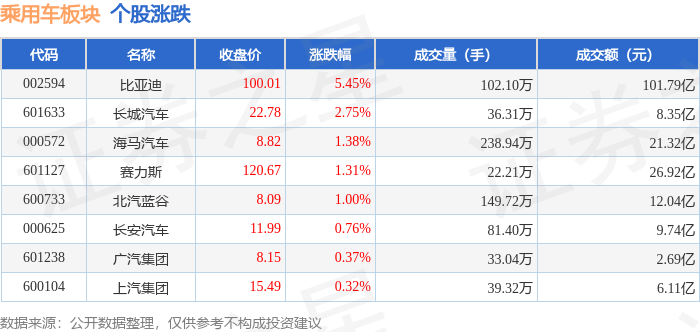
Group 1 - The passenger car sector increased by 2.54% compared to the previous trading day, with BYD leading the gains [1] - The Shanghai Composite Index closed at 3963.68, up 0.1%, while the Shenzhen Component Index closed at 13603.89, up 0.54% [1] - Major stocks in the passenger car sector showed varied performance, with BYD closing at 100.01, up 5.45%, and Great Wall Motors at 22.78, up 2.75% [1] Group 2 - The passenger car sector saw a net inflow of 1.699 billion yuan from main funds, while retail investors experienced a net outflow of 794 million yuan [1] - BYD attracted a significant net inflow of 1.473 billion yuan from main funds, while retail investors had a net outflow of 683 million yuan [1] - Other notable stocks included Seres with a net inflow of 152 million yuan from main funds and a net outflow of 106 million yuan from retail investors [1]

2026年权益市场展望:结构性机遇凸显,多主线值得关注
Zheng Quan Shi Bao Wang· 2025-12-26 04:42
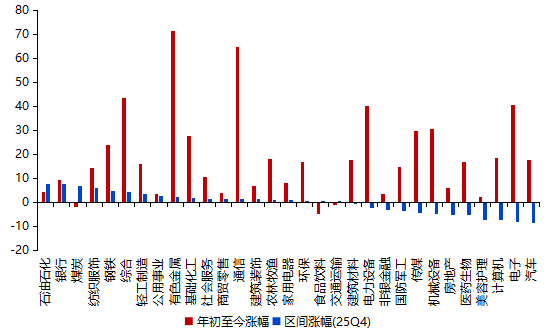
Core Viewpoint - The market is increasingly focused on investment opportunities for 2026 as the A-share market approaches the end of 2025, with sectors like metals, TMT, and power equipment performing well, while dividend stocks and real estate are under pressure [1] Group 1: Global Economic Environment - The global macroeconomic landscape is expected to show positive changes in 2026, with the U.S. likely to adopt more accommodative fiscal and monetary policies, potentially increasing the federal deficit by approximately $3.4 trillion over the next decade [4] - The anticipated fiscal expansion in the U.S. may require a low-interest-rate environment, which could improve global liquidity and stabilize the external environment for the A-share market [4] Group 2: Domestic Economic Policies - The Central Economic Work Conference at the end of 2025 has set a policy direction of "seeking progress while maintaining stability," indicating a focus on quality and efficiency improvements [5] - Industrial enterprises are at the bottom of the inventory cycle, with a narrowing decline in PPI suggesting an approaching recovery phase for corporate profits, as evidenced by a 3.2% year-on-year growth in net profit for all A-shares in Q3 2025 [5] Group 3: Investment Opportunities for 2026 - The A-share market is expected to remain structurally driven, with five key areas for investors to focus on: 1. AI Super Cycle: Continued growth in domestic and international computing power chains, with a focus on new technology iterations and the gaming industry [9] 2. High-end Manufacturing Overseas: Attention on sectors like energy storage and lithium batteries, as well as heavy-duty vehicles and engineering machinery that offer growth potential [11] 3. Strategic Resource Revaluation: Long-term focus on precious and industrial metals, with particular attention to energy and lithium carbonate showing signs of stabilization [11] 4. Frontier Technology Breakthroughs: Ongoing interest in industries such as robotics, solid-state batteries, and quantum computing [11] 5. New Consumption and Innovative Pharmaceuticals: Focus on sectors with solid fundamentals in consumer and technology spending, as well as innovative medical devices [11] Group 4: Market Liquidity - The degree of asset allocation migration towards equity markets is still in its early stages, with significant room for growth as indicators remain at historical lows [10] - Institutional investors, including insurance funds and bank wealth management products, are expected to become important sources of marginal capital in 2026, further enhancing market liquidity [10]
乘用车板块12月25日跌0.07%,海马汽车领跌,主力资金净流出5.36亿元
Zheng Xing Xing Ye Ri Bao· 2025-12-25 09:07
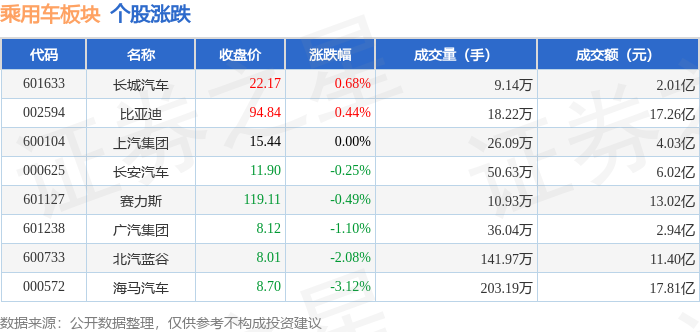
Core Insights - The passenger car sector experienced a slight decline of 0.07% on December 25, with Haima Automobile leading the drop [1] - The Shanghai Composite Index closed at 3959.62, up 0.47%, while the Shenzhen Component Index closed at 13531.41, up 0.33% [1] Market Performance - Great Wall Motors closed at 22.17, with an increase of 0.68%, trading volume of 91,400 shares, and a transaction value of 201 million yuan [1] - BYD closed at 94.84, up 0.44%, with a trading volume of 182,200 shares and a transaction value of 1.726 billion yuan [1] - SAIC Motor remained unchanged at 15.44, with a trading volume of 260,900 shares and a transaction value of 403 million yuan [1] - Changan Automobile closed at 11.90, down 0.25%, with a trading volume of 506,300 shares and a transaction value of 602 million yuan [1] - Seres closed at 119.11, down 0.49%, with a trading volume of 109,300 shares and a transaction value of 1.302 billion yuan [1] - GAC Group closed at 8.12, down 1.10%, with a trading volume of 360,400 shares and a transaction value of 294 million yuan [1] - BAIC Blue Valley closed at 8.01, down 2.08%, with a trading volume of 1,419,700 shares and a transaction value of 1.14 billion yuan [1] - Haima Automobile closed at 8.70, down 3.12%, with a trading volume of 2,031,900 shares and a transaction value of 1.781 billion yuan [1] Capital Flow - The passenger car sector saw a net outflow of 536 million yuan from institutional investors, while retail investors had a net inflow of 484 million yuan [1] - BYD had a net inflow of 171 million yuan from institutional investors, but a net outflow of 117 million yuan from retail investors [2] - Great Wall Motors experienced a net inflow of 22.71 million yuan from institutional investors, with a net outflow from retail investors [2] - GAC Group had a significant net outflow of 63.71 million yuan from institutional investors, while retail investors contributed a net inflow of 39.88 million yuan [2] - Changan Automobile faced a net outflow of 83.01 million yuan from institutional investors, with retail investors showing a net inflow of 75.99 million yuan [2] - BAIC Blue Valley had a net outflow of 126 million yuan from institutional investors, while retail investors contributed a net inflow of 81.98 million yuan [2] - Haima Automobile saw a net outflow of 186 million yuan from institutional investors, with retail investors showing a net inflow of 16.8 million yuan [2] - Seres experienced a net outflow of 27.37 million yuan from institutional investors, while retail investors had a net inflow of 18.41 million yuan [2]


早新闻 | 四部门重磅发声
Sou Hu Cai Jing· 2025-12-25 00:11
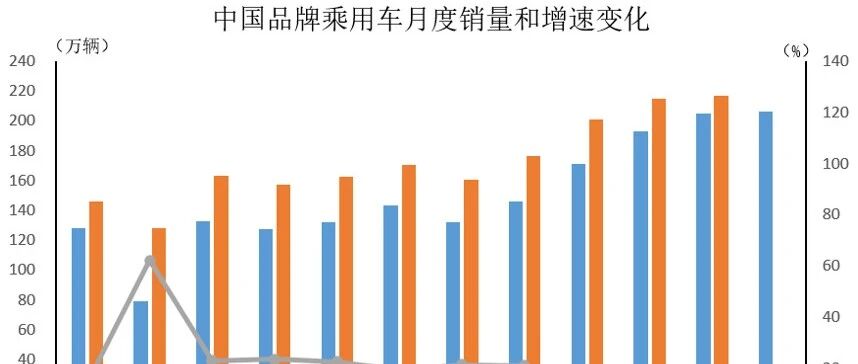
Macro Highlights - The Ministry of Finance, State-owned Assets Supervision and Administration Commission, Financial Regulatory Administration, and China Securities Regulatory Commission issued a notice emphasizing strict adherence to accounting standards for the preparation of 2025 annual reports, focusing on areas such as long-term equity investments, fixed assets, intangible assets, and revenue recognition [1] Industry News - In November 2025, Chinese brand passenger cars sold 2.169 million units, a month-on-month increase of 1% and a year-on-year increase of 5.8%, accounting for 71.4% of total passenger car sales, with a market share increase of 3.1 percentage points compared to the same period last year [3] - From January to November 2025, sales of Chinese brand passenger cars reached 18.978 million units, a year-on-year increase of 19.4%, representing 69.6% of total passenger car sales, with a market share increase of 4.6 percentage points compared to the same period last year [3] Company News - Kefa Electric announced that three shareholders plan to collectively reduce their holdings by 0.6999% [5] - Tongxingbao's subsidiary signed an operating contract worth 43.166 million yuan [5] - Kangchen Pharmaceutical's KC1086 project received FDA approval to commence clinical trials [5] - Yuantong Biological's methylene blue injection received drug registration approval from the US FDA [6] - Heng Rui Pharmaceutical's SHR-A1904 injection was included in the list of breakthrough therapy products [6] - Yu Huan CNC's wholly-owned subsidiary received a government subsidy of 3.565 million yuan [6] - Kangtai Biological's pentavalent vaccine has entered phase III clinical trials with the first subject enrolled [6] - Duofuduo expects its battery segment capacity to reach 50 GWh by the end of next year, planning to ship around 30 GWh [6]
中汽协:11月中国品牌乘用车共销售216.9万辆 同比增长5.8%
智通财经网· 2025-12-24 09:30
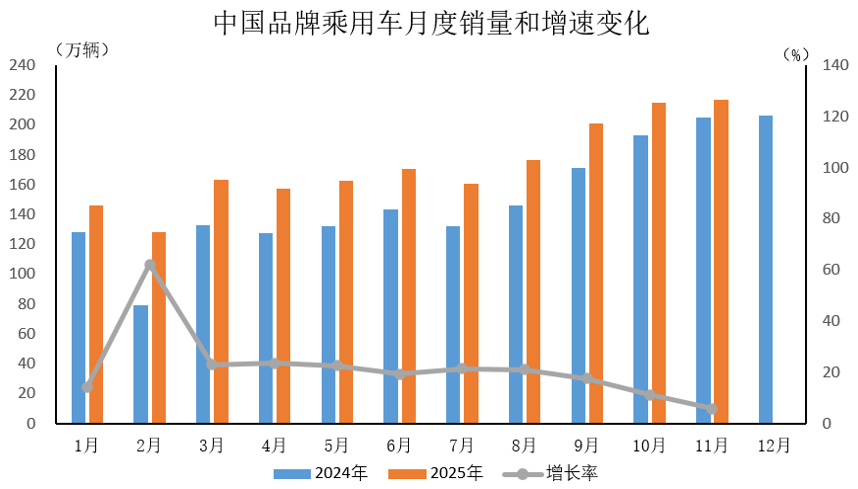
Group 1 - In November 2025, Chinese brand passenger car sales reached 2.169 million units, representing a month-on-month increase of 1% and a year-on-year increase of 5.8% [1] - Chinese brands accounted for 71.4% of total passenger car sales in November 2025, with a market share increase of 3.1 percentage points compared to the same month last year [1] - From January to November 2025, sales of Chinese brand passenger cars totaled 18.978 million units, showing a year-on-year growth of 19.4% and a market share of 69.6%, which is an increase of 4.6 percentage points compared to the same period last year [1]
数据简报 | 2025年11月中国品牌乘用车销售情况简析
中汽协会数据· 2025-12-24 09:07
2025 年 1 - 11 月, 中国品牌乘用车共销售 1897.8 万辆,同比增长 19.4% ,占乘用车销售总量的 69.6% ,销量占 有率比去年同期提升 4.6 个百分点 。 据中国汽车工业协会统计分析 , 2025 年 1 1 月, 中国品牌乘用车共销售 216.9 万辆,环比增长 1% ,同比增长 5.8% ,占乘用车销售总量的 71.4% , 销量 占有率比去年同期提升 3.1 个百分点 。 来源: 中汽协会行业信息部 ...
乘用车板块12月24日跌0.18%,海马汽车领跌,主力资金净流出7.87亿元
Zheng Xing Xing Ye Ri Bao· 2025-12-24 09:03
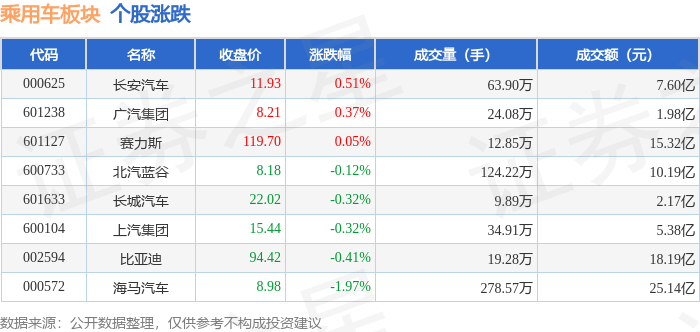
Core Viewpoint - The passenger car sector experienced a slight decline of 0.18% on December 24, with Haima Automobile leading the drop, while the overall stock market indices showed positive movements, with the Shanghai Composite Index rising by 0.53% and the Shenzhen Component Index increasing by 0.88% [1] Group 1: Market Performance - The Shanghai Composite Index closed at 3940.95, up 0.53% [1] - The Shenzhen Component Index closed at 13486.42, up 0.88% [1] - The passenger car sector saw a net outflow of 7.87 billion yuan from main funds, while retail investors contributed a net inflow of 6.13 billion yuan [1] Group 2: Individual Stock Performance - Changan Automobile (000625) closed at 11.93, with a slight increase of 0.51% and a trading volume of 639,000 shares, amounting to 760 million yuan [1] - GAC Group (601238) closed at 8.21, up 0.37%, with a trading volume of 240,800 shares, totaling 198 million yuan [1] - BYD (002594) closed at 94.42, down 0.41%, with a trading volume of 192,800 shares, amounting to 1.819 billion yuan [1] - Haima Automobile (000572) led the decline with a drop of 1.97%, closing at 8.98, with a trading volume of 2.7857 million shares, totaling 2.514 billion yuan [1] Group 3: Fund Flow Analysis - GAC Group saw a main fund net outflow of 2.9128 million yuan, with retail investors contributing a net inflow of 996.65 million yuan [2] - Great Wall Motors (601633) experienced a main fund net outflow of 14.755 million yuan, while retail investors had a net inflow of 1.91547 million yuan [2] - BYD faced a significant main fund net outflow of 199 million yuan, but retail investors contributed a net inflow of 82.7275 million yuan [2]


乘用车板块12月23日跌0.71%,海马汽车领跌,主力资金净流出13.6亿元
Zheng Xing Xing Ye Ri Bao· 2025-12-23 09:01
证券之星消息,12月23日乘用车板块较上一交易日下跌0.71%,海马汽车领跌。当日上证指数报收于 3919.98,上涨0.07%。深证成指报收于13368.99,上涨0.27%。乘用车板块个股涨跌见下表: 以上内容为证券之星据公开信息整理,由AI算法生成(网信算备310104345710301240019号),不构成投资建议。 fund 从资金流向上来看,当日乘用车板块主力资金净流出13.6亿元,游资资金净流入1.76亿元,散户资金净 流入11.83亿元。乘用车板块个股资金流向见下表: ...
