
互联网医疗

Search documents
GEO在医药数字化营销行业的应用及前景
2026-01-20 01:50
Summary of Conference Call Records Industry Overview - The pharmaceutical marketing industry is shifting from traffic competition to value provision, emphasizing full-process empowerment for patients, including chronic disease and health management. Digital marketing investment is expected to grow significantly, reaching 24% by 2025 [1][5][14]. Key Insights and Arguments - **Unique Position of GO in Pharmaceuticals**: GO has a unique position in the pharmaceutical field, where AI models can provide professional consultation but cannot replace the prescription authority of doctors. Pharmaceutical companies may utilize AI models for advertising, with some already experimenting with this approach [1][4]. - **Digital Marketing Metrics**: Advertisers focus on GMV (Gross Merchandise Volume), sales, and ROI (Return on Investment), while brand owners emphasize supply chain value and patient lifecycle value, shifting from CPC (Cost Per Click) to the value of each lead [1][6]. - **Efficiency Improvement through Digitalization**: Medical platforms enhance management efficiency for doctors and patients by providing educational resources, patient management functions, and innovative online payment methods, as well as supporting home services [1][7][8]. - **Major Players**: Key players in digital marketing include large internet healthcare platforms like JD Health and Alibaba Health, which focus on supply chain value and comprehensive patient management rather than just product sales [1][5]. Additional Important Content - **Growth of Digital Marketing**: The scale of digital marketing is expanding, with growth rates projected at 18.7% in 2023, 24% in 2024, and 19%-20% in 2025. The share of GO is expected to increase from 22% in 2023 to 41% in 2025 [1][5]. - **JD Health's New Drug Launch Platform**: JD Health aims to create a new drug launch platform supported by AI laboratories, with new drug launches expected to account for 30% of the overall budget and a gross profit margin of about 10% to 12% [1][17]. - **Impact of New Products**: The recent launch of new products by JD Health and Alibaba Health aims to better serve doctors and hospitals, enhancing data systematization and patient management [1][11][12]. - **Future Growth Trends**: Digital marketing is expected to maintain a strong growth trend over the next three years, with annual growth rates projected to exceed 30% due to changes in operational models that deepen the integration of pharmaceutical companies and major platforms [1][14]. - **Compliance in Content Generation**: JD Health employs a dynamic monitoring system to ensure compliance in generating healthcare content, utilizing blockchain technology to meet regulatory requirements [1][20]. - **Challenges in AI Development**: The development of AI technology in internet healthcare faces challenges, including strict data regulations and the need for real-time updates to AI models due to evolving medical research and treatment methods [1][21]. Competitive Landscape - **Competition with Other Platforms**: JD Health competes with platforms like Doubao and Qianwen, which rely on open interfaces and lack real-time supply chain data. JD Health's advantage lies in its comprehensive data and services [1][18]. - **Flow Doubling Strategy**: JD Health's flow doubling plan has significantly increased user engagement, with average user time rising from 2.1 minutes to 8 minutes and conversion rates improving by 2.5 times [1][22][23]. - **Digital Marketing Profit Margins**: JD Health's digital marketing gross profit margin typically ranges from 50% to 60%, although not all services achieve this level of profitability [1][15][16]. Conclusion - The pharmaceutical digital marketing landscape is evolving rapidly, with significant investments in technology and innovative strategies to enhance patient engagement and operational efficiency. JD Health and Alibaba Health are at the forefront of this transformation, leveraging AI and digital platforms to capture market share and improve service delivery.
阿里健康上线首个自研医学大模型;江中药业证券简称变为华润江中
2 1 Shi Ji Jing Ji Bao Dao· 2026-01-20 00:51
Policy Developments - The State Administration for Market Regulation has approved the national standard for "Classification and Determination of Traditional Chinese Medicine Constitution," which will be implemented from April 1. This standard categorizes nine basic types of TCM constitution and aims to enhance health literacy and optimize health service models [2]. Medical Device Approvals - Opcon Vision's application for the registration of "soft hydrophilic contact lenses" has been accepted by the National Medical Products Administration, currently in the acceptance phase [4]. - Livzon Pharmaceutical announced that its clinical trial application for injectable brexpiprazole microspheres for treating schizophrenia has been accepted by the National Medical Products Administration [5]. Capital Markets - AstraZeneca will acquire the remaining 50% equity of Westman Biotech's GPC3 armored CAR-T therapy in China, with a potential payment of up to $630 million, including upfront and milestone payments [7]. - Aote Biological's controlling shareholder has proposed a share buyback plan using funds from its IPO, with a total amount between RMB 100 million and RMB 200 million [8]. Industry Developments - Alibaba Health has launched its self-developed AI medical model "Hydrogen Ion," which is now in practical application, targeting clinical and research fields. This move complements Alibaba's existing health service strategies [10][11]. - Jiangzhong Pharmaceutical has changed its name to "China Resources Jiangzhong Pharmaceutical Co., Ltd." and will also change its stock abbreviation to "China Resources Jiangzhong," while keeping the stock code unchanged [12]. Shareholder Actions - Liaoning He Eye Hospital Group has received a notice from a major shareholder planning to reduce its stake by up to 3,106,074 shares, representing 1.97% of the total share capital, between February 7 and May 6, 2026 [14].




平安好医生(01833.HK):1月19日南向资金增持314.42万股
Sou Hu Cai Jing· 2026-01-19 20:25
Group 1 - The core point of the article highlights that southbound funds have increased their holdings in Ping An Good Doctor (01833.HK) by 3.1442 million shares on January 19, with a total net increase of 14.5367 million shares over the past five trading days [1] - Over the last 20 trading days, there have been five days of net reductions in holdings by southbound funds, totaling 13.2186 million shares [1] - As of now, southbound funds hold 485 million shares of Ping An Good Doctor, representing 22.41% of the company's total issued ordinary shares [1] Group 2 - Ping An Good Doctor is a company engaged in providing medical and health services through mobile platforms and offline resources [1] - The company operates through two segments: the medical services segment, which includes online consultations, referrals, appointment scheduling, hospitalization arrangements, disease diagnosis, and related sales of pharmaceuticals and medical devices [1] - The health services segment offers a variety of standardized health service packages that integrate services from medical health institutions to meet users' health-related needs, covering areas such as physical examinations, elderly care, dental services, anti-aging, and general health [1]


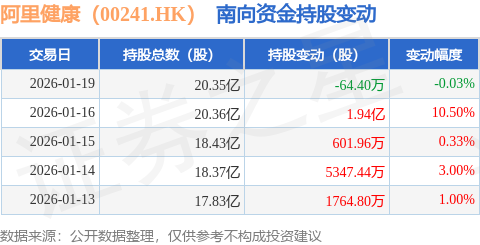
阿里健康(00241.HK):1月19日南向资金减持64.4万股
Sou Hu Cai Jing· 2026-01-19 20:21
Group 1 - The core point of the article highlights the recent trading activity of Southbound funds in Alibaba Health, indicating a slight reduction in holdings on January 19, with a total of 64,400 shares sold, while overall, there has been a net increase of 270 million shares over the past five trading days [1] - Over the last 20 trading days, Southbound funds have increased their holdings in Alibaba Health for 14 days, resulting in a total net increase of 214 million shares [1] - As of now, Southbound funds hold 2.035 billion shares of Alibaba Health, which represents 12.57% of the company's total issued ordinary shares [1] Group 2 - On January 19, the total number of shares held by Southbound funds was 2.035 billion, reflecting a decrease of 64,400 shares, which is a change of -0.03% [2] - On January 16, there was a significant increase of 194 million shares, marking a 10.50% change [2] - The company, Alibaba Health Information Technology Co., Ltd., focuses on providing industrial internet solutions for the healthcare and pharmaceutical industry, operating e-commerce platforms and consumer medical service platforms [2]
医院需要办实事的AI
Sou Hu Cai Jing· 2026-01-19 15:03
Core Viewpoint - The article discusses the ongoing debate in the medical AI sector regarding whether AI can fully replace doctors or simply enhance their capabilities, highlighting the need for practical AI solutions that address real-world challenges in healthcare [2][3]. Group 1: Market Trends and Developments - The Hong Kong stock market has seen a surge in AI medical concepts since the beginning of the year, driven by various initiatives from major companies like Ant Group and Alibaba, which have heightened investor interest in the sector [2]. - A significant debate has emerged in the industry, particularly after Zhang Wenhong, director of the National Center for Infectious Disease Medicine, expressed his refusal to integrate AI into his hospital's electronic medical record system, reigniting discussions on AI's role in healthcare [2]. Group 2: Company Initiatives and Strategies - JD Health has positioned itself on the side of practical solutions, emphasizing the importance of AI that can genuinely alleviate burdens for healthcare providers and improve patient experiences [3][4]. - At the recent "Annual Doctor Ceremony" and "Smart Medical Conference," JD Health introduced "JD Zhuoyi 2.0" for hospitals and the AI tool "Zhi Yi" for doctors, establishing a dual empowerment matrix targeting both healthcare providers and institutions [4][6]. Group 3: AI Application and Solutions - JD Health's CEO, Cao Dong, articulated a focus on three core issues: reducing the workload for healthcare providers, enhancing diagnostic quality, and improving patient experiences through AI [6]. - The company has identified three major pain points in hospitals: clinical nutrition management, medication supply issues, and chronic disease management, which have informed the development of its "JD Zhuoyi 2.0" system [7][9]. Group 4: Specific Solutions Offered - The "JD Zhuoyi 2.0" system addresses clinical nutrition management by providing an AI-driven solution that streamlines the entire process from outpatient to inpatient care, significantly reducing patient hospital visits and improving nutritional management [10]. - For medication services, the system utilizes AI to manage prescription reviews and follow-ups, ensuring compliance and improving the efficiency of medication delivery [12]. - In weight management, the system identifies individuals needing intervention and offers personalized plans, aiming to cover 80% of high-risk patients through digital tracking and support [12]. Group 5: AI Product Development - The "Zhi Yi" product aims to serve as an intelligent assistant for doctors, integrating a vast database of medical literature and guidelines to enhance clinical decision-making and research capabilities [15][16]. - Recent tests have shown that "Zhi Yi" outperformed competitors in confidence levels and coverage of reference materials, addressing concerns about the accuracy of AI in medical applications [16]. Group 6: Long-term Vision and Market Positioning - JD Health's strategy emphasizes long-term investment and compliance, aiming to create a sustainable value proposition rather than chasing short-term gains [22]. - The company adopts a business model that combines free tools for doctors with value-added services and supply chain revenue, fostering a cycle of value creation and revenue sharing [22]. - The overarching goal is to integrate AI into hospital operations effectively, ensuring that it serves as a practical tool rather than an additional burden for healthcare providers [22].

医院需要办实事的AI
虎嗅APP· 2026-01-19 13:53
Core Viewpoint - The article discusses the ongoing debate in the medical AI sector regarding whether AI can fully replace doctors or enhance their capabilities, highlighting the need for practical AI solutions that address real-world challenges in healthcare [2][3]. Group 1: AI in Healthcare Market Trends - The Hong Kong stock market has seen a surge in AI medical concepts since the beginning of the year, driven by significant updates from companies like Ant Group and Alibaba, which have heightened investor interest in the sector [2]. - There is a clear division in the industry, with some companies focusing on consumer-facing solutions while others target operational efficiencies within hospitals [2][3]. Group 2: JD Health's Approach - JD Health has positioned itself on the side of practical solutions, launching "JD Zhaoyi 2.0" aimed at empowering hospitals and doctors through AI tools [4][6]. - The CEO of JD Health emphasized that the focus should be on reducing the burden on healthcare providers, improving diagnostic quality, and enhancing patient experience [6]. Group 3: Identified Pain Points in Healthcare - JD Health's research identified three major challenges in hospitals: inadequate clinical nutrition management, issues with outpatient medication continuity, and difficulties in chronic disease management [9][11]. - The average incidence of nutritional risk among hospitalized patients is reported at 23.3%, with over 50% of cancer patients experiencing malnutrition [11]. Group 4: JD Zhaoyi 2.0 Solutions - JD Zhaoyi 2.0 offers three key solutions: clinical nutrition management, pharmaceutical services, and weight management, creating a comprehensive response to hospital challenges [12][15]. - The clinical nutrition solution aims to streamline processes and reduce costs by utilizing AI to manage patient nutrition from admission to discharge [13]. Group 5: AI Product "Zhi Yi" - The "Zhi Yi" product was introduced to assist doctors by integrating a vast database of medical literature and guidelines, aiming to enhance clinical decision-making and research efficiency [20][21]. - "Zhi Yi" has shown high performance in tests, particularly in confidence levels and coverage of reference materials, addressing concerns about the accuracy of AI in medical applications [21][22]. Group 6: Long-term Strategy and Market Positioning - JD Health's strategy focuses on long-term investment and compliance, aiming to create a sustainable value proposition rather than chasing short-term gains [28][29]. - The company employs a business model that combines free tools for doctors with value-added services and supply chain revenue, fostering a cycle of value creation and revenue sharing [28][29].

巨头竞逐医疗AI 如何重塑行业发展逻辑?
2 1 Shi Ji Jing Ji Bao Dao· 2026-01-19 12:21
Core Insights - Artificial Intelligence (AI) is becoming a core force driving a new round of technological revolution and industrial transformation in the healthcare sector, injecting strong momentum for high-quality development [1] - The medical AI sector is a competitive battleground for internet healthcare companies and technology firms, with significant advancements and product launches occurring [1][2] Company Developments - JD Health launched the "Zhuoyi" 2.0 version, aiming to become a new growth engine for hospitals, having already served over 5 million patients [2][3] - Alibaba Health introduced its first self-developed medical model "Hydrogen Ion," focusing on low hallucination rates and high evidence-based capabilities, now in practical application [3][4] - OpenAI has launched a healthcare version of ChatGPT, which is being deployed in various institutions to enhance patient care [5][4] Industry Trends - The healthcare industry is entering a new phase that demands high quality, efficiency, and sustainability, with AI technology providing new possibilities [2] - The integration of AI in healthcare is shifting patient behavior from single-instance treatment to long-term health management, indicating a transition to continuous healthcare [7][10] - The AI healthcare market in China reached 97.3 billion yuan in 2023 and is projected to grow to 159.8 billion yuan by 2028, marking a shift from conceptual hype to value realization [10] Challenges and Considerations - The successful implementation of AI in healthcare requires addressing data quality issues, regulatory frameworks, and ensuring a balance between technological functionality and humanistic care [8][9] - Companies must collaborate deeply with healthcare institutions to optimize AI models and workflows, creating a mutually beneficial relationship [8][10]
OpenAI及谷歌等巨头齐攻AI医疗,健康 160(2656.HK) 与京东健康(6618.HK)等国内龙头如何打造中国方案
Zhong Jin Zai Xian· 2026-01-19 09:16
Core Insights - The global tech giants are intensifying their efforts in the AI healthcare sector, with Chinese companies adopting pragmatic approaches that are becoming essential [1] - The AI healthcare market in China is experiencing rapid growth, driven by an aging population and a structural imbalance in quality medical resources [7] Group 1: Major Players and Their Strategies - OpenAI's ChatGPT Health focuses on consumer engagement, allowing users to upload medical records for personalized health advice, processing over 230 million health interactions weekly [2] - Google has launched the MedGemma 1.5 model, which operates offline and supports 3D scanning and medical text analysis, with a speech-to-text error rate of only 5.2% [2] - Anthropic targets the enterprise market with Claude for Healthcare, emphasizing privacy and compliance, and has partnered with institutions like Boston Children's Hospital [2] Group 2: Chinese Companies' Developments - Health 160 has connected over 44,800 healthcare institutions and developed an AI health management system that covers the entire patient journey, achieving a content click-through rate increase of 90% [3][4] - JD Health aims to evolve AI from a tool to a core engine for personalized health management, launching the "Zhi Yi" AI for evidence-based medicine [5][6] - JD Health's AI initiatives include a comprehensive health service matrix and specialized systems for cancer treatment, showcasing the potential of AI in personalized medicine [6] Group 3: Market Trends and Challenges - The AI medical device market in China is projected to grow from 292 million yuan in 2020 to 24.2 billion yuan by 2025, highlighting the sector's rapid expansion [7] - The competitive focus in AI healthcare is shifting from utility to stable, compliant, and sustainable implementation, with ecological layouts being crucial for achieving these goals [7] - Challenges include data privacy, ethical standards, and the need for improved data quality and interoperability among healthcare systems [8] Group 4: Future Directions - The future of AI healthcare in China will see a complementary relationship between major players' comprehensive strategies and targeted niche developments [9] - As technology matures, AI models are expected to further empower the healthcare industry, shifting the focus from treatment to proactive health management [9]


AI医疗如何全面赋能健康应用管理
2026-01-19 02:29
摘要 AI 医疗如何全面赋能健康应用管理 20260118 蚂蚁阿福(原产品)通过接入可穿戴设备数据和设定健康小目标等互动 方式,显著提升用户使用频次和访问深度,为后续商业化奠定基础。产 品未来将接入公立医疗机构数据,完善健康服务,并与更多生态伙伴对 接,提高交付质量和安全性。 蚂蚁集团对医疗健康领域投入大量资源,将蚂蚁健康从事业部升级为事 业群,团队规模近千人,其中 400 人与阿福业务紧密相关。集团目标在 2026 年底实现 3 亿注册用户和 8,000 万活跃用户,打造国民级医疗 APP 入口。 蚂蚁阿福计划通过 C 端用户付费(严肃医疗和消费医疗服务,订阅会员 模式)和 B 端收入(保险公司合作,药品销售与生态伙伴合作)实现商 业化,中长期目标(2027-2029 年)是实现 1,000 亿营收和 100 亿利 润。 与保险公司的合作模式包括定制保险产品销售分成、采购健康服务(如 垫付陪诊绿通)以及商保码支付解决方案,通过技术服务费收费,节省 资金成本。 Q&A 蚂蚁阿福的产品发展历程和主要功能有哪些? 蚂蚁阿福于 2025 年 6 月上线,最初名为 AQ,主要提供基于 AI 能力的健康咨 询和健康服 ...
京东健康发布京东卓医2.0
Xin Lang Cai Jing· 2026-01-19 01:31
Core Viewpoint - JD Health has officially launched the 2.0 version of its large model product "JD Zhuoyi," which integrates AI and supply chain capabilities to provide comprehensive management solutions for hospitals [1][3]. Group 1: Product Features - The new JD Zhuoyi 2.0 combines JD Health's "AI + Supply Chain" advantages, creating a system that supports clinical nutrition, outpatient medication, and weight management [1][3]. - The "AI + Clinical Nutrition" feature focuses on nutritional assessment and intervention for inpatients and outpatients, making nutritional treatment traceable and assessable [1][3]. - A "Clinical Nutrition Large Model" developed in collaboration with Wenzhou Medical University and the National Health Commission provides foundational support for the solution, enabling automatic assistance for healthcare personnel in nutrition risk screening, assessment, diagnosis, and personalized treatment plan generation [1][3]. Group 2: AI Applications - The "AI + Pharmacy Management" feature utilizes AI tools for prescription review and smart pharmacist assistance, allowing doctors and pharmacists to focus on high-value diagnosis and academic development [2][4]. - An AI prescription flow platform has been established to manage the entire cycle of prescription review, medication collection, home medication, and follow-up prescriptions, with 24/7 online AI pharmacists available for patient inquiries [2][4]. - The "AI + Weight Management" feature automates standard tasks, allowing professional doctors to concentrate on critical decisions and risk management, balancing scalable services with cost control [2][4]. Group 3: Patient Engagement - The solution integrates hospital medical data with external lifestyle data to create a complete patient profile, using AI to recommend effective weight treatment plans [2][4]. - AI provides instant feedback and emotional support, converting medical advice into daily actionable tasks, enhancing patient compliance through encouragement and guidance after completing dietary, exercise, and weight tracking [2][4].