
厨卫电器

Search documents
厨卫电器板块10月29日跌0.25%,火星人领跌,主力资金净流出901.15万元
Zheng Xing Xing Ye Ri Bao· 2025-10-29 08:34
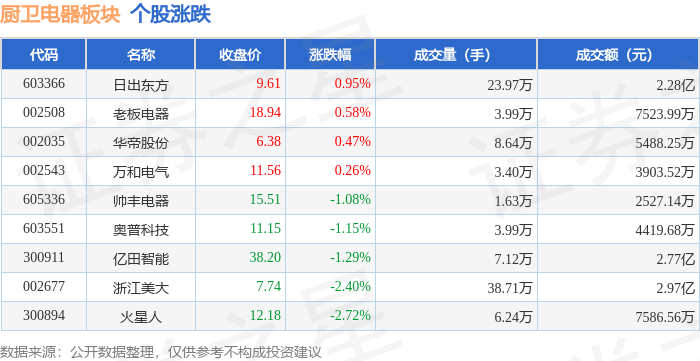
Core Viewpoint - The kitchen and bathroom appliance sector experienced a slight decline of 0.25% on October 29, with Mars Man leading the drop, while the overall Shanghai Composite Index rose by 0.7% [1] Market Performance - The Shanghai Composite Index closed at 4016.33, up 0.7% - The Shenzhen Component Index closed at 13691.38, up 1.95% [1] Individual Stock Performance - Notable stock performances in the kitchen and bathroom appliance sector include: - Sunrise Oriental (603366) closed at 9.61, up 0.95% with a trading volume of 239,700 shares and a turnover of 228 million yuan - Boss Electric (002508) closed at 18.94, up 0.58% with a trading volume of 39,900 shares and a turnover of 75.24 million yuan - Mars Man (300894) closed at 12.18, down 2.72% with a trading volume of 62,400 shares and a turnover of 75.87 million yuan [1] Capital Flow Analysis - The kitchen and bathroom appliance sector saw a net outflow of 9.01 million yuan from institutional investors and 10.39 million yuan from speculative investors, while retail investors had a net inflow of 19.40 million yuan [1] - Detailed capital flow for selected stocks includes: - Sunrise Oriental (603366) had a net inflow of 12.38 million yuan from institutional investors - Mars Man (300894) experienced a net outflow of 5.69 million yuan from institutional investors [2]


收评:沪指涨0.7%创指涨2.9% 能源金属板块强势
Zhong Guo Jing Ji Wang· 2025-10-29 07:21
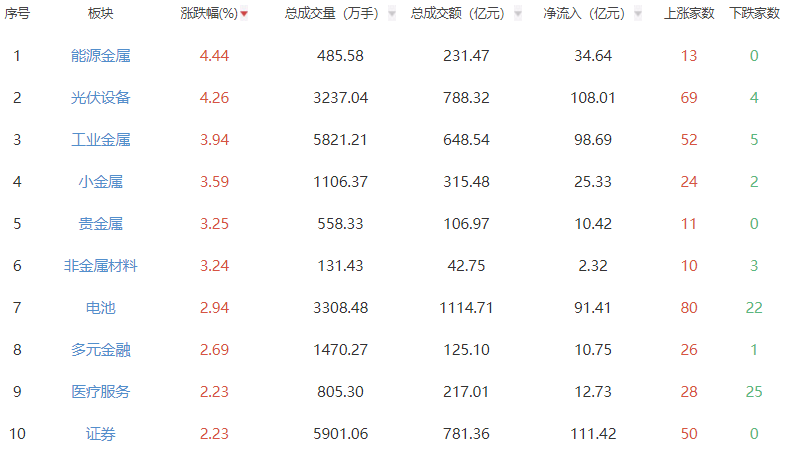
Core Viewpoint - The A-share market showed a strong performance in the afternoon session, with significant increases in major indices and notable sector movements [1]. Market Performance - The Shanghai Composite Index closed at 4016.33 points, up 0.70%, with a trading volume of 968.216 billion yuan - The Shenzhen Component Index closed at 13691.38 points, up 1.95%, with a trading volume of 1287.814 billion yuan - The ChiNext Index closed at 3324.27 points, up 2.93%, with a trading volume of 616.646 billion yuan [1]. Sector Performance - Leading sectors in terms of gains included energy metals, photovoltaic equipment, industrial metals, minor metals, and precious metals - Sectors that experienced declines included banks, film and television, textile manufacturing, kitchen and bathroom appliances, and liquor [1]. A-Share Sector Rankings - The top-performing sectors included: - Hosting and related services: +4.44% with a trading volume of 485.58 million hands and a net inflow of 34.64 billion yuan - Photovoltaic equipment: +4.26% with a trading volume of 3237.04 million hands and a net inflow of 108.01 billion yuan - Industrial-related sectors: +3.94% with a trading volume of 5821.21 million hands and a net inflow of 98.69 billion yuan [2]. - The sectors with the largest declines included: - Banks: -1.81% with a trading volume of 5002.30 million hands and a net outflow of 99.21 billion yuan - Film and television: -0.95% with a trading volume of 592.35 million hands and a net outflow of 2.48 billion yuan - Textile manufacturing: -0.93% with a trading volume of 360.92 million hands and a net outflow of 4.38 billion yuan [2].
火星人(300894):经营承压明显,盈利能力下滑
GOLDEN SUN SECURITIES· 2025-10-29 02:41
Investment Rating - The report maintains a "Buy" investment rating for the company [2][5]. Core Views - The company has experienced significant operational pressure, with a notable decline in profitability. For the first three quarters of 2025, total revenue was 577 million yuan, down 43.03% year-on-year, and the net profit attributable to shareholders was -218 million yuan, a decrease of 1546.12% [1]. - In Q3 2025, the company reported total revenue of 203 million yuan, a year-on-year decline of 35.81%, and a net profit of -95 million yuan, down 265.08% year-on-year [1]. - Despite the decline in revenue, the gross margin improved slightly to 39.44%, an increase of 0.36 percentage points year-on-year [1]. Financial Performance Summary - **Revenue Forecast**: The company is expected to generate revenues of 826 million yuan in 2025, with a year-on-year decline of 40.0%, followed by a slight recovery in 2026 and 2027 [4]. - **Net Profit Forecast**: The projected net profit for 2025 is -155 million yuan, with a significant year-on-year decrease of 1493.8%, but a recovery is anticipated in 2026 and 2027 with profits of 28 million yuan and 30 million yuan, respectively [4]. - **Earnings Per Share (EPS)**: The latest diluted EPS is forecasted to be -0.38 yuan in 2025, with a recovery to 0.07 yuan in 2026 and 2027 [4]. - **Valuation Ratios**: The P/E ratio is projected to be 181.0 in 2026 and 170.4 in 2027, indicating a high valuation relative to earnings [4]. Cash Flow and Financial Health - In Q3 2025, cash received from sales was 199 million yuan, a decrease of 41.87% year-on-year, leading to a negative operating cash flow of -58 million yuan [1]. - The company's financial expenses increased primarily due to the capitalization of bond interest expenses, impacting the overall financial health [1]. Market Context - The company operates in the kitchen and bathroom appliance industry, which is currently facing challenges, contributing to the operational pressures observed [5].
浙江美大(002677):收入持续承压,公司盈利能力下滑
GOLDEN SUN SECURITIES· 2025-10-29 01:03
Investment Rating - The report maintains a "Buy" investment rating for the company [2][5] Core Views - The company has experienced significant revenue decline, with total revenue for Q1-Q3 2025 at 337 million yuan, down 48.52% year-on-year. The net profit attributable to shareholders was 18 million yuan, a decrease of 83.21% year-on-year [1] - In Q3 2025, the company's total revenue was 124 million yuan, down 36.16% year-on-year, and the net profit was 6 million yuan, down 37.91% year-on-year [1] - The gross margin for Q3 2025 decreased by 1.7 percentage points to 39.09% [1] - The company is expected to achieve net profits of 26 million yuan, 32 million yuan, and 35 million yuan for 2025, 2026, and 2027 respectively, reflecting a year-on-year decline of 76.1% in 2025, followed by growth of 23.0% in 2026 and 7.5% in 2027 [2] Financial Summary - For 2025, the company is projected to have total revenue of 483 million yuan, a decrease of 45.0% year-on-year, with a net profit of 26 million yuan [4] - The earnings per share (EPS) for 2025 is estimated at 0.04 yuan, with a projected price-to-earnings (P/E) ratio of 194.5 times [4] - The net asset return rate (ROE) is expected to drop to 1.3% in 2025, with a gradual increase to 2.2% by 2027 [4]

华帝股份(002035):收入承压,盈利质量逆势提升
Tianfeng Securities· 2025-10-29 00:14
Investment Rating - The investment rating for the company is "Buy" with a target price not specified [6][4]. Core Views - The company reported a revenue of 4.16 billion yuan for the first three quarters of 2025, a year-on-year decrease of 9.1%, and a net profit attributable to the parent company of 360 million yuan, down 11.9% year-on-year [1]. - The decline in revenue is attributed to weakening sales in the home appliance market and the impact of reduced national subsidies, particularly affecting the kitchen appliance sector [2]. - Despite the revenue pressure, the company has improved its gross margin to 42.8%, an increase of 2.7 percentage points year-on-year, indicating better profitability through product upgrades and brand strategies [3]. Financial Performance Summary - For 2025, the company expects net profits of 440 million yuan, 530 million yuan, and 600 million yuan for the years 2025, 2026, and 2027 respectively, with corresponding dynamic P/E ratios of 12.2x, 10.2x, and 9.0x [4][5]. - The company’s revenue for 2025 is projected to be 6.02 billion yuan, reflecting a decline of 5.52% compared to 2024 [5]. - The gross margin is expected to improve gradually, reaching 41.69% by 2027 [12]. Market Context - The kitchen appliance industry is currently in a low cycle, influenced by a decline in residential construction area, which fell by 17.1% year-on-year [2]. - The company is focusing on channel management and product innovation to enhance competitiveness and profitability in a challenging market environment [4].

浙江美大(002677.SZ)发布前三季度业绩,归母净利润1789.43万元,同比下降83.21%
智通财经网· 2025-10-28 12:20
Core Viewpoint - Zhejiang Meida (002677.SZ) reported a significant decline in both revenue and net profit for the first three quarters of 2025, indicating potential challenges in its financial performance [1] Financial Performance - The company achieved an operating revenue of 337 million yuan, representing a year-on-year decrease of 48.52% [1] - The net profit attributable to shareholders was 17.89 million yuan, down 83.21% year-on-year [1] - The net profit attributable to shareholders after deducting non-recurring gains and losses was 16.21 million yuan, reflecting a decline of 84.72% year-on-year [1]
奥普科技(603551):Q3业绩略低于预期,盈利能力保持稳健
Shenwan Hongyuan Securities· 2025-10-28 10:44
Investment Rating - The investment rating for the company is maintained at "Outperform" [6] Core Insights - Q3 performance was slightly below expectations, with total revenue for the first three quarters of 2025 at 1.248 billion yuan, a year-on-year decrease of 3.16%, and net profit attributable to shareholders at 184 million yuan, a year-on-year decrease of 1.11% [6] - The company continues to innovate with new product launches, including the "Aopu SMART Intelligent Bathing Heater" and "Aopu Beauty Cabin Bathing Heater," which have received positive market feedback [6] - The company has optimized its distribution channels, expanding both offline and online sales, and has established strategic partnerships in the home decoration sector [6] - The gross profit margin for the first three quarters of 2025 was 43.98%, with a net profit margin of 14.62%, reflecting stable profitability [6] - The company is expected to achieve net profits of 303 million yuan, 320 million yuan, and 337 million yuan for 2025, 2026, and 2027 respectively, with a corresponding PE ratio of 15, 15, and 14 [6] Financial Data and Profit Forecast - Total revenue for 2025 is projected at 1.874 billion yuan, with a year-on-year growth rate of 0.4% [5] - The expected net profit for 2025 is 303 million yuan, with a year-on-year growth rate of 1.7% [5] - The company maintains a high dividend payout ratio, with a current dividend yield of 7.11% [6]

厨卫电器板块10月28日跌0.06%,奥普科技领跌,主力资金净流入8849.98万元
Zheng Xing Xing Ye Ri Bao· 2025-10-28 08:33
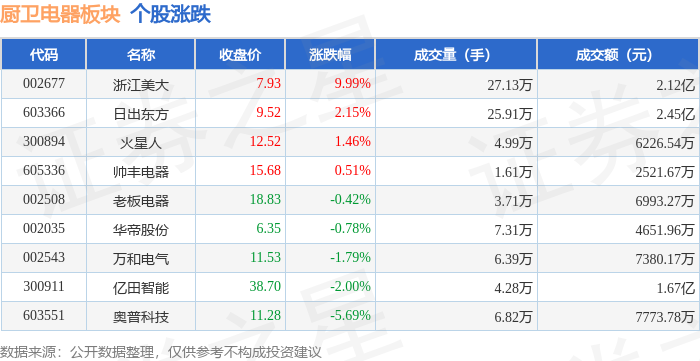
Core Viewpoint - The kitchen and bathroom appliance sector experienced a slight decline of 0.06% on October 28, with Aopu Technology leading the losses. The Shanghai Composite Index closed at 3988.22, down 0.22%, while the Shenzhen Component Index closed at 13430.1, down 0.44% [1]. Group 1: Market Performance - Zhejiang Meida saw the highest increase in the sector, with a closing price of 7.93, up 9.99% and a trading volume of 271,300 shares, amounting to 212 million yuan [1]. - The overall trading volume for the kitchen and bathroom appliance sector was significant, with major stocks like Rishidongfang and Huoxingren also showing positive performance, increasing by 2.15% and 1.46% respectively [1]. - Aopu Technology, however, faced a notable decline, closing at 11.28, down 5.69% with a trading volume of 68,200 shares, totaling 77.73 million yuan [1]. Group 2: Capital Flow - The kitchen and bathroom appliance sector saw a net inflow of 88.5 million yuan from institutional investors, while retail investors experienced a net outflow of 61.83 million yuan [1]. - Zhejiang Meida attracted the most institutional investment, with a net inflow of 86.66 million yuan, accounting for 40.90% of the total [2]. - Aopu Technology had a net outflow of 13.39 million yuan from retail investors, indicating a negative sentiment among smaller investors [2].


浙江美大:2025年前三季度净利润约1789万元
Mei Ri Jing Ji Xin Wen· 2025-10-28 08:24
Group 1 - Zhejiang Meida reported a revenue of approximately 337 million yuan for the first three quarters of 2025, a year-on-year decrease of 48.52% [1] - The net profit attributable to shareholders of the listed company was approximately 17.89 million yuan, a year-on-year decrease of 83.21% [1] - Basic earnings per share were 0.03 yuan, a year-on-year decrease of 82.35% [1] Group 2 - As of the report date, Zhejiang Meida's market capitalization was 5.1 billion yuan [2]
华帝第三季度财报发布!高端转型推动毛利率实现稳健增长
Zhong Jin Zai Xian· 2025-10-28 07:31
Core Insights - The company reported a total revenue of 4.158 billion yuan and a net profit of 356 million yuan for the first three quarters of 2025, with a gross margin of 43.29% [1] - Despite intense competition in the domestic kitchen and bathroom appliance sector, the company's gross margin improved by 2.79 percentage points year-on-year, indicating a robust performance [1] - The company has successfully optimized its product structure, leading to a year-on-year increase in gross margin, demonstrating the sustainability of its value enhancement strategy [1] Company Strategy - The company has focused on upgrading kitchen experience standards with products like the GW6i beauty gas water heater and VB50 micro-steaming oven, accumulating a total of 4,690 patents by June this year [2] - High-end products are becoming a new growth driver for the company, enhancing its brand image among consumers [2] - The company aims to deepen its high-end transformation strategy through technological innovation and product upgrades, emphasizing a "fashionable scientific brand" positioning to uncover deeper user value [2] Market Context - The kitchen appliance market faces challenges such as real estate regulation and recovering consumer confidence, yet the company's third-quarter report sends a positive signal about its high-end transformation strategy [2] - The company's focus on user-centric approaches and technology as a support system is seen as a way to seek stable and sustainable growth amid market fluctuations [2]