
粮食种植

Search documents
探寻新时代发展足迹|中国人的饭碗应该主要装中国粮
Zhong Guo Xin Wen Wang· 2025-12-25 00:48
作为全国粮食主产区之一,2025年,湖南围绕打造更高水平"洞庭粮仓"发力,克服多种不利因素,通过 科技赋能、设施完善等举措,促进粮食生产高产再高产。三湘大地的每一寸耕土、每一粒稻穗,都在书 写着"中国人的饭碗装中国粮"的生动答卷。(徐志雄 张雪盈 龚顺) 2024年3月,习近平总书记来到湖南省常德市鼎城区谢家铺镇粮食生产万亩综合示范片区,走进水稻田 边,察看秧苗培育和土地翻耕情况,并同种粮大户、农技人员、基层干部和村民亲切交流,详细询问春 耕备耕等情况。总书记强调,我国有14亿多人口,粮食安全必须靠我们自己保证,中国人的饭碗应该主 要装中国粮。 ...
中经评论:粮食增产改写“靠天吃饭”
Jing Ji Ri Bao· 2025-12-25 00:07
Core Insights - China's agricultural resilience has significantly improved, allowing for a stable grain production of over 1.4 trillion jin despite adverse weather conditions this year [1][2][3] Group 1: Grain Production and Management - The strategy of "autumn compensating for summer" has effectively balanced seasonal crop production, with summer grain primarily from winter wheat and autumn grain including rice, corn, and soybeans [1] - This year, 29 out of 31 provinces have reported an increase in grain production, with major producing regions like Inner Mongolia, Liaoning, Jilin, Heilongjiang, and Xinjiang contributing 11.47 billion jin to the national increase [2] Group 2: Infrastructure and Technological Innovation - The modernization of agricultural infrastructure, including over 100 million acres of high-standard farmland, has enhanced the ability to withstand climate shocks [3] - Technological innovations, such as drought-resistant and pest-resistant crop varieties, along with water-saving irrigation techniques, are crucial for improving agricultural climate resilience [3] Group 3: Policy Support and Institutional Innovation - The government has strengthened the grain production support policy system, including minimum purchase price policies and various subsidies to stabilize farmers' expectations and encourage grain production [3] - A compensation mechanism for major grain-producing regions has been initiated to support local agricultural efforts, enhancing the motivation for grain production [3][4] Group 4: Systematic Approach to Agricultural Resilience - A comprehensive modern grain production system is being developed, focusing on engineering, technology, and institutional frameworks to proactively manage risks and ensure stable grain production [4]
粮食增产改写“靠天吃饭”
Jing Ji Ri Bao· 2025-12-24 22:38
Core Viewpoint - The article emphasizes the significant improvement in China's agricultural climate resilience, demonstrated by the successful increase in autumn grain production to compensate for summer grain losses due to extreme weather events, maintaining a stable total grain output of over 1.4 trillion jin for the year [1][2]. Group 1: Seasonal Complementarity - The strategy of "using autumn to compensate for summer" has been effectively implemented, allowing for seasonal complementarity between summer and autumn grains, primarily winter wheat and various autumn crops like rice, corn, and soybeans [2]. - The government has taken swift actions to expand autumn grain planting areas and improve yields through administrative mobilization, technical guidance, and resource allocation, particularly increasing high-yield corn areas [2]. Group 2: Regional Coordination - Regional collaboration has effectively dispersed the risks of localized crop failures due to disasters, with 29 out of 31 provinces experiencing grain production increases, including major production and consumption areas [3]. - Notably, regions like Inner Mongolia, Liaoning, Jilin, Heilongjiang, and Xinjiang contributed significantly to the national grain increase, with a total of 11.47 billion jin, accounting for nearly 70% of the national increment [3]. Group 3: Agricultural Infrastructure and Technological Innovation - The modernization of agricultural infrastructure, including over 100 million acres of high-standard farmland and improved irrigation facilities, has enhanced the ability to withstand climate shocks [4]. - Technological innovations, such as the development of drought-resistant and disease-resistant crop varieties, along with the promotion of water-saving irrigation and conservation tillage, are crucial for improving climate resilience [4]. Group 4: Policy Guidance and Institutional Innovation - The government has focused on enhancing the grain production support policy system to motivate farmers and main production areas, implementing minimum purchase price policies and various subsidies to stabilize farmers' expectations [4]. - The establishment of compensation mechanisms for main production areas and increased support for grain-producing counties have effectively encouraged local governments to prioritize agricultural production [4]. Group 5: Systematic Approach to Climate Resilience - Enhancing agricultural climate resilience is a systematic project that requires building a modern grain production system based on engineering, technology, and institutional support, transitioning from passive disaster response to proactive risk management [5].
年终话“三农” | 全链条发力 携手护粮安——2025年粮食和重要农产品稳产保供一线观察
Xin Hua She· 2025-12-24 14:07
Core Viewpoint - Food security is a national priority, and efforts are being made to ensure stable production and supply of food and important agricultural products by 2025 [1] Group 1: Agricultural Production - In 2025, China's grain production faced challenges from various natural disasters, yet the total grain output reached a historical high of 14,297.5 billion jin, marking a significant increase from the previous year [2][3] - The national grain yield per mu was 399.1 kg, an increase of 4.4 kg or 1.1% year-on-year, with corn planting area reaching 67.4 million mu, up by 3.3 million mu [3] - The Ministry of Agriculture and Rural Affairs reported that grain production achieved a bumper harvest, ensuring basic self-sufficiency in grains and absolute safety in staple foods [3] Group 2: Storage and Processing - Enhancements in grain storage capabilities are crucial for food security, with the introduction of intelligent control systems in storage facilities to maintain grain quality [5] - The use of advanced technology in grain processing has significantly reduced loss rates, with one company reporting a decrease in wheat breakage from 0.3% to 0.1% [6] Group 3: Waste Reduction and Consumer Awareness - Initiatives to reduce food waste at the consumer level include offering smaller portion sizes in community dining facilities, which helps minimize waste while catering to diverse customer needs [8][9] - The promotion of food-saving concepts and practices in restaurants and households is essential for contributing to overall food security [9]

农业农村部推介泰州姜堰粮食大面积增产成功经验
Zhong Guo Fa Zhan Wang· 2025-12-24 03:24
Core Viewpoint - Jiangyan District in Taizhou, Jiangsu Province has successfully implemented a model for enhancing grain yield through the activation of diverse production factors, focusing on the synergy of "people, land, and technology" to overcome yield bottlenecks and establish a replicable and sustainable path for large-scale grain production [1] Group 1: Agricultural Practices and Innovations - The district has strengthened the protection of arable land in terms of quantity, quality, and ecology, enhancing disaster prevention capabilities and overall grain production levels [3] - High-standard farmland construction has been expanded, achieving over 90% completion rate, transforming fragmented fields into high-yield farmland [3] - A project aimed at improving soil fertility has led to a 3% increase in rice and wheat yields after one year of implementation [3] Group 2: Agricultural Technology and Collaboration - The establishment of integrated agricultural technology demonstration bases in collaboration with local universities and research institutes has accelerated the conversion of agricultural technology achievements, showcasing over 50 new rice and wheat varieties annually [4] - The "Four-in-One" model promotes the application of advanced agricultural technologies, with plans to cover 320,000 acres by 2025, resulting in an average cost reduction of 118 yuan per acre, totaling 37.76 million yuan in savings [5] Group 3: Talent Development and Education - A comprehensive talent development system for the grain industry has been established, including the formation of expert teams for on-site technical guidance to support farmers in increasing production [6] - The "Jiangyan Model" for farmer education focuses on practical training through local schools, enhancing farmers' skills to meet industry demands [6] - A scientific management service system for family farms has been developed, incorporating performance evaluations to optimize resource allocation and improve production efficiency [6]

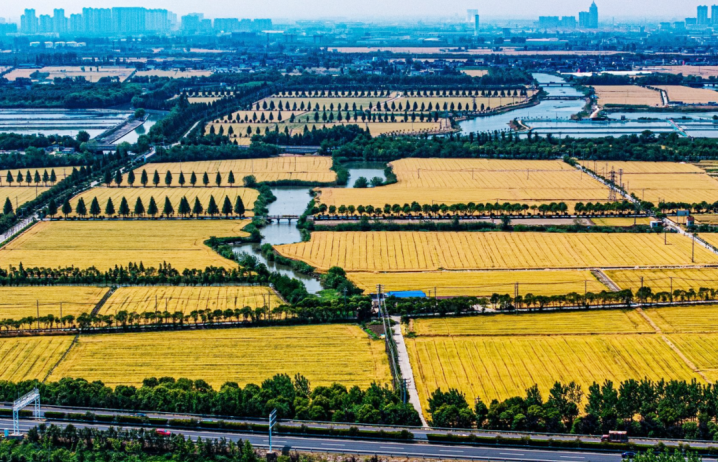
粮食总产量连续三年稳步增长
Xin Lang Cai Jing· 2025-12-22 20:23
Core Insights - The grain production capacity of Huzhu County has significantly improved, with an expected total grain output of over 155,200 tons in 2023, representing a year-on-year increase of 4.25%, marking three consecutive years of steady growth in grain production [1] Group 1: Grain Production and Agricultural Practices - Huzhu County has implemented strict land protection measures to stabilize grain planting areas, maintaining a total crop planting area of 63,500 hectares, including 18,100 hectares of wheat and 11,900 hectares of potatoes [1] - The county has successfully cultivated 672 potato planting cooperatives and established 441 potato storage facilities, enhancing the agricultural infrastructure [1] Group 2: Market Development and Sales Channels - Various sales channels have been developed, including centralized purchasing points and the first potato trading market, effectively addressing the transportation challenges faced by potato producers [1] - Online sales initiatives, such as the "Lifeng Commune" live-streaming sales, have achieved over 100,000 views per video, leveraging cold chain logistics to facilitate the distribution of agricultural products from rural areas to urban markets [1] Group 3: Financial Support and Cultural Integration - Huzhu County has collaborated with financial institutions to launch special support policies, issuing 13 loans totaling 3.74 million yuan for the potato industry, including low-interest loans of 1.28 million yuan [2] - Cultural activities, such as poetry competitions and food auctions, have been organized to enhance the cultural significance of the potato industry, promoting the integration of agriculture with culture, tourism, and commerce [2]
视频丨日本农相“大米言论”引发强烈不满
Yang Shi Xin Wen Ke Hu Duan· 2025-12-22 08:05
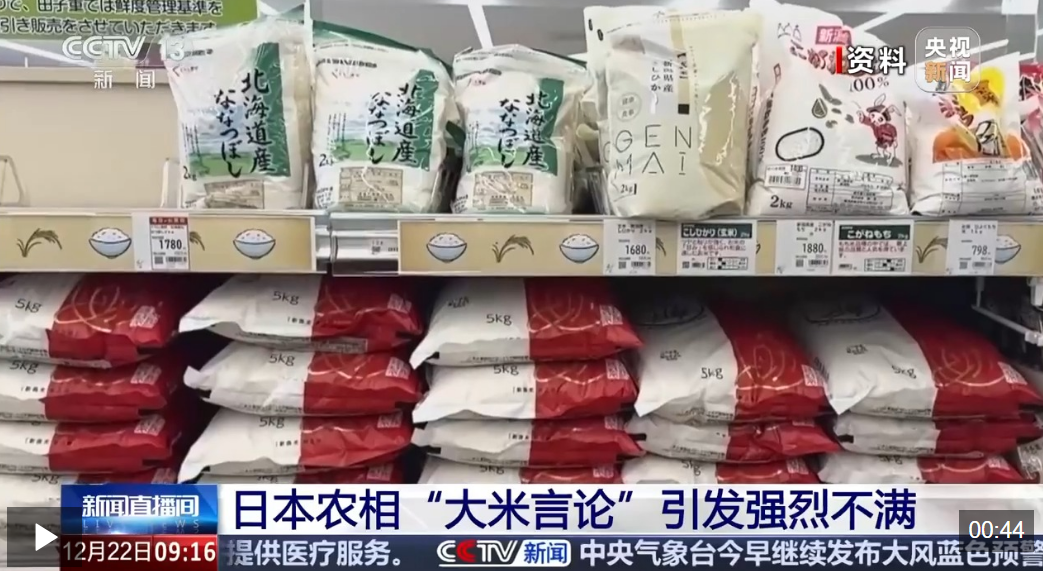
在日本面临大米短缺以及米价居高不下的背景下,日本农林水产大臣铃木宪和19日称,"为了防止米价暴跌,有必要抑制大米生产"。铃木宪和的言 论引发强烈不满,不少日本民众指责铃木宪和为了自己的政治利益,无视普通民众的负担。 据悉,高市早苗政府上台前,石破茂政府为应对大米供应不足和米价高涨,宣布增加大米产量。然而,高市政府后来却大幅度改变政策方向。日本 农林水产省本月表示,计划修改日本"粮食法",将"按需生产"写入法律。 ...
粮食高位增产增添发展底气
Xin Lang Cai Jing· 2025-12-21 22:46
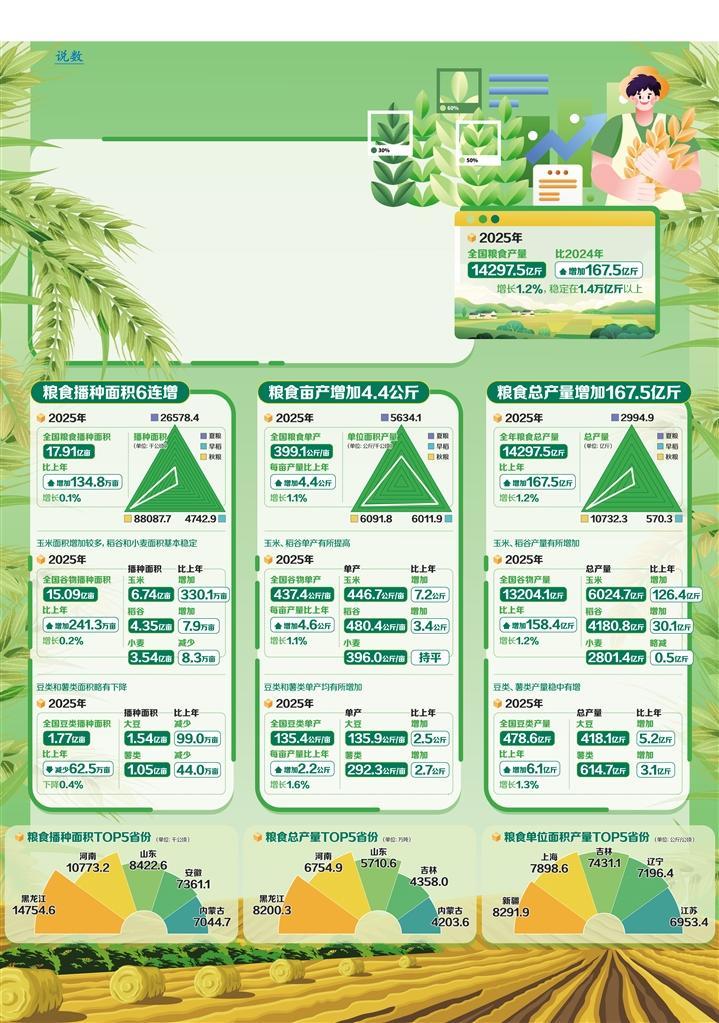
Core Viewpoint - The national grain production in 2025 is projected to reach 14,298 billion jin, marking a 1.2% increase from the previous year, indicating a stable and robust agricultural foundation for China's food security [2][3]. Group 1: Grain Production Overview - The total grain production for 2025 is expected to increase by 167.5 billion jin, maintaining a level above 14 trillion jin [1][2]. - The grain planting area has seen a continuous increase for six consecutive years, with a notable rise in corn acreage while rice and wheat areas remain stable [3][4]. - The average yield per mu (亩) has increased by 4.4 kg compared to the previous year, reflecting improvements in agricultural practices and technology [3][4]. Group 2: Contributing Factors to Grain Production - Government policies have been favorable, including increased minimum purchase prices for wheat and early indica rice, as well as expanded insurance coverage for major grain crops [3][4]. - Local efforts have focused on protecting arable land, optimizing planting structures, and enhancing land quality, which have contributed to improved yields [3][4]. - Favorable weather conditions in major production areas have significantly boosted grain output, with regions like Inner Mongolia, Liaoning, Jilin, and Heilongjiang contributing to nearly 70% of the national increase [3][4]. Group 3: Future Outlook and Challenges - The new benchmark of 14 trillion jin in grain production presents challenges for future stability and growth, necessitating a comprehensive approach to strengthen food security [4]. - Recommendations include increasing investment in agricultural infrastructure, enhancing disaster prevention capabilities, and promoting agricultural technology innovations [4].
优化晒场管理畅通销售渠道
Xin Lang Cai Jing· 2025-12-21 21:43
(姜欣) 连日来,为进一步提高各管理区晒场粮食安全生产意识、抓好余粮销售,北大荒集团青龙山农场多点发 力打好售粮"组合拳",守护粮食安全、促进粮食销售,为种植户粮食变现保驾护航。 农场高度重视粮食安全保管工作,进一步强化粮食保管举措,组织开展晒场安全隐患排查,确保粮食在 恶劣天气条件下安然无恙。各管理区线上、线下多方联系粮食收购企业,帮助种植户切实做好余粮销售 工作。晒场上,各管理区党员干部对储存的粮食进行通风测水,确保粮食存储处于适宜条件,用实际行 动帮助各管理区种植户守护粮食安全。 下一步,青龙山农场将密切关注天气走势和粮食市场行情,引导种植户加快余粮销售变现速度,为明年 生产奠定基础。 (来源:黑龙江日报) 转自:黑龙江日报 ...
2025年我国粮食丰收
Xin Lang Cai Jing· 2025-12-21 05:20
(来源:中国妇女报) 粮食产量是衡量农业生产的重要指标,反映地区农业综合生产能力。2025年,我国粮食丰收态势显著, 国家统计局权威数据显示,全国粮食总产量达71488万吨(14298亿斤),较2024年增加838万吨(168亿 斤),同比增长1.2%,在1.4万亿斤台阶上再创新高。 我国粮食主产区主要分布在东北、华北和长江中下游地区。2025年各省粮食产量数据显示,黑龙江以 8200.3万吨居首,河南6754.9万吨次之,山东5710.6万吨位列第三。 转自:中国妇女报 ...
