机器人

Search documents
机器人变革工业场景创新发展:从工业场景到多领域渗透,轨道交通机器人加速智能化落地
Tou Bao Yan Jiu Yuan· 2026-02-06 12:36
Investment Rating - The report indicates a strong growth potential for the rail transit robot industry, with a projected market size of 8.9 billion CNY in 2024 and expected to exceed 12 billion CNY in 2025, driven by multi-field demand [7]. Core Insights - The rail transit robot market is experiencing rapid growth due to the increasing demand for industrial automation and the replacement of high-risk scenarios. The market is expected to reach 8.9 billion CNY in 2024 and exceed 12 billion CNY in 2025, indicating strong growth momentum [7]. - The industry faces challenges related to technology and cost constraints, with high-end products being expensive and small to medium enterprises struggling to procure them. The competition is focused on creating an ecosystem around "computing power + services" [7]. - Policy support is driving industry standardization, with subsidies and standards expected to accelerate development. By 2027, the localization rate of core components is anticipated to exceed 60%, marking a new growth cycle for rail transit robots [7]. Summary by Sections Industry Definition and Classification - Rail transit robots are automated devices used in the rail transit sector to perform tasks related to rail operations through sensors, actuators, and control systems. They are classified based on application scenarios, functional types, and mobility modes [8]. Core Technologies - The core technologies of rail transit robots include autonomous navigation, computer control, human-machine interaction, sensor perception, and target recognition. These technologies support the intelligent, safe, and reliable operation of rail transit systems [10][12]. Application Areas - Rail transit robots are utilized across various application areas, including construction, manufacturing, operation and maintenance, autonomous driving, and passenger services. They enhance operational safety and efficiency throughout the lifecycle of rail transit systems [17]. Current Application Status - Rail transit robots demonstrate high detection rates and low false positive rates in inspections, significantly improving operational efficiency and safety. They complete a closed-loop process from task assignment to result submission, standardizing and automating inspection work [19][22]. Future Development Trends - The future of rail transit robots is expected to evolve from "individual intelligence" to "group intelligence and data closure," promoting standardized, replicable, and comprehensive value chain penetration. Predictive maintenance and large model diagnostics will be key components of this evolution [25][29].
鸿富瀚(301086):携手立讯精密体系共拓新蓝海 看好新业务驱动价值重塑
Xin Lang Cai Jing· 2026-02-06 12:30
Core Viewpoint - The company has signed a tripartite framework agreement with Guangdong Quanxiang Intelligent Technology Co., Ltd. and Jiangxi Xiexun Intelligent Equipment Co., Ltd., along with a purchase contract worth 480 million yuan, aiming to enhance collaboration in AI servers and robotics [1] Strategic Aspects - The agreement is expected to deepen the binding with major clients and seize opportunities in the AI and robotics sectors [2] - The collaboration with Jiangxi Xiexun, a wholly-owned subsidiary of Luxshare Precision, and Guangdong Quanxiang, a company focused on AGV development, will create a closed loop of "technology R&D + product supply + market promotion," accelerating product iteration and market entry [2] - The partnership is anticipated to strengthen the industry ecosystem and enhance the company's bargaining power within the supply chain, potentially expanding cooperation to other products [2] Market and Business Aspects - The purchase contract of 480 million yuan accounts for approximately 59.68% of the company's projected revenue for 2024, with full delivery expected by the end of 2026, directly contributing to performance growth [3] - The collaboration with Jiangxi Xiexun allows the company to enter the promising markets of AI server hardware supply and robotics, leading to order growth and new opportunities in liquid cooling technology [3] - The company is focusing on liquid cooling solutions, having established partnerships with major domestic and international clients, including ZTE and Meta, positioning liquid cooling as a strategic growth direction [3] Investment Recommendations - The company is actively expanding into AI, robotics, and cooling solutions while maintaining its core business, with the 480 million yuan contract providing revenue certainty in the short term [4] - If the ecological cooperation is executed efficiently, it could open new growth trajectories, leading to revised profit forecasts for 2025-2027, with expected revenues of 1.065 billion, 2.872 billion, and 3.741 billion yuan, reflecting year-on-year growth of 30.0%, 169.7%, and 30.2% respectively [4] - The projected net profits for the same period are 150 million, 455 million, and 682 million yuan, maintaining a "strong buy" rating [4]

大洋电机拟间接投资世航智能 完善机器人产业链战略布局
Zhi Tong Cai Jing· 2026-02-06 12:28
Core Viewpoint - The company, Dayang Motor (002249.SZ), has signed a partnership agreement to invest in Suzhou Shihang Intelligent Technology Co., Ltd., focusing on the robotics industry and enhancing strategic cooperation with quality enterprises in the sector [1] Investment Details - The partnership agreement was signed on February 5, 2026, with Beijing Shanghe Momentum Private Fund Management Co., Ltd. and other limited partners [1] - The target subscription scale of the partnership, Jiaxing Shanghe Hualong Equity Investment Partnership (Limited Partnership), is set at 177 million yuan, with the company contributing 30 million yuan to the fund [1] Company Focus - Suzhou Shihang Intelligent Technology Co., Ltd. specializes in the independent research, production, sales, and service of marine general robots and intelligent unmanned equipment [1] - The core products include marine robots (Whale and OceanX series), surface robots (Tiger Shark series), and key components (Pangu propeller series), catering to various fields such as ship cleaning, marine engineering, offshore photovoltaic, offshore wind power, and marine scientific research [1] Strategic Objectives - The investment aims to further enhance the company's strategic layout in the robotics industry chain and deepen industrial collaboration [1]

大洋电机(002249.SZ)拟间接投资世航智能 完善机器人产业链战略布局
智通财经网· 2026-02-06 12:27
Core Viewpoint - The company, Dayang Electric (002249.SZ), has signed a partnership agreement with Beijing Shanghe Momentum Private Fund Management Co., Ltd. and other limited partners to establish a fund aimed at investing in Suzhou Shihang Intelligent Technology Co., Ltd. [1] Group 1: Investment Details - The target subscription scale of the partnership, Jiaxing Shanghe Hualong Equity Investment Partnership (Limited Partnership), is set at 177 million yuan, with the company contributing 30 million yuan as a limited partner [1] - The investment is intended to enhance the company's strategic layout in the robotics industry and strengthen strategic cooperation with high-quality enterprises in the sector [1] Group 2: Target Company Overview - Suzhou Shihang Intelligent Technology Co., Ltd. focuses on the independent research, production, sales, and service of marine general robots and intelligent unmanned equipment [1] - The core products of Suzhou Shihang include marine robots (Whale and OceanX series), surface robots (Tiger Shark series), and key components (Pangu propeller series), which cater to various fields such as ship cleaning, marine engineering, offshore photovoltaics, offshore wind power, and marine scientific research [1]
行业洞察:从工业场景到多领域渗透,轨道交通机器人加速智能化落地
Tou Bao Yan Jiu Yuan· 2026-02-06 12:24
Investment Rating - The report indicates a strong growth potential for the rail transit robot industry, with a market size expected to reach 8.9 billion CNY in 2024 and exceed 12 billion CNY in 2025, driven by multi-field demand [7]. Core Insights - The rail transit robot market is experiencing rapid growth due to the increasing demand for industrial automation and the replacement of high-risk scenarios. The market is projected to grow significantly, with a strong momentum driven by diverse applications [7]. - The industry faces challenges related to technology and cost constraints, particularly in high-precision algorithms and multi-sensor collaboration, which require advanced computing power. The competition is focused on creating an ecosystem centered around "computing power + services" [7]. - Policy support is expected to accelerate the standardization of the industry, with subsidies and standards anticipated to be introduced by 2027, leading to a significant increase in domestic production rates of core components [7]. Summary by Sections Industry Overview - Rail transit robots are defined as automated devices used in the rail transit sector, equipped with sensors, actuators, and control systems to perform related tasks autonomously [8]. - The classification of rail transit robots includes operational robots for track inspection, station service robots, and maintenance robots for train depots, each serving specific functions in various environments [8]. Core Technologies - The core technologies of rail transit robots encompass autonomous navigation, computer control, human-machine interaction, sensor perception, and target recognition, which collectively support intelligent, safe, and reliable operations [10][12]. - Autonomous navigation ensures safe and efficient operation through high-precision positioning and path planning, while computer control provides precise execution and task scheduling capabilities [12]. Application Areas - Rail transit robots are utilized across various application areas, including construction, manufacturing, maintenance, and passenger services, enhancing operational efficiency and safety [17]. - In construction, robots are employed for track laying and component manufacturing, while in maintenance, inspection robots play a crucial role in ensuring infrastructure safety through intelligent inspections and defect detection [17]. Future Trends - The future of rail transit robots is expected to evolve towards "single-machine intelligence—group intelligence—data closed-loop," facilitating comprehensive application expansion and real-time unified scheduling [25]. - Predictive maintenance and large model diagnostics will be supported by multi-modal data training for fault recognition, enhancing the overall operational efficiency and safety of rail transit systems [25][29].



宇树、银河通用等卡位马年春晚,智元另立舞台
AI研究所· 2026-02-06 11:31
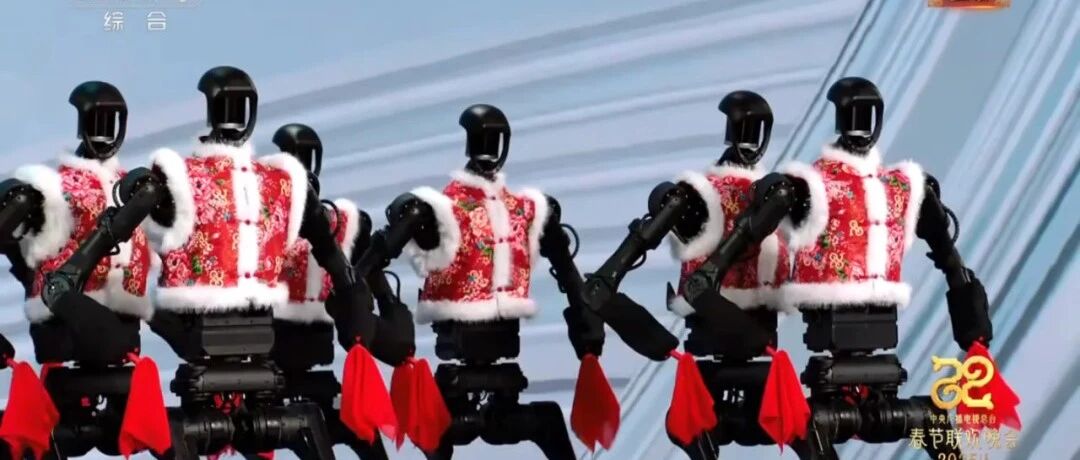
机器人打拳、机械 马奔腾、具身大模型互动, 2026 年马年春晚节目单逐步曝光后,机器人元素的 密集程度创下历史纪录。 据统计,本届春晚共有六家中国机器人企业以不同身份深度参与,涵盖智能机器人战略合作伙伴、指 定具身大模型机器人等类别,覆盖北京主会场与合肥、沈阳两大分会场。 图源企业公众号,来自中新经纬 从媒体报道的亿元赞助费传闻,到企业高管口中的战略卡位,机器人公司对春晚舞台的热情超乎想 象。 这场看似热闹的科技秀背后, 其实 是一场关乎 品牌声量、资本青睐与行业话语权 的激烈角逐。 而在这场春晚盛宴之外,另一种发展路径同样值得关注 —— 以智元机器人为代表的头部企业避开春 晚,转而通过自主举办晚会的方式深耕技术与场景。 一个业内的共识是, 2026 年被视为具身智能产业规模化落地的关键元年 。 现如今, 春晚 会场 内外的两种选择,恰好勾勒出当前中国机器人产业的竞争生态:有人选择站在 国民舞台的聚光灯下抢流量,有人选择埋头实验室与市场一线练内功。 亿元烧钱上春晚: 卡位赛与超级路演 据报道, 2026 年春晚首次采用多企业联盟 + 分层合作的模式,构建起覆盖全技术维度的机器人展 示矩阵,六家本土企业各显神 ...

特斯拉宣布:Model S/X现车上新,是“最后的入手机会”
Xin Lang Cai Jing· 2026-02-06 11:27
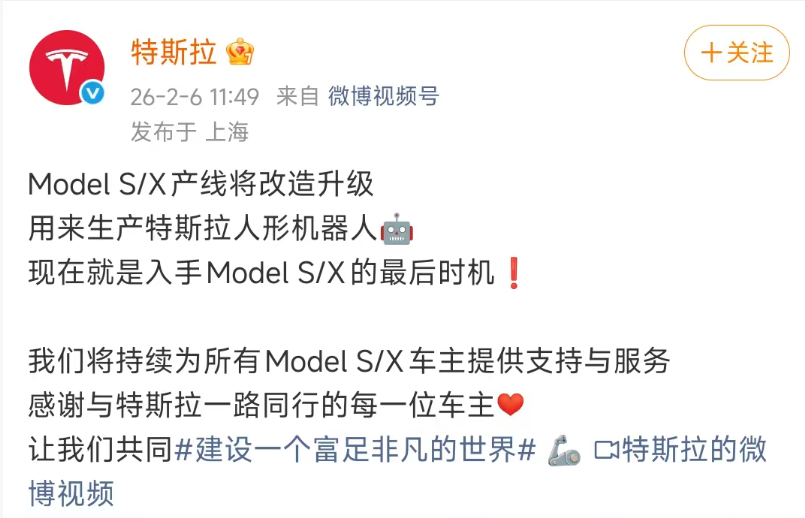
2月6日,特斯拉宣布:Model S/X 现车上新,"最后的入手机会"来了。我们将持续为所有Model S/X车主提供支持与服务,感谢与特斯拉一路同行的每一位 车主。并宣布ModelS/X产线将改造升级,用来生产特斯拉人形机器人。 源:特斯拉官方微博 2月6日,特斯拉宣布:Model S/X 现车上新,"最后的入手机会"来了。我们将持续为所有Model S/X车主提供支持与服务,感谢与特斯拉一路同行的每一位 车主。并宣布ModelS/X产线将改造升级,用来生产特斯拉人形机器人。 此前,特斯拉CEO马斯克在季度财报电话会议上宣布,最后一批 Model S 轿车和 Model X SUV 将在下个季度结束生产。 源:特斯拉官方微博 此前,特斯拉CEO马斯克在季度财报电话会议上宣布,最后一批 Model S 轿车和 Model X SUV 将在下个季度结束生产。 ...

第三届雄安未来之城场景汇首批564项场景需求发布 涵盖9大前沿方向,总投资92.9亿元
Xin Lang Cai Jing· 2026-02-06 11:19
Core Insights - The third Xiong'an Future City Scene Fair has officially released its first batch of scene demands, comprising 564 items across nine cutting-edge areas, with a total investment of 9.29 billion yuan [1][6] Group 1: Scene Demands Overview - The scene demands cover nine key areas: aerospace information, low-altitude transportation, robotics, healthcare, smart agriculture, safety and emergency, green energy, smart cities, and artificial intelligence [1][6] - A total of over 1,700 scene demands were collected within two months, with 564 selected after thorough communication and careful screening [1][6] Group 2: Investment Breakdown - Aerospace information has 41 demands with an investment of 1.06 billion yuan, including satellite communication and navigation services [1][6] - Low-altitude transportation has 55 demands with an investment of 750 million yuan, focusing on ecological monitoring and drone management [1][6] - Robotics includes 69 demands with an investment of 400 million yuan, covering industrial and service robots [2][7] - Healthcare has 37 demands with an investment of 220 million yuan, focusing on health data applications and smart hospitals [3][8] - Smart agriculture has 61 demands with an investment of 870 million yuan, including intelligent harvesting and agricultural management systems [3][8] - Safety and emergency has 62 demands with an investment of 390 million yuan, addressing urban safety and disaster response [3][8] - Green energy has 59 demands with an investment of 2.52 billion yuan, focusing on smart operations and energy efficiency [3][8] - Smart cities have 68 demands with an investment of 960 million yuan, covering urban management and logistics [3][8] - Artificial intelligence has 112 demands with an investment of 2.12 billion yuan, focusing on various applications in industry and public services [3][8] Group 3: Future Events and Initiatives - The third Scene Fair will host 12 preliminary competitions from April to June, aiming to attract advanced enterprises and innovative teams [4][9] - The organizing committee will facilitate supply-demand matching and enhance the experience center for better showcasing and trading [4][9] - A multi-channel financing mechanism will be explored to support scene innovation, along with the development of standards and typical cases for broader replication [4][9]
机器人板块小幅回调显韧性,机器人ETF易方达(159530)本周连续获资金布局
Sou Hu Cai Jing· 2026-02-06 11:13
Group 1: Market Overview - The technology sector experienced a collective pullback this week, with the robotics sector showing a narrower decline, as the National Robotics Industry Index fell by 0.2%, the China Securities Intelligent Electric Vehicle Index decreased by 0.7%, the China Securities Internet of Things Theme Index dropped by 5.6%, and the China Securities Consumer Electronics Theme Index declined by 6.1% [1] - The E Fund Robotics ETF (159530) saw a continuous net inflow of funds totaling 340 million yuan over the first four trading days of the week, with an additional net subscription of 74 million yuan today [1] Group 2: Future Market Expectations - According to CITIC Securities, the global liquidity easing trend is expected to deepen by 2026, with ongoing policy benefits in the domestic financial market, enhancing the motivation for individual investors to enter the market, which may lead to an increase in incremental funds in the A-share market [1] - The core logic supporting the bull market is anticipated to continue or even strengthen, with projections indicating that the market size for embodied intelligence could exceed one trillion yuan in the long term, shifting focus from thematic investment to production expectations in the humanoid robotics sector [1] Group 3: Sector-Specific Insights - The China Securities Intelligent Electric Vehicle Index focuses on smart electric vehicles, which are expected to become a representative direction for embodied intelligence, covering various segments of the industry chain including power systems, perception systems, decision-making systems, execution systems, communication systems, and vehicle production [3] - The China Securities Consumer Electronics Theme Index centers on AI hardware, which is currently the main category of smart terminal products, comprising stocks of companies involved in component production and complete machine brand design and manufacturing [4] - The China Securities Internet of Things Theme Index emphasizes the Internet of Things as a crucial foundation for achieving connectivity among smart terminals, including stocks of companies engaged in information collection, transmission, and IoT applications [5]


马斯克又“造梦” 没人会记得特斯拉曾造过车
Sou Hu Cai Jing· 2026-02-06 11:04
特斯拉"汽车人"变身"机器人" | 图源:豆包AI 作者/ IT时报 林斐 编辑/ 王昕 孙妍 首先,Optimus机器人面临技术与供应链的双重瓶颈,量产难度远超预期。Optimus机器人拥有全新的供应链体系,与特斯拉现有汽车供 应链几乎无重叠,这意味着特斯拉需要重新搭建机器人核心供应链,而核心零部件的产能与可靠性成为关键制约因素。Optimus机器人集 成的14个直线关节,其核心部件"行星滚柱丝杠"精度要求极高,误差需控制在±6微米以内,目前全球可稳定量产该部件的供应商数量有 限,且该关节使用寿命仅约1年,远未达到工业应用所需的5年以上标准。 同时,Optimus机器人灵巧手的研发也面临困境,早期采用的全腱绳驱动方案暴露出握力不足、材料易损耗等问题,后续转向"肌腱+连 杆"混合驱动方案后,又出现结构复杂、制造成本攀升的新问题,当前试产期单台成本高达4万~5万美元,远超2万美元以下的量产成本 目标。从此前的量产实践来看,2025年特斯拉计划量产5000台Optimus机器人,实际产出仅数百台,完成率仅10%,年产100万台的目标 仍存在很大不确定性。 其次,Optimus机器人的技术可行性遭到业界专家质疑,麻 ...