
智能手机

Search documents
机器人+AI!荣耀,大动作
中国基金报· 2025-10-16 04:11
Core Viewpoint - Honor has launched its first "self-evolving" AI-native smartphone, the Honor Magic8 series, along with the new MagicOS 10, aiming to redefine user interaction and experience through continuous evolution of its AI capabilities [2][4]. Group 1: Self-Evolution Capability - The "self-evolution" capability is positioned as a core differentiator for Honor's products, with the YOYO AI agent designed to provide increasingly personalized services through continuous learning [5][6]. - Unlike traditional AI assistants that reach a performance ceiling at launch, the YOYO AI agent is expected to grow in its capabilities, supporting over 3,000 scenarios as of now, up from just over 200 in July [6][7]. Group 2: Future Product Development - Honor's future product roadmap includes the development of a robot phone, with plans to unveil more details at the 2026 Mobile World Congress in Barcelona [9][10]. - The company aims to transition from a smartphone manufacturer to a leading global AI terminal ecosystem company, emphasizing the importance of creating significant value in the future terminal market [12].


CounterPoint报告:2025年第三季度全球智能手机出货量同比增4%
Huan Qiu Wang Zi Xun· 2025-10-16 03:44
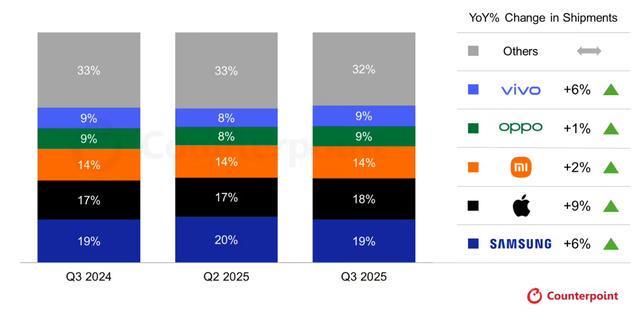
Core Insights - The global smartphone market is projected to see a 4% year-on-year increase in shipment volume by Q3 2025, driven primarily by strong performances in the Asia-Pacific (APAC) and Middle East and Africa (MEA) regions [1][3] Regional Performance - The MEA region experienced a 14% year-on-year increase in shipment volume, attributed to strong market performance from Samsung and Xiaomi, supported by a wide range of mid-range products and increased consumer demand during the back-to-school season and pre-holiday inventory buildup [1] - The Indian market also showed a notable 9% year-on-year growth in shipment volume, driven by early demand for the festive season, government relief measures boosting consumer confidence, and accelerated adoption of high-end and mid-range devices due to significant discounts and promotional support [1] Brand Competition Landscape - Samsung maintained its leadership in the global market with a 19% shipment volume share in Q3, reflecting a 6% year-on-year growth, supported by the Galaxy A series product line [3] - Apple emerged as the fastest-growing brand among the top five, with a 9% year-on-year growth rate, achieving strong growth in Japan, China, Western Europe, and parts of the APAC region, bolstered by the successful launch of the iPhone 17 series [3] - Xiaomi held the third position globally with a 14% shipment volume share and a 2% year-on-year growth rate, enhancing its market presence through partnerships with carriers and diverse promotional activities, particularly in Southeast Asia, MEA, and Latin America [3] - OPPO and vivo ranked fourth and fifth in the global smartphone market, with OPPO achieving moderate growth in the Southeast Asia and MEA markets through affordable 5G models, while vivo maintained strong momentum in India and Southeast Asia, expanding its influence in the MEA region [3]
小米集团-W再跌超3% 机构称小米股价波动受多宗新闻热点及市场传闻影响
Zhi Tong Cai Jing· 2025-10-16 03:42
Core Viewpoint - Xiaomi Group's stock has experienced a decline of over 3%, attributed to safety concerns regarding its electric vehicle and a cooling market for its automotive orders [1] Group 1: Stock Performance - Xiaomi Group's stock fell by 3.03%, trading at HKD 47.96, with a trading volume of HKD 5.336 billion [1] Group 2: Safety Concerns - A Xiaomi SU7 vehicle caught fire after a collision in Chengdu, raising public concerns about the safety of electronic door handles [1] Group 3: Market Conditions - Reports indicate that the market for Xiaomi's automotive orders has cooled, with order recovery prices dropping to HKD 2,000, down from a premium of HKD 20,000 two months ago [1] Group 4: Analyst Insights - According to CMB International, Xiaomi's stock price has been volatile due to various news and market rumors, including the Chengdu accident, testing of a third model in Xinjiang, and readiness of a second factory in Beijing [1] - Despite the improved performance of the Xiaomi 17 series compared to the Xiaomi 15, the gross profit margin (GPM) for Xiaomi smartphones is expected to hit a low in the second half of the year, with an estimated GPM of 11% for Q3, down from 11.5% in Q2 [1]

苹果iPhone 18 Pro系列或将首搭可变光圈,立讯精密、舜宇光学参与核心部件供应
Huan Qiu Wang· 2025-10-16 03:27
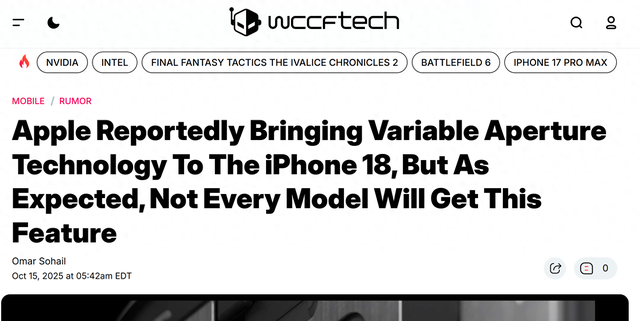
Core Insights - Apple plans to introduce variable aperture lens technology in the iPhone 18 Pro series, set to launch in the fall of 2025, marking a significant technological breakthrough in smartphone imaging [1][3] - The variable aperture will allow for flexible adjustments to real depth of field based on shooting conditions, providing users with a wider variety of photo styles [1][3] Company Developments - Apple has initiated preparations for mass production of related components and lens modules for the iPhone 18 Pro and iPhone 18 Pro Max, with the main camera module being manufactured by LG Innotek and Foxconn [3] - Key components for the variable aperture will be supplied by domestic companies Luxshare Precision and Sunny Optical, showcasing the technological strength of the domestic supply chain in high-end electronic components [3] Industry Trends - In a saturated smartphone market, Apple aims to enhance the photography capabilities of its next-generation models through variable aperture technology, seeking to break the market stalemate with differentiated technological innovation [3] - The current "camera wars" in the smartphone industry are facing technological bottlenecks, and Apple's introduction of variable aperture technology is expected to shift the competition from hardware specifications to functional innovation [3]


荣耀手机背面翻出一个机器人,RobotPhone将MWC亮相
Qi Lu Wan Bao· 2025-10-16 03:26
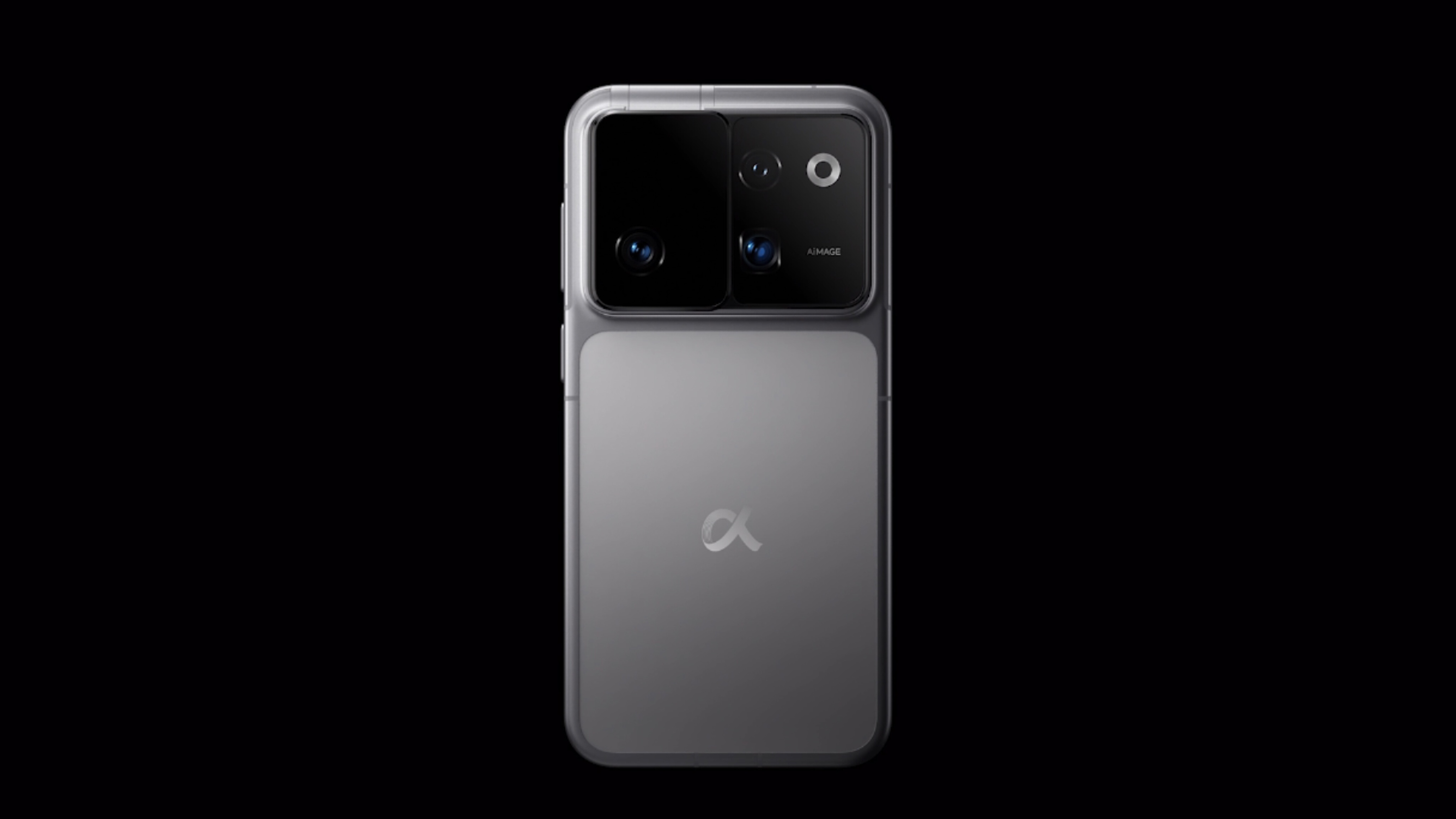
Core Insights - The core focus of the news is the launch of the Magic8 series flagship smartphone and the MagicOS 10 system, alongside the introduction of the AI concept product Robot Phone, which outlines the future of mobile terminals in the industry [1][5]. Group 1: Product Launch - The Magic8 series flagship smartphone and MagicOS 10 system were unveiled at the event held at the Water Cube in Beijing [1]. - MagicOS 10 has received national L3-level intelligent certification and features the YOYO intelligent agent, which integrates deeply into five core user life scenarios [3]. Group 2: AI Technology Advancements - Eight core AI technology breakthroughs were showcased, including a cross-device knowledge base and a multimodal interaction framework, aimed at creating a comprehensive solution ecosystem for daily needs [3]. - A monthly update plan for the system was introduced to facilitate rapid user feedback and product iteration [3]. Group 3: Robot Phone Concept - The Robot Phone is designed with three capabilities: environmental cognitive decision-making, physical interaction execution, and intelligent imaging recording [5]. - It features a retractable gimbal camera structure and is positioned as a technological extension of the Magic8 series, representing the early form of future AI terminal ecosystems [5]. Group 4: Industry Evolution - The CEO of Honor, Li Jian, articulated a transformative product philosophy, indicating a shift from traditional smartphones to AI phones and ultimately to robot phones, emphasizing the need for devices to gain perception and evolutionary capabilities [8]. - Li Jian highlighted that the Robot Phone represents a frontier exploration of terminal forms, aiming to redefine the standards for AI-native devices [8].

新机发售之际,荣耀手机影像专家言论争议不断、引翻车质疑
Guan Cha Zhe Wang· 2025-10-16 03:19
Core Viewpoint - The controversy surrounding Honor's Chief Imaging Engineer, Luo Wei, has escalated due to his inappropriate comments and actions on social media, leading to significant backlash from the photography community and potential reputational damage to the Honor brand [1][10]. Group 1: Controversy and Public Reaction - Luo Wei's comments on social media, particularly regarding the capabilities of the Honor Magic8 Pro, have drawn criticism from users who question his photography skills [2][3]. - The backlash intensified when Luo Wei responded rudely to critics, further alienating users and prompting many to report being blocked by him for voicing concerns [5][7]. - The situation has led to a broader discussion about Honor's acceptance of criticism, with many users mocking the blocking as a "photographer certification badge" [7][10]. Group 2: Product Launch and Market Context - The controversy coincides with the upcoming launch of the Honor Magic8 series, which is expected to feature advanced hardware and imaging capabilities, including a 200MP telephoto lens [17][20]. - Despite the anticipated launch, the negative sentiment surrounding Luo Wei's comments may impact the perception of the Magic8 series, which is crucial for Honor's goal of regaining market share [20]. - Honor's recent market performance has been declining, with a drop in rankings and sales, making the success of the Magic8 series vital for the company's recovery strategy [19][20].

带着2大诉求,库克访华,美媒点名苹果和特斯拉:“中方很清楚,有能力痛击美企”
Sou Hu Cai Jing· 2025-10-16 03:00
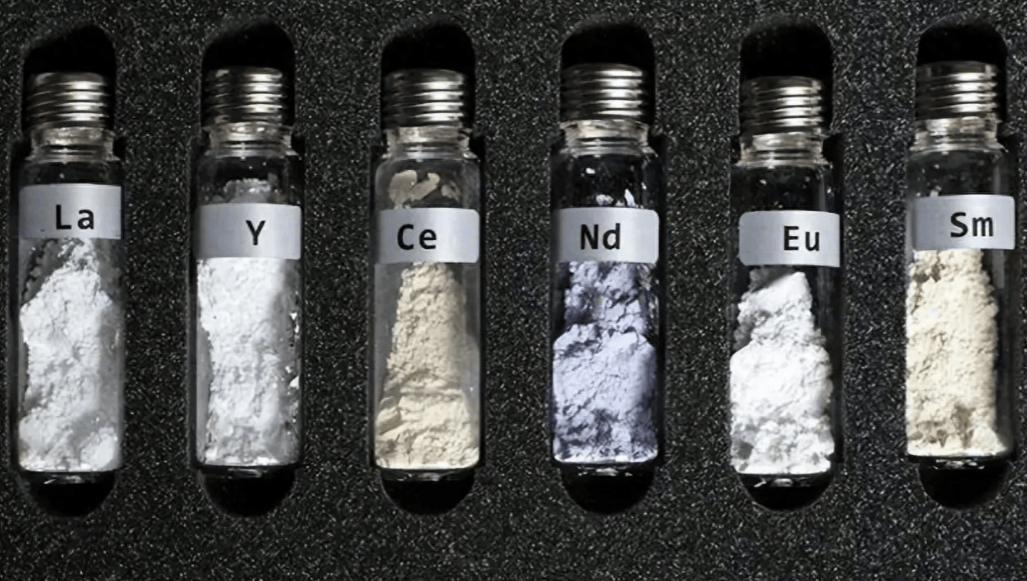
Core Insights - Tim Cook's visit to China aims to promote eSIM technology and enhance Apple's AI projects in the country, amidst rising tensions in US-China relations [1] - China's new rare earth export regulations are seen as a strategic move to assert its influence in the global market and protect its interests [1][3] - The US media expresses concern that these regulations may disrupt the supply chains of American companies like Apple and Tesla, potentially impacting their profitability in China [3][5] Group 1: Rare Earths and Technology - Rare earth metals are crucial for modern high-tech industries, affecting everything from smartphones to military products, making their control vital for economic and national security [3] - China dominates the global rare earth market, controlling the supply of seven key rare earth metals, while the US lacks refining capabilities in this area [3] - The shift in China's role to a "rare earth order manager" enhances its bargaining power in US-China relations, potentially affecting American companies' operations [3][5] Group 2: US-China Relations - The recent changes in China's rare earth policies may compel the US to reassess its approach towards China, especially in light of ongoing technological restrictions [5][6] - The strategic adjustments in the rare earth sector could provide new dimensions for future negotiations between the US and China, particularly on sensitive issues like Taiwan and the South China Sea [5][6] - The evolving dynamics in the rare earth market could lead to a recalibration of the current imbalance in US-China relations, with China leveraging its dominance to influence negotiations [5][6] Group 3: Future Implications - The implementation of new rare earth regulations marks a turning point in US-China relations, reflecting a sophisticated approach to international negotiations by China [6][7] - Companies like Apple need to understand China's strategic intentions and seek cooperation based on mutual benefits to navigate the complexities of US-China competition [6][7] - The trajectory of the global rare earth market will significantly impact both China's development and the technological supremacy of the US, making it a critical variable in future bilateral relations [7]

Counterpoint:全球二手智能手机市场正在转型
Zhi Tong Cai Jing· 2025-10-16 02:48
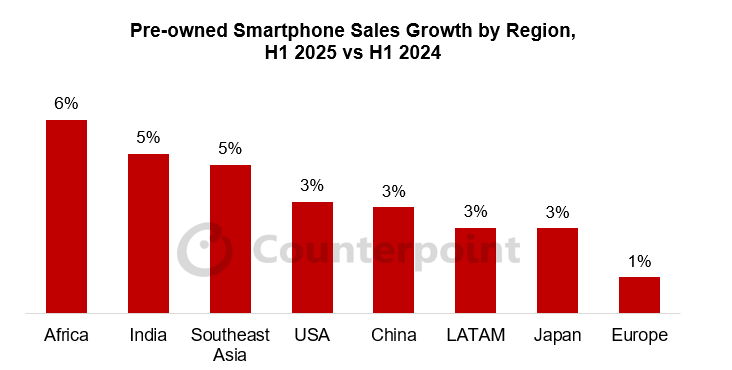
Core Insights - The second-hand smartphone market in mature regions like Europe, the US, and Japan is expected to show flat performance in the first half of 2025, with an average year-on-year growth of about 1% [1] - In contrast, emerging markets such as Africa, India, Southeast Asia, China, and Latin America are projected to remain active, with an average year-on-year growth of approximately 4%, significantly higher than the global average [1] Group 1: Africa Market Insights - The African second-hand smartphone market is anticipated to grow by 6% year-on-year in the first half of 2025, making it the fastest-growing region globally [5] - Factors driving growth include the increasing number of authorized retailers absorbing sales from informal channels and government-led initiatives like "Bridge by Digital Africa" that support local refurbishment ecosystems [5] - The popularity of imported second-hand iPhones is attributed to economic pressures and consumer perceptions of reliability and longevity compared to local new devices [5] Group 2: India Market Insights - The Indian second-hand smartphone market is expected to grow by 5% year-on-year in the first half of 2025, led by Apple [6] - Authorized retailers are accelerating online and offline recycling programs, positioning refurbished high-end models as reliable and cost-effective alternatives [6] - The market demand is shifting towards newer models due to retailer-driven trade-in programs and extended warranty services [6] Group 3: Southeast Asia Market Insights - The Southeast Asian second-hand smartphone market is projected to grow by 5% year-on-year, supported by a large informal channel system and stable inflow of second-hand devices and components from China [9] - C2C transactions driven by online platforms are becoming a significant growth engine for the second-hand market, fueled by improved consumer trust and supply chain enhancements [9] - Apple is leading the market with a 15% year-on-year growth, primarily due to the popularity of iPhone 12 and 13 models [10] Group 4: Mature Markets Insights - Mature markets like the US, Europe, and Japan are experiencing stable performance, with supply constraints and declining exports to emerging markets affecting sales [11] - In the US, market sentiment is volatile, with retailers and OEMs stockpiling components to mitigate potential policy changes [11] - In Japan, the recognition of officially certified second-hand smartphones is increasing, supported by government initiatives promoting transparent pricing [11]
Counterpoint:2025年Q3全球智能手机出货量同比增长4%
智通财经网· 2025-10-16 02:40
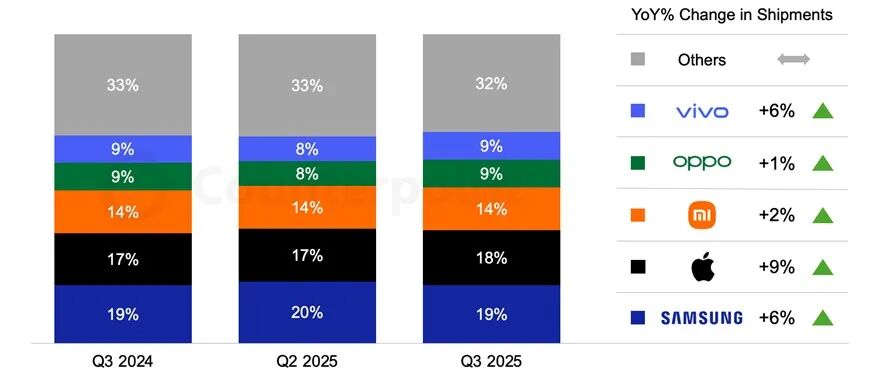
Core Insights - Global smartphone shipments are projected to grow by 4% year-on-year in Q3 2025, driven by strong performances in emerging markets like India, MEA, Japan, and parts of Asia-Pacific, despite declines in mature markets such as North America and Europe [1] Market Performance - Developed markets continue to show strong demand for high-end models, while emerging markets are increasingly favoring affordable 5G devices [1] - The Chinese market is experiencing a slowdown due to inventory reduction strategies, and consumer confidence in Latin America remains weak, leading to moderate overall growth [1] - Japan's smartphone market saw a 15% year-on-year growth, supported by the strong sales of iPhone 16 and iPhone 16e, as well as Samsung's Galaxy S25 series [1] Regional Highlights - The MEA region experienced a 14% year-on-year increase in shipments, primarily driven by strong performances from Samsung and Xiaomi, with Apple leading the high-end segment [1] - In India, smartphone shipments grew by 9% year-on-year, benefiting from early festive season demand, government relief measures improving consumer sentiment, and widespread adoption of high-end and mid-range models due to aggressive discounts and promotions [1] Brand Performance - Samsung led the global market in Q3 2025 with a 19% shipment share and a 6% year-on-year growth, driven by the strong performance of the Galaxy A series and the new Galaxy Z Fold7 [4] - Apple recorded a 9% year-on-year growth, making it the fastest-growing brand among the top five, with significant growth in Japan, China, Western Europe, and parts of Asia-Pacific [4] - Xiaomi maintained a 14% shipment share with a 2% year-on-year growth, particularly strong in Southeast Asia, MEA, and Latin America, benefiting from operator partnerships and promotional activities [4] - OPPO and vivo ranked fourth and fifth globally, with OPPO achieving growth through affordable 5G models in Southeast Asia and MEA, while vivo maintained steady growth in India and Southeast Asia [4] Other Notable Brands - Google saw an 18% year-on-year increase in shipments, with its Pixel 9 series performing well, supported by the integration of AI features and regional expansion strategies [5]

Omdia:第三季度中国智能手机市场同比下降3%,vivo出货量重返第一
Zheng Quan Shi Bao Wang· 2025-10-16 02:30
Core Insights - The Chinese smartphone market is experiencing a year-on-year decline of 3% as of Q3 2025, indicating an ongoing adjustment phase in the industry [1] - The competitive landscape is becoming increasingly tight, with narrowing gaps among leading manufacturers [1] Company Performance - Vivo regained the top position with a shipment of 11.8 million units, capturing an 18% market share [1] - Huawei ranked second with a shipment of 10.5 million units, holding a 16% market share [1] - Apple continued its upward trend with a shipment of 10.1 million units, moving up two positions compared to the same period last year [1] - Xiaomi shipped 10 million units, placing fourth, while OPPO followed closely with 9.9 million units, ranking fifth [1]