
磷化工

Search documents
磷石膏治理迈向向产消动态平衡
Zhong Guo Hua Gong Bao· 2026-01-23 06:13
Core Insights - The report by the Ministry of Ecology and Environment highlights the progress in the management of phosphogypsum, indicating a shift towards a dynamic balance in production and consumption [1] Group 1: Phosphogypsum Production and Utilization - In 2024, China is expected to produce 86 million tons of phosphogypsum, with 70% concentrated in Hubei, Yunnan, and Guizhou [1] - Hubei's phosphogypsum utilization rate reached 69.53%, an increase of 2.2% year-on-year [2] - Guizhou's capital, Guiyang, achieved a phosphogypsum utilization rate of 81.42%, exceeding the provincial target by 1.32 percentage points [2] Group 2: Company Initiatives - Guizhou Phosphate Group has transitioned from "reduction and harmless treatment" to "high-value and large-scale" utilization, achieving a phosphogypsum utilization rate of 78.62% at its Guizhou base in 2024 [2] - The company is also working on phosphogypsum disposal at its bases outside the province, with the Dazhou base in Sichuan achieving production-consumption balance through construction material utilization [2] Group 3: Recommendations for Further Progress - The report suggests promoting phosphogypsum building materials through policies, funding, standards, and application scenarios, including national promotion policies and financial support for application projects [3] - It recommends that the government support the use of modified phosphogypsum in various environmental applications and provide policy support for land and forestry procedures [3] - Guizhou Phosphate Group plans to focus on phosphogypsum storage management, harmless treatment, large-scale utilization, and clean production, targeting new building materials and high-value applications [3]
拐点已至!板块迅速起飞
Sou Hu Cai Jing· 2026-01-22 10:51
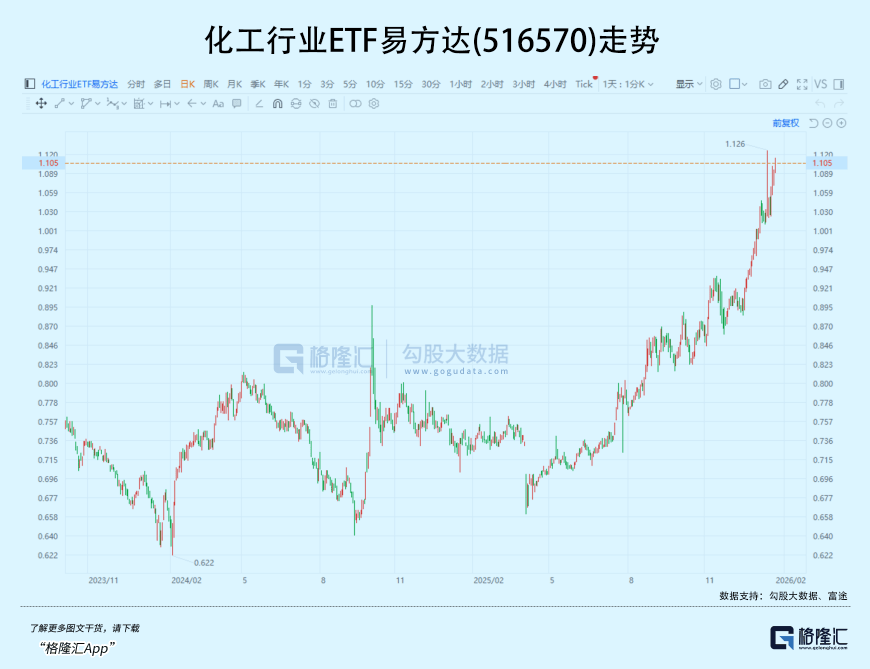
Group 1 - The A-share market experienced a collective rise, with the Shanghai Composite Index increasing by 0.14%, the Shenzhen Component Index by 0.5%, and the ChiNext Index by 1.01% [1] - The oil and petrochemical sector saw a rapid increase, with significant gains from the "three major oil companies," which boosted the chemical industry ETF E Fund (516570) by 1.92% [1] - Brent crude oil prices rose to $64.92 per barrel, up 5.85% from the beginning of the month [3] Group 2 - The chemical sector's strength is not solely attributed to oil price fluctuations; 2024 may be an optimal time for investors to position themselves in this sector [4] - The E Fund chemical industry ETF has surged over 24% in the last 25 trading days, reaching a new high since 2022, with net inflows exceeding 127 million yuan in the past 20 trading days [5] - The chemical industry has undergone a prolonged capacity digestion period over the past three years, with a significant supply pressure expected to ease by 2025 [8] Group 3 - The inventory cycle is shifting from "passive destocking" to "active restocking," with inventory levels in most segments at historical lows since Q3 2025 [11] - The central government's policy changes aim to prevent "involution-style" competition, establishing new operational principles for the industry [14] - The chemical industry is transitioning from a focus on market share to return-oriented strategies, which is expected to elevate the industry's profit margins [14] Group 4 - The phosphate and fluorine chemical sectors are experiencing a revaluation from "cyclical" to "resource" products, driven by the scarcity of phosphate rock and increasing demand from the lithium iron phosphate battery market [15][17] - The fluorochemical sector is witnessing a shift due to the implementation of third-generation refrigerant quotas, leading to a recovery from previous losses [19] Group 5 - The chemical sector is poised for valuation recovery, with the chemical industry ETF E Fund (516570) currently showing a price-to-earnings ratio of 16.09 and a dividend yield of 2.81% [20] - The overall net profit of the petrochemical industry index is expected to grow by 8.78% in 2026, indicating a stabilization in profitability [22] - The E Fund ETF offers a cost-effective investment option with a low fee structure of 0.2% per year, making it attractive for long-term investors [27] Group 6 - The chemical industry is entering a significant turning point, supported by macroeconomic recovery, stable oil prices, and supply-side reforms [27] - Each segment within the chemical industry is experiencing its unique narrative of "supply-demand rebalancing" and "value re-evaluation," indicating a promising outlook for the sector [27]

拐点已至,板块迅速起飞
Ge Long Hui· 2026-01-22 09:44
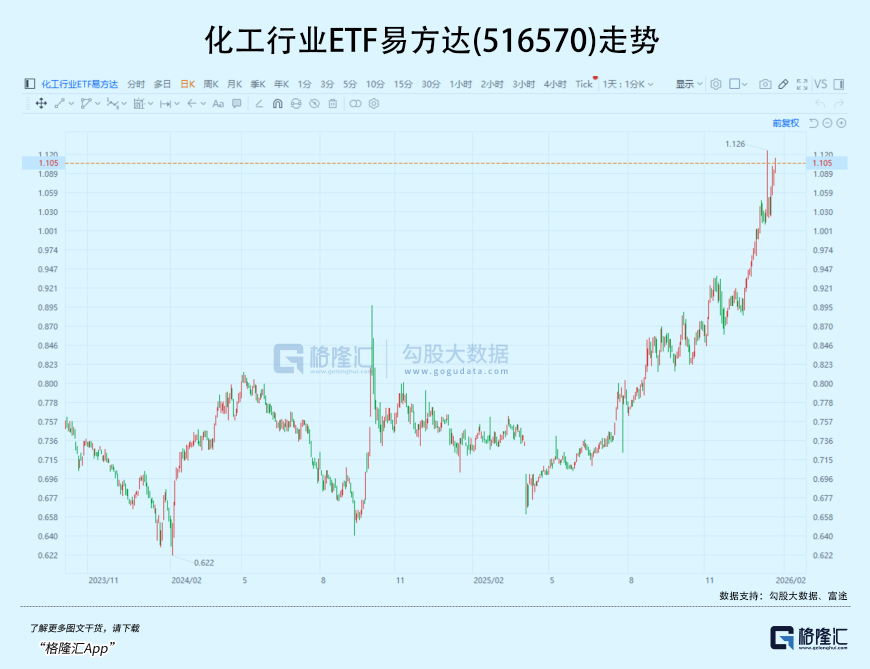
Core Viewpoint - The chemical sector is experiencing a significant turnaround driven by supply-side reforms, demand recovery, and the emergence of new productive forces, indicating a favorable investment environment for 2026 [31]. Group 1: Market Performance - The A-share market saw collective gains, with the Shanghai Composite Index rising by 0.14%, the Shenzhen Component Index by 0.5%, and the ChiNext Index by 1.01% [1]. - The oil and petrochemical sector experienced a rapid increase, with the "three major oil companies" showing significant gains, which in turn boosted the chemical industry ETF E Fund (516570) by 1.92% [1]. Group 2: Oil Price and Demand Forecast - As of January 22, the Brent crude oil benchmark price was $64.92 per barrel, up 5.85% from the beginning of the month [3]. - The International Energy Agency's report predicts that global oil demand will grow by an average of 930,000 barrels per day by 2026, exceeding previous forecasts [3]. Group 3: Chemical Sector Dynamics - The chemical sector has seen a net inflow of funds, with the E Fund ETF rising over 24% in the last 25 trading days, reaching a new high since 2022 [5]. - The industry has transitioned from a prolonged capacity digestion phase, with capital expenditure peaks established, signaling the end of a multi-year expansion cycle [8]. Group 4: Inventory and Consumption Trends - The inventory cycle is shifting from "passive destocking" to "active restocking," with inventory levels in many segments at historical lows due to recovering downstream consumption [11]. - Any minor demand fluctuations could lead to significant price volatility as the industry moves away from high inventory pressures [11]. Group 5: Policy Influence - The central government's policy shift aims to prevent "involutionary" competition, establishing new operational principles for the industry [14]. - The introduction of the "Petrochemical Industry Stabilization Growth Work Plan (2025-2026)" emphasizes strict control over new capacity and scientific regulation to prevent oversupply [14]. Group 6: Investment Opportunities - The chemical sector's valuation recovery is supported by a combination of low valuations and an anticipated earnings rebound, with the chemical industry ETF currently having a PE ratio of 16.09 and a dividend yield of 2.81% [22]. - The overall net profit of the petrochemical industry index is expected to grow by 8.78% in 2026, indicating a stabilization in profitability [24]. Group 7: ETF Advantages - The E Fund chemical industry ETF (516570) offers a cost-effective investment option with a low fee structure of 0.2% per year, significantly lower than similar products [29]. - The ETF's portfolio includes high-growth material leaders and traditional refining giants, providing a balanced strategy to capture both beta and alpha returns [27].
华泰证券:预计黄磷景气有望上行 下游磷酸等亦或受带动
Zheng Quan Shi Bao Wang· 2026-01-22 00:05
Core Viewpoint - The report from Huatai Securities indicates a positive outlook for yellow phosphorus demand driven by the growth in downstream phosphoric acid, terminal new energy cathode materials, electronic-grade phosphoric acid, and fine phosphate demand [1] Supply and Demand Dynamics - Yellow phosphorus demand is expected to improve due to increased demand from downstream applications [1] - The cost competitiveness of thermal phosphoric acid over wet phosphoric acid is becoming more pronounced due to high prices of sulfur and sulfuric acid, which may further boost the demand for thermal process phosphoric acid and yellow phosphorus [1] - On the supply side, domestic production of yellow phosphorus is strictly controlled due to high energy consumption and environmental safety regulations, with only slight increases in capacity through capacity replacement [1] - Under the dual carbon policy, existing high-energy-consuming capacities may face pressure to exit the market, leading to a favorable supply-demand balance for yellow phosphorus [1] Industry Outlook - The expected improvement in yellow phosphorus market conditions may also positively influence the phosphoric acid market [1] - Companies with yellow phosphorus production capacity reserves and integrated leaders in the phosphate-yellow phosphorus-phosphoric acid value chain are likely to benefit from these trends [1]

祥云股份:加速布局磷化工新材料产业链
Zhong Guo Hua Gong Bao· 2026-01-21 07:07
Core Insights - The first phase of the Zhongchem New Xiangyun New Materials Industrial Park has entered trial production, with products like potassium dihydrogen phosphate being sold domestically and internationally, marking a shift towards high-end and specialized applications in various sectors [1] - Xiangyun Co. has established a development strategy focusing on green, technological, digital, and clustered industrial park growth, while expanding into the phosphate chemical industry and related sectors [2] - The company has invested nearly 1 billion yuan in the comprehensive utilization of phosphogypsum, addressing a significant challenge in the phosphate chemical industry [3] Group 1: Project Development - The first phase of the Zhongchem New Xiangyun New Materials Industrial Park is expected to generate annual revenue of 3 billion yuan, with the second phase already in preparatory construction [2] - The second phase will focus on phosphate-based chemicals, fluorine-based new materials, and coal chemical sectors, enhancing the company's competitive edge and supporting its green transformation strategy [4] Group 2: Environmental Initiatives - Xiangyun Co. is implementing a comprehensive utilization plan for phosphogypsum, including partnerships with companies like Huaxin Cement and Xintianhong Building Materials, and aims to increase processing capacity from 3 million tons to 5 million tons annually [3] - The company is developing a closed-loop industrial chain for phosphogypsum, converting it into green building materials through integrated processes [3]
黄磷供需向好且或受益于硫磺高价
HTSC· 2026-01-21 02:50
Investment Rating - The industry investment rating is maintained as "Overweight" [2] Core Viewpoints - The demand for yellow phosphorus is expected to improve due to growth in downstream phosphoric acid and terminal materials for new energy, electronic-grade phosphoric acid, and fine phosphates. The high prices of sulfur and sulfuric acid are enhancing the cost competitiveness of thermal phosphoric acid over wet phosphoric acid, which may further boost the demand for thermal process phosphoric acid and yellow phosphorus [5][6] - The supply of yellow phosphorus is strictly controlled in China due to high energy consumption and environmental safety concerns, with only limited new capacity being added through capacity replacement. The dual carbon policy may lead to the elimination of high-energy-consuming existing capacity, which is expected to optimize the supply side [6][7] - The average operating rate of the domestic yellow phosphorus industry is projected to reach approximately 63% in 2025, the highest level since 2017, driven by favorable supply and demand dynamics. The price of yellow phosphorus is showing an upward trend, with a reference price of around 23,000 yuan per ton as of January 19, 2025, reflecting a 2.4% increase from the end of 2025 [7][5] Summary by Sections Demand and Supply Dynamics - The demand for yellow phosphorus is projected to grow by 26% year-on-year in 2024, reaching 850,000 tons, while phosphoric acid consumption is expected to increase by 19% to 2.96 million tons. The five-year CAGR for yellow phosphorus and phosphoric acid is estimated at 5% and 12%, respectively [5][6] - The high prices of sulfur and sulfuric acid, which have reached nearly a decade high, are expected to drive the demand for thermal phosphoric acid and yellow phosphorus. The cost advantage of thermal phosphoric acid over wet phosphoric acid is becoming more pronounced, especially considering the offset from by-products [5][6] Supply Constraints - The domestic yellow phosphorus capacity has decreased from 1.9 million tons in 2013 to 1.41 million tons in 2020, with a slight recovery to 1.58 million tons by the end of 2025, primarily due to capacity replacement. Only ten companies have a capacity of 50,000 tons or more, indicating a highly concentrated industry [6][39] - The dual carbon policy is expected to continue limiting new supply, with high-energy-consuming and inefficient capacities facing elimination pressure [6][7] Price Trends and Market Outlook - The average operating rate for yellow phosphorus is expected to improve, with a projected increase in monthly operating rates throughout 2025. The price of yellow phosphorus is anticipated to be supported by potential supply disruptions and increasing demand from new energy and electronic chemical sectors [7][5] - Companies with integrated operations in the yellow phosphorus value chain, including mining, yellow phosphorus production, and phosphoric acid, are expected to benefit significantly from the favorable market conditions [5][7]


未知机构:国信石化化工2026核心方向炼油炼化钾肥磷化工氟化工-20260121
未知机构· 2026-01-21 02:15
Summary of Conference Call Records Industry Overview - **Industry Focus**: The records primarily discuss the petrochemical industry, including segments such as refining, potassium fertilizers, phosphorus chemicals, fluorochemicals, MDI, sustainable aviation fuel (SAF), and electronic resins [1][2]. Key Insights and Arguments - **Oil and Gas Market**: - A global interest rate reduction cycle has begun, leading to a moderate recovery in oil demand. - OPEC+ has paused production increases, with a projected Brent oil price range of $60-65 per barrel by 2026, influenced by high fiscal balance prices and the elevated costs of new shale oil wells in the U.S. [1] - Natural gas consumption is expected to reach approximately 450 billion cubic meters by 2026, with a peak domestic consumption forecast of 650-700 billion cubic meters between 2030-2040 [1]. - **Refining and Petrochemical Sector**: - Stable crude oil prices at mid-high levels are expected to restore refining and petrochemical profits, with significant profit contributions from by-products like sulfur [2]. - The "anti-involution" policy signals are anticipated to optimize the supply side of refined oil and PX-PTA industries [2]. - **Potassium Fertilizer Market**: - The global potassium fertilizer industry is characterized by oligopoly and high concentration, with a tight balance between supply and demand, suggesting that prices may remain elevated [2]. - **Phosphorus Chemicals**: - Demand in the energy storage sector is driving significant growth in the demand for iron phosphate and phosphate rock, leading to a revaluation of phosphate rock prices, which are expected to remain high in the medium to long term [2]. - **Fluorochemicals**: - The refrigerant market is experiencing price increases due to supply constraints from quota limitations and high concentration, indicating a prolonged period of price growth [2]. - **MDI and TDI**: - The U.S. interest rate reduction cycle is expected to boost overseas MDI demand, while supply constraints and tariffs are raising global MDI trade costs, with declining raw material costs leading to continuous profit recovery [5]. - **Sustainable Aviation Fuel (SAF)**: - Under a green low-carbon framework, a mandatory 2% SAF blend in Europe by 2025 is likely to drive up bio-jet fuel prices, with potential for similar policies in other regions, suggesting sustained high-speed growth in SAF demand [5]. - **Electronic Resins**: - Electronic resins are critical materials for the production of copper-clad laminates, with increasing demand driven by AI servers and high-end electronic applications, particularly for PPO and ODV resins [6]. Additional Important Insights - **Liquid Cooling Solutions**: - Immersion and dual-phase cooling solutions are expected to drive rapid growth in the demand for upstream fluorinated liquids and refrigerants, highlighting the importance of liquid cooling applications [4]. - **Energy Storage Demand**: - Continuous optimization of the supply-demand relationship for PVDF fluoropolymers is anticipated due to energy storage needs [5]. This summary encapsulates the critical points from the conference call records, providing a comprehensive overview of the discussed industries and their future outlooks.
未知机构:中信新材料芭田股份磷化工涨价核心受益涨价增产业绩弹性7股息率-20260121
未知机构· 2026-01-21 02:15
Summary of Conference Call Records Company Overview - **Company**: 芭田股份 (Batian Co., Ltd.) - **Industry**: Phosphate Chemical Industry - **Core Business**: Integrated operations from phosphate mining to downstream functional fertilizers and phosphate chemicals Key Points and Arguments Financial Performance - In the first three quarters of 2025, the company achieved a net profit attributable to shareholders of **6.87 billion yuan**, representing a **236.13% year-on-year increase** [1] - The company is expected to maintain high profitability due to improved mining efficiency and ongoing expansion projects [1] Supply and Demand Dynamics - Phosphate rock is a non-renewable resource, leading to long-term supply constraints due to resource endowment, environmental approvals, and construction cycles [1] - The company’s **Xiaogaozai phosphate mine** has a resource volume of approximately **63.92 million tons** with an average grade of **26.74%**, providing a strong resource position during the phosphate market upcycle [1] Price Outlook - The demand for fertilizers is a long-term foundation, while emerging sectors like new energy materials provide marginal support for phosphate prices [2] - It is anticipated that phosphate prices will maintain a stable upward trend through **2026**, given limited new production capacity in the industry [2] Production Capacity and Efficiency - The company has a current safety-approved production capacity of **2 million tons per year**, with an expansion plan to **2.9 million tons per year** approved in November 2025 [2] - Daily production is approximately **12,000 tons**, translating to an annualized capacity significantly exceeding theoretical values [2] - Continuous investments in smart mining and technical upgrades are expected to further enhance production and efficiency [2] Cost Structure and Profitability - The company’s comprehensive cost, including taxes, is approximately **400 yuan per ton**, ensuring strong profit margins as phosphate prices remain high [2] - The company utilizes a nitric acid route for its compound fertilizers, which offers a cost advantage over traditional sulfuric acid-dependent methods, especially in the current fertilizer price environment [2] Strategic Goals and Shareholder Returns - The company has established a production capacity of **50,000 tons per year** for iron phosphate in the new energy materials sector, with ongoing production and sales [3] - The profit targets for the company's stock incentive plan for 2025/2026 are set at **1.2 billion yuan** and **1.5 billion yuan**, or sales volumes of **3.5 million tons** and **4.3 million tons**, respectively [3] - The company commits to a dividend payout ratio exceeding **60%**, resulting in a current dividend yield of over **7%**, indicating a favorable investment profile with both safety margins and profit elasticity [3]

东方证券:聚焦化工行业景气修复 主要看好MDI、石化、磷化工、PVC和聚酯瓶片
Zhi Tong Cai Jing· 2026-01-21 01:49
Core Viewpoint - The chemical industry is experiencing a collective shift in business strategies driven by multiple factors, leading to a recovery in industry prosperity [1] Group 1: Industry Trends - The long-standing focus on market share in China's chemical industry is being transformed, with companies now facing increased barriers to entry due to supply-side reforms, environmental checks, and dual carbon goals [1] - Internal policy adjustments and external anti-dumping investigations are signaling a necessary change in the expectations surrounding market share [2] Group 2: Business Strategy Shifts - Companies are moving towards sacrificing existing market share to enhance short-term return rates, as merely halting expansion is no longer sufficient to address inventory and excess capacity [2] - The change in business strategies is primarily driven by shifts in the mindset of entrepreneurs and management, marking a significant departure from previous industry recovery patterns [2] Group 3: Selection Criteria for Investment - The preferred selection criteria for the industry include the strength of expansion constraints and the depth of leading companies' advantages, with stronger constraints leading to lower expectations for market share-driven growth [3] - The depth of leading companies' advantages not only constrains industry expansion but also determines the potential recovery in industry return rates [3] Group 4: Investment Recommendations - Recommended investment opportunities include: - MDI: Wanhua Chemical (600309) - Petrochemicals: Sinopec (600028), Rongsheng Petrochemical (002493), Hengli Petrochemical (600346) - Phosphate Chemicals: Chuanheng Shares (002895), Yuntianhua (600096), Xingfa Group (600141) - PVC: Zhongtai Chemical (002092), Xinjiang Tianye (600075), Chlor-alkali Chemical (600618), Tianyuan Shares (002386) - Polyester Bottle Chips: Wankai New Materials (301216) [4]





从份额向回报,行业预期正迎来重构化工行业的心动时刻
Orient Securities· 2026-01-20 14:42
Core Insights - The chemical industry is undergoing a strategic shift from a focus on market share to profitability, driven by internal policy adjustments and external pressures such as anti-dumping investigations [4][7][11] - The report identifies five key sectors with investment potential: MDI, petrochemicals, phosphate chemicals, PVC, and polyester bottle flakes, emphasizing the importance of leading companies with significant market share and competitive advantages [4][12][55] Group 1: Industry Trends - The chemical industry has historically prioritized market share, but recent policies and market conditions are prompting a shift towards profitability [7][13] - The supply-side reforms and dual carbon goals have raised entry barriers, leading to increased industry concentration without curbing expansion ambitions [7][13] - The trend of sacrificing market share for improved returns is becoming more prevalent, as companies recognize the need to adapt to changing market dynamics [31][11] Group 2: Investment Recommendations - MDI: The leading company, Wanhua Chemical, is expected to benefit significantly from its strategic shift towards profitability, with potential for substantial earnings growth in 2026 [56] - Petrochemicals: Major players like Sinopec and Rongsheng Petrochemical are undergoing operational adjustments that could reshape industry trends [57] - Phosphate Chemicals: The sector is poised for revaluation due to a tight supply-demand balance and increasing recognition of phosphate's value in energy security [59][60] - PVC: The industry faces strong supply constraints, with emerging markets driving demand growth despite domestic challenges [60] - Polyester Bottle Flakes: The sector is experiencing a recovery in profitability due to high industry concentration and strategic production limitations by leading firms [61]