自动驾驶

Search documents
小马智行获纳入恒生综合指数 有望成为港股通标的
Zhi Tong Cai Jing· 2026-02-13 14:41
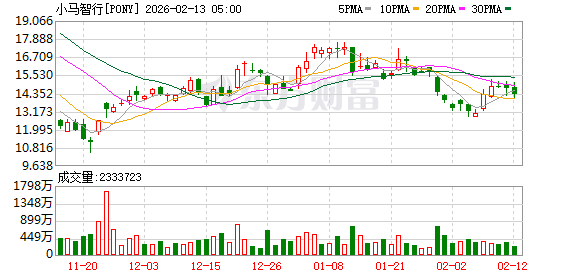
Group 1 - The Hang Seng Index Company announced the quarterly review results for the Hang Seng Index series as of December 31, 2025, with Pony.ai (02026) being included in the Hang Seng Composite Index [1] - The changes will be implemented after the market closes on March 6, 2026, and will take effect on March 9, 2026, leading to adjustments in the eligible stocks for the Hong Kong Stock Connect [1] - According to a report by CICC, Pony.ai is likely to be included in the Hong Kong Stock Connect due to meeting various criteria, including market capitalization, liquidity, and listing duration [1] Group 2 - On February 6, Pony.ai, known as the "first global Robotaxi stock," announced a strategic partnership with Moore Threads (688795.SH), a leading domestic full-function GPU company [1] - The collaboration will focus on the implementation and large-scale application of L4 autonomous driving technology, emphasizing deep cooperation on Pony.ai's core technologies, including the world model and virtual driver system training and optimization [1] - The partnership aims to leverage safe and reliable AI computing power to enhance the iteration of autonomous driving technology and its commercial deployment [1]
小马智行跻身MSCI中国指数 成首家自动驾驶成分股
Nan Fang Du Shi Bao· 2026-02-13 07:40
Core Insights - MSCI China Index has added 37 new constituent stocks, including 4 Hong Kong stocks and 33 A-shares, focusing on sectors like hard technology, semiconductors, digital economy, and strategic resources [1] - Pony.ai is the first and only autonomous driving company included in the MSCI China Index, indicating recognition of its business model and long-term value by international capital markets [1] - The MSCI China Index serves as a key reference for global investment institutions allocating Chinese assets, with over $100 billion tracking the index [1] Company Developments - Pony.ai's founder and CEO, Peng Jun, stated that the Robotaxi industry has entered a new phase of large-scale production and commercialization, with the company achieving dual listings in the US and Hong Kong [2] - The inclusion in the MSCI China Index is expected to enhance communication with global institutional investors and provide more capital support [2] - As of December 31, 2025, Pony.ai's Robotaxi fleet has reached 1,159 vehicles, exceeding its annual deployment target [4] - The company has recently launched its first mass-produced Robotaxi, the Platinum Smart 4X, marking a significant breakthrough in scaling production and operational capabilities [4]

出行经济的全球大航海时代悄然开始
3 6 Ke· 2026-02-13 04:20
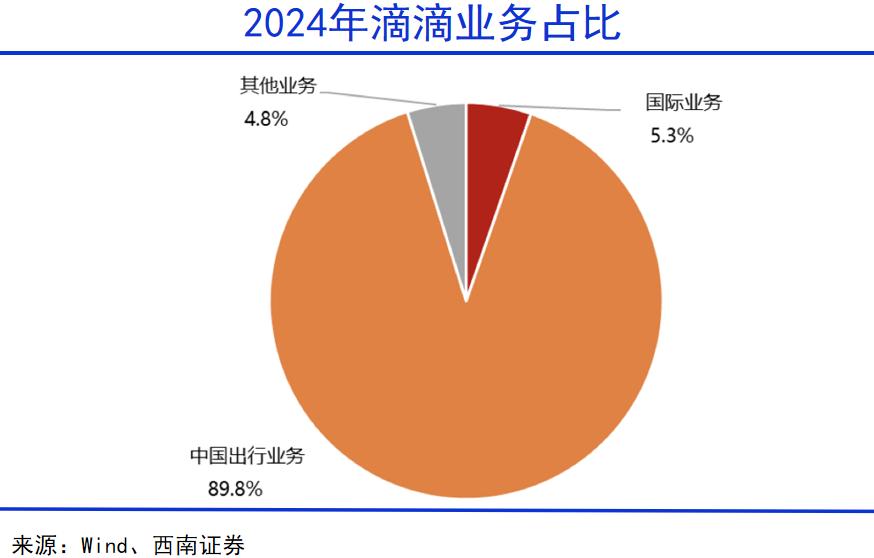
Core Insights - The article discusses the evolution and globalization of the Chinese mobility industry, highlighting key players like Didi and Cao Cao Mobility, and their strategies for international expansion [1][2][5][10]. Group 1: Didi's International Expansion - Didi began its international journey in 2015 by investing in various global ride-hailing platforms, including Grab and Lyft, and later focused on deeper market penetration in Latin America, particularly Brazil [2][5]. - By 2023, Didi had 55 million active users and 1.5 million drivers in Brazil, covering over 3,300 towns, marking a significant achievement in its international strategy [2]. - Didi's international business saw over 20% growth in Q3 2025, with a total order volume of 1.162 billion, indicating its status as a benchmark for Chinese mobility companies going global [8]. Group 2: Cao Cao Mobility's Strategy - Cao Cao Mobility, backed by Geely, achieved a Gross Transaction Value (GTV) of 17 billion yuan in 2024, making it the second-largest ride-hailing platform in China with a market share of 5.4% [9]. - The acquisition of Yao Mobility and Geely Business Travel expanded Cao Cao's service network to 12 international cities, enhancing its global footprint [9]. - Cao Cao's integration with Geely's ecosystem allows for localized operations and shared vehicle development capabilities, positioning it favorably against competitors [9][10]. Group 3: Autonomous Driving Expansion - The autonomous driving sector is a critical extension of the mobility industry, with companies like WeRide and Pony.ai aggressively pursuing global markets [11][16]. - WeRide received approval to operate a fully autonomous Robotaxi service in Abu Dhabi, marking a significant milestone in global autonomous driving commercialization [14][17]. - The competition in the autonomous driving space is intensifying, with companies like Waymo and Tesla also making significant advancements and investments [20][21]. Group 4: New Entrants and Market Dynamics - New players like Hello Mobility are expanding their business models to include two-wheeled and four-wheeled services, supported by Ant Group [21][23]. - The mobility industry in China is projected to reach 8 trillion yuan in 2024, with expectations to grow to 10 trillion yuan by 2029, indicating a robust market potential [21][25]. - The shift towards international markets is also seen in the mapping and location services sector, as companies adapt to new technological trends and consumer demands [24][25]. Group 5: Future Outlook - China's automotive exports reached 7.098 million units in 2025, solidifying its position as the world's largest automotive exporter for the third consecutive year [25]. - The article emphasizes the need for mobility companies to adapt their business models and technologies for international markets, particularly in autonomous driving and ecosystem development [25][26]. - The future of the global mobility economy is expected to be dynamic, with numerous companies vying for market share in an increasingly competitive landscape [26].
【光大研究每日速递】20260213
光大证券研究· 2026-02-12 23:06
Group 1: Macroeconomic Insights - The January non-farm payroll data exceeded expectations, primarily driven by recovery in the private sector, with significant job additions in both production and service sectors, indicating signs of economic stabilization in the U.S. [5] - The improvement in employment aligns with rising trends in U.S. manufacturing and service PMIs, suggesting a positive economic outlook amidst reduced tariff disruptions and the potential for the Federal Reserve to resume interest rate cuts in 2025 [5] Group 2: Utility Sector Developments - The "Document No. 4" outlines the national unified electricity market framework, marking a significant step in China's electricity market reform initiated by the "Document No. 5" in 2002, which emphasized the separation of generation and grid operations [5] - The reforms aim to enhance market mechanisms, including pricing and trading structures, to facilitate a more competitive electricity market [5] Group 3: Company-Specific Analysis - Xidi Intelligent Driving, established in 2017, focuses on autonomous driving technology for commercial vehicles, particularly in mining and logistics, and is one of the first companies in China to achieve regular operations of unmanned mining trucks [5] - Kintor Technology, a leading manufacturer of copper-clad laminates, is projected to see significant profit growth from 2025 to 2027, with net profits expected to reach HKD 21.70 billion, HKD 39.52 billion, and HKD 48.37 billion, reflecting year-on-year growth rates of 64%, 82%, and 22% respectively [7] - NetEase Cloud Music reported a revenue of RMB 77.59 billion for 2025, slightly below expectations, with a year-on-year decline of 2.4%, while adjusted net profit saw a substantial increase of 68.2% to RMB 28.60 billion, largely due to deferred tax asset recognition [7]

文远知行获机构评级,股价波动受关注
Jing Ji Guan Cha Wang· 2026-02-12 21:49
经济观察网近期多家机构对文远知行发布评级,普遍认可其技术优势,但盈利时间表仍是焦点。 机构观点 2026年2月11日,麦格理首次覆盖给予"跑赢大市"评级,目标价港股46港元、美股17.5美元,看好其海 外轻资产模式及中东Robotaxi部署计划。2026年2月10日,中银国际维持"买入"评级,目标价34港元, 预计2025年第四季度收入环比增长超70%,主要受益于Robotaxi业务放量。2026年2月9日,摩根大通重 申"增持"评级,但指出其美股年内跑输相关指数,反映市场对Robotaxi领域竞争的担忧。 近期事件 2026年2月6日,文远知行与Uber宣布升级战略合作,计划于2027年内在中东地区部署至少1,200辆 Robotaxi,覆盖阿布扎比、迪拜和利雅得三大市场,全部接入Uber App提供出行服务。该合作基于现有 运营基础,旨在加速车队扩张和商业化落地。 股票近期走势 文远知行-W股价近期呈现波动。截至2026年2月12日,收盘价20.26港元,单日下跌3.98%,年初至今累 计下跌11.91%。2月9日因合作消息盘中涨超6%,但随后回落,近一周区间涨跌幅为4.59%,成交额显示 流动性较低,反 ...
小马智行纳入MSCI中国指数,与丰田、广汽丰田合作Robotaxi量产下线
Jing Ji Guan Cha Wang· 2026-02-12 21:46
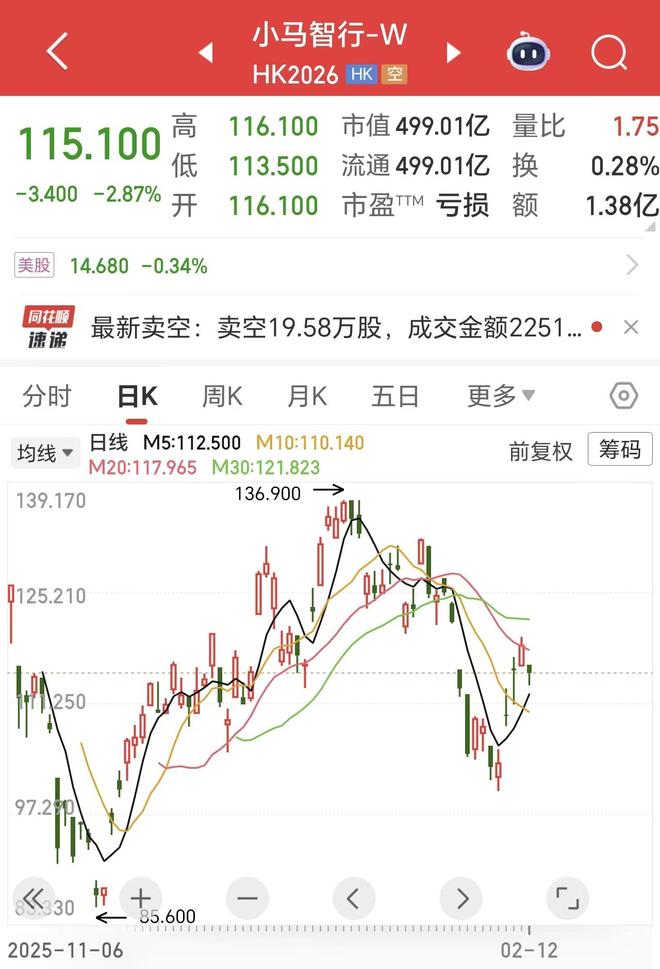
Core Insights - The company Xiaoma Zhixing (stock code: 02026) is currently involved in several significant events, focusing on strategic partnerships, index inclusion, and business progress [1] Group 1: Recent Events - MSCI announced on February 11, 2026, that Xiaoma Zhixing will be included in the MSCI China Index, with the adjustment taking effect after the market close on February 27, 2026 [2] Group 2: Business Progress - On February 6, 2026, Xiaoma Zhixing formed a strategic partnership with domestic GPU company Moore Threads to advance L4-level autonomous driving world model training and simulation, utilizing the MTT S5000 intelligent computing card and "Kuaguo" cluster for the first large-scale application of domestic AI computing power in critical areas [3] - On February 9, 2026, the first mass-produced Platinum 4X Robotaxi, a result of collaboration with Toyota China and GAC Toyota, officially rolled off the production line, marking the transition of the strategic partnership into large-scale production, with plans to deploy a fleet of over 1,000 vehicles in 2026 [3] - In early February 2026, Xiaoma Zhixing partnered with Aitebo to jointly build a fully autonomous driving service fleet, expanding into high-end market scenarios of "AI + mobility" [3] Group 3: Performance and Operations - On February 4, 2026, the company released a performance forecast for 2025, expecting an annual loss to narrow to between $69 million and $86 million, a significant reduction of 68.7% to 74.9% compared to 2024 [4] - In terms of business metrics, the gross margin for Q3 2025 increased to 18.4%, with the Robotaxi fleet size surpassing 1,159 vehicles, and the seventh-generation model achieving a positive unit economic model in Guangzhou, with a daily net income of 299 RMB, laying the groundwork for expanding the fleet to 3,000 vehicles in 2026 [4]
宝马将在全球召回数十万辆汽车;乘联分会:1月全国乘用车市场零售154.4万辆,同比下降13.9%丨汽车交通日报
创业邦· 2026-02-12 10:30
Group 1 - BMW will recall hundreds of thousands of vehicles globally due to potential safety hazards related to the engine start device, affecting cars produced between July 2020 and July 2022, with estimates of up to 575,000 vehicles involved [2] - In January, the retail sales of passenger cars in China reached 1.544 million units, representing a year-on-year decline of 13.9%, reflecting a trend of significant fluctuations in January sales over recent years [2] - WeRide and Uber have launched the first Robotaxi commercial operation service in downtown Abu Dhabi, expanding their operational coverage to approximately 70% of the core area since the service began in December 2024 [2] - Waymo plans to exceed 1 million weekly paid ride-hailing orders in the U.S. by the end of this year, with plans to launch services in over 20 cities including Tokyo and London, following a $16 billion funding round that valued the company at $126 billion [2]

文远知行─W(00800.HK):重视国内市场、深厚布局海外的L4平台型公司
Ge Long Hui· 2026-02-12 10:27
Core Insights - The company has established a strong competitive moat in technology, licensing, mass production capabilities, and operational capacity, with significant advancements in autonomous driving technology and regulatory approvals [1][2] Group 1: Technology and Innovation - The company has developed a universal technology platform called WeRide One, which integrates AI models, software algorithms, modular hardware design, and cloud architecture, showcasing high versatility and scalability [1] - The recent launch of WeRide GENESIS has significantly enhanced the company's autonomous driving algorithms' ability to handle complex real-world scenarios, improving iteration efficiency and reducing the time and cost of traditional road testing [1] Group 2: Licensing and Regulatory Approvals - The company has achieved a first-mover advantage in licensing, having obtained autonomous driving licenses in eight countries, including China, UAE, Singapore, France, the USA, Saudi Arabia, Belgium, and Switzerland, by 2025 [1] Group 3: Fleet and Operational Capacity - As of January 12, 2026, the company's global Robotaxi fleet has reached 1,023 vehicles, with approximately 200 units deployed in the Middle East, aiming for tens of thousands of Robotaxis by 2030 [1] - The company is actively expanding its presence in the domestic Robotaxi market, with operations in major cities like Beijing, Guangzhou, and Shanghai, and plans to introduce autonomous taxi services in Shanghai by July 2025 [2] Group 4: Global Expansion Strategy - The company has a robust global expansion strategy, with plans to increase its Robotaxi fleet in the Middle East from 200 to 500-1,000 vehicles by 2026, and is set to launch a fully autonomous commercial operation in Abu Dhabi with Uber by November 26, 2025 [2] Group 5: Market Position and Future Prospects - The company employs a platform strategy in its L4 business, leveraging its success in autonomous taxi development to explore other autonomous vehicle solutions, including minibuses and freight vehicles [2] - By August 2025, the company is projected to hold a 36% market share in the global autonomous minibus market, ranking first based on revenue [2] Group 6: Financial Projections - The company forecasts net losses of 1.69 billion yuan, 1.37 billion yuan, and 1.10 billion yuan for the years 2025 to 2027, with corresponding EPS of -1.65 yuan, -1.33 yuan, and -1.07 yuan [3]
小马智行纳入MSCI中国指数!成为首家且唯一自动驾驶企业!Robotaxi运营车队今年将达3000台
Jin Rong Jie· 2026-02-12 09:52
Core Insights - MSCI has included 37 new stocks in its China Index, with Pony.ai being the only autonomous driving company added, which is expected to attract more passive fund attention and improve liquidity [1][3] Company Overview - Pony.ai is the first and only autonomous driving company included in the MSCI China Index, which is a significant benchmark for global investment institutions allocating assets in China [3] - The company was founded in 2016 and focuses on providing autonomous driving technology and solutions for mobility and logistics, with a dual listing on NASDAQ and the Hong Kong Stock Exchange [3][4] Business Operations - Pony.ai's core business includes Robotaxi services, autonomous truck services, and technology licensing, with operations in major Chinese cities and a growing international presence [4][6] - The company has received permits for fully autonomous Robotaxi operations in Beijing, Shanghai, Guangzhou, and Shenzhen, making it the only company to do so in these cities [4] Financial Performance - For 2025, Pony.ai anticipates a loss of approximately $69 million to $86 million, a significant reduction from a loss of $275 million in 2024, primarily due to increased fair value gains from investments [4] - The Robotaxi business revenue grew by 89.5% year-on-year, with passenger fare revenue increasing by over 200%, indicating strong commercial progress [4] Fleet and Technology - The Robotaxi fleet has surpassed 1,159 vehicles, with plans to expand to 3,000 vehicles by 2026, demonstrating exponential growth [5] - The company has achieved cost reductions in its new generation of autonomous driving technology, with production material costs decreasing by 70% and specific components like the autonomous driving computing unit by 80% [5] Global Expansion - Pony.ai is pursuing a light-asset model and has formed partnerships with various companies to accelerate fleet expansion and global market entry [6] - The company has established operations in eight countries and is collaborating with major ride-hailing platforms to enhance its market presence [6] Analyst Coverage - A recent report from Zhongyou Securities initiated coverage on Pony.ai with a "Buy" rating, projecting revenues of $81.92 million, $121.85 million, and $235.58 million for 2025, 2026, and 2027, respectively, while also forecasting continued losses [6]
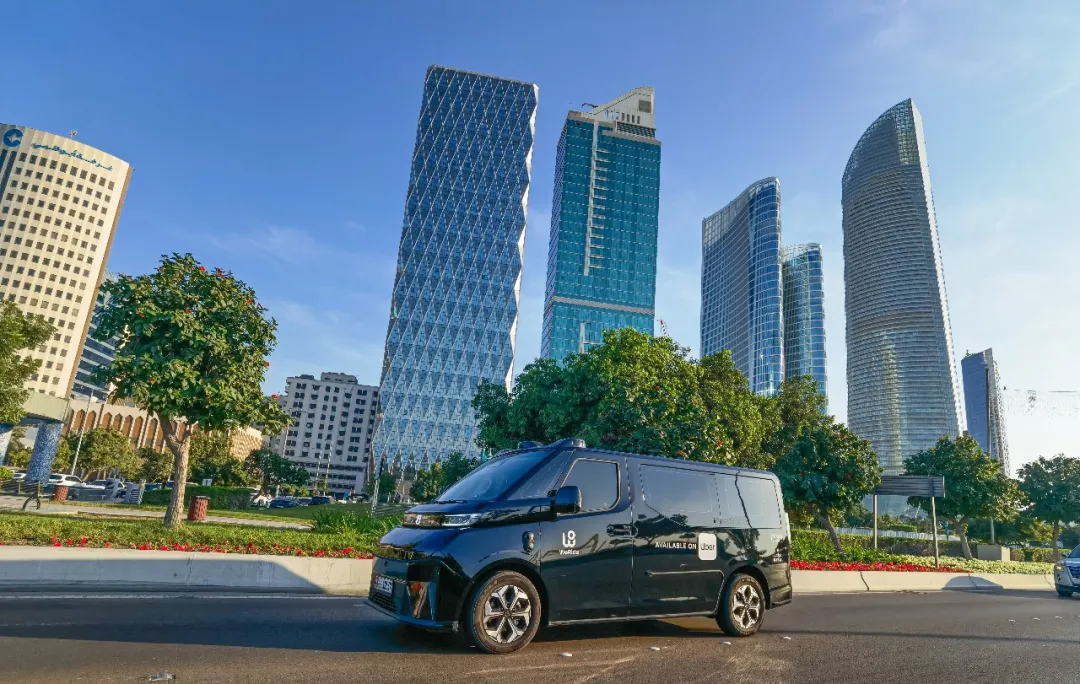
Robotaxi开进阿布扎比市中心 文远知行携手Uber再拓商业运营版图
Huan Qiu Wang· 2026-02-12 09:48
Core Insights - WeRide and Uber have officially launched the first Robotaxi commercial operation service in Abu Dhabi, marking the deployment of autonomous vehicles in the city center [1] - The Robotaxi service will connect key tourist areas and hotels, enhancing Abu Dhabi's status as a global tourism hub [1] - The service is currently operational with a safety driver on board, transitioning to fully autonomous operation in phases [1] Group 1 - The Robotaxi service area now covers approximately 70% of Abu Dhabi's core regions, significantly improving urban transportation connectivity [2] - WeRide has deployed over 200 Robotaxis in the Middle East, with a fourfold increase in fleet size since the commercial operation began in December 2024 [2] - The partnership between WeRide and Uber reflects rapid expansion in the UAE, with WeRide being the first to obtain a national-level full model autonomous driving license in the country [4] Group 2 - Future plans include expanding the Robotaxi fleet in the Middle East to thousands of vehicles, with a commitment to deploy at least 1,200 Robotaxis by 2027 across Abu Dhabi, Dubai, and Riyadh [4] - The collaboration between WeRide and Uber positions them as the largest Robotaxi commercial operation service outside the US and China [4]